Categories
DIY Effects

Next Week on Fuzz Detective!

UPDATE: Based on cool info supplied by YOU, dear readers, I’m expanding the scope of this piece. I’m furiously wiring up clones of some very rare models, and I can promise many cool and interesting surprises. Thanks, guys! :beer:

Okay, now that we’ve all gotten that silly “reading” stuff out of our systems with Book Week, it’s time to get back to the real focus of this blog: nasty, filthy fuzz pedals.

Last time we were on the subject, we looked at the original version of Dallas-Arbiter Fuzz Face, and included Mitchell “super-freq” Hudson’s beautiful DIY instructions.

Those posts generated many interesting comments — plus some misinformation on my part. For example, I said that the original Fuzz Face circuit is a close cousin to the Tone Bender Mk I, which would mean, for example, that known Mk 1 user Mick Ronson was essentially using a Fuzz Face between his Les Paul and his Marshall. But subsequent listening and reading makes me believe I was wrong. So I figured it was time to play fuzz detective and sort the facts from the other stuff.

First, I made clones of all the early commercial fuzzes. I’ll be posting a compare-and-contrast video in the coming days. (The audio forensics will be quite incriminating.) Here’s the lineup:
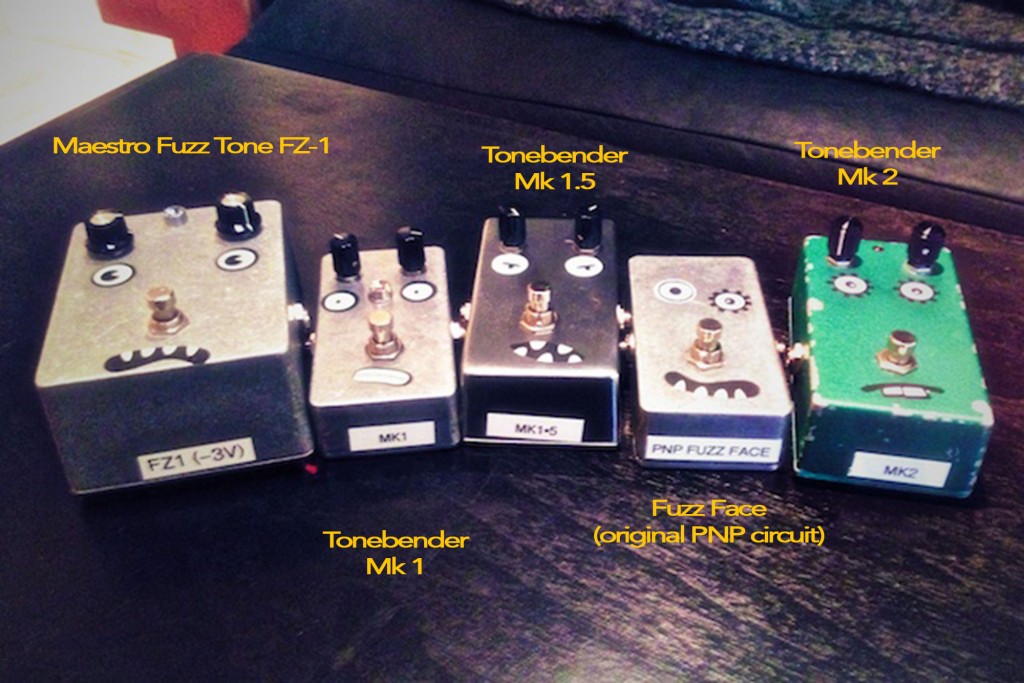
The usual suspects. (Incriminating audio/video evidence to be posted soon!)

I’ve also re-read the experts, and man, even my most trusted sources contradict each other right and left, especially when it comes to those darn Tone Benders. While I have absolutely no inside dope on what actually transpired, I think David from D*A*M Stompboxes offers the most convincing Tone Bender chronology, which you can read here.

Anyway, here’s my best guess about how the early fuzz years unfolded:

Categories
Music

Tonefiend Book Week 2013
Thursday: Musical Biographies

Monday: Theory and Technique
Tuesday: Gear
Wednesday: Repairs and DIY
Thursday: Biography
Friday: Fiction

Tonefiend Book Week is simple: I discuss a few titles I’ve found particularly enlightening, useful, or entertaining, and then you jump in and do the same. I’ve organized the days of this week by subject matter. Today’s topics are musical biographies and autobiographies.

Classic rock fans have been rewarded with many cool autobiographies in recent years: Keith Richards’ Life, Patti Smith’s Just Kids, Bob Dylan’s Chronicles, Neil Young’s Waging Heavy Peace, and Pete Townshend’s Who Am I: A Memoir, to name a few. I’ve read Richards and Smith, and I plan to read the others. Any thoughts about those and similar titles?

And then there are the great jazz autobiographies, such as Miles Davis’s Miles and Duke Ellington’s Music is My Mistress. Despite their alleged omissions and inaccuracies, both are epic accounts of epic lives dedicated to epic music. (So which is better: a lively, lying-through-the-teeth autobiography, or a dry but truthful biography?)

But my favorite musical autobiography is Hector Berlioz’s Mémoires, first issued in 1865.

Screen Shot 2013-06-05 at 2.36.11 PM
Hector Berlioz: total punk!

This, admittedly, isn’t a book for all musicians, or even most musicians. It concerns the explosive classical music scene of 19th-century Europe. If that topic holds no interest, the Mémoires probably won’t either.

But consider: Berlioz (1803-1869) is, along with Debussy, France’s greatest composer. He was a founder of Romanticism, and the first composer to fuse literature and instrumental music on a grand scale. He helped create the modern concept of orchestration and wrote the first orchestration manual. And of all the great composers, Berlioz is hands-down the best writer. He is arrogant, irreverent, sarcastic, and blisteringly funny. If you enjoy, say, the acidic humor of Mark Twain’s essays, you’ll dig Berlioz’s voice.

And like Twain, Berlioz played guitar. (More on that in a bit.)

The Mémoires drip attitude from page 1:

Needless to say, I was brought up in the Catholic faith. This charming religion (so attractive since it gave up burning people) was for seven whole years the joy of my life, and although we have long since fallen out, I have always kept the most tender memories of it.

Berlioz's music was often less than subtle. Here's how one cartoonist depicted it.
Berlioz’s music was often less than subtle. Here’s one contemporary caricature.

…and it never lets up. We meet the era’s greatest composers and performers and learn what it was like to be a professional musician in an era before recorded music. Concerts were longer. Audiences were more passionate. Wars were waged in the music journals. If you think going on tour today is demanding, imagine it in an era of unpaved roads and horse-drawn carriages.