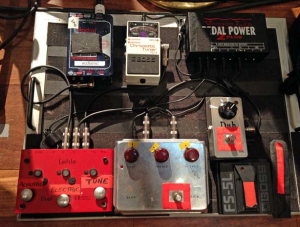
Sorry for even more solipsistic stompbox stuff, but I couldn’t resist. David Torn, one of the players I admire most on earth, just posted an unsolicited demo of my Filth Fuzz on Soundcloud. I love his post-apocalyptic soundscape.
For the uninitiated, David is one of those rare players who deploys staggering technical skill in a bold, unique style utterly unpolluted by cheesy guitar heroics. He’s recorded with Bowie, Tori Amos, John Legend, Madonna, and k.d. lang and created many brilliant solo albums. Last year’s Only Sky is particularly magnificent. It makes a great introduction to this singular guitarist/composer.
Lookit! My pals and colleagues at Premier Guitar just posted a video demo of my pedals shot at NAMM last month.
It was a trip being on the business end of that gear-review microphone! Shooting this clip was surprisingly nerve-racking. You have to make the gear sound good … try not to play too terribly … speak coherently … and not come off as a dick. It’s a tall order, at least for me.
Thanks to the gang at Voodoo Lab for letting me shoot this in their booth. (Which they did because they’re just plain cool.) Thanks also to Shabat Guitars for letting me borrow this pretty guitar, and to Fryette for letting me plug it into one of their spectacular Aether combo amps. Man, am I a freeloader, or what?
If you’d like to learn more about Gore Pedals, please visit my Gore Pedals page for studio-quality recordings with multiple guitars, more pedal settings, and lots of geeky tech info.
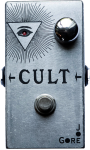
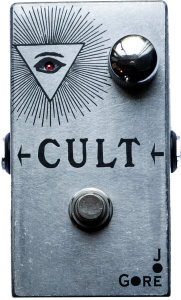
Of the four pedals new I announced at NAMM, Cult is probably closest to my heart— it’s my favorite overdrive circuit. If you’ve watched many of my videos, you’ve heard it. I even built it into a few guitars, including this one, this one, this one, and this one. And now Cult is coming in pedal form.
It’s no secret that 90% of today’s overdrive circuits are derived from the Ibanez Tube Screamer. Screamers are great if you want to compress your signal for consistent and predicable results. But Cult provides the opposite effect, expanding your guitar’s dynamic range rather than compressing it. It’s great for players who vary their touch and guitar-knob settings for maximum tonal variation.
Cult is sort of the mutant grandchild of the single-transistor boosters of the 1960s, including the Dallas Rangemaster. It’s no Rangemaster clone, though — the parts, values, controls, and tones have little to do with that classic treble booster. But Cult has the crackling presence and extreme dynamic response you only get from such minimal germanium-transistor circuits. (Guitar Player magazine went so far as to call it “the most dynamic overdrive we’ve heard.”) The pedal heard in this video is a final factory prototype, and the units now in production look and sound identical.
Have a listen:
As the video demonstrates, Cult lets you veer from crispy-clean to spatter distortion just by adjusting your guitar’s volume control. But my favorite way to use it is to set the gain so that you can go from sparkle to splat just by altering your touch, as heard in this video:
Cult with be available from Vintage King in the next month or two. There’s more info on the Joe Gore Pedals product page.
My Filth Fuzz pedal is finally in production and will be shipping within a few weeks. It’s one of three new pedals I’ll be showing at this week’s NAMM show in Anaheim, California. I just finished the demo video, and I’m stoked about how it’s sounding.
I’ll also be debuting three other new pedals: Gross Distortion, Cult Germanium Overdrive, and Boring Boost & Buff. Filth, Gross, Cult, and are finalized and in production, and should be available from my partner, Vintage King, sometime in February. (Vintage King is also currently the sole vendor of my Duh Remedial Fuzz, released last year.) We’re still working out a minor bug in Boring, but it should arrive soon after.
Now, it’s not like I can afford a proper booth or anything, so when I say “I’ll be showing these at NAMM,” I mean I’ll be walking around with a bag of merchandise. I’ll have a pedalboard with all my products on display at the Vintage King booth in Hall A, but sadly, it won’t be set up for demoing — there just isn’t enough space. However, my super-cool friends at Voodoo Labs will have a Filth Fuzz on their demo pedalboard, so you can take it for a spin in their booth while checking out the new stuff from that ever-innovative company. (I have no business connection to Voodoo Labs — they’re just helping me out because they’re nice.)
If you’re going to the show and would like to meet up, contact me and we’ll work something out. 🙂
Here’s what I wrote about Filth on its product page. (If you’re allergic to marketing copy, skip ahead, where I share some interesting backstory on how we arrived at the interface design.)
Man, I love those mad scientist fuzzes with too many knobs! I’ve collected them for decades and used them on a zillion sessions. It got to the point were people were hiring me specifically to make those sort of farting, fried-circuit tones.
But the downside of those complex fuzzes is that they’re a little too wide-ranging, with many settings you’ll probably never use. It’s easy to spend 20 minutes dicking around with the dials without nailing the perfect tone. I’ve always wished for a wild, highly variable fuzz that was a bit more “curated,” with easier access to the tones you’re likeliest to use.
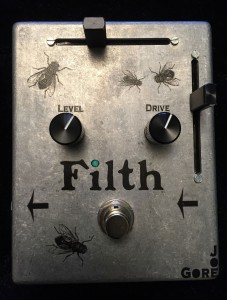
That’s what inspired the Filth Fuzz. It’s only got four controls, but it’s a cornucopia of cool, quirky, and usable fuzz flavors.
The drive and level controls do what you’d expect. But unlike many fuzz drive controls, this one sounds great throughout its range. Extreme settings are molten-lava thick. Lower settings are like…slightly cooled lava, maybe?
But the real action is in the two sliders. They’re tone controls of a sort, but not in the usual way. Most fuzz tone controls are tone-sucking passive circuits situated downstream from the fuzz effect. But here, the sliders alter the voltages at the transistors, radically changing not only the tone, but also the timbre, response, attack, sustain, and compression. In other words, the sliders radically alter the fuzz’s core character, as opposed to simply EQing a single core tone.
TO USE: Set desired gain and output levels. Move the sliders till it sounds awesome.
CAUTIONS: Filth sounds best before any buffered effects. It usually works best at or near the front of your effect chain.
Filth Fuzz was created in San Francisco and is built in Michigan by skilled craftspeople earning a fair wage.
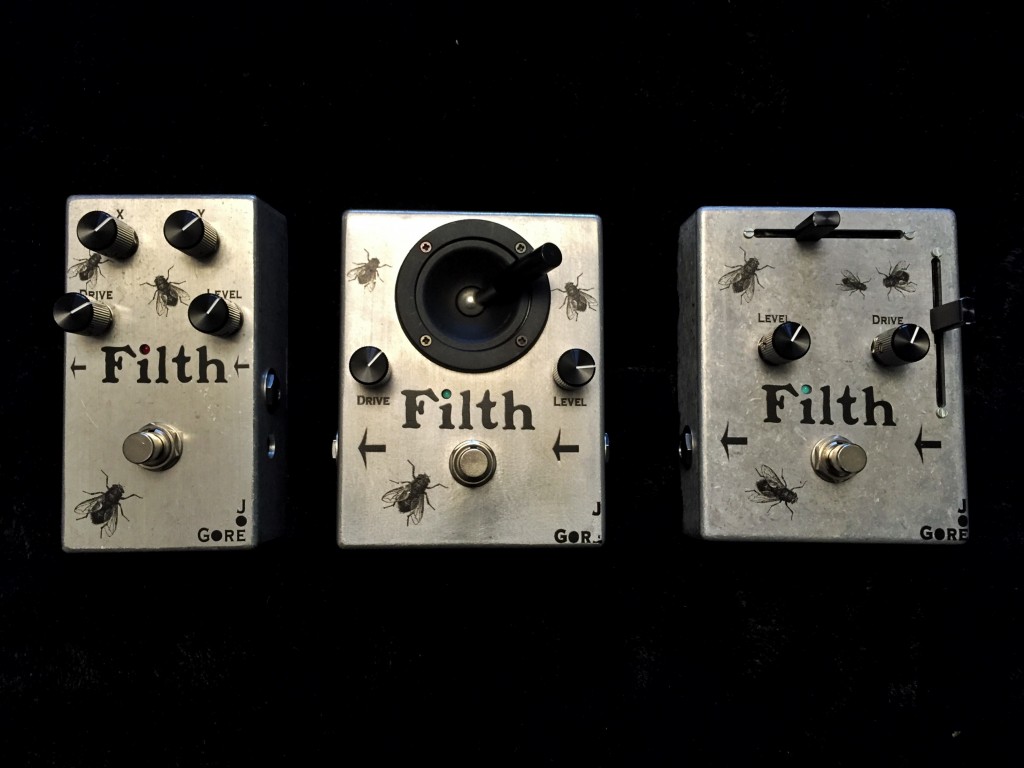
Filth’s sound hasn’t changed since I concocted the circuit on breadboard a few years ago. but the interface has gone through many iterations. It kept changing even after I sent schematics and prototypes to Tony Lott at Cusack Music (my manufacturer). Here’s a pic of three production prototypes:
Three incarnations of Filth Fuzz (in order of appearance).
To dial in tones on Filth, you adjust two highly interactive pots (let’s call them x and y), which tweak the voltages going in and out of the transistors, providing many tone variations. The original version used two standard pots for these x/y controls. It worked okay, but the ergonomics weren’t ideal. I’ve found that the fastest way to refine sounds is to move both pots at once over a sustained note or chord, and it was just a bit awkward having to take both hands off the guitar to turn the controls simultaneously.
So I decided to employ a joystick, which lets you adjust x and y with one hand (and it looks pretty bitchin’). The ergonomics were great, and I thought we’d finalized the format.
But then I showed a joystick prototype at the L.A. Amp Show in October, and for the first time I had a chance to sit back and watch other guitarists interact with the device. Players seemed to have a blast with it, but I kept noticing how often a heavy stompbox foot would land perilously close to the joystick’s none-too-sturdy shaft.
Meanwhile, we discovered that the the only compatible joystick option cost about $25 per unit — enough to jack the retail cost way up. Also, it was tricky to replicate exact setting via the joystick, which would suck if, say, you were trying to get identical tones night after night on tour. (I knew that when I first opted for the joystick, but I’d figured the fun factor would more than compensate.)
Then Miko Mader, a clever guitarist who works for my distributor, M1, came up with the perfect solution: Why not use two sliders instead of pots? Tony at Cusack sourced the perfect part, and we prototyped a third version.
Bingo!The ergonomics were great (check out the demo video to see how quickly you can change sounds with one hand). You can mark exact settings with tape if you need to, easily repeating specific sounds. The two sliders are a fraction of the cost of a single joystick, so we can sell the pedal for far less. (We’re still nailing down the retail price as I write.) There’s no fragile shaft to break. And while I miss the goofy fun of the joystick, the sliders are still pretty darn entertaining. (So thanks, Miko, for your brilliant idea.)
I’m really stoked about this pedal. I hope you enjoy it as well.
I’ve been breathlessly awaiting one of these since I saw this. It’s Korg’s Miku Stomp, a spinoff from the company’s Vocaloid voice synthesizer. It tracks your pitch as you play and responds with a synthetic voice that forms various syllables and phrases.
There’s some cheating here: The effect’s latency is quite severe, so I had to slide the Miku track back in time while mixing. Its triggering is also inconsistent, so I replaced a few notes. Miku tracks best when playing melodies on a single string, hence my awkward, position-jumping fingering. (Actually, it tracks pretty well when you play slow melodies full of sustained notes. But steady eighth-notes at 155 BPM as heard here is a major challenge.)
One of the pedal’s most interesting aspects is the way it interprets slurs. When there’s no break between notes, Miku sings a sort of pseudo diphthong. Detached notes get a syllable with a clear transient.
IMHO, the inescapable facts that Miku is silly and doesn’t work terribly well doesn’t diminish her total awesomeness. No doubt about it: heaviest stompbox ever.
The tune, of course, is “Georgy Girl,” which I’ve loved since forever. It was a blast recording the backing tracks with classical guitar, ukulele, ukulele bass, 12-string, toy piano, M-Tron Pro, and a mix of live and sampled percussion. And of course, gobs of my favorite reverb effect: Universal Audio’s EMT140 plate simulation. Yum.
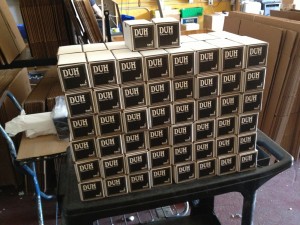
Wow — I can’t believe my eyes! After years of planning, scheming, and screwing around, my very first batch of production fuzz pedals has arrived at my distributor, ready for sale. Will they gather dust or sell like hotcakes? That depends on you, dear reader!
You can read about the Duh Remedial Fuzz, hear a demo, and place orders from the product page at Vintage King. (For now, Vintage King is my sole distributor.) If you’ve been following my videos, you’ve heard Duh already — I’ve got the circuit mounted inside some of my favorite guitars, including the Hello Kitty! and lipstick-tube Strats.
Excuse me for quoting again from the great review I got in Guitar Player — I’m just a proud pedal papa! Have a cigar.
“Remarkable … responsive dynamics and simultaneously fierce and expressive tone. This is a pedal that doesn’t give up even one less-than-spectacular sound. It reminds me of ’60s records where the fuzz sound jumped right out of the grooves and changed my world.” [Editor’s Pick Award recipient.] — Guitar Player magazine, 2014
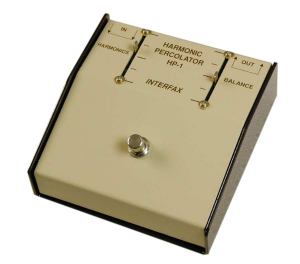
Few guitar pedals can rival the cult cachet of the Harmonic Percolator, a singularly ugly distortion stompbox produced in minuscule numbers in the early ’70s by Interfax, a small company based in Milwaukee, Wisconsin. And guess what? They sound ugly too, though they’re ugly in a cool and useful way.
They don’t get much rarer — or uglier. (This is a cosmetically faithful reproduction from Theremaniacs.)
I’ve been wanting to write about these for years, but was hindered by the fact that I don’t have access to one. No one does! Well, except the pedal’s best-known user, producer/guitarist Steve Albini. (Steve has posted several popular YouTube videos in which he sings the praises of the original and evaluates it against modern clones.)
But I revisited the idea recently when Christian Magee, who runs Tube Depot, sent me a couple of old 2N404A transistors from a stash he recently acquired. This rare PNP germanium transistor appeared in the original, along with an NPN 2N3565 (also rare, but not as ridiculously rare as the 2N404A). Yes—this pedal uses both a positive-ground germanium transistor and a negative-ground silicon transistor in the same circuit. (Another Fuzz Face/Tone Bender clone, this ain’t!)
I whipped up several variants:
• a clone using the original parts
• a near-clone using more readily available alternatives
• a Harmonic Jerkulator, an all-silicon/no-diodes variation created by DIY stompbox titan Tim Escobedo
I was just in Europe, but I’m heading right back — this time on vacation. We’re going to spend a few days knocking around some fave cities, then embark on a tour of Paleolithic cave painting sites in France and Spain.
Our Cro-Magnon ancestors had to contend with such hardships as poor stage lighting, inadequate sound reinforcement, and excessively reflective surfaces.
I know it’s hard to tell when I’m being sarcastic, but this time I’m not. I wanted to be an archaeologist as a kid, until my mom said, “Why? All you’ll do is sit in a closet polishing worthless scraps with a toothbrush.” (Fortunately, she was more supportive of my musical dreams. She never said, “Why do you want to be a studio musician? All you’ll do is sit in a closet polishing worthless scraps with Pro Tools.”)
Since I won’t be able to post and reply as often as usual until I return at the end of the month, I figured you guys could help me keep things interesting. Which brings me to the latest tonefiend contest: the Cro-Mag Comedy Competition!
The rules are simple, just like the musicians we’ll be poking fun at. All you must do to enter is post a funny musical anecdote to the comments section below. It doesn’t have to be about musical stupidity, though experience suggests that those are the funniest stories. Nor does it have to be about guitar, though there are few things stupider than stupid guitarist stories. (Drummer, bassist, and vocalist stories are the obvious exceptions.) The tales should be true, or at least sufficiently true-sounding to dupe the rest of us. If they involve real people, please change their names enough to avoid legal action.
I’ll winnow down the entires to a manageable number via some as-yet-undertermined means (dartboard, or maybe animal entrails), and you, dear readers, will get to select the final three winners, each of whom will receive one of my unique handmade stompboxes, created in a closet at my cutting-edge workbench out of worthless scraps premium mojo parts.
Enter as many times as you like — but please, only one anecdote per comment. Also, please post your anecdotes here on the site, rather than in Facebook comments. Stories can be as long as you like, but remember: Your judges will be musicians, so they may have difficulty grappling with complex sentences.
The contest runs till I get back, or till jet lag subsides — whichever comes last.
Here’s a sample story to get the ball rolling. Naturally, I’m ineligible for the competition because I already have enough crappy little pedals it’s the ethical thing to do.
I heard this one from one of my favorite guitar techs. He’s such a pro that he refused to reveal the identity of the musicians in question, though I managed to pry from him the fact that it’s a leading UK or Irish band you’ve probably heard of.
Anyway, the band’s bass player insisted on using a large, loud, miked amp onstage, even though the front of house guy used only the direct signal in the PA. “Please don’t use an amp,” the crew and band pleaded. “It leaks into the other mics. It screws up everyone’s onstage mix. It makes everyone’s life more difficult. You can have as much bass in your wedges as you like. Or wear-in-ear monitors. Or anything! But please, no amp!”
“Sorry,” said the bassist. “It’s my sound. What’s more, I refuse to step foot onstage tonight unless I see my amp up there with a mic on it!”
That night the amp was right where the bassist expected it, with the usual mic in the usual place. But unbeknownst to the bassist, the mic cable wasn’t connected to the sound system. The cable ran offstage, where it was plugged into … a cabbage, pilfered from catering.
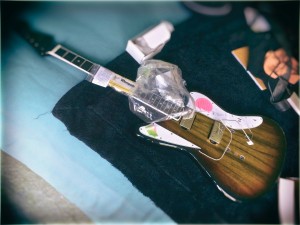
I just received from Warmoth all the parts for my next DIY guitar. I loved testing eight sets of P-90 pickups for Premier Guitar, but I don’t own any P-90-eqipped guitars.I will soon, though!
This one will be a bit of a platypus — as opposed to, you know, all my other other platypi. (The actual plural of “platypus” is “platypuses,” but “platypi” is more fun to type.) It’s built from Warmoth’s “split Jazzmaster” template, with a korina body, bound neck, Tune-o-matic/stop-tailpiece bridge, and a pair of hum-cancelling Fralin P-92s. Yeah, it’s kind of a stab-in-the-dark experiment, and not a inexpensive one. But hope springs eternal. Prepare to be bored with details!
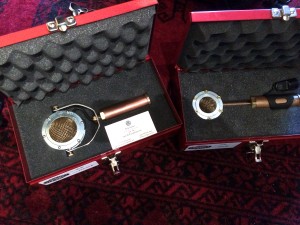
I’ve also just received an amazing-looking pair of condenser mics from Portland, Oregon’s Ear Trumpet Labs. ETL kingpin Philip Graham’s business card identifies him as “proprietor and bricoleur.” Bricolage, of course, is the ten-dollar word for “making stuff out of junk and other found objects.” Dig the steampunk vibe of that repurposed hardware! I haven’t even plugged these in yet (though the reviews I’ve read have been stellar). I just like staring at them! But I’m going to try them out at my monthly Strung Out! show tonight.
Ear Trumpet Labs’ Edwina and Edna models: a higher calling for found objects!
Which brings me another of this week’s highlights: I got to perform last night with my dear friends Teja Gerken and Adam Levy. Teja is an astonishing acoustic fingerstylist and a fine composer. His vocabulary has hints of Bensusan, Hedges, and classical, but he’s molded those influences into a thoroughly unique sound. And Adam, who I’ve known since my Guitar Player magazine days, is equally renowned for his jazz work and for accompanying such singer/songwriters as Norah Jones and Tracy Chapman. (I get to play some of Adam’s cool parts when I gig with Tracy.) These days Adam’s focusing on songwriting, and he his sings his “smart Americana” songs (my description, not Adam’s) in a sweet, soulful voice. Man, what a treat to hear both of them up close. And tonight, Adam, Shelley Doty, and I perform at my local dive, El Rio. Can life get any better?
Apparently so! Yesterday Premier Guitar posted John Bohlinger’s piece on the Pixies, which includes a pic of Charles “Frank Black/Black Francis” Thompson’s pedalboard, with my grubby, hand-built Duh fuzz pedal front and center. I’d originally made if for Joey Santiago, the other Pixies guitarist, but I guess Charles swiped it. Hey, I’d be honored if either guy spat on the thing! They’ve been heroes since I first heard the band in a small San Francisco club back in ’88. (Everyone went to hear the Sugarcubes, but left talking about that awesome opening act from Boston.)
Frank Black’s pedalboard: Lookit! I’m Pixies-approved!
It’s funny, because I really was thinking “Pixies” when I sound-designed the Duh. I was going for “bubblegum metal” — a thick, heavy sound, but not a macho one. The tone is too fizzy and funny for 100% sincere heavy rock, IMHO. It’s more of a “greasy kid stuff” distortion. (Note to readers under 45: That was once the tagline for a “dry look” mens hair product, referring to the outdated coiffures that would return with a vengeance when punk broke a few years later.) It’s a vaguely Muff-like sound, but with less compression, less scoop, and one big, stupid knob. I also like building that circuit into guitars. Like this one:
So it’s been a grand week, but a hectic one. Thanks for reading this far. Next week I promise a proper post, and not another collection of … odds & ends.
One of the coolest gizmos from last weeks NAMM show is already in my grubby little hands: It’s the Logidy EPSi, the first customizable convolution reverb pedal. I ordered it the instant I heard about it, and it arrived right before I left for Anaheim.
Convolution (or impulse response) reverbs can mimic acoustic spaces and outboard gear with astonishing accuracy. (If this concept is new to you, check out this article by me. Or better yet, this one written by someone who knows what he’s talking about.) Nutshell: You create impulse response (IR) files by playing and recording a test tone in rooms or through gear. Once you load the file into an IR reverb device or plug-in, it can make anything sound as if it was recorded with the same ambience.You can also generate eerie, otherworldly sounds by loading unusual audio files.
Many software and hardware amp and effect modellers use IRs to mimic gear. Software convolution reverb plug-ins such as Audio Ease’s Altiverb, Logic Pro’s Space Designer, and Waves IR1 include reverb libraries, and also let you load your own IRs. But as far as I know, EPSi us the first device that lets you load your IRs into a stompbox and access them without playing through a computer.
I’m psyched to add IR reverbs to my (mostly) analog pedalboard, and EPSi makes it relatively easy to load the IR libraries I’ve compiled. The files require special treatment: They must be 44.1kHz WAVs, and the names must be formatted quite specifically, as detailed in Logidy’s documentation. The interface is extremely minimal: just a bypass footswitch and a knob/button pair to navigate the simple menus.
This unique reverb stompbox sounds great and offers limitless opportunities for creative sound design. You can load your own impulses, or add ones from from some of the fine freeware libraries online. (Thanks for the link, Scott!) On the downside, it’s difficult to load or edit sounds on the fly, so while it might be fun to spelunk for new sounds in the studio with EPSi, don’t plan on modifying sounds onstage. (The ability to recall several saved presets would vastly improve EPSi as a gigging tool.)