Categories
Effects guitar

Phasers That Stun

phaser_stun


UPDATE: My Premier Guitar Heptode Virtuoso review is live. Read and listen here.

I’ve got phase shifters on the brain, especially after encountering a couple of truly stunning ones. I just wrote a review for Premier Guitar of Heptode’s Virtuoso phaser, a superb clone of the old Maestro PS-1A. (I’ll link to the review when it goes live.)

It took me back to my Pleistocene pre-teen years, when I once spent hours in my local music shop playing an electric nylon-string through a big-ass PS-1A mounted on a music stand. Despite its size, it had few controls — just big colored switches that could have been swiped from one of the era’s cheesy home organs. It sounded glorious to my 12-year-old ears. I’ve never since held such a high opinion of my own playing.

I haven’t played a PS-1A since then, but the Heptode pedal took me right back. It really is a gorgeous-sounding phaser, and one that vanished soon after the debut of the cheaper, smaller, and awesome-sounding MXR Phase 90. The sound captivated me all over, though I’m not sure if I actually like it more than the Phase 90, or if it just sounds so cool because it’s a less familiar color.
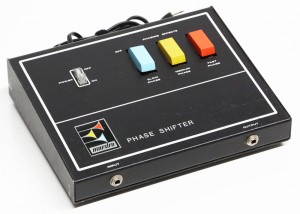
The plastic switches make it sound better.

I dug out a few other favorite phasers, like the $89 BYOC Phase Royale that usually lives on my analog pedalboard. It’s yet another brilliant DIY kit from BYOC’s Keith Vonderhulls. It’s basically a Phase 90, but with all the cool mods, like mix and resonance controls, plus a six-stage phasing option. (The Phase 90 and the Uni-Vibe are four-stage, while the Maestro is six-stage). It’s a fun build, and an excellent next step for DIYers who have built a few fuzzes and are ready for something a bit more challenging.

I concluded my little phase-fest by unearthing my old Lovetone Doppelganger, a bitchin’ dual-LFO phaser from the late ’90s. Not to be confused with today’s Lovepedal brand, Lovetone was a British company run by Dan Coggins and Vlad Naslas. They specialized in large-format pedals with an almost absurd number of controls. (Their brilliant slogan — “Big Pedals to Trip Over” — is rivaled only by Zachary Vex’s “Crazy Effects for Rich People.”) I’d flip out when each new Lovetone pedal came in for review at Guitar Player. Even then, they were expensive, usually in the $400-500 range. Now, of course, they’re obscenely rare and valuable. I bought as many review models as I could afford, and to this day I regret not purchasing their Meatball, Wobulator, and Brown Source. I did, however, snag the Big Cheese, Flange with No Name, Ring Stinger, and this guy:

I haven’t heard the Doppelganger in years, and it was interesting to revisit it. See, while I always loved the ideas behind the Lovetone boxes and was happy to own them, I’d found that I just didn’t tend to use them a lot for gigging and recording. For me, they had tons of cool sounds, but often not quite the right one. But I’ve gotten better at dialing in tones in recent years, and really dug the sounds I got yesterday while making the video. Maybe it just took me 15 years to learn how to wrangle these beasts!

Anyway, the Doppelganger is now a Museum of Lost Effects inductee, and it’ll be joined soon by its big-box brothers.
Categories
Effects guitar Music Recording Technique

The WRONG Way to Use a Talk Box

Any talk box fans out there?

Whew. Didn’t think so. I mean, doesn’t everybody hate those godforsaken things? Wasn’t it all downhill after “Tell Me Something Good?”

But did you know that the “talking guitar” has a rather exalted history four decades pre-Frampton Comes Alive? Check out this performance by Alvino Rey, the steel guitar genius who pioneered the technique.

I am TOTALLY going to have nightmares about Stringy for the next 10 years!

Rey worked his magic in tandem with his vocalist wife. She supposedly stood behind a curtain with a mic attached to her throat, the output of which modulated the guitar signal. (That’s what online sources say, though it sounds a bit fishy to me.) A similar technique — or perhaps the same one — was known as the Solovox. In this case, a small loudspeaker attached to the singer’s throat, “playing” the music through the vocalist’s mouth. More amazing/horrifying evidence:

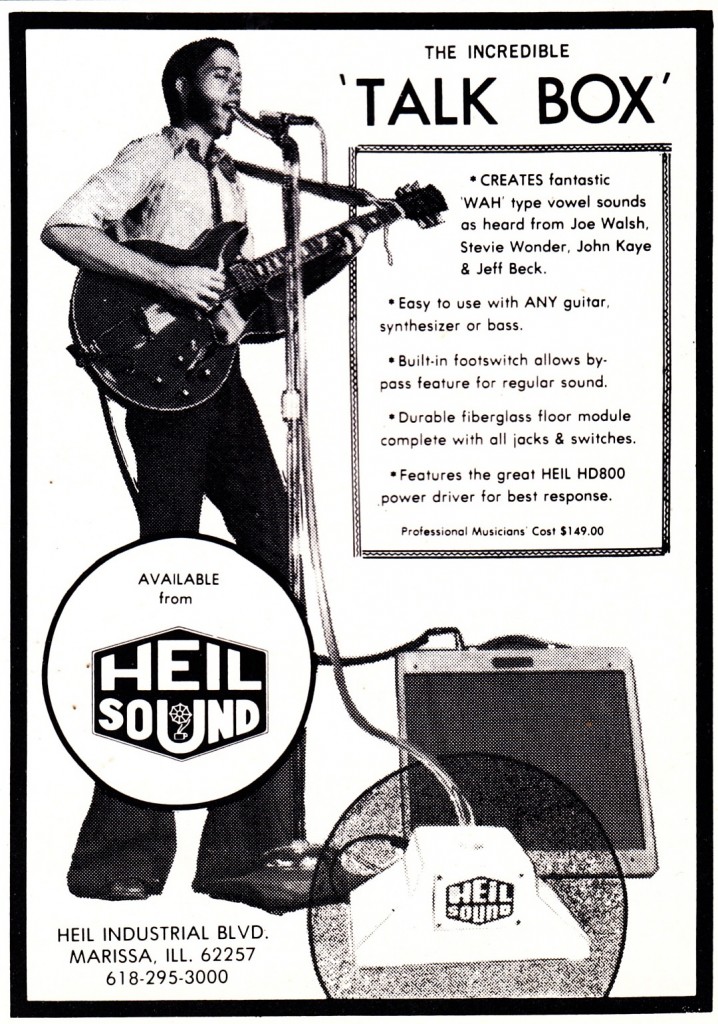
That’s the basic principle behind the rock-era talk boxes, though they rely on a plastic tube inserted into the mouth rather than a mic pressed to the neck. The first commercially available model was Kustom’s The Bag from 1969, “immortalized” on Steppenwolf Live. The Heil Talk Box — the version of the effect most of us know and loath — debuted in 1973. Dunlop is still making them.

But I have a perverse affection for the Rocktron Banshee. It’s incredibly loud. It’s actually a small amp, quite capable of driving a speaker cab, with a blunt-force distortion tone. That extra power is useful for my preferred way of using a Talk Box:

How about you guys? Anyone have anything good to say about the talk box?

Heil_TalkBox_1974

Categories
Effects guitar

Ring Modulation: The Effect from HELL!

effect_from_hell
Only very bad dogs like ring modulation!

No disrespect to Chuck Berry, but I seriously doubt Johnny B. Goode played guitar just like a-ringin’ a bell unless he was using a ring modulator. That’s the only effect that can give you the complex, clangorous harmonics of a bell or a cymbal. Or make you sound like a ravenous horde of mutant robot ants.

Theoretically, Johnny could have used one. By 1958, when Berry documented the guitarist in song, the effect was already being exploited extensively by avant-garde classical composers, notably the late Karlheinz Stockhausen, who used it to terrifying effect in his Gesang Der Jünglinge [1956].

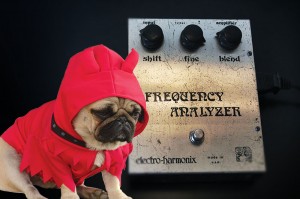
This post drips with perverse ring-mod love, including a demo of a rare vintage Electro-Harmonix Frequency Analyzer, and another featuring Roswell Ringer, a wicked ring mod plug-in.

Categories
Effects guitar

Museum of Lost Effects:
Morley “Oil Can” Wah

The mighty Morley Rotating Sound Wah

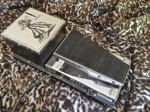
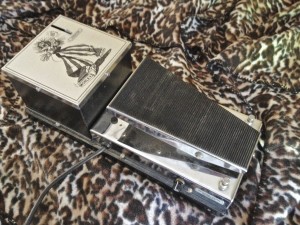
Two indisputable facts about Leslie rotating speaker cabinets: They sound awesome, and they’re approximately the size and weight of Rhode Island. Since the ’60s manufacturers have attempted to mimic the spinning-speaker effect in a more modest package. And one of the best mimics is the second exhibit in our Museum of Lost Effects.

The Morley Rotating Sound Wah is less well known than an earlier pseudo-Leslie, the Univox Uni-Vibe,forever associated with Hendrix. Like the Uni-Vibe, it a) tried to duplicate the Leslie, b) failed, but c) wound up creating a cool tone of its own. But while the Uni-Vibe milks its modulation from a series of optical sensors, the Morley relies on a rotating disc inside a can of electrostatic fluid. The result is a cool and complex modulation sound unlike any other (and one I’ve never been terribly successful at mimicking digitally).

This technology is descended from the “oil can” delays produced in the ’60s by the Los Angeles-based Tel-Ray company.In fact, Morley was a Tel-Ray spinoff — company founders Ray and Marv Lubow chose the name Morley for their line of guitar pedals based on the boast that this relatively compact modulation effect offered “more-lie,” as opposed to “less-lie.” (Note that I said “relatively” compact, since this beast is far and away the heaviest stompbox I’ve ever owned.)

The Morley Rotating Sound Wah is ugly, clunky, and klugey. If you drop it on your foot, you’ll never walk again. But I think it sounds incredibly cool.

Have a listen and see whether you agree: