Categories
DIY guitar

Telecaster Deluxe Variations: Six Pickups and Some Weird Wiring

Fender’s Telecaster Deluxe has had an interesting and checkered history. Once regarded as yet another mediocre product from the company’s era of CBS ownership, these turn-of-the-seventies instruments now fetch huge prices on the collector’s market. I’ve never owned own. But when singer/songwriter Greer Sinclair loaned me one of Fender’s 2010 reissues, it was time for research — and experimentation.

The made-in-Mexico 1972 Deluxe reissue is a cool guitar. It replicates many details of the original: the oversized headstock, the Strat-like belly cut and fixed Strat-style bridge, and the big-ass pickguard. But its pickups are definitely a departure. In lieu of the original’s large-format “Wide Range” pickups, it employs a P-94R (a humbucker-sized P-90 spinoff) at the neck, and a conventional Gibson-style humbucker at the bridge.

The Wide Range pickup was a unique beast. Fender had commissioned Seth Lover, the man who invented the Gibson humbucker, to create a Fender humbucker in hopes of cashing in on the growing popularity of hard rock. With DC resistance in the 10k range, the new Wide Range pickup was a bit hotter than a vintage Gibson humbucker. Wide Range pickups appeared in several of the era’s models, including the Tele Thinline, Tele Custom, and semi-hollowbody Starcaster.

Gibson humbuckers have a bar magnet within, but the pole pieces are not magnetic. But on Wide Range pickups, the pole pieces are magnetic, as on Fender’s single-coil pickups. Situating individual magnets closer to the strings yield a brighter sound with greater note defition and string-to-string separation — characteristics we associate with vintage Fender pickups. So the Wide Range pickup lent a uniquely “Fender” twist to the Gibson design.
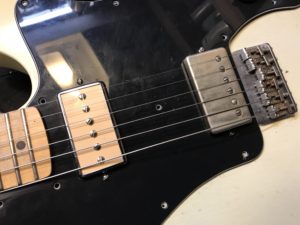
Wide Range pickups are slightly larger than conventional humbuckers. Most of Fender’s circa-1970 Tele reissues substitute generic humbuckers of the standard size. Standard humbuckers can sound superb in a Tele, but they’re horses of different colors. Fender has also created some reissues with the larger-sized pickups, but these are also garden-variety humbuckers — the larger format is purely cosmetic. The pole pieces of the factory humbucker on Greer’s guitar don’t align with Fender’s wider string spacing. (But one thing I’ve leaned from my various Fender/Gibson hybrid experiments is that sonically, this can matter very little.)

The P-94R’s cream-colored top looks wicked against the guitar’s finish. It’s a warm, full-sounding pickup from the mellower side of the P-90 spectrum. Actually, it doesn’t sound all the different from a traditional Telecaster neck pickup. (Like that pickup, it works quite well for jazz.) Note, though, that its dimensions differs substantially from those of a Gibson P-90, as you can the in the photo where it sits alongside a historically accurate Lollar P-90. When you change the size of a pickup’s components, you inevitably alter the sound. The tones can be for better or worse — but they will be different.

Categories
Pickups

Ten Unusual Strat Pickups Tested

I should have been out buying nice presents for you all. Instead I sat around inhaling solder fumes. When the smoke cleared (mostly, anyway) I’d tested ten unusual Strat pickups in the same poor guitar.

Tested pickups sets:

Jason Lollar Gold Foils
Lindy Fralin Big Singles
Seymour Duncan Antiquity II Mini-Humbuckers
Jason Lollar Staple/P-90 set
Allparts Gold Foils

Verdicts? I dig them all, and not just ’cause I’m too polite/chicken to say otherwise.

I love the Lollar Gold Foils so much I’m assembling a new parts guitar to surround them. I’m going to keep the Fralin Big Singles in the demo Strat, at least till the next Mongrel Strat Project. I’m going to try putting the mini-humbuckers in a “parts” Tele at some point. I originally reviewed the Lollar P-90 set for Premier Guitar (where I evaluated them the “right” way: in a Gibson guitar), so they go back to manufacturer, though I’d sure like to own a set someday. Meanwhile, the Allparts set isn’t in the same league as its high-end competitors, but at a mere $30 per pickup, it costs about 1/4 the price of its expensive rivals. You could definitely do a lot of lo-fi damage with a pair of these surprisingly solid-sounding pickups!

This article joins the long list of experiments in the Mongrel Strat Project archive.

And how about you? Have you but stuffing any pickups into places where they don’t belong? Maybe that’s why Santa left you sucky presents this year.

Categories
Pickups Uncategorized

Happy Humbucker-Sized P-90s!

Happy-P-90s

Just in time for the single-coil holiday season: my comparison review of 16 humbucker-sized P-90 pickups is live at Premier Guitar. This heartwarming holiday fun-fest has it all: Mouth-watering adjectives. Freshly baked audio clips. Irate manufacturers. Don’t miss it!

This was a fun, if challenging project. Comparison pickup reviews are such cans of worms! Not only are they sadistically labor-intensive, but the differences between one pickup and the next are easily overshadowed by other variables in the tone chain.

After much thought about how to create meaningful comparisons, we came up with an intriguing process: I tested all the pickups in the same guitar, with identical setups, and ReAmped them through the same combo amps with identical recording settings. If this were an amp or pedal review, I would have used the same performances throughout, but of course, each example had to be played anew with each pickup, so I spent much time matching performances to guard against misleading variations in touch and intensity. It’s not a perfect solution, but better than most, and in the end quite revealing.

And what did it reveal, exactly? You’ll find out at the link. Beyond that, I can report that:

  • All the products sounded pretty good.
  • They sounded more similar than you might expect.
  • I’m gonna find me a guitar to house a set of my favorites — though I’m not sure which ones are my faves! Really, they’re close enough that, say, the tone of a particular body wood alone would be enough to sway the decision. It’s not so much a case of “better or worse” as “brighter or darker” and “louder or quieter.”

As mentioned in the article, there’s no “gold standard” of P-90 tone — or rather, every P-90 lover has his or her own standard. Gibson’s ’50s original are notoriously inconsistent in their output, even their magnet type. Plus, the mere fact that you’re winding coils around a narrow, tall humbucker bobbin rather than a wide, low P-90 one has sonic implications. So I tend to think of this entire pickup category as either “single-coils that are ballsier than Fender single-coils,” or, in the case of hum-canceling models, “humbuckers with brighter highs and clearer mids.” (Or as my ol’ pal Steve Blucher from DiMarzio calls them, “humbuckers that hum.”)

Funny thing: I love P-90s, but don’t own any guitars fitted with them. Not yet. :satansmoking:

So talk to me about P-90s! Your faves? Beloved P-90 guitars? Fave P-90 players and performances?

Categories
DIY Effects guitar Pickups

Hello Kitty Strat: Not for Pussies!

Would this be anything less than awesome? I think not.

As I gloated last week, Jane Wiedlin gave me her Hello Kitty Stratocaster  — the most bitchin’ $99 guitar ever conceived! I finally had a chance to destroy/customize it yesterday, in what will no doubt be the first of many desecrations/enhancements.

I’d ordered one of those Synyster Gates Duncan Invaders with the pretty white pole pieces for the guitar, but just couldn’t wait to experiment, so I browsed through the ol’ pickup collection, and found a nice Duncan Phat Cat I’d used in a Les Paul experiment some months ago.

I don’t generally recommend choosing pickups because of their names, but come on! Kitty + Cat? How could I resist?

Turns out it was a lucky choice. I hadn’t planned to install a pickup that was actually lower in output than the stock humbucker, but it lets me get nicer clean sounds, and coughs up more than enough crunch when goosed with distortion. Speaking of which: the other custom feature is a built-in-distortion circuit activated via push-pull pot (I took lots of pics of the process for a DIY built-in-effects tutorial I’ll be posting very soon.)

View the carnage in this little video. Thanks, Jane Weidlin! Sorry, Stevie Nicks!