Plato credited the invention of disco to his mentor, Socrates. However, most modern historians and classics scholars believe the style originated with an earlier, unknown Athenian proto-philosopher.
The guitar is a Steelcaster built by my pal James Trussart. If you’re not familiar with his breathtaking work, stop now and visit his site. (If you’re going to NAMM 2019 in Anaheim, you can meet us both at the same time, since we’ll be sharing a booth.)
I’ve been obsessed with Henry Mancini’s music for decades. Here’s an example of his “tropical” exotica side.
My Mancini loved deepened after I joined Oranj Symphonette, a ’90s band founded by cellist Matt Brubeck (Dave’s son). It’s fascinating how accessible and catchy all his tunes are, even though you realized they’re incredibly weird and original once you look under the hood. You can hear those albums on YouTube. Plays Mancini includes only Mancini music (including a version of “Lujon” featuring our sorely missed friend Ralph Carney). The Oranj Album mixes Mancini with other retro sounds track themes.
Admittedly, there’s only a smidgen of looping here. I usually play this without a looper, but it’s nice being able to grab that lovely falsetto line at 02:25.
The guitar is a Guild X-15 arch top from the ’90s. It’s had many pickups over the years. This one is a lovely Lollar Charlie Christian model.
I probably sound like I’m being ironic, but no — I really love this Taylor Swift song.
The Hello Kitty! Stratocaster was a gift from my lovely friend and bandmate Jane Wiedlin. I replaced the factory humbucker with a Duncan Phat Cat (sort of a humbucker-sized P-90). Again, no irony intended. I like Sanrio characters! (Especially Aggretsuko!)
I got to interview Robert Smith for a Guitar Player cover story in 1992. It was one of funnest of the 1,000+ musician interviews I’ve conducted over the last few decades. Robert is brilliant, bitchy, and hilarious. We talked most of the night over too many drinks.
Years later I was recording with sociopath Courtney Love at Chateau Miraval in Provence, where the Cure recorded their Kiss Me Kiss Me Kiss Me album, including “Just Like Heaven.” The studio manager recalled how Robert would quote Apollinaire and Verlaine around the dinner table. En francais, bien sûr.
The guitar is a 000-sized Lowden I’ve owned since the early ’90s and have used on many sessions and tours. It’s fun playing acoustic guitar with distortion and effects, as long as you give up on the idea of generating traditional acoustic tones.
For Day 2 of Loopocalypse, here’s an angst-ridden original featuring brutal bit-crushed distortion and Tesla coil samples.
Thunderbeast Park was an Oregon roadside tourist attraction with cheesy plaster dinosaurs. I think I visited here as a kid, though I’m not certain. At least I would have pleaded for us to stop on one of my family’s up-the-coast road trips. I often got my way, ’cause my folks liked this stuff too.
The guitar is my DIY Birdmaster. The pickups are unpotted Duncan/Bonnamassa PAFs — probably the best humbuckers I own.
On the occasion of a daunting round-number birthday, I’ve just completed Loopocalypse, a concert-length video of my live looping show. I’ll be posting a song per day, each featuring a different guitar, from now till Thanksgiving/birthday. Here’s Day 1 of 17, a tribute to that dearest of the dearly departed, David Bowie. I’ve been playing this for years, and it just gets sadder and sadder. Tomorrow I’ll share something appropriately angst-ridden for the US election day. (Here’s a remembrance of my brief Bowie encounters, written the day after he died.)
Here’s an explanation of my live looping rig. The guitar is an all-original 1963 Strat that I’ve owned since 1980. For many years it was my only good guitar.
I’ve been following the story of Fishman Fluence pickups and their radical pickup design for a few years. From the beginning, I’ve thought Fluence pickups sounded great in the hands of some other guitarist, but this is the first chance I’ve had to experiment with my own set.
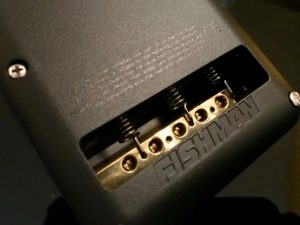
Most of the tech details are in the video. But in brief: These are active pickups with magnets, but no wire coils. Instead, the “coils” are printed on thin pieces of circuit board glued together like plywood. This design removes all noise and hum — chances are these are the quietest single-coil-sounding you’ll find. (Fishman also makes humbuckers and Tele pickups.) They can run on 9-volt batteries or (this is the other interesting part) a separately sold battery pack that replaces the trem cavity back plate. (There are other battery configurations for other guitars.) Another marquee feature: Each Fluence set includes a push/pull pot to switch between vintage voicing and a hotter “modern” sound.
This technology originated at an aerospace company. Someone there realized that their printed coils might work on musical instruments, and they contacted a leading pickup manufacture, who passed on the idea. Next it went to Larry Fishman, who was all over it from the get-go. He refined the idea and came up with lots of clever engineering to make it work in guitars. [DISCLAIMER: I have been paid in the past as a freelance contributor to Fishman products, but no one paid me to post this.]
To my ear these sound perfectly authentic, though the fact that they’re active is problematic for me personally. (That’s because I use so many retro stompboxes that don’t play well with the active pickups, which are buffered. The same goes for most of the pedals I sell.)
Killer, indeed!
While installing this in my much-abused MIM Strat, I also added a heavyweight bridge, trem block, and claw from Killer Guitar Components. I’m not kidding when I say “heavyweight” — it’s a formidable piece of metal, beautifully tooled. It feels like a major improvement on the standard design, and I think it sounds great as well (though it’s hard to be definitive about that without side-by-side comparisons). My favorite feature is the way the string inserts are chamfered — strings pop in correctly every time, which. as any Strat player can tell you, it not always the case. Killer, indeed!
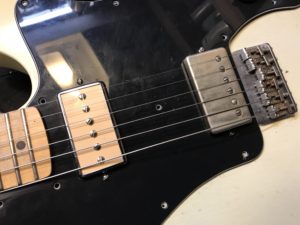
Fender’s Telecaster Deluxe has had an interesting and checkered history. Once regarded as yet another mediocre product from the company’s era of CBS ownership, these turn-of-the-seventies instruments now fetch huge prices on the collector’s market. I’ve never owned own. But when singer/songwriter Greer Sinclair loaned me one of Fender’s 2010 reissues, it was time for research — and experimentation.
The made-in-Mexico 1972 Deluxe reissue is a cool guitar. It replicates many details of the original: the oversized headstock, the Strat-like belly cut and fixed Strat-style bridge, and the big-ass pickguard. But its pickups are definitely a departure. In lieu of the original’s large-format “Wide Range” pickups, it employs a P-94R (a humbucker-sized P-90 spinoff) at the neck, and a conventional Gibson-style humbucker at the bridge.
The Wide Range pickup was a unique beast. Fender had commissioned Seth Lover, the man who invented the Gibson humbucker, to create a Fender humbucker in hopes of cashing in on the growing popularity of hard rock. With DC resistance in the 10k range, the new Wide Range pickup was a bit hotter than a vintage Gibson humbucker. Wide Range pickups appeared in several of the era’s models, including the Tele Thinline, Tele Custom, and semi-hollowbody Starcaster.
Gibson humbuckers have a bar magnet within, but the pole pieces are not magnetic. But on Wide Range pickups, the pole pieces are magnetic, as on Fender’s single-coil pickups. Situating individual magnets closer to the strings yield a brighter sound with greater note defition and string-to-string separation — characteristics we associate with vintage Fender pickups. So the Wide Range pickup lent a uniquely “Fender” twist to the Gibson design.
Wide Range pickups are slightly larger than conventional humbuckers. Most of Fender’s circa-1970 Tele reissues substitute generic humbuckers of the standard size. Standard humbuckers can sound superb in a Tele, but they’re horses of different colors. Fender has also created some reissues with the larger-sized pickups, but these are also garden-variety humbuckers — the larger format is purely cosmetic. The pole pieces of the factory humbucker on Greer’s guitar don’t align with Fender’s wider string spacing. (But one thing I’ve leaned from my various Fender/Gibson hybrid experiments is that sonically, this can matter very little.)
The P-94R’s cream-colored top looks wicked against the guitar’s finish. It’s a warm, full-sounding pickup from the mellower side of the P-90 spectrum. Actually, it doesn’t sound all the different from a traditional Telecaster neck pickup. (Like that pickup, it works quite well for jazz.) Note, though, that its dimensions differs substantially from those of a Gibson P-90, as you can the in the photo where it sits alongside a historically accurate Lollar P-90. When you change the size of a pickup’s components, you inevitably alter the sound. The tones can be for better or worse — but they will be different.