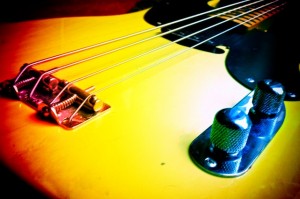
After auditioning so many different tone-control schemes over the course of the Mongrel Strat Project, I wound up with more tone circuits than I have Strats, so I figured I’d victimize a bass — specifically, a 1954 Fender P-Bass reissue with a Seymour Duncan Quarter-Pound pickup, which I’ve written about here. It’s a minimalist one-pickup model with basic volume and tone controls.
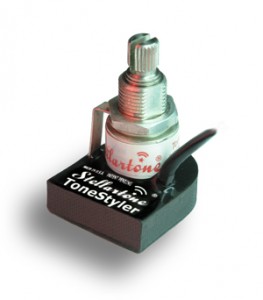
I was eager to audition a multi-capacitor tone control like I wrote about here. (Actually, it’s literally the same tone control — the guitar where it used to reside now houses the Stellartone ToneStyler tone pot covered here.) And while I had the patient on the operating table, I figured I’d also install the Black Ice distortion cube I wrote about here. (My friends in the medical profession assure me that patients always appreciate it when surgeons indulge in improvisational operating-theater mods.)
More bad Photoshop: You can't REALLY print a guitar at home . . . yet.
Yes, it's bad Photoshop. You can't REALLY print a guitar at home . . . not quite yet, anyway.
UPDATE:Check out the comments, where reader J links to videos of a 3D-printed guitar and violin.It’s cool and INTENSE.
Last weekend I got to enjoy one of my favorite things in the universe: the Maker Faire, held each year in San Mateo, California, outside San Francisco.
The event, which draws 100,000 people each year (not counting the thousands who attend satellite fairs in NYC, Detroit, and other cities), was launched by Make magazine, the closest thing to a house publication for the international DIY movement. Adherents of maker culture — or just plain “makers” — are a loose aggregation of artists, geeks, hackers, Steampunks, subversive ETSY craftspeople, and others who embrace various facets of DIY culture. “If you can’t open it, you don’t own it” is one of many unofficial mottos. Another is “Void your warranty, violate a user agreement, fry a circuit, blow a fuse, poke an eye out…”
And who isn’t in favor of poking out a few eyes? 😉
The Faire, now in its eighth year, is a joyous affair, assuming you derive joy from things like flashing Van der Graaf generators, 50-foot-tall kinetic sculptures that spew fire, the Faire’s iconic cupcake cars, and the sight of hundreds of cute kids learning to solder DIY projects at rows of workstations.
Each year there’s more new stuff than you can possibly consume, but even even amidst the ear-pounding experimental music and eye-pounding LED art, one development seemed to dominate: 3D printers are getting faster, smarter, and cheaper (as in, several DIY kits sell for less than $500). And it’s difficult to imagine them not changing how we will create and mod our musical instruments in the very near future.
(Quick memory refresher: The Vari-Tone appeared in several historic Gibson guitars, notably the ES-345. It uses a half-dozen different-sized capacitors to alter the voicing of the tone pot. It also adds an inductor, which preserves lows while the capacitors remove highs. Result: the rolled-off settings have a somewhat piercing, nasal character, as opposed to the usual dark, wooly sound of a rolled-off tone pot.)
Like some cool DIY versions of the project, the ToneStyler omits the inductor. And while it looks like a conventional tone pot,it’s actually a 16-position switch that selects between stepped capacitors, all of them smaller than in a conventional tone control. Result: rolled-off tones that maintain more volume and impact than in a conventional tone control.
Ordinarily I wouldn’t publicize “causes” on this site, but this one has special relevance for musicians and music fans.
My pal Count, a producer/mixer who’s done work for Radiohead, DJ Shadow, New Order, the Stones, No Doubt, and many other artists, is launching an online campaign to get musicians, producers, engineers, and other contributors credited on iTunes, Pandora, and other digital music services.
Consider the absurdity of the current situation: Why, in the digital age, are we granted only a fraction of the info available in the analog age? Why should fans be denied the details of their favorite recordings? And for underpaid musicians and technicians, the credit is often the only meaningful payment for services, a possible path to future work. The current state of affairs is just plain wrong!
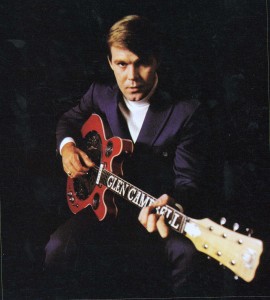
Dang — I wish I had a white turtleneck and a Mosrite electric resophonic!
After some of the long-running contests around here, it was nice having a quickie for a change. San Diego-based steel guitarist Doug Meyer was the first of several readers to correctly identify the four iconic Bass VI riffs in the post on ancient strings. He wins a Seymour Duncan Pickup Booster, a cool clean boost pedal that sound fabulous on 6-string bass, not to mention standard-tuned guitars.
The tunes were, in order of appearance:
1. Glen Campbell’s “Wichita Lineman”
2. Glen Campbell’s “Galveston”
3. Elmer Bernstein’s “Theme from The Magnificent Seven”
4. Steve Earle’s “Guitar Town”
Glen Campbell not only sang those two classic Jimmy Webb songs, but played the beautiful 6-string bass parts. As most ’60s pop fans know, Campbell was a leading L.A. session player before becoming a star — he played with Elvis, the Everly Brothers, the Monkees, and on many Beach Boys sessions, including Pet Sounds(that’s him playing electric 12-string on “Sloop John B.”) [CORRECTION IN COMMENTS.]
About the ’90s reissue Bass VI that inspired my original post: I’ve always liked it, and I’ve used it on a zillion sessions, but I never thought it sounded as good as an original. Now I realize that it sounds just like an original — all it needed was the right strings! 🙂
"We love candlelight, long walks on the beach, and really expensive old-school strings."
PLUS: New Contest! Name the Classic 6-String Bass Riffs and Win a Seymour Duncan Pickup Booster Pedal!
"We both love candlelight, long walks on the beach, and really expensive old-school strings."
NOTE:The contest is at the bottom of this post. You can skip ahead if you don’t care about rare and expensive guitar strings.
What do the classical guitar and the Fender Bass VI have in common?
Both instruments were developed using types of strings that are practically extinct.
First, let’s talk nylon strings. When these appeared after WWII, classical guitarists, led by Andrés Segovia, ditched gut overnight. Nylon strings were louder and brighter, and they offered better consistency, superior intonation, and longer life.
Few living guitarists have ever actually played gut strings, which really are made from animal guts (usually cows, goats, or sheep). I’ve never tried them myself.
But one of my darkest secrets is the fact that I started out as a teenaged lute player. (I have a photo of myself playing on a hay bale at a Renaissance Faire, wearing a feathered tudor cap and white tights. And you will never, ever see it.) I experimented with gut lute strings, only to run screaming. Total tuning nightmare, especially on an Elizabethan-era axe with friction tuning pegs, not to mention lots of unison- and octave-tuned strings. Guitarists were smart when they ditched the stuff.
But I recently bought a new ukelele, which came strung a set of Aquila strings from Italy. They have several lines of faux-gut nylon strings made from a proprietary material called — wait for it — “nylgut,” which allege to capture the sound of gut without the tears. They sounded cool on the uke, so I ordered a few guitar sets. At between $12 and $21 dollars per set, depending on the bass-string wrap material, they’re pricy, but not crazy expensive — about the same as other high-end, E.U.-made brands, like Savarez or Thomastik-Infeld. (Aquila’s US distributor is Just Strings.)
And holy cow, do I love ’em! They don’t look anything like gut strings, which resemble, well, dried-out intestines. But they really do capture a lot of “gutness.” Their tone is quieter and warmer than conventional nylon, with markedly less string noise (a great thing for a very rusty classical player like me). Check out this demo:
Did you know you can add a simple circuit to your guitar or bass that produces onboard distortion — without using a battery?
The idea is pretty simple — you attach a pair of diodes to the guitar’s output via a pot or switch. With the diodes connected to ground, you get a fairly nice distortion sound. With the connection to ground broken, you get your regular tones. It’s the same method used to create distortion in a several ’70s distortion pedals, notable the MXR Distortion+ and the DOD 250.
You can purchase the necessary components in a sleek black housing under the name Black Ice for $27.50, or you can do a DIY version for about $2 in parts. I’ll explain how after this brief video demo:
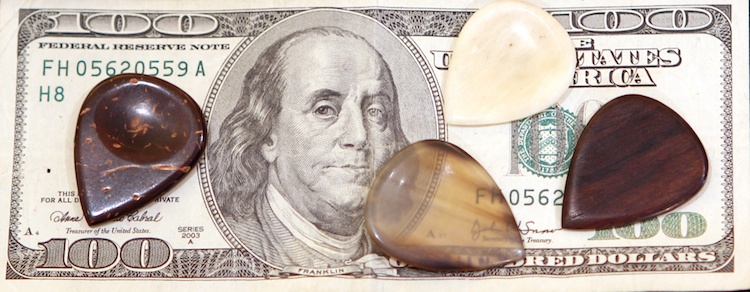
UPDATE: I’m proud to announce that the first part of my report on high-end picks has been selected to appear in the debut issue of Pure Guitar, a new digital guitar mag whose editorial staff includes my two music journo mentors : Tom Wheeler and Jas Obrecht. Also on board: jazz ace Wayne Goins, session superhero Tim Pierce, Nashville’s leading guitar tech, Joe Glaser, and other preeminent axe experts.
You’ll find my article here — but frankly, I recommend starting at the homepage of issue #1 and reading all the way through!
Congrats, guys, on the new mag. I’m psyched to be part of it. :beer:
UPDATE:Wow! I’m overwhelmed by the initial response. Hundreds of cool tips! Please bear with me as I process them and send out the access info. I could automate the process, but I want this to be more than just a bunch of random posts, and I want to weed out the silly stuff. —Joe
Do you have a secret? I want it!
No, not your credit card number, or the truth about what you were really doing on the night of September 23rd. Just a cool tip about anything that makes you play better or sound better. The kind of hard-won musical wisdom that’s almost too good to share.
And in exchange for surrendering a precious secret, you get access to the best secrets of many other players, including some whose names you know.
Just contribute a cool tone secret, and you’ll get access to this password-protected site. While there, you’ll be able to comment on the secrets and add ratings. Just to keep things lively, the authors of the highest-rated secrets will win cool gear prizes. In fact, whoever creates the highest-rated post between now and March 1st will receive a Godin Natural Summit CT, a lovely and versatile carved-top solidbody electric guitar that sells for $1,000. The authors of the second and third most popular posts win a their choice of Seymour Duncan pickup sets. (Custom Shop sets excluded.)
The site is already looking pretty cool — but it will be cooler if you contribute! Learn more (and submit a secret) here.
Don’t you love when someone revisits a weird idea from the past — and makes it even weirder?
I got a new bass last week, right before I left for the NAMM show. I finally had a chance to try it out yesterday. I think I’m in love. View the incriminating evidence in this brief video: