Categories
DIY Effects guitar Pickups

Ultimate Lipstick-Tube Guitar (with experimental tone control & onboard overdrive)

Okay, it’s not the ultimate lipstick-tube guitar for everybody, but it probably is for me. It’s my third lipstick-tube pickup experiment — and definitely my favorite.

You may have heard some of these parts before: I used the neck for all my Mongrel Strat projects, and the Strat-sized Seymour Duncan pickups appeared in my previous lipstick-tube experiments. (I love Duncan’s lipstick-tubes. To my ear, they sound way better than the ones in new-school Danelectros.) The new body is Warmoth’s Hybrid Tele model, in purple with butterfly stickers. It’s très macho. (Better not use if for gigs in Indiana and Arkansas.)

My previous lipstick tube experiments used a MIM Strat body, but I wanted something a little more distinctive, and with a built-in battery compartment (because nothing is a bigger pain than changing batteries in a traditional Strat control cavity). Also, I like how the design evokes both Strat and Tele, since the guitar has three-Strat sized pickups and a whammy, but is wired more like a Tele.

About that wiring: The 3-way pickup selector chooses neck, bridge or both pickups, like on a Tele. Meanwhile, a SPDT switch toggles the middle pickup on and off regardless of the pickup selector, so you get six settings: neck, bridge, neck + bridge, neck + middle, bridge + middle, and all at once. It’s a pragmatic variation on “Nashville Tele” wiring with a switch rather than a pot. That means you can’t dial in varying amounts of middle pickup—it’s all or nothing. But on the plus side, I can jump instantly to an out-of-phase sound from any pickup-selector setting, and it freed up space for the other weird crap I put in this guitar. (Yo, electrical engineers: Don’t bother telling me that combined-pickup settings aren’t really out-of-phase True, they’re not out-of-phase electronically, but they are acoustically, and the distinctive “hollow” sound of combined settings is precisely the result of phase cancellation from two pickups at different positions.)

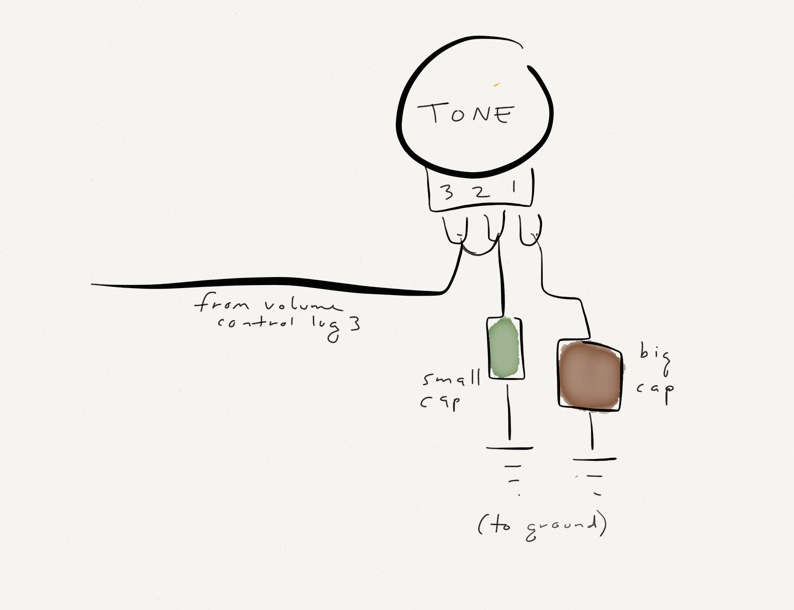
The weirdest detail is what I call a “cap-fade” tone control. It’s an idea I speculated about back in January, and to which many of you contributed cool perspectives. I pretty much followed the scheme in the original diagram:
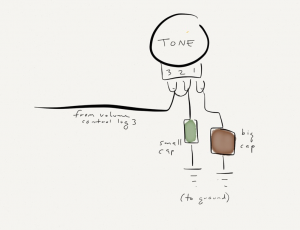
cap-fade tone control

The idea again: Instead of sending varying amounts of signal to ground via a tone cap, the pot here fades between a small-value cap (which defines the minimum cut when the control is engaged) and a larger one (defining the frequency of the maximum cut). In other words, instead of sending varying amounts of signal to ground, this circuit always sends everything above the cutoff frequency to ground, with the pot determining the frequency.

Categories
DIY

A New Tone Control Concept — or Is It?

Hey, smart people — let me get your take on this. I’ve been playing with a new tone control idea that’s so simple, I can’t believe no one’s done it before. (Chances are someone has.)

Here’s the idea: Conventional electric guitar tone controls employ a single pot and single capacitor connected to ground. As you turn the pot, more signal goes to ground for a darker sound. The capacitor value determines the cutoff frequency — the larger the cap, the lower the cutoff frequency and the darker the sound. In other words, the cutoff frequency is fixed, but the percentage of signal that gets cut off changes as you move the pot.

Meanwhile, the Gibson Vari-Tone circuit uses a rotary switch rather than a pot, and a set of capacitors of ascending size. The small caps have a brighter tone, and the large ones sound darker. But once a cap is engaged, it’s engaged all the way. In other words, the cutoff frequency varies as you move the switch, but not the percentage of affected signal—it’s always 100%.  (The Stellartone ToneStyler employs the same concept, with as many as 16 caps arranged around a rotary switch.)

But do you really need all those caps? Why not use the tone pot to fade between a small cap and a large one, like so:

double cap

Here, the brighter/lower-value cap is engaged when the pot’s all the way up. As you roll it back, the larger cap is introduced, producing greater capacitance and a deeper treble cut. When you arrange caps in parallel, their total capacitance is the sum of their values. For example, I tried a .0047µF cap and a .047µF, so the minimum value is .0047µF (a very modest cut) and the maximum is approximately .052µF (a very dark tone).

So far I’ve only tried this on breadboard, though I plan to deploy it in a new “parts” guitar I’m assembling. So far it sounds … really good. A lot like a ToneStyler, actually, but with fewer parts and handpicked values. The only tricky thing was finding a good pot value where all the action wasn’t bunched up at one end of the knob’s range. A reverse-log pot worked best for me—I got nice results with both a C500K and C1M.

I often use similar wiring to alter the value of the input cap on distortion pedals. (High values filter our more bass for a brighter/cleaner sound.) But I’m not aware of anyone having tried this on a guitar tone control.

Another issue is the fact that, in this circuit, the tone pot always has a cap engaged. You could use a really tiny value for the smaller cap so there’s little perceptible cut at the minimum setting, but that can make a substantial part of the pot’s range a little too subtle. So my plan is to combine this with a Ned Steinberger-designed JackPot as the volume control. This part has an “off” setting that bypasses the tone circuit entirely for a maximum-bright sound. That way, I’d choose for the smaller cap a value that provides the minimum treble cut I’m likely to want. (I suspect I’ll wind up with something between .0022µF and .0047µF.)

Have any of you seen or heard of such a guitar circuit? If so, any observations or advice?


Categories
Bass DIY Pickups

A Cool Alternative Tone Control for Bass

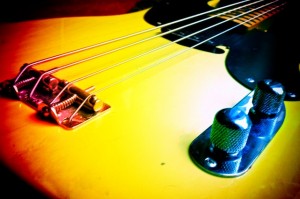
Looks vintage, but it ain't.

After auditioning so many different tone-control schemes over the course of the Mongrel Strat Project, I wound up with more tone circuits than I have Strats, so I figured I’d victimize a bass — specifically, a 1954 Fender P-Bass reissue with a Seymour Duncan Quarter-Pound pickup, which I’ve written about here. It’s a minimalist one-pickup model with basic volume and tone controls.

I was eager to audition a multi-capacitor tone control like I wrote about here. (Actually, it’s literally the same tone control — the guitar where it used to reside now houses the Stellartone ToneStyler tone pot covered here.) And while I had the patient on the operating table, I figured I’d also install the Black Ice distortion cube I wrote about here. (My friends in the medical profession assure me that patients always appreciate it when surgeons indulge in improvisational operating-theater mods.)

Demo and details after the break:

Categories
Bass DIY guitar

A Modern Vari-Tone Alternative…

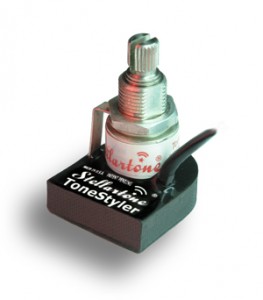
Looks like a pot — but it's not!

In the comments on my post on the Mongrel Strat with the Obsessive-Compulsive Tone Control, reader Dave mentioned a related product: The Stellartone ToneStyler. I ordered one and popped in into my dual-humbucker Hamer 20th Anniversary guitar (which still boasts the Seymour Duncan Joe Bonamassa pickup set I demoed here.)

(Quick memory refresher: The Vari-Tone appeared in several historic Gibson guitars, notably the ES-345. It uses a half-dozen different-sized capacitors to alter the voicing of the tone pot. It also adds an inductor, which preserves lows while the capacitors remove highs. Result: the rolled-off settings have a somewhat piercing, nasal character, as opposed to the usual dark, wooly sound of a rolled-off tone pot.)

Like some cool DIY versions of the project, the ToneStyler omits the inductor. And while it looks like a conventional tone pot,it’s actually a 16-position switch that selects between stepped capacitors, all of them smaller than in a conventional tone control. Result: rolled-off tones that maintain more volume and impact than in a conventional tone control.

Have a listen: