Categories
DIY Effects guitar

The Prettiest Pedalboard! (Plus: A New DIY Lipstick Tube Guitar)

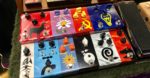
You know what sucks about attending NAMM as a manufacturer rather than a gear writer? I was epoxied to my booth all day, and I barely saw anything other than my guitar pedals. But on one rare break, I got to hang out with Jannis Anastasakis and his crew from JAM Pedals of Athens, Greece. (I highlighted some of their beautiful work in my pathetically skimpy “NAMM report.”)

Happily, there’s more to celebrate here than great visuals. JAM builds lovely versions of many classic analog effects. Their sounds and production quality are stellar, and JAM often adds modern updates such as realtime expression control, extra knobs, and internal trim pots for customizing tones. It’s quality stuff, used by many a guitar star.

And guess what? Jannis loaned me one of his magnificent Custom Shop analog pedalboards. Γαμώτο!

Sadly, I must now pack up and return this pretty pedalboard. But I’ll be getting my own JAM Delay Llama Supreme, an expanded version of the analog delay heard here, with tap tempo, a cool modulation section, and the almighty infinite-hold switch. (I reviewed it for Premier Guitar a few months ago.)

In the meantime, this experience makes me want to try my own DIY pedalboards. Not as an item for sale — just as a way to group related effects in a single enclosure for stage use. Gears are spinning ….
Categories
Effects Recording

A Quick Compressor Class

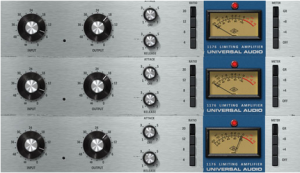
UA Compressors

Do compressors confuse you? And who don’t they confuse?

My just-posted Premier Guitar column covers some basics and walks you through a typical guitar compression scenario (with many audio examples).

Using a variation on a technique borrowed from engineer Michael Paul Stavrou’s cool recording technique book, Mixing with Your Mind, I start with extreme settings that make it easy to hear the compressor’s effect, and then back the processing down to realistic levels.

If you ever find yourself twiddling those inscrutable knobs while remaining unclear exactly what, if anything, is changing, this case study may clarify the process. I hope it’s helpful! :pacman:

Categories
guitar Music Recording

No Stinkin’ Amps (or Amp Simulators)

An advanced technical diagram.

No videos or audio examples today — I’m in the midst of “reconfiguring” my studio. (That’s the technical term for pulling stuff out of racks, tangling all your cables, making an ungodly mess, and dissolving into a puddle of bitter, frustrated tears.)

But the good news is, I got some cool new stuff. I’m switching over a pair of large Pro Tools and Apogee systems to a minimalist Universal Audio Apollo setup, an audio interface that doubles as a plug-in host. UA makes killer plug-ins, but I’ve never owned any, since they’ve always run off of proprietary PCI cards, and the card slots in my computers have always been filled to capacity. Now that I have the UA stuff in my grubby mitts, I’m obsessing on the idea of exploring non-amped guitar tones, especially distorted ones. And I’m not talking amp simulators, but the distortion you get from overdriving a recording console’s preamps.