Categories
guitar Music

Jimmy Page at 13

Aha! Now we know why no one has developed a cancer cure! It’s because young James Page took that skiffle thing a little too seriously.

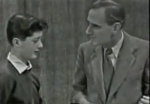
Yep — it’s Jimmy Page at 13 in 1957. (He turned 70 this week.) Imagine how different the world would be had he followed his stated goal of becoming a cancer researcher. We’d probably have eliminated cancer 30 years ago, but our music would be a lot crappier.

As much as I love Pagey’s playing, I’ve long felt his greatest influence was as a producer. He defined what rock sounds like, largely via his unprecedented innovations in exploiting and manipulating reverberant spaces. Zep sounds like modern rock. Nothing before does.
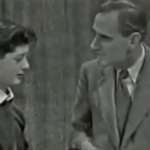
BBC assclown: "What are you going to do when you leave school? Take up skiffle?"
Condescending BBC presenter: “What are you going to do when you leave school? Take up skiffle?”

Many years ago I was kicking that notion around with my friend Andrew Goodwin, the brilliant British media studies scholar. He expanded our ramblings into a journal paper, and gave me an entirely undeserved co-author credit. To this day, it’s my only academic publication. Andrew went on to create a Led Zeppelin course at the University of San Francisco. He was working on a Zep book when he died in a freak apartment fire a few month ago. I assume he was aware of this clip, though I’m not certain. He definitely would have loved it! I miss him.

What’s your favorite Pagey moment? I think mine is from one of those leaked studio outtakes, an excerpt from “Heartbreaker.” You hear the amp close-miked and claustrophobic-sounding. Then you hear it miked from a distance, spooky and reverberant. Then you hear both sounds together. Voilà — modern rock guitar.

My fave Pagey solo is — hehe — “Sympathy for the Devil.” Yeah — I still think he played that one.

Earlier this year I got to do a couple of shows with Marianne Faithfull, who prompted the song in the first place when she gave Mick a copy of Bulgalkov’s brilliant novel The Master and Margarita. We were talking about the song, so I figured it was my moment to finally solve the mystery.

“So who played the solo?” I asked.

She rolled her eyes and sighed. “I just knew you were going to ask me something idiotic like that.”
Categories
DIY guitar Pickups

The Pagey Project: Postscript

Does this guitar LOOK like it has over a hundred settings?

Just a quick follow-up on the Pagey project, which first recreated the original Jimmy Page wiring scheme, and then explored an even  more extreme version using Seymour Duncan Triple Shot Mounting Rings.

Once I’d finished the project, I had to decide whether to keep the guitar heavily modded, or revert to something simpler. It probably won’t surprise you to hear I decided to keep the extreme Phase 2 wiring, with its added germanium overdrive.

But as cool as the Duncan ’59 model pickups sounded, I wanted to revisit the Duncan Seth Lover pickups I’d previously had in the guitar. They’re bright — twangy, even — compared to the ’59s, and I like the midrange honk they add by virtue of being unpotted. (I’ve written about the pros and cons of potting here.)

I’ve recorded an example of how the guitar sounds with the Seth Lovers. (You can’t make exact comparisons with the previous Pagey videos, since I used an amp for those, while the new examples were recorded through an amp simulator, though the “Seth” character still shines through.) I’ve included the clip in the post after/above this one, because it’s my first audio example using SoundCloud, and I wanted to say a few words about that.

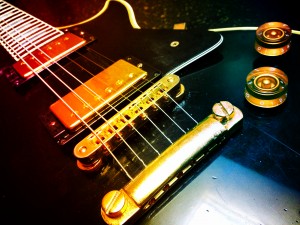
"There's GOLD in that thar pickup!"

And call me shallow, but…I really dig the way my guitar looks with the Seth Lovers installed. Between the teensy switches on the mounting rings and the push/pull pots, you really have to look hard to tell the guitar is not merely non-stock — it’s a morbidly overdeveloped tweak machine.

Funny — I’ve always found gold hardware a little bit tacky. But now I’m so enthusiastic about the look of gold that I feel like this guy at the right.

Categories
DIY guitar Pickups Recording

The Pagey Project, Phase 2:
An INSANELY Versatile Les Paul

Just how many colors can you coax from one guitar?

This post is about a guitar wiring scheme that only geeks and tweakers could love.

I think you’ll dig it. :satansmoking:

In Phase 1 of this project, I recreated the original Page wiring scheme using an ’82 Paul, a pair of Duncan ’59 model pickups, and four push-pull pots. The result was a great-sounding, almost absurdly versatile guitar, though the sheer number of options was downright bewildering.

So naturally, the only way forward was to make the instrument even more bewildering by adding additional sonic options. This version offers all the sound of the Phase 1 model, and a buttload more. Several buttloads, actually — and I’m not talking about those skimpy metric buttloads!

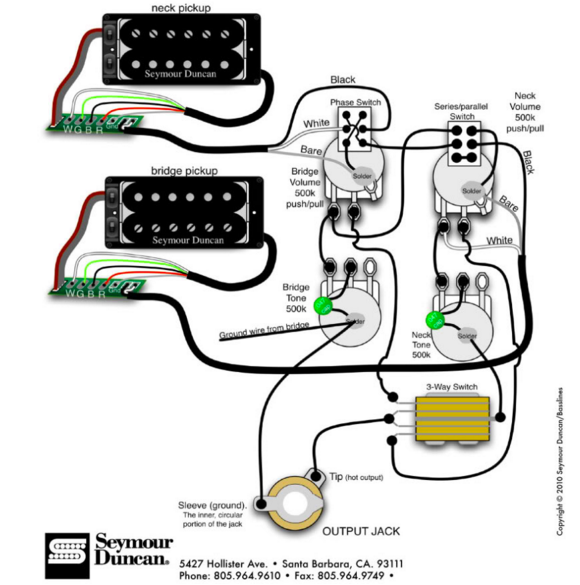
I gutted all the Phase 1 electronics. (Man, that hurt!) Next, using the same pickups, I added a pair of Duncan Triple Shot Mounting Rings. These provide four settings per pickup: humbucker, inner coil split, outer coil split, and both coils in parallel. (The Phase 1 plan offers only one split-coil setting per pickups. While you can configure the two pickups in parallel, you can’t do so with the individual coils in each pickup like you can here in Phase 2.) Here’s the wiring diagram I worked from, which for some reason is no longer posted on the Duncan site.

Since the Triple Shots add four new switches, the Phase 2 wiring requires only two push/pull pots. I wan’t about to let that real estate go unused! I installed a homemade germanium overdrive circuit (similar to the one we made in DIY Club) inside the guitar. My third push/pull pot activates it, and the fourth selects between two input caps, so I get a choice between a fat, Sabbath-style drive and a brighter, thinner Bluesbreakers-type tone.

Check out the demo video:

Categories
DIY guitar Pickups

The Pagey Project, Phase One!

Hey kids! You’re never too young to mod your guitars!
Now get off my lawn.

As promised, here are a demo video and tech notes for the first phase of the Pagey Project, which recreates Jimmy Page’s original Les Paul wiring scheme. (The upcoming Phase Two will expand on the idea with even more crazy options.)

All I can say is, sheesh! Why did it take me decades to try out this awesome Les Paul mod?

I think it’s because I had a nasty dual-humbucker guitar many years ago with series and coil-split switches. Even though I knew the pickups were crap, it still prejudiced me against alternate humbucker wirings. “Just pick up a Fender!” I’d think.

Another factor: I lacked the sophistication to know that, while many of the tones unlocked by the Pagey wiring sound thin and/or weird on their own, they can be quite useful in context.

And make no mistake — except for the series switch, all the alternate Page sounds are smaller than stock Les Paul sounds. And that’s a good thing! They’re great for crystalline clean tones, ratty faux-P-90 distortion, and simply making the regular Les Paul sounds seem gigantic by contrast.

Have a listen. There video starts with a 90-second overview, then works through the system in detail:

Categories
DIY guitar Pickups

The Pagey Project: Prelude

Double the sounds available from your axe!

Man, preparing the Pagey project has been a real eye-opener! Expect some surprising results! (Hint: There’s much of interest, even for players who have zero desire to sound like Page.)

I’ll be posting the first video and tech walk-through after the weekend, but in the meantime, I wanted to update you on the game plan, which, frankly, only became clear once I started soldering.

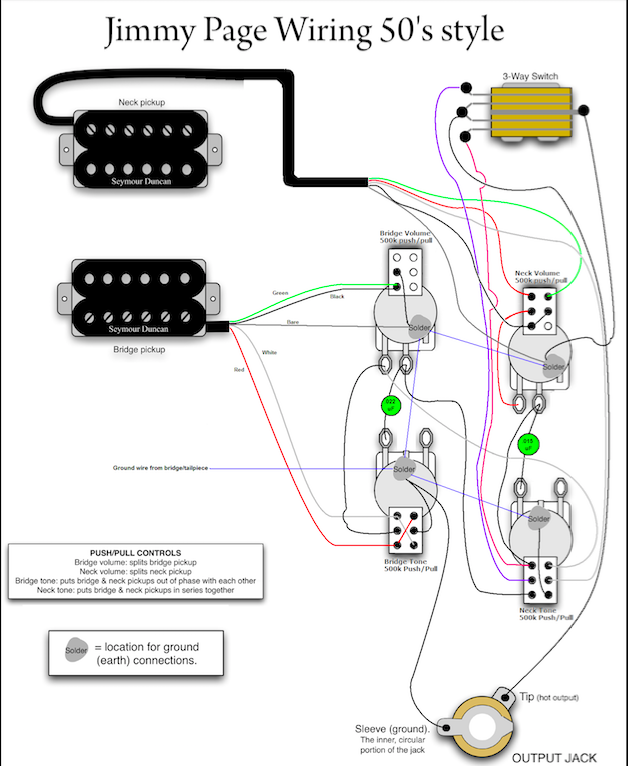
If you haven’t downloaded the relevant schematics, you can snag them here. (Reader Jeff pointed out pointed out a difference between the two versions of the four-push/pull wiring. I have no idea which version page used, but I went with the version from Scott Miller’s Guitar Player magazine article because it offers a bit more control — and this project is all about control!)

We’re going to tackle the project in two phases. First, we’ll look at the original Pagey wiring, using four push-pull pots and period-accurate pickups (I went with Duncan ’59s with four-connector cable). I’ve wired up my ’82 Les Paul in exactly this fashion, and it’s pretty dang cool. Yes, it’s a complicated job, but not as tough as anticipated. Amazingly (for me) it turned out great on the first attempt.

Categories
DIY guitar Pickups

Join the Pagey Project — If You Dare!

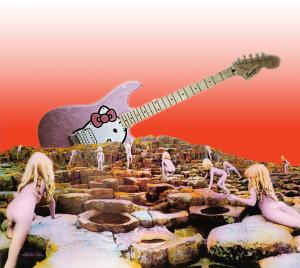
True fact: While Jimmy Page is usually pictured with a Les Paul, he recorded many of Led Zeppelin's greatest tracks with Fender guitars. (Artist's conception.)

All aboard, mateys! Join our ship of fools as we sail the fiercest seas of guitar electronics: Yes, the legendary Jimmy Page wiring scheme. There will be NO QUARTER for pickup pussies!

Actually, there will be a great deal of quarter as we help each other with this cool but tricky project. I’ll be disembolwing the black Les Paul Custom I wrote about here. My hope is that many of you will join me on this voyage. We can troubleshoot together, share tips, and commiserate after we’ve destroyed a bunch of nice guitars other things.

As you probably know, this complex wiring scheme transforms a standard Les Paul into an über-versatile tone machine with added series/parallel, phase-canceling, and split-coil options. It was the means by which Pagey reproduced the many Telecaster and Danectro parts from Zep’s studio albums when performing live.

We’ll cover the classic arrangement, with four push/pull pots. Then we’ll go a step further: If you add a pair of Seymour Duncan Triple Shot Mounting Rings to the mix, you get many more options than with the original scheme. Yes, we can all be bigger badasses than Pagey.   :shake:

(FWIW, I’m less interested in cloning Page’s setup than in mastering the ins and outs of alternative humbucker wiring. So think of this as a chance to explore all available options, and refine a mod that works best for you.)

Here’s what you must have before setting sail: