Inspired by the most sublime thing you can drop into a cocktail. Or maybe that and the cocktail.
The guitar is a random collection of Fender Strat parts with Duncan lipstick tube pickups. They sound a zillion times better than modern Danelectro pickups. (Plus I boycott Dano on principle because their parent company is a major supporter of homophobic far-right legislation.)
On the occasion of a daunting round-number birthday, I’ve just completed Loopocalypse, a concert-length video of my live looping show. I’ll be posting a song per day, each featuring a different guitar, from now till Thanksgiving/birthday. Here’s Day 1 of 17, a tribute to that dearest of the dearly departed, David Bowie. I’ve been playing this for years, and it just gets sadder and sadder. Tomorrow I’ll share something appropriately angst-ridden for the US election day. (Here’s a remembrance of my brief Bowie encounters, written the day after he died.)
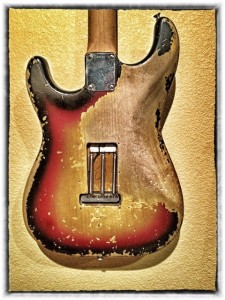
Here’s an explanation of my live looping rig. The guitar is an all-original 1963 Strat that I’ve owned since 1980. For many years it was my only good guitar.
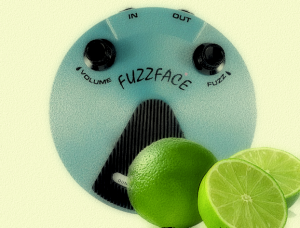
Most sentient guitarists love Hendrix, but not everyone is equally fond of his signature distortion pedal.
So what’s your take on the Fuzz Face?
I used to hate them — but only because my sole exposure to them was via the crappy reissues of the ’70s, ’80s, and ’90s. They sounded so brittle and harsh! Not till this century did I encounter the pedal in its original incarnation.
What a difference!
Vintage-style Fuzz Faces produce tones that are warm, rich, and unbelievably dynamic. It was like the first time I tasted a vintage-style daiquiri. Like the Fuzz Face, the classic daiquiri is a delicate concoction made from a few simple yet complexly interactive ingredients — nothing like those nasty blended drinks that taste like Slurpees spiked with Everclear.
Here’s everything I love about vintage Fuzz Faces, compressed into 60 seconds:
My DIY version is based on inventor Ivor Arbiter’s original 1966 schematic. That’s also the basis for a new DIY project created by my stompbox-buildin’ pal Mitchell Hudson, who runs the cool DIY site Super-Freq. We’ll both be posting it on our sites in the next few days. You can source the parts on your own, or order a kit for less than $50 — not as cheap as some of our other DIY projects, thanks to its two relatively pricy germanium transistors.
Most lore about “mojo” stompbox parts is utter nonsense, but there is something harmonically unique about the germanium transistors used in ’60s fuzz pedals, including original Fuzz Faces. (See my “Germanium Mystique” post/rant for more info.) You don’t need germanium for a good fuzz sound — there are many great tones available via silicon transistors, integrated circuits, and digital modeling. But one problem with those god-awful Fuzz Face reissues was that they often simply substituted high-gain silicon transistors for germanium ones without modifying anything else in the circuit. The result was more gain, but at the cost of harsh, excessively bright tones and inferior dynamic response.
In the last decade or so, builders have wised up. Numerous manufacturers offer authentic ’60s-style replicas. Meanwhile, the DIY community has created countless variations, many of which use post-germanium parts to great effect. These days it’s pretty easy to find a Fuzz Face that doesn’t suck.
I’ve build many Fuzz Face variants, but until Mitchell created his Fuzz Face project, I’d never done a strict original, with positive-ground wiring, PNP transistors, and few latter-day “refinements.” (Don’t sweat it if those terms mean nothing to you — they’re all explained within the project.)
Anyway, that’s the circuit you hear in the video above. It’s not a fuzz for all seasons — it doesn’t have a ton of gain, and its loose, spongy distortion is unsuitable for metal and modern hard rock. But I love its warm, non-macho timbre and phenomenal dynamic response. It’s simple, classic, and delicious, much like this.
Thank heaven I became a guitar geek shortly before my 12th birthday. If I hadn’t, I probably would have requested a minibike for my bar mitzvah present a year later, instead of my first electric guitar. And today I’d be an over-the-hill biker instead of an over-the-hill guitarist.
My schoolteacher mom had a colleague whose son worked at Fender in Fullterton, California, not far from where I grew up. (Sadly, I’ve forgotten his name). Shortly before my big day, we visited his mobile home (let’s face it: the musical instrument industry has never been lucrative) to audition some decidedly post-CBS guitars he was selling. I opted for a black Jazzmaster, though I was tempted by the paisley Tele. It was my sole electric throughout high school, though I sold it at exactly the wrong time: five minutes before new-wave guitarists such as Tom Verlaine and Elvis Costello made it cool again. (Though I shouldn’t complain, since I managed to procure my pre-CBS Strat around that time.)
The Fender guy didn’t have extra amps on hand, but I slavered over the oversized amps in the early-’70s Fender catalog.Which sleek silver combo would greet me on the big day?
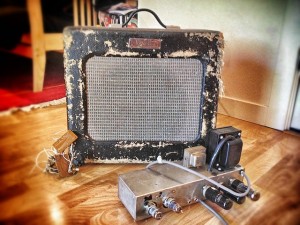
To my horror, I received an ancient, teensy-weensy combo amp, an ugly thing spray-painted black. I was mature enough not to express anything other than delight, but my heart ached. I wanted an amp as big and loud as my dreams, not this sad relic. They told me I was a man when I turned 13 — but I didn’t feel like one without the Dual Showman of my dreams.
My disappointing amp was a tweed 1952 Deluxe — which makes it sound like this story will have a happy ending. Sadly, no. (more…)
Last weekend I went to a memorial service for a music pal I hadn’t seen since the ’80s. Judging by the pictures I saw and the stories I heard, Brett remained the gentle, generous music lover I’d remembered till he died in his sleep a few weeks ago.
I ran into lots of old music friends and bandmates, and we alternately smiled and winced as our old photos and concert videos flashed on the big screen. Were we really that skinny? Did we actually wear that stuff without being coerced at gunpoint?
Like we tend to do at such moments, I left brimming with resolutions: Appreciate life. Cherish friends. Remember that music is a joy as well as a job. And do something nice for my sad old Strat, the guitar in all those old photos and videos.
See, back then I only had one guitar — an all-original ’63 Strat I’d picked up in 1980, when pre-CBS Fenders were still perched on the precipice between collectible and affordable. (I paid $450, a staggering investment for me at the time.) It remained my only serious guitar for a decade. It was in near-perfect condition when I bought it, and it was a battered ruin by decade’s end. (The ’80s were a tough time for guitars, what with all those studded belts.) I was a young player with a bad attitude and little concern for collectibility, as opposed to the middle-aged player with a bad attitude and little concern for collectibility that I am today.
I’ll some thoughts about Strats then and now. But first, have a listen:
 Most sentient guitarists love Hendrix, but not everyone is equally fond of his signature distortion pedal.