Categories
Digital Effects guitar

Double Double MIDI Trouble

I just recorded a solo version of one of my fave film themes: Jerry Goldsmith’s main title to the 1967 spy spoof In Like Flint. I’ve adored the melody since childhood, and I blame it for instilling the love of chromaticism that made possible my extraordinarily uncommercial career.

I’d previously posted another version of this tune, performed upside-down on a friend’s lefty guitar. But that was all-analog — this time it’s digital. And I’ve used the video to highlight a favorite MIDI technique: doubling recognizable guitar sounds with non-guitar synths and samples.
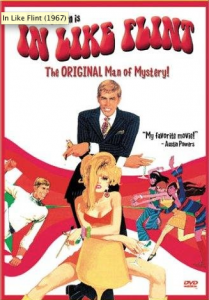
I've been obsessed with this score since dinosaurs ruled the earth.
I’ve been obsessed with this score since dinosaurs ruled the earth.

It’s funny — being able to trigger pretty much any sound from the guitar isn’t necessarily as liberating as you might think. Sure, when you first try it out, it’s thrilling to conjure an electric piano sound from the fretboard. But who wants to hear some schmo noodle aimlessly on electric piano when they could be noodling aimlessly on guitar?

For better or worse, I find myself using this technique repeatedly. When I double a part effectively, the result still seems like part of the guitar cosmos. It feels like expanding the palette, as opposed to vomiting on it. (Not that I’d be above vomiting on a palette if it helped create a cool painting.)

Did anyone else encounter this sort of childhood musical contamination? A melody, progression, or tone that infected you early on, and colored everything after? I’m not talking image, like falling in love with the Beatles on Ed Sullivan or Nickelback on the CBC because they were so frickin’ cool. I mean a primal sonic imprint. Anyone?
Categories
Digital guitar Pickups Recording

Demo: Fishman TriplePlay Wireless MIDI Guitar System

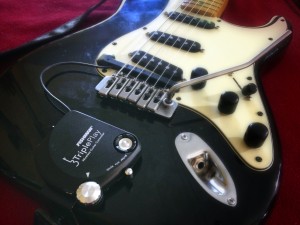
I've installed TriplePlay on this homemade strat.
I’ve installed TriplePlay on the homemade strat.

For the last few months I’ve been working with Fishman on the documentation for TriplePlay, their long-awaited wireless MIDI guitar system, which will finally ship this quarter. I had a blast demoing TriplePlay at MacWorld a few weeks ago, and I’m looking forward to doing so again at Musikmesse in Frankfurt in April.

But at times, it’s been frustrating. I power up TriplePlay to study some feature, get all excited, and then have to turn it off and write about it instead of going off and playing it for six hours. This little demo was my first real chance to just fool around with the thing. Thoughts and details after the video.

Categories
Digital guitar

A Good Direction for Digital Guitar?

Is this what your studio will look like in 2023?

The recent post on Auto-Tune for Guitar generated much interesting discussion, plus a few good Auto-Tune jokes. Thanks, guys!  :beer:

The comments from smgear particularly impressed me, because he managed to assemble a wish list for a future digital guitar with more detail and clarity than I could have managed.

It’s always a good idea for smart, articulate musicians to sound off about the musical tools they desire. But that’s especially true now, as manufacturers grapple with technological change with varying degrees of success. People really are listening!

Anyway, smgear wrote:

Basically, the problem is that the majority of the manufacturers seem locked into old paradigms. The bulk of their new designs are intended to mimic something else (Line 6), combine/integrate technologies (Roland) or make the ‘art’ less rigorous (Antares). Those are all fine pursuits and have resulted in some great tech, but they’re basically locking everyone into a pre-1980 palette of sounds, functions, and expression. Quite honestly, after my momentary enthusiasm has passed, I just pick up one of my no-name beater acoustics or electrics and dig in because every day I find a new sound, attack, approach, or whatever that allows me to express something in a new way. It’s true that I could do that playing through those tools, but I don’t need them and they are specifically designed to conform my sound to specific realms rather than to let me explore new spaces.

So with regards to this batch of hex-based modeling tech, my general requirements are fairly simple. I want clean and discrete signals from each string (check), I want a serious multi-core processor AND a couple programmable on-board control knobs/switches (semi-check), and I want an easily accessible and intuitive interface that gives me full control over how each particular string or any group of strings is processed/routed (no check).

Categories
Digital guitar Pickups

Synth Guitar:
Did They Finally Get It Right?

Anyone here ever owned a synth guitar? Not a Keytar, but a guitar fitted with a hexaphonic pickup that transmits MIDI data to external devices? And if so, do you readily admit it?

The synth guitar has had one of the most checkered histories outside of, well, checkers. Since the ’70s, many brilliant minds have tried to bridge the gap between the plucked string and the external tone generator. But despite a few notable exceptions (mostly in the prog/fusion realm), guitarists have been reluctant to embrace the technology.

I’ve had a Yahama synth system (basically a clone of the Roland GK-2) for many years, though I rarely use it. Like a lot of players, I balk at the installation hassle and the ugly, cumbersome hardware. (Plus, I’ve played keys longer than I’ve played guitar, so I don’t really need a guitar to conjure synth sounds.) Also, those systems are expensive! Many players have been disappointed. Many businesses too — the Avatar guitar synth probably killed off the ARP company.

But I’ve been thinking about guitar synth again since last January’s NAMM show, where Fishman previewed their Triple Play system, a new take on MIDI guitar which I mentioned at the time here. (Here’s much more info from the company’s Summer NAMM press release.)

I finally got to play a late-stage prototype this weekend. But before I discuss the experience, I need to confide that a) Larry Fishman is a pal of mine, and b) I may be working with his company on the product’s documentation and marketing. (My words of praise are 100% sincere — but as always, consider the source.)