Categories
Amps

18 Wicked Watts

I had a blast building and testing two Marshall 18-watt kits for a Premier Guitar story — and I emerged with new respect for this cool 1965 design.

These mini-Marshalls were neglected in their day, but are now treasured. The oft-heard claim that they provide plexi tones at reasonable volumes is only partially true — these are open-backed combos powered by a Vox-like pair of EL-84s tubes. But while they have roughy the same horsepower as the era’s Fender Deluxe and Vox AC15, their tone is undeniably ’60s Marshall. In the studio, they sound far larger than their actual size. And out of the studio, they’re still pretty darn loud.
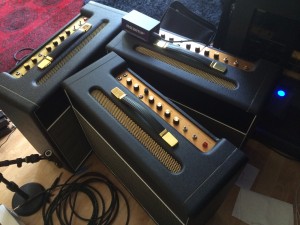
I've never seen three 18-watts in the same place before.
I’ve never seen three 18-watts in the same place before.

Even though the Mojotone and Tube Depot kits I built share the same schematic (and identical cabinets, both made by Mojotone), the build experiences and final results differed greatly.

And just when I thought I’d scaled the Everest of 18-watt ecstasy, I get a real Marshall 18-watt reissue for an upcoming Premier Guitar review. Stay tuned.

Are any of you guys 18-watt fans? Any observations to share?
Categories
Amps DIY

Review: Tube Depot Tweed Champ Kit

When you make DIY stompboxes powered by 9-volt batteries, your biggest fear is a solder burn (or dropping your drill on your iPad, but that’s another story). DIY amps are different: AC voltage can kill you, so a klutz like me approaches amp builds with caution.

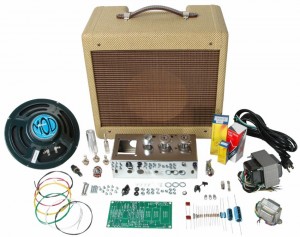
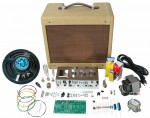
Which brings me to one of the great things about Tube Depot’s Tweed Champ Vacuum Tube Amp Kit: the fantastic assembly manual. Other great things include the price ($499, roughly half the price of a non-kit Champ clone of comparable quality). The design (which follows the original circuit, but substitutes an intelligently designed circuit board layout for the original turret board). And most of all, the tone.

I’ve got lots more to say about the kit, the fun I had building it, the lore of the 5-watt ’58 Champ, and the pros and cons of Class A amps (the Champ is the only Fender classic that merits the classification). But first, have a listen!

Categories
Amps DIY guitar Recording

Small Amps for Small Spaces?

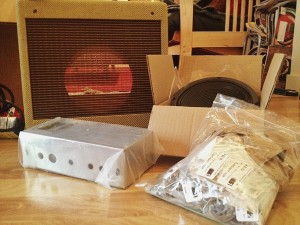
I’ve got a Tweed Champ kit, and I’m not afraid to use it. Or at least not VERY afraid.

Why do they make amps so damn loud?

It’s not just a cranky question from a guitarist who’s drawing depressingly close to the “Get off my lawn!” years. I ask sincerely: Why?

Big amps make total sense — but only if a) it’s 1969, b) you’re playing venues with Jurassic sound reinforcement, and c) you’re a guitarist in danger of being drowned out by Keith Moon or John Bonham.

Okay, end of harangue — I’ll have time for that when I’m chasing kids off my lawn (after I move to the suburbs and GET a lawn). But as I get psyched up to build this review model of Tube Depot’s Tweed Champ kit in the coming days, I figured I’d ask what folks are using these days to get cool amp tones in their bedrooms and basements. Not dedicated practice amps, necessarily, but great-sounding stuff that happens to be ultra-low-wattage? Name your petite-amp poison!

Anyway, I’m stoked about this kit. I’ve already completed a few amp clones from Ceriatone. They were fun to build and sounded great. But I can tell right off the bat that this Tube Depot kit has at least one major advantage over its Malaysian cousins: This one comes with a fabulous 40-page instruction manual. (Most clone vendors simply link you to a schematic.)  Having  created a few step-by-step instruction manuals myself, I can testify how much painstaking work these entail. Hats off to Tube Depot’s Rob Hull for doing it right!

Details and build report to follow. But now, let’s talk tiny-amp tone!