Categories
Live Looping

Loopocalypse Day 10 (of 17): “Pandemonic Waltz”

I always feel a bit guilty playing this one, because it uses the one looping technique I’ve always tried to avoid: simply slathering one part on top of another till you have a damn racket, and then lurching to a halt. But hey.

The guitar is a Lowden 15E, a cool yet bargain-priced 12-string. Not that it sounds anything like a 12-string here. Here’s a more naturalistic demo.

Here’s an explanation of my live looping rig.

Categories
guitar

Those $24 Acoustic Strings

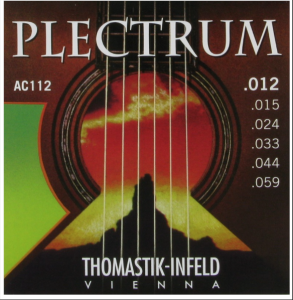
As if I weren’t already blowing enough money on arcane strings, I’ve got a new obsession: Thomastik-Infeld Plectrum series acoustic strings (which sell for $24 in the U.S.).

If you hang out here much, you’ve heard me bitch incessantly about acoustic strings. I hate the way most modern strings are all hyped treble zing and blaring volume, at the expense of deep, decisive fundamentals. With due respect to my vegetarian friends, too many strings are all sizzle and no steak.

Screenshot 2015-06-03 14.55.56

Yeah, bright strings can seem energizing in a cocaine-binge sort of way. But all that glassy presence gets fatiguing. Meanwhile, darker bass strings leave sonic space for the treble strings to shine. Even on my teensy-tiny Martin 0-17, these low strings sing in a warm baritone voice, not like some squeaky, poorly Auto-Tuned teen idol.

This pricy Austrian set features brass-coated steel 1st and 2nd strings, while the bass strings are bronze, but with both silk inlays and flexible steel cores. The flatwound 3rd, 4th, and 5th strings nix finger noise and minimize tone contrasts between wound and unwound strings. The polished roundwound 6th string adds a touch of focus to the lowest register, yet introduces no awkward contrasts on melodies played across multiple strings.

The set is low in both tension and volume relative to most U.S.-made strings. Even though the low E is a chunky .059, it has a soft, relaxed feel that makes me want to linger over notes, shaping them. The harmonic range is fantastic, the dynamic range even more so. They’re long-lasting too — this video was recorded three weeks and many playing hours after installing the set.

I’m hooked. Damn it.

(Hey, Mr. Tambourine Man — I don’t want you getting your nasty treble overtones all over my acoustic strings, no matter how frickin’ jingle-jangle the morning happens to be. Just back off, pendejo.)

Categories
Acoustic guitar Music

Magic Fairy Dust: The Veillette Avante Gryphon

I recently reviewed the gorgeous little Veillette Avante Gryphon for Premier Guitar and liked it so much that I bought one. This was my first opportunity to record it in my studio.

The Avante Gryphon is a relatively low-cost version of Woodstock luthier Joe Veillette’s Gryphon, an 18.5″-scale 12-string designed to be tuned a minor seventh (an octave minus two frets) above standard. But while 12-string guitars feature octave-tuned string pairs, here all six courses are unisons, as on a mandolin. In fact, the Avante Gryphon sounds a lot like a mandolin, but with a wider range and guitar-like tuning. And unlike the couple of janky plywood mandolins I own, it plays gloriously in tune. It’s made (very nicely!) by Korean CNC robots and sells for $1,400, as opposed to $4K+ for Veillette’s hand-built models.

For years I’ve been looking for the right upscale mandolin, but now I’m happy I found this instead. My original motivation was a high-tuned soprano instrument for multi-guitar arrangements, or for magic-fairy-dust studio overdubs. But the thing is so fun — and sounds so darn pretty — that I can’t stop playing it solo. This Bach prelude, for example:

I won’t recap my review here—check it out if you’re curious. Instead, let’s yak about Johann Sebastian!

Categories
Acoustic

Taylor 150e: An Affordable 12-String Acoustic

I needed a 12-string acoustic in a hurry for a session, so I picked up a new Taylor 150e for under $700. It wasn’t a review model or anything — I just ordered one online, sight unseen and sound unheard.

This model has been generating much buzz as an affordable yet good-sounding 12-string. It’s savvy positioning on Taylor’s part: I suspect there are many players who, like me, would love to have a nice 12-string, but aren’t about to spend $2,000+ for that occasional color. Anyway, I’m duly impressed. Have a listen!

I’ve got it strung with a super-heavy set from Pearse, and it’s a bit too macho for me. I dig the volume and harmonic richness, but it’s a beast to maneuver, at least for complex fingerstyle stuff. Either I’ll restring with something lighter, or consider testosterone supplements.

I haven’t owned a 12-string acoustic since I was 13. My first decent acoustic guitar was a late-’60s Fender Villager 12-string purchased for under $200. I loved it, but unfortunately, the shop that worked on it removed the tone bar, an essential brace. Uh oh — after a couple of weeks, I opened the case to find that the guitar had imploded on itself overnight. Instead I got a Yamaki 6-string, a crappy Yamaha knockoff. I’ve spent years in therapy working through the trauma.

The 150e is a Mexican-made instrument with a solid spruce top and a layered sapele body. I didn’t even realize till I received the guitar that it included onboard electronics. I almost never use that stuff, but before typing this, I went to plug it in. And guess what? It’s a surprisingly decent-sounding system that relies on an internal microphone. It doesn’t sound as good plugged in as it does in the video, but it’s totally acceptable for stage use. I didn’t expect it to sound half as good.

Anyone tried one of these? Any other acoustic 12-string recommendations, observations, or rants? What’s the coolest 12-string riff? And who’d win in a fight: Leo Kottke, Ralph Towner, or Leadbelly?

Categories
Acoustic guitar Recording

How Nashville High-Stringing Works

You don’t have to be high in Nashville to enjoy Nashville high-strung.

Nashville high-strung tuning is one of the guitar’s great magic tricks. It has a delicious, “secrets of the Guild” quality — you feel like an insider just knowing what it is.

Not that I did know what it is until embarrassingly late in life. For the sake of my fellow late-bloomers, I’ll explain: You replace your guitar’s lowest four strings with thinner strings tuned an octave higher than normal.

You can think of it as using the higher-pitched of a each pair in a 12-string string set. (Or the top two strings of a normal set, and the top four strings from another normal set, with the first string as the third string, the second string as the fourth, etc.)

I love how this tuning can work subliminal magic, or step front and center for marquee riffs. Nashville session players conceived it as a way to add stereo shimmer to doubled acoustic guitar tracks. But rock players have used it to great effect as a foreground sound, as heard on the Stones’ “Wild Horses,” Floyd’s “Hey You,” Kansas’s “Dust in the Wind,” and Tracy Chapman’s “The Promise.”

Here’s a quick little demonstration, both solo and in a mix: