Categories
DIY guitar Pickups

A Cheap Archtop Upgrade!

Sounds like MONEY!

I’ve said it so many times, I feel like the parrot of pickups, but here goes again: These days the weakest links on inexpensive Asian and Mexican guitars are invariably the pickups. Upgrading them often yields a princely axe at a pauperly price.

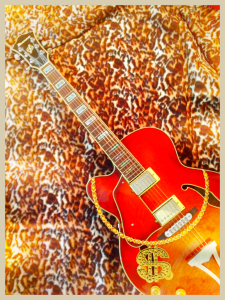
A perfect example is the Ibanez Art Star archtop I just upgraded for my friend Dusty. These aren’t especially sought-after models — they seem to sell used here in the States for for between $400 and $500.

The guitar looked cool and played well, but the pickups were murky and undistinguished. I replaced them with a pair of Duncan ’59s, and man — a merely decent guitar suddenly became very good.

Dusty’s not really a jazz player — more a cool indie-rock-pop guy — so I figured he’d like the option of a brighter, single-coil sound. I requested the ’59 model with four-connector cable (plus chrome covers to maintain the retro look), and used push/pull pots from StewMac for humbucker/single-coil switching. That was also my rationale for choosing “vintage-style” wiring, which keeps the tone relatively bright, even when rolling back the tone pots. Dusty also wanted to keep the guitar’s flatwound string as a departure from his usual roundwounds, which was all the more reason to keep the tone as bright as possible.

Just one disclaimer before you view the demo: Dusty is left-handed, and I am not. I foolishly bravely recorded the performance playing the guitar upside-down without restringing. So you’re going to have to imagine how it would sound played confidently and comfortably! (It was an interesting experience, to say the least, one I wrote about it here.)

Check it out:
Categories
DIY guitar Pickups

The Pagey Project: Postscript

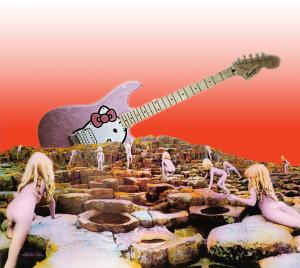
Does this guitar LOOK like it has over a hundred settings?

Just a quick follow-up on the Pagey project, which first recreated the original Jimmy Page wiring scheme, and then explored an even  more extreme version using Seymour Duncan Triple Shot Mounting Rings.

Once I’d finished the project, I had to decide whether to keep the guitar heavily modded, or revert to something simpler. It probably won’t surprise you to hear I decided to keep the extreme Phase 2 wiring, with its added germanium overdrive.

But as cool as the Duncan ’59 model pickups sounded, I wanted to revisit the Duncan Seth Lover pickups I’d previously had in the guitar. They’re bright — twangy, even — compared to the ’59s, and I like the midrange honk they add by virtue of being unpotted. (I’ve written about the pros and cons of potting here.)

I’ve recorded an example of how the guitar sounds with the Seth Lovers. (You can’t make exact comparisons with the previous Pagey videos, since I used an amp for those, while the new examples were recorded through an amp simulator, though the “Seth” character still shines through.) I’ve included the clip in the post after/above this one, because it’s my first audio example using SoundCloud, and I wanted to say a few words about that.

"There's GOLD in that thar pickup!"

And call me shallow, but…I really dig the way my guitar looks with the Seth Lovers installed. Between the teensy switches on the mounting rings and the push/pull pots, you really have to look hard to tell the guitar is not merely non-stock — it’s a morbidly overdeveloped tweak machine.

Funny — I’ve always found gold hardware a little bit tacky. But now I’m so enthusiastic about the look of gold that I feel like this guy at the right.

Categories
DIY guitar Pickups Recording

The Pagey Project, Phase 2:
An INSANELY Versatile Les Paul

Just how many colors can you coax from one guitar?

This post is about a guitar wiring scheme that only geeks and tweakers could love.

I think you’ll dig it. :satansmoking:

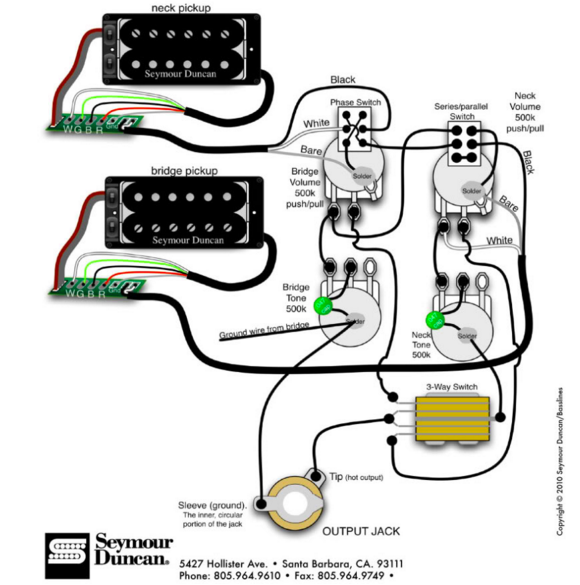
In Phase 1 of this project, I recreated the original Page wiring scheme using an ’82 Paul, a pair of Duncan ’59 model pickups, and four push-pull pots. The result was a great-sounding, almost absurdly versatile guitar, though the sheer number of options was downright bewildering.

So naturally, the only way forward was to make the instrument even more bewildering by adding additional sonic options. This version offers all the sound of the Phase 1 model, and a buttload more. Several buttloads, actually — and I’m not talking about those skimpy metric buttloads!

I gutted all the Phase 1 electronics. (Man, that hurt!) Next, using the same pickups, I added a pair of Duncan Triple Shot Mounting Rings. These provide four settings per pickup: humbucker, inner coil split, outer coil split, and both coils in parallel. (The Phase 1 plan offers only one split-coil setting per pickups. While you can configure the two pickups in parallel, you can’t do so with the individual coils in each pickup like you can here in Phase 2.) Here’s the wiring diagram I worked from, which for some reason is no longer posted on the Duncan site.

Since the Triple Shots add four new switches, the Phase 2 wiring requires only two push/pull pots. I wan’t about to let that real estate go unused! I installed a homemade germanium overdrive circuit (similar to the one we made in DIY Club) inside the guitar. My third push/pull pot activates it, and the fourth selects between two input caps, so I get a choice between a fat, Sabbath-style drive and a brighter, thinner Bluesbreakers-type tone.

Check out the demo video:

Categories
DIY guitar Pickups

The Pagey Project, Phase One!

Hey kids! You’re never too young to mod your guitars!
Now get off my lawn.

As promised, here are a demo video and tech notes for the first phase of the Pagey Project, which recreates Jimmy Page’s original Les Paul wiring scheme. (The upcoming Phase Two will expand on the idea with even more crazy options.)

All I can say is, sheesh! Why did it take me decades to try out this awesome Les Paul mod?

I think it’s because I had a nasty dual-humbucker guitar many years ago with series and coil-split switches. Even though I knew the pickups were crap, it still prejudiced me against alternate humbucker wirings. “Just pick up a Fender!” I’d think.

Another factor: I lacked the sophistication to know that, while many of the tones unlocked by the Pagey wiring sound thin and/or weird on their own, they can be quite useful in context.

And make no mistake — except for the series switch, all the alternate Page sounds are smaller than stock Les Paul sounds. And that’s a good thing! They’re great for crystalline clean tones, ratty faux-P-90 distortion, and simply making the regular Les Paul sounds seem gigantic by contrast.

Have a listen. There video starts with a 90-second overview, then works through the system in detail: