Categories
DIY

A New Tone Control Concept — or Is It?

Hey, smart people — let me get your take on this. I’ve been playing with a new tone control idea that’s so simple, I can’t believe no one’s done it before. (Chances are someone has.)

Here’s the idea: Conventional electric guitar tone controls employ a single pot and single capacitor connected to ground. As you turn the pot, more signal goes to ground for a darker sound. The capacitor value determines the cutoff frequency — the larger the cap, the lower the cutoff frequency and the darker the sound. In other words, the cutoff frequency is fixed, but the percentage of signal that gets cut off changes as you move the pot.

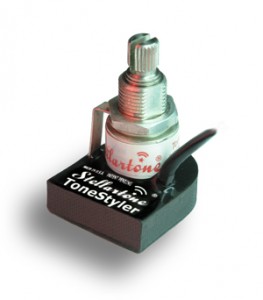
Meanwhile, the Gibson Vari-Tone circuit uses a rotary switch rather than a pot, and a set of capacitors of ascending size. The small caps have a brighter tone, and the large ones sound darker. But once a cap is engaged, it’s engaged all the way. In other words, the cutoff frequency varies as you move the switch, but not the percentage of affected signal—it’s always 100%.  (The Stellartone ToneStyler employs the same concept, with as many as 16 caps arranged around a rotary switch.)

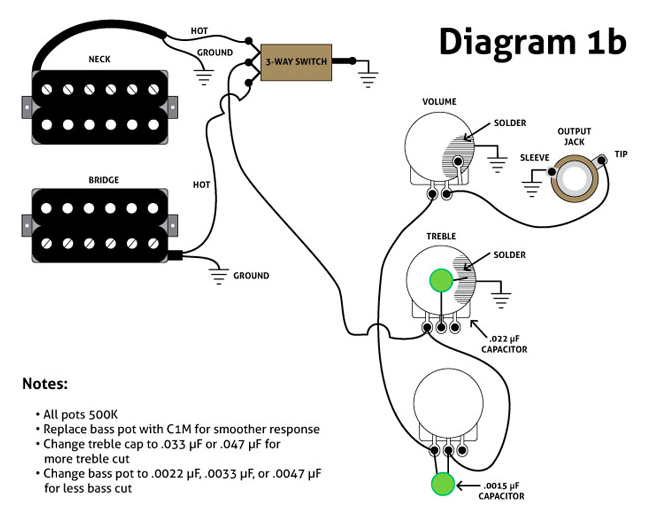
But do you really need all those caps? Why not use the tone pot to fade between a small cap and a large one, like so:
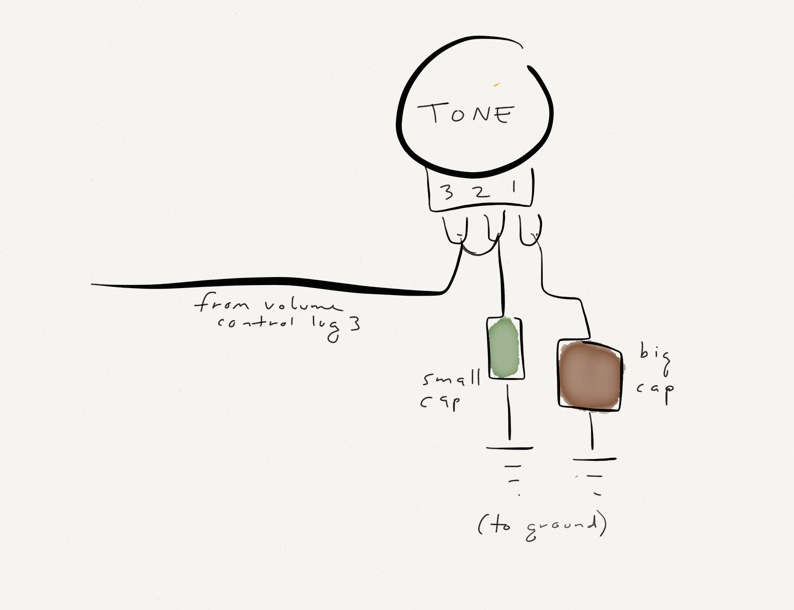
double cap

Here, the brighter/lower-value cap is engaged when the pot’s all the way up. As you roll it back, the larger cap is introduced, producing greater capacitance and a deeper treble cut. When you arrange caps in parallel, their total capacitance is the sum of their values. For example, I tried a .0047µF cap and a .047µF, so the minimum value is .0047µF (a very modest cut) and the maximum is approximately .052µF (a very dark tone).

So far I’ve only tried this on breadboard, though I plan to deploy it in a new “parts” guitar I’m assembling. So far it sounds … really good. A lot like a ToneStyler, actually, but with fewer parts and handpicked values. The only tricky thing was finding a good pot value where all the action wasn’t bunched up at one end of the knob’s range. A reverse-log pot worked best for me—I got nice results with both a C500K and C1M.

I often use similar wiring to alter the value of the input cap on distortion pedals. (High values filter our more bass for a brighter/cleaner sound.) But I’m not aware of anyone having tried this on a guitar tone control.

Another issue is the fact that, in this circuit, the tone pot always has a cap engaged. You could use a really tiny value for the smaller cap so there’s little perceptible cut at the minimum setting, but that can make a substantial part of the pot’s range a little too subtle. So my plan is to combine this with a Ned Steinberger-designed JackPot as the volume control. This part has an “off” setting that bypasses the tone circuit entirely for a maximum-bright sound. That way, I’d choose for the smaller cap a value that provides the minimum treble cut I’m likely to want. (I suspect I’ll wind up with something between .0022µF and .0047µF.)

Have any of you seen or heard of such a guitar circuit? If so, any observations or advice?
 

Categories
DIY

Double Varitone: A Two-Headed Tone Control

I was kind of stoked about my latest wiring experiment: a “double Varitone” scheme I installed in my DIY “Kitschcaster.” I’ve written about these multi-capacitor tone switches a lot on this site, but this is the first time I’ve tried using a similar scheme to cut bass frequencies. The result is a lot like the G&Ls “PTB” circuit (covered here and at Premier Guitar), but with adjustable treble-cut and adjustable bass-cut.

The reason I say I was kind of stoked is, just as I was preparing this post, some fascinating marketing materials appeared in my comments queue. A manufacturer uploaded a barrage of marketing copy about his product, a prefab pickup-switching system. I visited the product site, and learned the most amazing thing: Unlike most of the stuff I write about here, his product can actually get you laid! No way can the double Varitone do that! Here’s how the product works:

Categories
DIY guitar

My Top Three Wiring Mods

Premier Guitar just posted my new article on three favorite electric guitar wiring mods. The concepts won’t be new to anyone who hangs out here — I’ve pretty much flogged them all to death! But the new article includes the step-by-step walkthroughs that I never got around to creating for this site, and PG art director Meghan Molumby created beautifully clear tech diagrams like this one:


Screen Shot 2014-07-23 at 9.54.35 AM

The descriptions and instructions in the new story are clearer and more detailed than my original posts here, plus I’ve refined some details, so I suggest working from the new PG versions.

My three choices:

Yup, the ol’ PTB tone control, the coolest mod I know, at least for players who love distortion. The new version of the project uses the 500K pots you probably already have in your guitar rather than the more eccentric G&L values.

I also revisited the Strat version of the “Nashville-style” Tele wiring popularized by Brent Mason and other Music City cats. It performs brilliantly in a Strat, and IMHO its benefits (vastly more blended-pickup options plus a musical and intuitive control layout) for outweigh the costs (loss of the middle-pickup-alone setting, cost of a 3-way switch). Not to launch a protracted Strat-vs.-Tele battle, but I love the whole notion of “Tele-fying” a Strat via wiring, control layout, and pickup choice.

In the article’s comments thread, several savvy readers also mention Strat wiring systems that provide the sounds of the Nashville mod without sacrificing any others. They’re right — but the more I mess with this stuff, the more I value simplified operation. I’m less concerned with having all options than with having the coolest ones, ergonomically organized. Still, there are many ways you can go here.

Finally, I’m once more beating the dead Varitone horse exploring variations on Gibson’s Varitone concept, updated for modern players. I added a new twist in the PG story: deploying these ideas via toggle switches, rather than a big, clunky rotary switch.

It was fun when PG editor Shawn Hammond asked me to choose my favorite mods. It was easy to decide though — these are the three I keep coming back to, and all three deliver dramatic results, unlike many better-known mods.

So which electric guitar mods would be on your short list? Wiring, hardware, whatever. How do you make your guitars cooler?

Categories
Bass DIY guitar

A Modern Vari-Tone Alternative…

Looks like a pot — but it's not!

In the comments on my post on the Mongrel Strat with the Obsessive-Compulsive Tone Control, reader Dave mentioned a related product: The Stellartone ToneStyler. I ordered one and popped in into my dual-humbucker Hamer 20th Anniversary guitar (which still boasts the Seymour Duncan Joe Bonamassa pickup set I demoed here.)

(Quick memory refresher: The Vari-Tone appeared in several historic Gibson guitars, notably the ES-345. It uses a half-dozen different-sized capacitors to alter the voicing of the tone pot. It also adds an inductor, which preserves lows while the capacitors remove highs. Result: the rolled-off settings have a somewhat piercing, nasal character, as opposed to the usual dark, wooly sound of a rolled-off tone pot.)

Like some cool DIY versions of the project, the ToneStyler omits the inductor. And while it looks like a conventional tone pot,it’s actually a 16-position switch that selects between stepped capacitors, all of them smaller than in a conventional tone control. Result: rolled-off tones that maintain more volume and impact than in a conventional tone control.

Have a listen:

Categories
DIY guitar Pickups

Twang Bangers, Vari-Tones & More Strat Strangeness

The latest Mongrel Strat (artist's conception).

Welcome to the second installment in the Mongrel Strat Series!

If I were a sensible person, I would have split this week’s experiments into several posts. But much like eating pistachios, it’s tough to know when to stop .

Anyway, this project tackles three topics:

1. Several readers dug the sound of the Telecaster-inspired Seymour Duncan Twang Banger pickup used in Mongrel #1, where I  paired it with a Duncan Lipstick Tube for Strat neck pickup and a Alnico II Pro middle. But I wanted to hear how the Twang Banger sounded in a more traditional Strat array, so this time I paired it was a couple of vintage-accurate SSL-1s, with a reverse-wound, reverse-polarity model in the middle position.

2. Over in The Secret Room, a participant brought up the subject of the Vari-Tone control used in the Gibson ES-345. I wanted to learn more about this often misunderstood circuit (well, I never understood it, anway) and explore whether it had relevance for Strats.

3. In response to another Secret Room topic, I wanted to resolve whether there’s any sonic benefit in bypassing the tone circuit completely.

And the results? You tell me — here’s the video: