NAMM was fun, though I’m paying a price with this dreaded flu I came home with. (“NAMMthrax,” they call it.) A highlight was getting interviewed on camera by my friend and frequent editor, Shawn Hammond.
Admittedly, there are some cringeworthy moments, especially when my entire Porkolator demo crashes and burns thanks to a funky cable. (I’ve played Shawn’s role at other tradeshows, and trust me, those guys sprint from booth to booth at speeds you wouldn’t believe — definitely no time for do-overs!) But you’ll get a decent idea of the other three. Soon I’ll have proper demos of the new releases, and I’ll share them here.
I was showing my stuff in the brand-new pro audio hall, miles away from most of the guitar stuff. That’s because my distributors, Vintage King/M1, work mainly in the high-end studio/audio realm. (I was set up right next to those magnificent Shadow Hills compressors.)
Still, I managed to see a few old friends and make some new ones. One reunion was with producer Matt Wallace (Faith No More, Maroon 5, Replacements, etc.) who I hadn’t seen in over 35 years, when I was his frickin’ “Intro to Music Appreciation” TA at UC Berkeley. Another was a middle-school friend with no connection to the music industry — his daughter just got a gig at Fender.
And when I wasn’t demoing, schmoozing, or contracting diseases, I was watching the nearby Mix With The Masters stage. That company sells online recording/mixing lessons featuring famed producers and engineers, many of whom gave live presentations in which they walked the audience through their productions. I saw my old pals Joe Chicarelli and Jacquire King, and I got to meet several others whose work I’ve long admired: longtime Nick Cave & the Bad Seeds accomplice Mick Launay, mastering legend Howie Weinberg, and Sylvia Massy. In addition to recording everyone from Tool to Johnny Cash to System of a Down to Julio Iglesias, Sylvia authrored the coolest book ever on creative recording.)
Totally off-topic: While driving from SF, I finally finished the audio book version of Alan Moore’s 1,255-page magnum opus, Jerusalem. Fuck me — the most amazing book I’ve encountered since David Mitchell’s Cloud Atlas over a decade ago.
My friend John Bohlinger from Premier Guitar just shot a Rig Rundown video with one of my utmost guitar heroes, Andy Gill.
I’ve rhapsodized about Gill’s guitar voice more times than I can count. But the aspect of his playing that I love the most is the way he created such a definitive voice with zero reference to prior rock and blues. If I’d ever worked at Art Forum like my wife did, I could probably draw comparisons to Luigi Russolo’s futurism and Jean Dubuffet’s art brut, but really, I just dig Gill’s blunt, brutal badass-ness.
The big surprise for me in this interview: These days Gill plays through a laptop running Logic, and he’s using some of the stuff that I helped make while sound-designing guitar components for Apple. This news makes my year (though given the year we’ve all been through, walking to the corner store without breaking my ankle would probably also make my year).
Nice work, JB! And thanks, Andy, for the endless inspiration since 1979’s Entertainment!
Lookit! My pals and colleagues at Premier Guitar just posted a video demo of my pedals shot at NAMM last month.
It was a trip being on the business end of that gear-review microphone! Shooting this clip was surprisingly nerve-racking. You have to make the gear sound good … try not to play too terribly … speak coherently … and not come off as a dick. It’s a tall order, at least for me.
Thanks to the gang at Voodoo Lab for letting me shoot this in their booth. (Which they did because they’re just plain cool.) Thanks also to Shabat Guitars for letting me borrow this pretty guitar, and to Fryette for letting me plug it into one of their spectacular Aether combo amps. Man, am I a freeloader, or what?
If you’d like to learn more about Gore Pedals, please visit my Gore Pedals page for studio-quality recordings with multiple guitars, more pedal settings, and lots of geeky tech info.
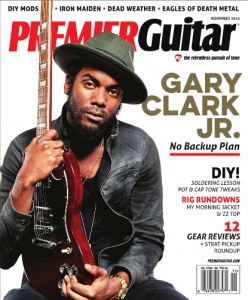
I’d like to call out several items of interest in the November issue or Premier Guitar. The first one is personal: As head honcho Shawn Hammond mentions in his monthly editor’s letter, I’m changing roles at the magazine. After two years as a part-time senior editor, I’m going part-part-time as a contributing editor.
It was a tough call for me — it was a fun gig working with awesome people on subjects I love. But I’ve felt an increasing need to dedicate more time to my own projects: playing, recording, writing, developing gear, and trying to make my tonefiend.com blog and YouTube channel seem a bit livelier than something you’d encounter at Urban Ghosts. (It’s one of my favorite websites, but not the attitude I’m aiming for here.)
If you’ve enjoyed the articles I’ve contributed to PG, well, first of all, thanks! And second, note that I’ll actually be contributing more columns and reviews than before. That may sound contrary to the laws of physics, but it’s possible because I will no longer be editing material by other writers. (I’d been processing an average of 35 stories per month in addition to my bylined pieces.) Picking up the slack will be new hire Ted Drozdowski, a fine writer and player, a lovely guy, and one of the music journalists I looked up to when I got into the guitar mag racket decades ago. (Ted was part of the now-legendary Musician magazine of the ’80s and ’90s.) Meanwhile, I’ll be contributing my Recording Guitarist column and at least three major gear reviews per issue.
Also in the issue are several tech-oriented pieces that I found particularly interesting. My old pal Frank Falbo — a leading pickup designer and master luthier — contributed a great piece on pot and capacitor substitutions. More than anything I’ve read, Frank’s article nails down exactly what changes to expect when swapping out part values, documented via audio files.
For me, the most fascinating part is how varying tone-pot values change your guitar’s tone, even when the tone knob is wide-open. Yeah, a lot of us would expect some change, because pots of varying resistances exert different loads on your pickups. But as far as I know, no one has ever nailed down the exact differences the way Frank has.
Others generalize. Frank Falbo nails it down.
Spoiler alert: The differences are massive — it’s a far bigger deal than I’d always assumed. Check out Frank’s first set of sound clips and prepare to be impressed.
It’s not a new idea that you can shift the overall tone of a guitar “bright-ward” or “dark-ward” by swapping pots, but Frank makes explicit how dramatic such changes can be, and what to expect from the likeliest substitutions.
I also learned much from two articles I wrote. The first is a shootout between five sets of ultra-vintage-style Strat replacement pickups, featuring models by Amalfitano, Fender, Klein, Manlius, and Mojotone. (Spoiler alert #2: They all sound pretty great, though the Kleins and Mojotones were my personal faves.)
I only realized after evaluating tones that the two sets I loved most don’t deploy a hotter pickup in the bridge position, while the other three do. (I don’t mean some blazing-hot bridge pickup, but one just a tasteful tad louder than the others, an approach many Strat players seem to love.) In the Klein and Mojotone sets, the middle pickup is loudest. Food for thought.
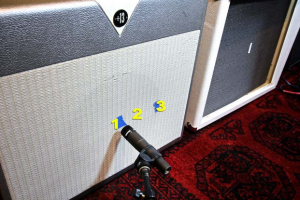
There are good reasons why few guitar mags run serious pickups reviews, and almost never compare models directly: It’s labor-intensive, and it’s damned hard to establish a level playing field. Here, I tried to remove as many variables as possible, installing all the pickups in the same test guitar, scrupulously measuring everything from pickup height to mic position, and laboring mightily to create identical demo performances for each set. My favorite part appears on the final page of the article, where you can directly compare each pickup from each manufacturer side-by-side.
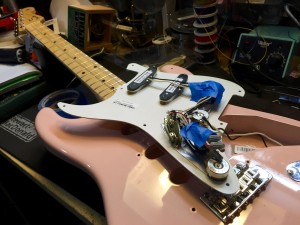
This poor pink Strat got one hell of a workout.
Finally, you might find interesting the audio clips in my latest Recording Guitarist column. It’s about is direct recording, a topic I’ve been covering since this blog began. I got cool sounds using a JHS Colour Box (a dumbed-down Neve channel in stompbox form) and especially with the Neve preamp simulations in the latest Universal Audio software. I’m hardly the first to point this out, but wow! Some recent plug-ins are so stupefyingly realistic that they can mimic analog gear pushed to extremes — a longstanding weak link in faux-analog plug-ins. I found it easy to create cool and compelling sounds without amps or amp simulators. Let me know what you think.
Okay, now I’m nodding off from jet lag. I just returned from a two-week trip to Italy, which generated some interesting musical thoughts and discoveries that I’ll share here soon. 🙂
May I take this opportunity to pimp my new monthly recording column in Premier Guitar? The first installment covers basic electric guitar miking technique. It’s ground that’s been covered often enough before, though I hope the article’s many audio files (recorded via ReAmp, moving the mic between “takes”) shed some new light on the topic.
Meanwhile, I’m breathlessly stoked about my new “Partsmaster.” It’s a Korina “Split Jazzmaster” body from Warmoth with Fralin P-92s and some new tricks I’ve been wanting to try with wiring and onboard overdrive, plus several other ill-considered, stab-in-the-dark adventurous experiments. It’s like some wacky Firebird/Jazzmaster hybrid (“Birdmaster?”) I hope to post some video later this week, but right now, the guitar is awaiting the plek treatment at Gary Brawer’s shop. Gary is also prettying up some of my clever but sloppy wiring, and remedying the fact that, when I brought the beast in, the strings were about a half-inch from the fretboard.
Just in time for the single-coil holiday season: my comparison review of 16 humbucker-sized P-90 pickups is live at Premier Guitar. This heartwarming holiday fun-fest has it all: Mouth-watering adjectives. Freshly baked audio clips. Irate manufacturers. Don’t miss it!
This was a fun, if challenging project. Comparison pickup reviews are such cans of worms! Not only are they sadistically labor-intensive, but the differences between one pickup and the next are easily overshadowed by other variables in the tone chain.
After much thought about how to create meaningful comparisons, we came up with an intriguing process: I tested all the pickups in the same guitar, with identical setups, and ReAmped them through the same combo amps with identical recording settings. If this were an amp or pedal review, I would have used the same performances throughout, but of course, each example had to be played anew with each pickup, so I spent much time matching performances to guard against misleading variations in touch and intensity. It’s not a perfect solution, but better than most, and in the end quite revealing.
And what did it reveal, exactly? You’ll find out at the link. Beyond that, I can report that:
All the products sounded pretty good.
They sounded more similar than you might expect.
I’m gonna find me a guitar to house a set of my favorites — though I’m not sure which ones are my faves! Really, they’re close enough that, say, the tone of a particular body wood alone would be enough to sway the decision. It’s not so much a case of “better or worse” as “brighter or darker” and “louder or quieter.”
As mentioned in the article, there’s no “gold standard” of P-90 tone — or rather, every P-90 lover has his or her own standard. Gibson’s ’50s original are notoriously inconsistent in their output, even their magnet type. Plus, the mere fact that you’re winding coils around a narrow, tall humbucker bobbin rather than a wide, low P-90 one has sonic implications. So I tend to think of this entire pickup category as either “single-coils that are ballsier than Fender single-coils,” or, in the case of hum-canceling models, “humbuckers with brighter highs and clearer mids.” (Or as my ol’ pal Steve Blucher from DiMarzio calls them, “humbuckers that hum.”)
Funny thing: I love P-90s, but don’t own any guitars fitted with them. Not yet. :satansmoking:
So talk to me about P-90s! Your faves? Beloved P-90 guitars? Fave P-90 players and performances?
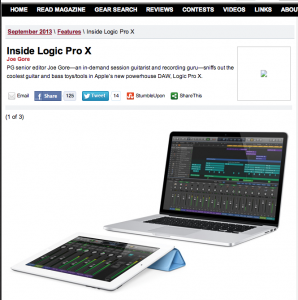
This is an exciting post for me, and not just because I get a desperately needed break from Klons and Screamers. I’m thrilled to bits about Logic Pro X and MainStage 3, though I’m still wrapping me head around them. (Yeah, I worked as a developer for both products, but I didn’t get a proper program-wide view until last week’s release.)
Also, it’s my first story for Premier Guitar, whose staff I’ve just joined as a senior editor. I’m stoked because it reunites me with PG editor Shawn Hammond and senior editor Andy Ellis, both of whom I remember fondly from my Guitar Player magazine days.
There’s much talent and coolness on the staff. I’m a happy little guitar nerd. Plus, the schedule is loose enough that I can still record, perform, and continue to work with audio/software clients.
What does the gig mean for this blog? Good things. I have no plans for a major course change — there are too many things I can only cover on a non-commercial site, including some of the topics closest to my heart. Meanwhile, working with PG will keep me more up-to-date on new music, new gear, and scurrilous guitar community gossip. In some cases, though, I may link to a PG article I’ve written rather than duplicate the work here. Today, for example. 🙂