Categories
DIY Effects guitar

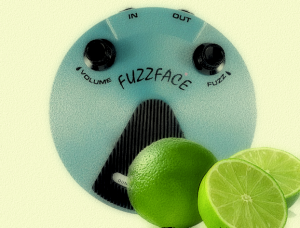
Fuzz Face:
The Daiquiri of Distortion Pedals?

fuzzlimeMost sentient guitarists love Hendrix, but not everyone is equally fond of his signature distortion pedal.

So what’s your take on the Fuzz Face?

I used to hate them — but only because my sole exposure to them was via the crappy reissues of the ’70s, ’80s, and ’90s. They sounded so brittle and harsh! Not till this century did I encounter the pedal in its original incarnation.

What a difference!

Vintage-style Fuzz Faces produce tones that are warm, rich, and unbelievably dynamic. It was like the first time I tasted a vintage-style daiquiri. Like the Fuzz Face, the classic daiquiri is a delicate concoction made from a few simple yet complexly interactive ingredients — nothing like those nasty blended drinks that taste like Slurpees spiked with Everclear.

Here’s everything I love about vintage Fuzz Faces, compressed into 60 seconds:

My DIY version is based on inventor Ivor Arbiter’s original 1966 schematic. That’s also the basis for a new DIY project created by my stompbox-buildin’ pal Mitchell Hudson, who runs the cool DIY site Super-Freq. We’ll both be posting it on our sites in the next few days. You can source the parts on your own, or order a kit for less than $50 — not as cheap as some of our other DIY projects, thanks to its two relatively pricy germanium transistors.

Most lore about “mojo” stompbox parts is utter nonsense, but there is something harmonically unique about the germanium transistors used in ’60s fuzz pedals, including original Fuzz Faces. (See my “Germanium Mystique” post/rant for more info.) You don’t need germanium for a good fuzz sound — there are many great tones available via silicon transistors, integrated circuits, and digital modeling. But one problem with those god-awful Fuzz Face reissues was that they often simply substituted high-gain silicon transistors for germanium ones without modifying anything else in the circuit. The result was more gain, but at the cost of harsh, excessively bright tones and inferior dynamic response.

In the last decade or so, builders have wised up. Numerous manufacturers offer authentic ’60s-style replicas. Meanwhile, the DIY community has created countless variations, many of which use post-germanium parts to great effect. These days it’s pretty easy to find a Fuzz Face that doesn’t suck.

I’ve build many Fuzz Face variants, but until Mitchell created his Fuzz Face project, I’d never done a strict original, with positive-ground wiring, PNP transistors, and few latter-day “refinements.” (Don’t sweat it if those terms mean nothing to you — they’re all explained within the project.)

Anyway, that’s the circuit you hear in the video above. It’s not a fuzz for all seasons — it doesn’t have a ton of gain, and its loose, spongy distortion is unsuitable for metal and modern hard rock. But I love its warm, non-macho timbre and phenomenal dynamic response. It’s simple, classic, and delicious, much like this.
Categories
DIY Effects guitar

New Frontiers in Fuzz:
The Devi Ever Interview

Some boutique stompbox builders pursue endless refinements of classic pedal designs, developing ever-more-suave iterations of the Tube Screamer and Ross Compressor.

And some just want to blow shit up.

Guess which category Portland, Oregon’s Devi Ever falls into? Hint: Her extensive line of guitar and bass pedals includes such anarchy boxes as the Little Shit, the Ruiner, the Heroin Lifestyle, and the Truly Beautiful Disaster.

Here’s what I’m talking about: Check out Devi’s video demo for her Shoe Gazer fuzz…

…or this one of Wilco’s mighty Nels Cline giving Devi’s Soda Meiser a workout:

Categories
DIY Effects guitar

Octave Fuzz Overdose!
Seven Classic Circuits

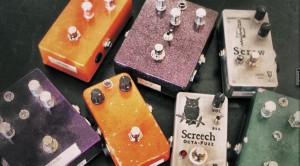
These funky homemade pedals represent all the leading octave-fuzz circuits.

I had no idea I had so many octave fuzz pedals! I had no idea they sounded so different! And after spending way too much time auditioning and recording them, I have no idea when I’m ever going to be able to stand listening to them again! :noshake:

Naw, just kidding — I had lots of fun putting together this octa-fuzz fest. It features no name-brand pedals, just DIY clones based on old circuits. But hey, most of today’s octave fuzzes are also clones of old circuits.

In fact, imitation has always been the name of the game here. The Roger Mayer Octavia used by Jimi Hendrix was inspired by a circuit found in a British mixing console. The US-made Tycobrahe Octavia was a ripoff of Mayer’s circuit, though tone snobs tend to regard it as the superior unit. It’s certainly one of the rarest and most valuable stompboxes ever.  The name “Octavia” has also been slapped on many other variations of the circuit, including some particularly dismal models. The Prescription Electronics Experience and Lovetone Ultimate Octave are based on the Foxx Tone Machine. The Dan Armstrong Green Ringer was based on the Ampeg Scrambler, and I used the Green Ringer circuit as a jumping-off point for some of my own designs. The sincerest form of flattery abounds here.

If you make it through this seven-circuit survey, you’ll encounter most of the major players, and if you hear something that particularly interests you, you can build it yourself using readily available schematics, or buy a nice kit or boutique clone.

Now, don’t confuse this effect with modern digital devices that actually transpose the notes you play. Octave fuzzes use an electronic trick to cancels out much of the fundamental of each note, making the octave overtone stand out more prominently. The process is called full-wave rectification, and ever-knowledgable reader mwseniff explains it far more capably than I in a comment following my previous post on this topic. It’s an odd, glitchy effect that tends to require specific playing techniques for the best results. And for better or worse, it’s an effect that has so far been difficult to mimic digitally. Sure, some of the modeling boxes out there have interesting-sounding octave-fuzz effects, but they tend to score low on the analog-realism scale.

Check out the video. The post-mortem comes after, as post-mortems usually do. 

Categories
Bass DIY Effects guitar

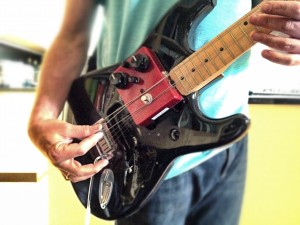
How to Install Onboard Effects

UPDATE: I’ve added a page listing all the “How To” posts on this site. Just click the cleverly titled How-To Posts Are Here! box at upper-right of each page.

There’s got to be a better way!

Several readers asked for more specific tech advice on how to wire up battery-powered effects inside a guitar or bass, so I created a step-by-step tutorial, which you can download here.

Some historical background: Since the ’60s, many guitar companies have toyed with the notion of installing battery-operated effects inside guitars.

And “toyed” is probably the perfect verb for it. Onboard effects have earned a reputation as cheesy, low-budget products. In many cases this reputation is justified. (And sometimes it’s not — the Electra guitars of the ’80s were never particularly popular, but their simple onboard distortion circuit has generated hundreds of “boutique” clones, not to mention our own Bad-Ass Distortion project).

And why would you want to put an effect inside a guitar or bass? You can use a stompbox with any electric instrument, but an onboard effect is married to one axe till solder-do-they-part.

I have an ironclad rebuttal to such concerns: 

Categories
DIY Effects guitar Pickups

Hello Kitty Strat: Not for Pussies!

Would this be anything less than awesome? I think not.

As I gloated last week, Jane Wiedlin gave me her Hello Kitty Stratocaster  — the most bitchin’ $99 guitar ever conceived! I finally had a chance to destroy/customize it yesterday, in what will no doubt be the first of many desecrations/enhancements.

I’d ordered one of those Synyster Gates Duncan Invaders with the pretty white pole pieces for the guitar, but just couldn’t wait to experiment, so I browsed through the ol’ pickup collection, and found a nice Duncan Phat Cat I’d used in a Les Paul experiment some months ago.

I don’t generally recommend choosing pickups because of their names, but come on! Kitty + Cat? How could I resist?

Turns out it was a lucky choice. I hadn’t planned to install a pickup that was actually lower in output than the stock humbucker, but it lets me get nicer clean sounds, and coughs up more than enough crunch when goosed with distortion. Speaking of which: the other custom feature is a built-in-distortion circuit activated via push-pull pot (I took lots of pics of the process for a DIY built-in-effects tutorial I’ll be posting very soon.)

View the carnage in this little video. Thanks, Jane Weidlin! Sorry, Stevie Nicks!