Categories
Effects guitar

Museum of Lost Effects:
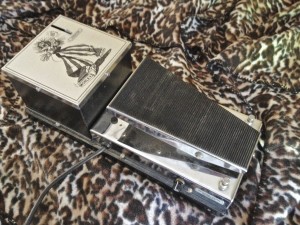
Morley “Oil Can” Wah

The mighty Morley Rotating Sound Wah

Two indisputable facts about Leslie rotating speaker cabinets: They sound awesome, and they’re approximately the size and weight of Rhode Island. Since the ’60s manufacturers have attempted to mimic the spinning-speaker effect in a more modest package. And one of the best mimics is the second exhibit in our Museum of Lost Effects.

The Morley Rotating Sound Wah is less well known than an earlier pseudo-Leslie, the Univox Uni-Vibe,forever associated with Hendrix. Like the Uni-Vibe, it a) tried to duplicate the Leslie, b) failed, but c) wound up creating a cool tone of its own. But while the Uni-Vibe milks its modulation from a series of optical sensors, the Morley relies on a rotating disc inside a can of electrostatic fluid. The result is a cool and complex modulation sound unlike any other (and one I’ve never been terribly successful at mimicking digitally).

This technology is descended from the “oil can” delays produced in the ’60s by the Los Angeles-based Tel-Ray company.In fact, Morley was a Tel-Ray spinoff — company founders Ray and Marv Lubow chose the name Morley for their line of guitar pedals based on the boast that this relatively compact modulation effect offered “more-lie,” as opposed to “less-lie.” (Note that I said “relatively” compact, since this beast is far and away the heaviest stompbox I’ve ever owned.)

The Morley Rotating Sound Wah is ugly, clunky, and klugey. If you drop it on your foot, you’ll never walk again. But I think it sounds incredibly cool.

Have a listen and see whether you agree:

Categories
Effects guitar

Museum of Lost Effects:
Maestro Rhythm ’N Sound for Guitar

Well, I’m not sure it’s fair to call it a “museum” when there’s only one exhibit so far. But it’s a really, really good one…

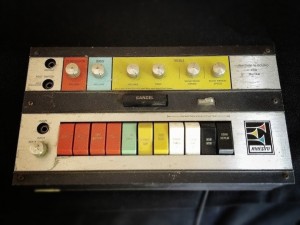
I bought this Maestro Rhythm ’N Sound for Guitar for a pittance back in the ’90s. It’s a primitive multi-effect unit from 1968, with a cool octave-down bass tone, auto-wah, and two fixed filters. It’s got fuzztone (though mine has always been broken), and a weird, choppy tremolo reminiscent of the Vox Repeat Percussion effect. (Mine worked fine — until I broke it yesterday while trying and failing to fix the fuzz. Kill me now.)

But the marquee feature of this hand-soldered contraption is the option of triggering four wonderfully cheesy analog percussion sounds. Bongo? Cymbal? Tambourine? Clave? At your command!

Does it sound as weird as it sounds? No — weirder!

You can’t assign specific specific notes to specific sounds — any input triggers the percussion, so the clicks and clanks tend to work best shadowing every note in a phrase, adding a weird edge. (I used them like that on Oranj Symphonette’s “Charade,” Erica Garcia’s “Yo No Tengo La Culpa,” and PJ Harvey’s “Maniac.”)

But then it occurred to me you could more ambitious things with the percussion sounds via looping. Which is exactly what I do in this short, fuzz-free video.

Check it out — and then let’s talk about this Museum of Lost Effects thing!

Categories
Amps DIY

My Sad Little Amp

My amp has a sad.

Thank heaven I became a guitar geek shortly before my 12th birthday. If I hadn’t, I probably would have requested a minibike for my bar mitzvah present a year later, instead of my first electric guitar. And today I’d be an over-the-hill biker instead of an over-the-hill guitarist.

My schoolteacher mom had a colleague whose son worked at Fender in Fullterton, California, not far from where I grew up. (Sadly, I’ve forgotten his name). Shortly before my big day, we visited his mobile home (let’s face it: the musical instrument industry has never been lucrative) to audition some decidedly post-CBS guitars he was selling. I opted for a black Jazzmaster, though I was tempted by the paisley Tele. It was my sole electric throughout high school, though I sold it at exactly the wrong time: five minutes before new-wave guitarists such as Tom Verlaine and Elvis Costello made it cool again. (Though I shouldn’t complain, since I managed to procure my pre-CBS Strat around that time.)

The Fender guy didn’t have extra amps on hand, but I slavered over the oversized amps in the early-’70s Fender catalog.Which sleek silver combo would greet me on the big day?

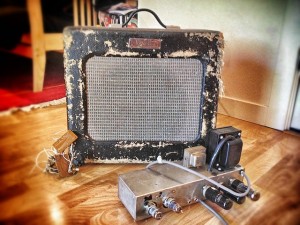
To my horror, I received an ancient, teensy-weensy combo amp, an ugly thing spray-painted black. I was mature enough not to express anything other than delight, but my heart ached. I wanted an amp as big and loud as my dreams, not this sad relic. They told me I was a man when I turned 13 — but I didn’t feel like one without the Dual Showman of my dreams.

My disappointing amp was a tweed 1952 Deluxe — which makes it sound like this story will have a happy ending. Sadly, no. 

Categories
guitar

A Very Vintage Strat

The ’80s were tough on guitars.

Last weekend I went to a memorial service for a music pal I hadn’t seen since the ’80s. Judging by the pictures I saw and the stories I heard, Brett remained the gentle, generous music lover I’d remembered till he died in his sleep a few weeks ago.

I ran into lots of old music friends and bandmates, and we alternately smiled and winced as our old photos and concert videos flashed on the big screen. Were we really that skinny? Did we actually wear that stuff without being coerced at gunpoint?

Like we tend to do at such moments, I left brimming with resolutions: Appreciate life. Cherish friends. Remember that music is a joy as well as a job. And do something nice for my sad old Strat, the guitar in all those old photos and videos.

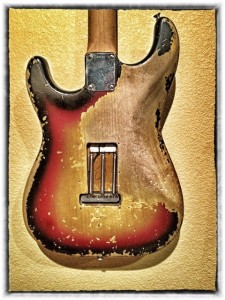
See, back then I only had one guitar — an all-original ’63 Strat I’d picked up in 1980, when pre-CBS Fenders were still perched on the precipice between collectible and affordable. (I paid $450, a staggering investment for me at the time.) It remained my only serious guitar for a decade. It was in near-perfect condition when I bought it, and it was a battered ruin by decade’s end. (The ’80s were a tough time for guitars, what with all those studded belts.) I was a young player with a bad attitude and little concern for collectibility, as opposed to the middle-aged player with a bad attitude and little concern for collectibility that I am today.

I’ll some thoughts about Strats then and now. But first, have a listen:

Categories
DIY guitar Pickups

“Vintage” Les Paul Wiring: BS or BFD?

Which sounds better: modern or vintage wiring? The experts disagree!

There’s a wealth of information online about the relative merits of “vintage” vs. “modern” wiring in Les Pauls. And after reading page after page on the topic, I was more confused than when I started. So here’s an attempt to pinpoint the sonic differences in a meaningful and relatively “scientific” fashion.

For those new to the debate, here are the basics: Nowadays tone pots in electric guitars usually connect to lug 3 of the volume pot, the same junction as the input from the pickup or pickup selector. Wired this way, the tone control siphons off highs before the volume control siphons off level. But in ’50s Les Pauls, the tone control often connects to lug 2, so treble is nixed after the volume pot does its thing. (I say “often,” because, as in so many other regards, vintage Gibson aren’t 100% consistent.) Here are some comparative schematics.

Most online sources manage to pinpoint the most basic difference: with vintage-style wiring, your tone retains more brightness as you lower the volume. But beyond that, there’s a buttload of b.s., including the frequent claim that vintage tone capacitors sound better or different from new ones. (They don’t.)

Anyway, I’ve made some comparative recording and measurements. After digesting all this geeky goodness, you’ll probably know whether ’50s wiring is an attractive option for you.