Categories
Effects guitar

NEW CONTEST: Klon vs. Screamer
Identify the Audio Clips and Win!

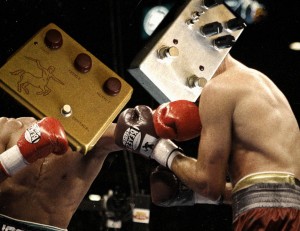
Left: Klon Centaur #309, worth over $2,000.Right: BYOC Overdrive 2, a $95 Tube Screamer clone.
Left: Klon Centaur #309, worth over $2,000.
Right: BYOC Overdrive 2, a $95 Tube Screamer clone.

It’s hardly a new idea: YouTube is full of Klon vs. Screamer comparison videos.

But this one is different.

Using the same “reasonably scientific” techniques deployed in my recent germanium fuzz survey, I’ve created a blind listening test that removes as many variables as possible from the equation.

The video details the testing procedures. But basically, the A/B recordings are identical save for the use of one pedal or the other. The rival pedals are Klon Centaur #309 (the unit reviewed in Guitar Player back in the ’90s) and a new BYOC Overdrive 2, a DIY Tube Screamer clone kit with extra knobs and pots to provide the most popular boutique mods.

This Klon would fetch north of $2,000 on EBay. You can order the Overdrive 2 online for $95.

Now, these two pedals are NOT identical circuits. (The key differences are covered in the video.) But they share the same topology and sonic character. It’s not an apples and oranges comparison — more like two apples of distinct but related varieties.

For the video I dialed in five different sounds from across the Klon’s range, and then tried to duplicate them with the BYOC Screamer clone. You’ll hear the same material ten times, like so:

Example 1: medium gain, medium tone

Pedal A =
Pedal B =

Example 2: high gain, medium tone

Pedal A =
Pedal B =

Example 3: low gain, medium tone

Pedal A =
Pedal B =

Example 4: medium gain, bright tone

Pedal A =
Pedal B =

Example 5: medium gain, dark tone

Pedal A =
Pedal B =

To compete, just fill in the blanks and copy your answers into the comments thread below.

The pedals might not appear in the same order for each pair of audio clips. Other than that, there are no sneaky tricks. (For example, you really do hear two different pedals for every example.)


The first three contestants to submit perfect scores before Tuesday, July 23rd, 2013, will each win fabulous prizes one of my hand-built stompboxes. On that date I’ll post the answers and announce the winners here, assuming there are some. You can still test your ears after that by watching this video and not peeking at the answers — but sorry, no more prizes.

Only one entry per person. Anyone caught circumventing this rule via multiple identities may be subject to global ridicule.

I’ll hold off on any sonic observations till I post the correct answers next week.

Good luck, and may the best ears win some gnarly stompbox.
Categories
guitar Music

The Best Music Notation Software for Guitarists?

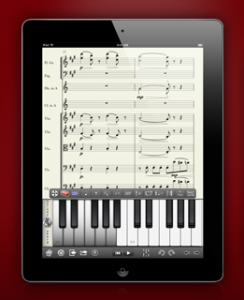
Since New Year resolutions expire at midnight, January 7th, I’m racing to realize my goal of finally becoming fluent with music notation software before the sands run out.

A new way to feign productivity in cafes!

I’d like to share some initial impressions about Notion. This isn’t a full-fledged product review — just a few thoughts about a half-dozen features I dig. (Most also apply to Notion’s sister app, Progression, which compiles all of Notion’s fretted-instrument tools, but omits the orchestral stuff. If you only plan to notate for guitar, the lower-priced Progression is probably all you need.)

1. Appropriate complexity. Two programs, Sibelius and Finale, dominate the music notation field. Both are powerful, deep programs. Most notation pros use them because they’re packed with features essential to “music engraving” (the archaic and pretentious term for the process of preparing music for publication).

Categories
Digital guitar

Analog Schmanalog

Ever notice how most analog vs. digital battles discussions boil down to two basic questions?

1. Can digital sound as good as analog?
2. What are the practical benefits of digital?

They’re good questions, but they tend to overshadow another important (and probably more interesting) topic: What are the musical benefits of digital?

Everyone loves great analog guitar sounds. But there’s lots of cool stuff that you can only do in digital. Here are a few of the ones I enjoy.

A partial list of the strictly digital sounds and techniques heard here:

• looping
• granular synthesis and delay
• pitch-shifted delays and reverbs
• impulse-response reverbs
• subharmonic sysnthesis
• Realtime MIDI control

You heard it here first!

Hey, I’m totally guilty of fostering simplistic analog vs. digital arguments. After all, I launched this blog over a year ago with an Amps vs. Models listening contest. (The prizes have long since been claimed, but you can still take the test.) But maybe we should spend a little less time arguing about how faithfully that amp model mimics the sound of an amp from 1965, and a little more time exploring the cool and meaningful musical applications of post-analog tone production?

Categories
Acoustic

Acoustic Strings: Bronze vs. Nickel

Like Talos the Giant from Jason & the Argonauts, most modern acoustic strings are made from bronze. Like him, they can be cruel and inflexible.

UPDATE: I’ve updated the audio examples to include 80/20 bronze strings, as detailed in this newer post.

Can I share my steel-string psychodrama?

I’m lucky enough to own many electric guitars, but I’ve played one steel-string acoustic almost exclusively for many years — a small-bodied Lowden with a tone that a very famous manufacturer of acoustic pickups once described as “like a f%^$ing cannon!” Its sizzling-bright treble and modest low-end make it a great recording instrument. (Engineers often boost highs and roll off lows when processing acoustic guitar, but this model is practically “pre-EQ’ed.”)

But it’s not an easy guitar to play. It seems to amplify string noise, flubbed notes, and all other playing imperfections. “This is a ‘tough love’ guitar,” muttered one singer/songwriter friend.

So when I bought a second steel-string recently, I wanted something warmer, softer, and more flattering, and I found it in a pretty old small-bodied Martin. The day I bought it, I restrung it with treble strings to record my recent Nashville high-strung demo, then popped on a set of the phosphor-bronze strings I’ve been using for years on the Lowden.

And I was seriously bummed out by the tone, as I lamented over at the forum.

The problem was, my sweet, soft antique suddenly sounded a hell of a lot like the Lowden, with blistering treble and cruel string noise. And I realized in a flash that a lot of the qualities I’d attributed to the Lowden were, in fact, a result of the modern, coated phosphor bronze string I’d been using. So I ordered some alternatives and made a few test recordings to demonstrate how dramatic the differences are.

Have a listen: