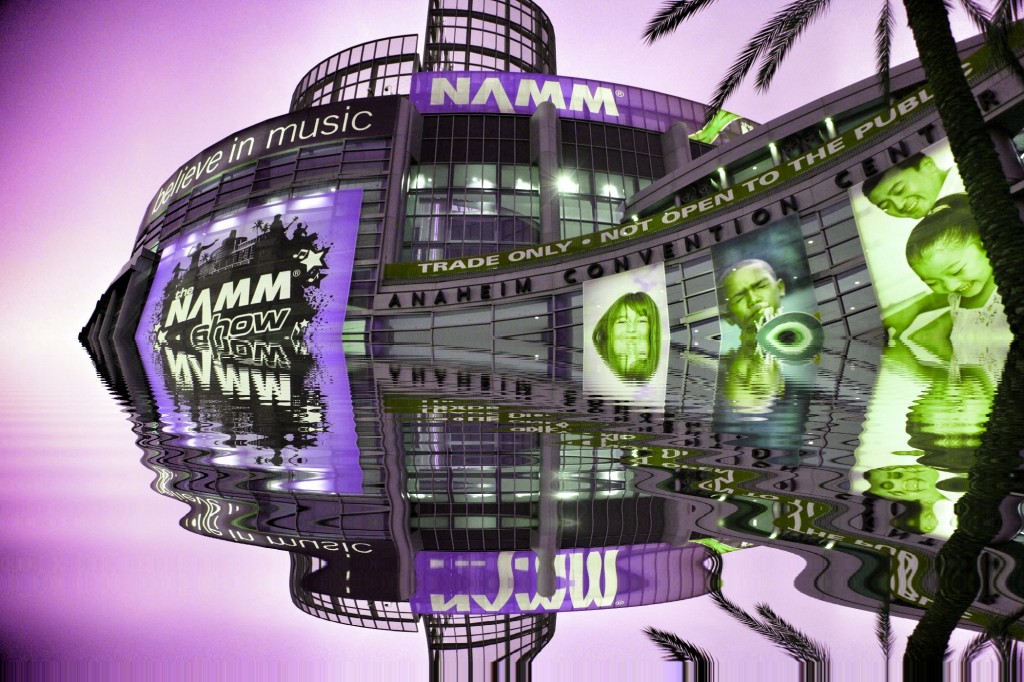
Oh wait — that was last month. Now it’s January. NAMM time!
I’ll be there for the duration, partly to hang out with my Pure Guitar pals, and partly to meet with Fishman about the upcoming TriplePlay release. But mostly to gawp at the weird shit admire the musical instrument industry’s latest offerings. :oogle:
I’ll be posting my findings here, and also doing a little write-up for my friends at Create Digital Music, one of my fave musician sites.
Actually, I have this perverse fantasy of spending an entire show in Hall E: the Anaheim Convention Center’s low-rent basement/dungeon, a dark, inhospitable region where Fender and Gibson fear to tread. That’s where the industry leaders of tomorrow rub elbows with mad scientists and perennial laughingstocks (AKA “my peeps”).
Any of you guys going? And if not, anything special you’re curious about?
Bartók: Smarter than math-rock — and way more violent.
My Bowie fandom is second to none. Yet I’ve always felt a vague sense of disappointment that the Spiders from Mars didn’t really sound much like spiders from Mars.
On the other hand, the fourth movement from Béla Bartók‘s Fourth String Quartet really does sound like Martian spiders — assuming the critters in question had been force-fed a diet of chord clusters, mathematics, Hungarian folk music, and some of the most astonishing counterpoint this side of J.S. Bach.
And dig it: This white-hot blast of dissonant modernism was composed in 1928!
And how does this string quartet music sound on guitars? Awesome, IMHO — largely because the movement is played entirely pizzicato (plucked, not bowed). Very few modifications were needed to adopt it for four electric guitars.
No disrespect to Chuck Berry, but I seriously doubt Johnny B. Goode played guitar just like a-ringin’ a bell unless he was using a ring modulator. That’s the only effect that can give you the complex, clangorous harmonics of a bell or a cymbal. Or make you sound like a ravenous horde of mutant robot ants.
Theoretically, Johnny could have used one. By 1958, when Berry documented the guitarist in song, the effect was already being exploited extensively by avant-garde classical composers, notably the late Karlheinz Stockhausen, who used it to terrifying effect in his Gesang Der Jünglinge [1956].
This post drips with perverse ring-mod love, including a demo of a rare vintage Electro-Harmonix Frequency Analyzer, and another featuring Roswell Ringer, a wicked ring mod plug-in.
Since New Year resolutions expire at midnight, January 7th, I’m racing to realize my goal of finally becoming fluent with music notation software before the sands run out.
A new way to feign productivity in cafes!
I’d like to share some initial impressions about Notion. This isn’t a full-fledged product review — just a few thoughts about a half-dozen features I dig. (Most also apply to Notion’s sister app, Progression, which compiles all of Notion’s fretted-instrument tools, but omits the orchestral stuff. If you only plan to notate for guitar, the lower-priced Progression is probably all you need.)
1. Appropriate complexity. Two programs, Sibelius and Finale, dominate the music notation field. Both are powerful, deep programs. Most notation pros use them because they’re packed with features essential to “music engraving” (the archaic and pretentious term for the process of preparing music for publication). (more…)
I tend to regard the New Year’s resolution like New Year’s drinking: not necessarily a bad tradition, but one I feel no guilt about ignoring most years.
But since I have some specific musical goals in 2013, I figured I’d share ’em — and open the floor to anyone who feels inspired to disclose his or her sonic goals for the coming year. Please post your personal promises to comments!
UPDATE:Here’s a direct link via SoundCloud. The file is downloadable for free. Sheesh — never occurred to me that folks might, like, actually download it and overwhelm my feeble little DropBox account!
While most people are baking cookies or lining up at the grocery store for 45 minutes to buy those frickin’ chives they forgot the other day, Dawn Richardson and I just put the finishing touches on Mental 99’s chaotic cover version of the Doors’ “Hello, I Love You.” (Mental 99 is our digital guitar/analog drums duo band.)
Have a free copy on us! Grab it here. (Download available.)
Why? Because we love you, man!
Seasons best from Mental 99!
(Nerd details: all guitar tracks played on my James Trussart Steelcaster though Apple’s MainStage software. Drums tracked at Fantasy Studio A, Berkeley, California, by Jason Carmer and Alberto Hernandez.)
Some boutique stompbox builders pursue endless refinements of classic pedal designs, developing ever-more-suave iterations of the Tube Screamer and Ross Compressor.
And some just want to blow shit up.
Guess which category Portland, Oregon’s Devi Ever falls into? Hint: Her extensive line of guitar and bass pedals includes such anarchy boxes as the Little Shit, the Ruiner, the Heroin Lifestyle, and the Truly Beautiful Disaster.
Here’s what I’m talking about: Check out Devi’s video demo for her Shoe Gazer fuzz…
…or this one of Wilco’s mighty Nels Cline giving Devi’s Soda Meiser a workout:
I’m psyched to announce a new guitar mag from some of the smartest and coolest folks in the industry.
Pure Guitar is a new online-only publication spearheaded by my friend and music-journalism mentor, Jas Obrecht. He’s rounded up a stellar team of writers and players — including my pals and former Guitar Player magazine colleagues Tom Wheeler, Tom Mulhern, and Jon Sievert — for what promises to be…well, I’ll let Jas tell you:
Our goal is to create a new breed of guitar magazine. Exclusively electronic, Pure Guitar will blend literate, in-depth journalism with the latest technological advancements available to online and mobile app users. We’ll bring you beautiful graphics, audio, video, and links to happenings in the wide, wonderful world of guitar….
From the start, we’ve imagined Pure Guitar as part Smithsonian, part old-school guitar magazine, part music channel, and a fun, informative place to hang out. In upcoming issues, we’ll cover provocative, inspiring guitarists in all genres, from legendary players to artists you haven’t yet encountered. We’ll bring you lessons and insights from highly accomplished teachers and artists; guitar lore not only from respected historians but also from the players, designers, and manufacturers who made history; career tips; gear reviews; and much more.
And guess what? Jas and company have produced exactly that, a publication that’s old-school in substance and new-school in implementation. I’m so proud that this inaugural issue includes two articles originally from tonefiend: About Those Expensive Picks… and Fingerstyle Boot Camp.
There — I fixed it.
Speaking of Jas, be sure to check out the astonishing back catalog of historic stories at the Jas Obrecht Music Archive. Since the ’70s, Jas has set the standard for detail, accuracy, and passion in musician interviews. He’s not some self-important blogger posting self-indulgent crap like, say, me. Jas is the real deal.
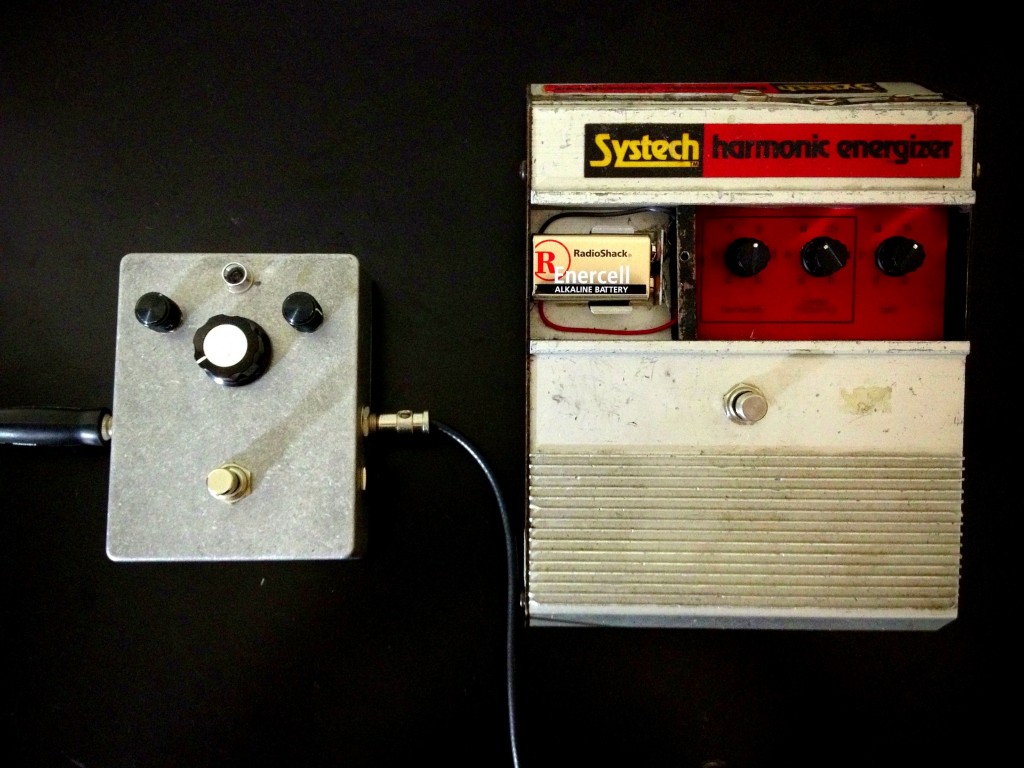
A homely clone cowers in the shadow of a ramshackle original.
Okay, here’s an old weirdo I’ve been meaning to write about for ages. The Systech Harmonic Energizer is an ultra-rare filter/distortion effect from the ’70s that takes the fuzz-wah formula in some interesting directions. Its signature is edgy, ultra-resonant filter sounds. You’re most likely to have heard it generating Frank Zappa’s nasal midrange squawk, but it does lots of other abrasive tricks too. I used this one on Tom Waits’s “All Stripped Down,” and on “Jets” by Action Plus.
The S.H.E. doesn’t do pretty. Most of its sounds are so strongly flavored, they’re hard to use as a primary tones. But it’s great for things like clanky percussive accents, or walloping low-frequency assaults.
Last week I dared all incautious chumps you to prognosticate about our guitaristic future. I knew the resulting comments thread would be fun, but I didn’t expect it to be that fun!
And also oddly uplifting. Future predictions just seem to skew in an optimistic direction, perhaps because you have to start by assuming that we have a future. So for every funny post suggesting that the most stupid and obnoxious aspects of today’s musical culture will get even more stupid and obnoxious, there’s a complementary positive perspective. In the future, these upbeat dreamers argue, we wil be better…stronger…faster. Of course we’ll have the technology! Better still, we’ll develop common sense.
Granted, some of the predictions are destined to be as disappointing as a 1948 issue of Popular Mechanics, with its broken promises of personal helicopters and monkey butlers domestic robots. But would it be preferable never to have dreamt of having you own jetpack? I think not!
Here’s a fine, optimistic example from Thecoslar, writing about “Lego” Pedals and Amps:
Standardized wiring “harnesses” and interchangeable components will allow companies to produce amp cabinets and pedal cases that consumers will purchase, in addition to compartmentalized circuits. The consumers will “design” their own pedals and amps by mixing and matching that various parts. Combine an optical compressor and a germanium boost. An octave up and a chorus. And that’s just pedals. Imagine what could be done by mixing and matching tone stacks, reverb and delay, or pre amp circuits in amps? Built in analog effects your amp, just by plugging in the components. Everyone and anyone will be able to piece together their own custom circuit, no solder, no muss, no fuss.
Yeah, that would be frickin’ awesome. Of course, we happen to live in a world with at least four common types of USB connectors, no standardized guitar wiring harnesses, and where millions of consumers sigh as they fork over yet more cash for the latest proprietary i-connector. But we can dream can’t we?
Hell yeah, we can! I hope you’re enjoying the conversation as much as I am.
(The fun’s not over, BTW — keep posting your predictions.)