Categories
Amps

18 Wicked Watts

I had a blast building and testing two Marshall 18-watt kits for a Premier Guitar story — and I emerged with new respect for this cool 1965 design.

These mini-Marshalls were neglected in their day, but are now treasured. The oft-heard claim that they provide plexi tones at reasonable volumes is only partially true — these are open-backed combos powered by a Vox-like pair of EL-84s tubes. But while they have roughy the same horsepower as the era’s Fender Deluxe and Vox AC15, their tone is undeniably ’60s Marshall. In the studio, they sound far larger than their actual size. And out of the studio, they’re still pretty darn loud.

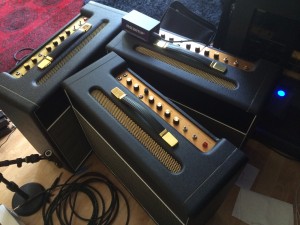
I've never seen three 18-watts in the same place before.
I’ve never seen three 18-watts in the same place before.

Even though the Mojotone and Tube Depot kits I built share the same schematic (and identical cabinets, both made by Mojotone), the build experiences and final results differed greatly.

And just when I thought I’d scaled the Everest of 18-watt ecstasy, I get a real Marshall 18-watt reissue for an upcoming Premier Guitar review. Stay tuned.

Are any of you guys 18-watt fans? Any observations to share?

Categories
Amps guitar Recording

Attenuation Nation:
Loud Sounds at Low Volume?

skrinking-ray

I just tried an interesting tone comparison, one I’ve never seen attempted. It concerns the search for loud amp sounds at low volumes.

Have any of you ever experimented with speaker attenuators — the passive load boxes that reside between your amp output and speaker input, which let you crank the amp while maintaining a low level from the speaker?

I’ve worked with one model before, a borrowed THD Hot Plate, and thought it performed well. I decided to purchase my own attenuator after several Premier Guitar reviews of large amps. As a small amp fan (not to mention an aging player with fragile ears), I wanted to minimize the aural assault of evaluating loud-ass amps.

But first, I wanted to determine whether it’s legit to evaluate amps at attenuated levels. Does attenuation inevitably alter the tone? And if so, can you compensate for via recording software?

Online opinions about attenuators range from “works like a charm!” to “totally killed my tone!” So I picked up a Swart Night Light and started recording and measuring. (I didn’t compare rival products. I just went with the Swart for its reasonable price, solid online reviews, and dual outputs for driving two cabs. I didn’t A/B it with a Hot Plate, though the results seem roughly similar.)

I direct-recorded a brief guitar phrase using my black Les Paul with Bigsby and PAFs, and then ran it through a ReAmp to my early ’60s Tremoverb, a 35-watt Fender with two 6L6 power tubes. I dimed the volume and left the EQ flat. Tt was insanely loud in my small studio. After recording that, I tracked the same clip again using the attenuator at each of its three settings. The lowest attenuation setting reduced the sound from insanely loud to very loud. Medium attenuation reduced to somewhat loud. Strong attenuation produced a sound quiet enough to speak over. I recorded the results through Royer R-121 ribbon mic. I added a touch of plate reverb, but no compression or EQ. (Though I did normalize the files so they played back at similar levels.) In other words, you hear the same clip four times through a head whose settings never vary.

So did the tone change? Have a listen:

Do you hear what I hear?

IMHO, none of the clips sound particularly great. (Most amps, including this one, don’t sound their best at 10.) But the unattenuated loud sound has some qualities the others examples lack. The attenuated clips have a little less low-mid impact, and the higher-register single notes that sound a bit thin and prickly even on the original sound even thinner and pricklier post-attenuation.

Why, since the amp settings don’t change, and the performance are identical? Mics can respond differently at different sound pressure levels, and the relatively restrained speaker movement alters the result as well. Conclusion: the timbres of the attenuated signals are fairly faithful to the original, but there are slight spectral differences and a bit less body/fatness, especially on single notes.

Then I introduced some additional wrinkles:

Categories
Amps DIY

Hey, Gang! Let’s Design a DIY Amp!

Let’s not just talk about one-knob gear — let’s design some! Any interest in conspiring to create a minimalist DIY amp?

Frankly, the intensity of the reaction to my recent One Knob Manifesto startled me. I had a general sense there was a growing interest in minimalist gear, but I was no idea the sentiment was so intense. (Though I’d hesitate to draw too many conclusions based on a focus group of the obsessive geeks who hang out here.)

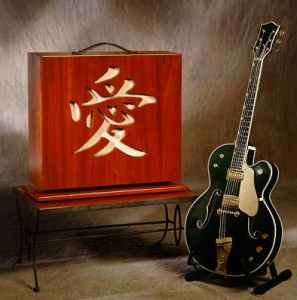
Now, don't get your hopes up — we probably won't create anything QUITE this awesome.
Now, don’t get your hopes up — we probably won’t create anything QUITE this awesome.

Since posting that piece, folks have been sending me info on relevant new products, like Henretta’s no-knob stompboxes and the Mill Hill Love amplifier, reportedly being used by Jonny Lang.

The limited edition Love amp fascinates me. Not its ornate furnishings, but the minimal controls: no tone stack, not even a volume control. It’s pretty much exactly what I was talking about when I expressed an interest in an amp with nothing but an on/off switch. That desire became even more focused last week when I reviewed a fabulous amp from a new Colorado Springs company called Toneville. (I’ll link to the Premier Guitar review when it goes live in a couple of weeks.) The Toneville Beale Street model I reviewed features a full compliment of blackface-style controls, but the tone controls are voiced so that the tone stack can largely be removed from the circuit, and there’s also a pot to remove the negative feedback loop for a more tactile/primitive response. As with some other ultra-high-end amps I’ve written about recently (like the Little Walter 50/22 covered here), the tone controls sound great wide-open, and it matters surprisingly little where you set the volume — you just drive it hard enough to warm things up, and then shape the tone from the guitar. With a nicely voiced and biased amp, you need far fewer controls than you might think. And the more crap you omit, more livelier the reponse and the more immediate the tone

The no-controls Mill Hill Love amp.

So why don’t we collectively create something in this vein? A simple but great-sounding tube amp with nothing but an on/off switch? I’ve never designed anything such thing and have little relevant expertise beyond the knowledge that, unlike 9v stompboxes, AC-powered amps can kill you. But I’ve built enough kit amps to know that a one-knob head can be easy, potentially inexpensive (though you could invest in ultra-premium tranformers, vintage tubes, NOS parts, and so on), and it should sound stunning. If we come up with a plan, we can source the parts, create step-by-step instructions, and probably get a vendor to put together a kit for us. (I’m thinking out loud here, so bear with me.)

I’m not firm on many details other than these:

  • head-only design (at least initially)
  • low-wattage for home/studio use — something you can crank without self-evicting
  • should sound big and bad-ass (not a cheap, practice-amp sensibility)

Any interest, folks? And more important, any ideas? And more important, any ideas? What would make this fun, useful, and bitchin’?

Categories
Amps

The Class A vs. Class A/B Slugfest!

Which kick more ass? Class A or Class AB?

The recent experience making a DIY Class A Champ  reignites for me the eternal debate between the merits of Class A and Class A/B amps. (I link once more to Dave Hunter’s excellent short article on the topic, since he explains the distinction so much better than I can.)

Like most American players of a certain age, I grew up without access to great Class A amps. (I’m going to take the lazy way out here, and lump Voxes and their kin into the Class A category, despite the distinctions that Dave H. explains so well.) My initial exposure to various ’90s Vox reissues and other “Voxoids” of the era was enough to spark my interest. (And is “spark” the perfect verb for great Class A amps, or what?) But it wasn’t till I encountered Matchless amps and real vintage Voxes that I totally got it.

But still, I go back and forth constantly. And whenever I switch between categories, I think, “Ah! There’s what I was missing,” though I tend not to miss it when I’m playing an amp of the opposite type. So at least I’m usually happy.

Overall I’ve probably favored Vox-type amps over Fender- and Marshall-flavored ones, though I’m the sort of player who’s rarely interested in macho rock and metal distortion. (If that weren’t so, I’d be an A/B purist!) But having said that, my fave amp these days is the decidedly A/B brownface Tremolux I use in the lion’s share of my videos. So put me down as perennially undecided.

How about you? Do you pledge your allegiance to the explosive harmonic energy of Class A or the focused impact of Class A/B? And has anyone explored switchable schemes, as found on some Mesas and modded Marshalls?

Categories
Amps DIY

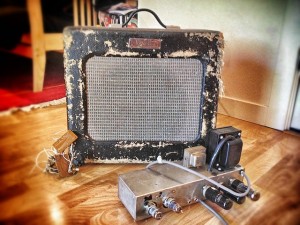
My Sad Little Amp

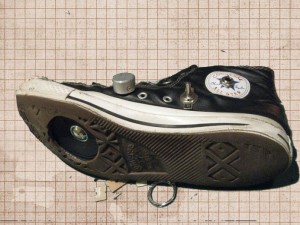
My amp has a sad.

Thank heaven I became a guitar geek shortly before my 12th birthday. If I hadn’t, I probably would have requested a minibike for my bar mitzvah present a year later, instead of my first electric guitar. And today I’d be an over-the-hill biker instead of an over-the-hill guitarist.

My schoolteacher mom had a colleague whose son worked at Fender in Fullterton, California, not far from where I grew up. (Sadly, I’ve forgotten his name). Shortly before my big day, we visited his mobile home (let’s face it: the musical instrument industry has never been lucrative) to audition some decidedly post-CBS guitars he was selling. I opted for a black Jazzmaster, though I was tempted by the paisley Tele. It was my sole electric throughout high school, though I sold it at exactly the wrong time: five minutes before new-wave guitarists such as Tom Verlaine and Elvis Costello made it cool again. (Though I shouldn’t complain, since I managed to procure my pre-CBS Strat around that time.)

The Fender guy didn’t have extra amps on hand, but I slavered over the oversized amps in the early-’70s Fender catalog.Which sleek silver combo would greet me on the big day?

To my horror, I received an ancient, teensy-weensy combo amp, an ugly thing spray-painted black. I was mature enough not to express anything other than delight, but my heart ached. I wanted an amp as big and loud as my dreams, not this sad relic. They told me I was a man when I turned 13 — but I didn’t feel like one without the Dual Showman of my dreams.

My disappointing amp was a tweed 1952 Deluxe — which makes it sound like this story will have a happy ending. Sadly, no.