Categories
Amps

The Last Affordable Vintage Amps?

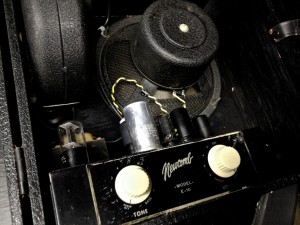
You can probably get cool tones from any old crap with a tube in it, such as this ’60s PA amp.

There were lots of interesting replies to last week’s post on small amps. Thanks for all the tips about some of today’s best tiny terrors!

The discussion reminded me of a cool old amp that’s been gathering dust in my garage — and also of a notion of mine I call the “any old crap” theory. The idea is simple: Any funky old amp, including P.A. models never intended for guitar, usually has some compelling sounds in it. Plus, those old Newcomb, Masco, and Tapco amps are among the few remaining affordable vintage amps.

Case in point: This early-’60s Newcomb P.A. amp I picked up a few years ago at my local cool guitar shop. Actually, my pal/hero Tchad Blake spotted it and bought it for a hundred bucks or so. He was here in San Francisco working on Tracy Chapman’s Where You Live album. When we finished the project, he decided he had too much gear to schlep back to the UK, so I took it off his hands. I used it on Tom Waits’s Orphans album, and then promptly forgot about it till last week. So I fired it up and made a little video demo with an old cheap guitar that didn’t cost much more than amp:

Categories
Effects guitar

Museum of Lost Effects: Klon Centaur

Overdrive from Heaven? Or hype from Hell?

Has any stompbox ever been as steeped in myth and legend as the Klon Centaur? Doubt it. Original Centaurs are extremely collectible, currently fetching around $1,500 on EBay. But for every player who drools over the prospect of obtaining this rare creature, there’s another who’s foaming at the mouth about idiots who’d pay four figures for a “glorified Tube Screamer.” When you Google “Klon Centaur,” one of the first items to appear is this memorable rant from the always entertaining Zachary of Zachary Guitars:

Here is a guitar pedal which has been around for about 10 years and stands for total Bull Shit in my opinion. The website, the presentation, the marketing, the hype, the price. Everything about it is why I hate the music business and the shockingly stupid guitar consumers. Its a mediocre and common pedal. Its your typical mild Tube Screamer- type of effect and sound. It really does not do much and is not very versatile. I found it stuffy and midrange sounding.In comparison to the great touch sensitivity, clarity, transparency and the wonderful independent Clean Boost section of the Zachary Pedal, well…there is absolutely no comparison.

Yow.

For a bit of perspective, how about we just listen to the thing? Here a little video demo, followed by a few observations.

Categories
DIY Effects guitar

Octave Fuzz Overdose!
Seven Classic Circuits

These funky homemade pedals represent all the leading octave-fuzz circuits.

I had no idea I had so many octave fuzz pedals! I had no idea they sounded so different! And after spending way too much time auditioning and recording them, I have no idea when I’m ever going to be able to stand listening to them again! :noshake:

Naw, just kidding — I had lots of fun putting together this octa-fuzz fest. It features no name-brand pedals, just DIY clones based on old circuits. But hey, most of today’s octave fuzzes are also clones of old circuits.

In fact, imitation has always been the name of the game here. The Roger Mayer Octavia used by Jimi Hendrix was inspired by a circuit found in a British mixing console. The US-made Tycobrahe Octavia was a ripoff of Mayer’s circuit, though tone snobs tend to regard it as the superior unit. It’s certainly one of the rarest and most valuable stompboxes ever.  The name “Octavia” has also been slapped on many other variations of the circuit, including some particularly dismal models. The Prescription Electronics Experience and Lovetone Ultimate Octave are based on the Foxx Tone Machine. The Dan Armstrong Green Ringer was based on the Ampeg Scrambler, and I used the Green Ringer circuit as a jumping-off point for some of my own designs. The sincerest form of flattery abounds here.

If you make it through this seven-circuit survey, you’ll encounter most of the major players, and if you hear something that particularly interests you, you can build it yourself using readily available schematics, or buy a nice kit or boutique clone.

Now, don’t confuse this effect with modern digital devices that actually transpose the notes you play. Octave fuzzes use an electronic trick to cancels out much of the fundamental of each note, making the octave overtone stand out more prominently. The process is called full-wave rectification, and ever-knowledgable reader mwseniff explains it far more capably than I in a comment following my previous post on this topic. It’s an odd, glitchy effect that tends to require specific playing techniques for the best results. And for better or worse, it’s an effect that has so far been difficult to mimic digitally. Sure, some of the modeling boxes out there have interesting-sounding octave-fuzz effects, but they tend to score low on the analog-realism scale.

Check out the video. The post-mortem comes after, as post-mortems usually do. 

Categories
DIY Effects guitar Pickups

Hello Kitty Strat: Not for Pussies!

Would this be anything less than awesome? I think not.

As I gloated last week, Jane Wiedlin gave me her Hello Kitty Stratocaster  — the most bitchin’ $99 guitar ever conceived! I finally had a chance to destroy/customize it yesterday, in what will no doubt be the first of many desecrations/enhancements.

I’d ordered one of those Synyster Gates Duncan Invaders with the pretty white pole pieces for the guitar, but just couldn’t wait to experiment, so I browsed through the ol’ pickup collection, and found a nice Duncan Phat Cat I’d used in a Les Paul experiment some months ago.

I don’t generally recommend choosing pickups because of their names, but come on! Kitty + Cat? How could I resist?

Turns out it was a lucky choice. I hadn’t planned to install a pickup that was actually lower in output than the stock humbucker, but it lets me get nicer clean sounds, and coughs up more than enough crunch when goosed with distortion. Speaking of which: the other custom feature is a built-in-distortion circuit activated via push-pull pot (I took lots of pics of the process for a DIY built-in-effects tutorial I’ll be posting very soon.)

View the carnage in this little video. Thanks, Jane Weidlin! Sorry, Stevie Nicks!

Categories
Bass DIY Pickups

A Cool Alternative Tone Control for Bass

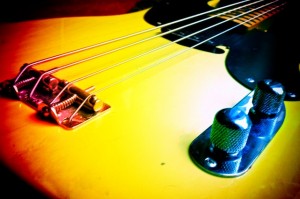
Looks vintage, but it ain't.

After auditioning so many different tone-control schemes over the course of the Mongrel Strat Project, I wound up with more tone circuits than I have Strats, so I figured I’d victimize a bass — specifically, a 1954 Fender P-Bass reissue with a Seymour Duncan Quarter-Pound pickup, which I’ve written about here. It’s a minimalist one-pickup model with basic volume and tone controls.

I was eager to audition a multi-capacitor tone control like I wrote about here. (Actually, it’s literally the same tone control — the guitar where it used to reside now houses the Stellartone ToneStyler tone pot covered here.) And while I had the patient on the operating table, I figured I’d also install the Black Ice distortion cube I wrote about here. (My friends in the medical profession assure me that patients always appreciate it when surgeons indulge in improvisational operating-theater mods.)

Demo and details after the break:

Categories
Acoustic Amps Effects Gigs

Amped-Up Acoustic Guitars

What could possibly go wrong?

There are two ways to approach amplifying an acoustic guitar: trying to duplicate the natural sound, only louder, and NOT trying to sound naturalistic at all. This post is about the second approach.

I love playing acoustic through an electric guitar amp (as opposed to a dedicated acoustic amp). True, the tubes and speakers amputate all high frequencies. But if you think of the instrument not as an acoustic guitar, but an idiosyncratic electric variant, it opens up amazing possibilities.

More often than not, I prefer to play acoustic gigs that way. I did a fun benefit show last year playing rock and R&B covers with a band consisting of Flea, Tracy Chapman, and drummer Dawn Richardson. Tracy had a beautiful, ultra-hi-fi acoustic tone, and the ratty, rumbling sound of my acoustic through a small combo was — well, let’s just say it was a very strong contrast.

Admittedly, relatively few  players exploit this technique. One notable exception is Daniel Lanois. He’s best known as a producer (U2, Peter Gabriel, Bob Dylan, etc.), but he’s also a phenomenal player who does amazing things with an acoustic guitar, an inexpensive magnetic soundhole mic, and small vintage Fender amps. I’ve watched him play up-close a few times, and he’s incredibly adept at conjuring a variety of tones and controlled feedback from this setup.

It’s definitely a white-knuckle playing experience. You have to listen carefully and nix unwanted feedback with quick damping technique. But it can be so expressive!

I’ll talk more about the technique in a bit. But first, check out this short video demo featuring distortion and other stompbox effects, controlled (and not-so-controlled) feedback, and a lot of awkward twisting and turning as I grapple with the tone: