I got to interview Robert Smith for a Guitar Player cover story in 1992. It was one of funnest of the 1,000+ musician interviews I’ve conducted over the last few decades. Robert is brilliant, bitchy, and hilarious. We talked most of the night over too many drinks.
Years later I was recording with sociopath Courtney Love at Chateau Miraval in Provence, where the Cure recorded their Kiss Me Kiss Me Kiss Me album, including “Just Like Heaven.” The studio manager recalled how Robert would quote Apollinaire and Verlaine around the dinner table. En francais, bien sûr.
The guitar is a 000-sized Lowden I’ve owned since the early ’90s and have used on many sessions and tours. It’s fun playing acoustic guitar with distortion and effects, as long as you give up on the idea of generating traditional acoustic tones.
For Day 2 of Loopocalypse, here’s an angst-ridden original featuring brutal bit-crushed distortion and Tesla coil samples.
Thunderbeast Park was an Oregon roadside tourist attraction with cheesy plaster dinosaurs. I think I visited here as a kid, though I’m not certain. At least I would have pleaded for us to stop on one of my family’s up-the-coast road trips. I often got my way, ’cause my folks liked this stuff too.
The guitar is my DIY Birdmaster. The pickups are unpotted Duncan/Bonnamassa PAFs — probably the best humbuckers I own.
On the occasion of a daunting round-number birthday, I’ve just completed Loopocalypse, a concert-length video of my live looping show. I’ll be posting a song per day, each featuring a different guitar, from now till Thanksgiving/birthday. Here’s Day 1 of 17, a tribute to that dearest of the dearly departed, David Bowie. I’ve been playing this for years, and it just gets sadder and sadder. Tomorrow I’ll share something appropriately angst-ridden for the US election day. (Here’s a remembrance of my brief Bowie encounters, written the day after he died.)
Here’s an explanation of my live looping rig. The guitar is an all-original 1963 Strat that I’ve owned since 1980. For many years it was my only good guitar.
I’ve just finished recording a concert’s worth of live looping performances. I’ll be posting these a day at a time, starting later today and continuing through Thanksgiving, 2018. (And there’s a daunting round-number birthday in there somewhere.) I’ve covered my looping setup before, but it’s changed a lot since the last time I wrote about it.
MainStage users, you can download my looping template here. It includes no user patches or third-party plug-ins — it’s just a raw template. But if I’d had this when I started out, it would have saved me a day or two!
I’ve just tested the first final production model of my long-promised Cult Germanium Channel. As usual, it sounds even better than my funky hand-built prototypes. These will be available in just a couple of weeks from my distribution partners, Vintage King.
There core circuit is the same as in my Cult overdrive. I’ve added a great-sounding active EQ, tuned to just the right frequencies, plus a new input stage with variable capacitance (translation: a sort of “crisp vs. fat” control). There’s much more info on the Joe Gore Pedals product page.
My apologies that this release has taken so long! I hope some players find it worth the wait.
Man, I’ve been wanting to do this experiment for ages — and largely because it’s been a black hole off ignorance for me. As mentioned in the video, I used to think they were the same pickup. But as you can hear, they’re quite distinct, and the differences are far from subtle.
Polly’s Firebird is a 1960s original.
Until now I’ve never owned a guitar with either pickup type. My chief experience with mini-humbuckers was when I demoed a set in this sane Strat for my Strat replacement pickups comparison. I liked them there as well, though I was using a set of Seymour Duncans, while these are Lollars. (I’d be cautious about making tone comparisons, since the two videos were recorded using very different tone chains.)
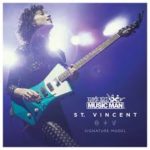
Annie Clark designed her own signature guitar.
I once played Polly Harvey’s original reverse Firebird on a gig, and I wasn’t that blown away at the time. (Though there were many other variables at play.) But I adored the way the Firebird pickups in Annie Clark’s Musicman St. Vincent model sounded, and I gave the instrument a rave review for Premier Guitar. I was struck then, as now, by their extraordinary dynamic response. Small variations in touch yield big tonal contrasts. My hope was that they’d sound like Fender pickups on steroids in a Strat, and to my ear, they do. (By “steroids,” I don’t mean high output — I generally recoil from extra-hot Strat pickups. Tones are simply fatter without neutering the high end as super-hot single coils tend to do.
I liked both pickups sets a great deal, but the Firebirds are a better match for my fingerstyle playing. What do you think?
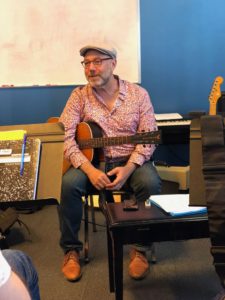
Adam Levy, looking like the 6-stirng zen master that he is.
My friend Adam Levy and I had an incredible time co-leading our first master class/workshop here in San Francisco a couple of weeks ago. Now we’ve just announced another event in Los Angeles for Sunday, August 26th, 2018. Details here. Please join us, SoCal pals!
The students at our San Francisco workshop couldn’t have been cooler. Skill levels varied, but everyone was super enthusiastic and quick to comprehend the topics. Judging by some of their comments, they seem to have dug the experience:
“Wonderful class — so worthwhile. Lots to process and apply!”
“It was so fantastic that I found myself looking at my watch a few times and thinking that it was all going too fast—just like a great jam session! Thank you both a thousand times over for such a lovely and inspiring musical event. I feel like you both gave me inspiration and practice material to last at least the next few years.”
“I had a blast and the workshop totally delivered as promised. Thanks.”
“Really inspiring, and tons to process and work on. Thanks so much, both of you!
“I left feeling really glad that I signed up and got the the opportunity to not only learn from musical guitar legends as yourselves, but also just be able to spend time talking to you and other guitar players. That vibe and energy in itself is really cool. I would definitely sign up for another class like this in the future!”
Plus, I always learn volumes by watching Adam teach. He is so calm and reassuring, with an amazing knack for making difficult goals seem attainable. (Note to self: more laid-back, less “squirrel on meth.”)
This was my first return to face-to-face teaching in many years. I’ve been thinking about it for a long time, and yeah, I was nervous. But it was everything I’d hoped it would be and more.
Hope to see you in August. And oh — there’s a discount for students who sign up by the end of July. 🙂
Here’s the info from the product page at gorepedals.com. Pardon then obnoxious use of the third-person.
OVERTONE OVERDOSE
The Joe Gore Screech is descended from vintage octave fuzzes like the Ampeg Scrambler and Dan Armstrong Green Ringer, but it’s not a clone. It provides much clearer octave overtones, and you don’t need an extra booster for great results.
Most octave fuzzes work best when you play near the 12th fret using the neck pickup. But Screech provides potent octaves regardless of neck position or pickup setting. It also does fine non-octave fuzz. A common mod for octave fuzzes is to add a switch that switches of the diodes, removing the octave effect. The problem is, the resulting sound is dull as dirt. Here, though, though non-octave fuzz is sufficiently fiery and dynamic to stand on its own.
Unlike most things Joe Gore makes, Screech is not especially dynamic. It needs consistently heavy gain for its powerful octave effects. But as on many vintage octave fuzzes, you get freaky harmonics and other interesting noises when you lower your guitar’s volume control.
Screech runs on standard 9-volt batteries or power supplies. It was created in San Francisco by Joe Gore and is built in Michigan by skilled craftspeople paid a fair wage. It comes with a lifetime warranty.
TO USE: The single knob is a master volume. (There’s no gain control because this circuit demands high gain to generate such strong octaves.) When you hit the DIST footswitch without the octave (OCT) engaged, the LED glows red. With the octave on, the light is yellow. (You can’t use the octave section without DIST activated.)
When Screech is bypassed, you can specify whether the octave will be engaged when you activate the pedal. If the LED glows green, the octave will be engaged when you hit DIST. If the LED isn’t glowing, you’ll get non-octave fuzz when you step on DIST.
BACKGROUND INFO FOR PEDAL GEEKS: Here’s an article and video I put together a few years ago, demonstrating all the classic octave fuzz circuits. Toward the end I show an early prototype of the circuit that would become Screech. It’s evolved since then, so don’t consider this a proper demo. It’s just some amusing pedal geekery. 🙂
I’ve been following the story of Fishman Fluence pickups and their radical pickup design for a few years. From the beginning, I’ve thought Fluence pickups sounded great in the hands of some other guitarist, but this is the first chance I’ve had to experiment with my own set.
Most of the tech details are in the video. But in brief: These are active pickups with magnets, but no wire coils. Instead, the “coils” are printed on thin pieces of circuit board glued together like plywood. This design removes all noise and hum — chances are these are the quietest single-coil-sounding you’ll find. (Fishman also makes humbuckers and Tele pickups.) They can run on 9-volt batteries or (this is the other interesting part) a separately sold battery pack that replaces the trem cavity back plate. (There are other battery configurations for other guitars.) Another marquee feature: Each Fluence set includes a push/pull pot to switch between vintage voicing and a hotter “modern” sound.
This technology originated at an aerospace company. Someone there realized that their printed coils might work on musical instruments, and they contacted a leading pickup manufacture, who passed on the idea. Next it went to Larry Fishman, who was all over it from the get-go. He refined the idea and came up with lots of clever engineering to make it work in guitars. [DISCLAIMER: I have been paid in the past as a freelance contributor to Fishman products, but no one paid me to post this.]
To my ear these sound perfectly authentic, though the fact that they’re active is problematic for me personally. (That’s because I use so many retro stompboxes that don’t play well with the active pickups, which are buffered. The same goes for most of the pedals I sell.)
Killer, indeed!
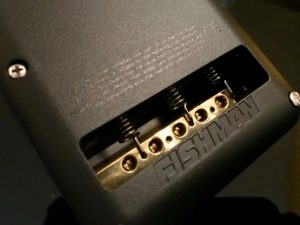
While installing this in my much-abused MIM Strat, I also added a heavyweight bridge, trem block, and claw from Killer Guitar Components. I’m not kidding when I say “heavyweight” — it’s a formidable piece of metal, beautifully tooled. It feels like a major improvement on the standard design, and I think it sounds great as well (though it’s hard to be definitive about that without side-by-side comparisons). My favorite feature is the way the string inserts are chamfered — strings pop in correctly every time, which. as any Strat player can tell you, it not always the case. Killer, indeed!
It was a longer and harder process than I’d ever imagined, but the first of my four new pedals is finally released and in stock now at Vintage King.
Here’s my product demo:
And here’s a just-posted “First Look” video from John Bohlinger at Premier Guitar:
Man, it’s always such a trip when you tinker with an effect and play it in isolation for years, and then hear it being played by someone else. But I couldn’t be luckier: The first person who ever played one beside me was the stupefyingly talented Blake Mills. (He dug it, and he got the very first production model). And now, another performance by another of my favorite players. Pinch me!
There’s lots more info about Porkolator on the Joe Gore Pedals product page. As I explain, this is a highly mutated version of a circuit that was pretty bizarre to begin with: the Interfax Harmonic Percolator. There is so much bad info about the original pedal floating around. Everyone seems use a couple of phrases over and over: “tube-like” and “even-order harmonics.” Wrong and wrong! Everyone’s just copying something (incorrect) they read somewhere else.
A few years ago, I did a story on the Harmonic Percolator and its boutique DIY spinoffs. Even if you don’t especially dig the pedal, it’s an interesting study in how an effect gets tweaked and modernized. Here’s the accompanying video.
At the end I demonstrate an early version or Porkolator, though it’s changed so much that you can’t really compare. I gave this original to famous drummer and not-as-famous guitar player Matt Chamberlin during a film score session. Like many of my hand-built prototypes, it promptly broke. Fortunately, the new ones are built by the talented professional at Cusack Music. I just designed the damn things.