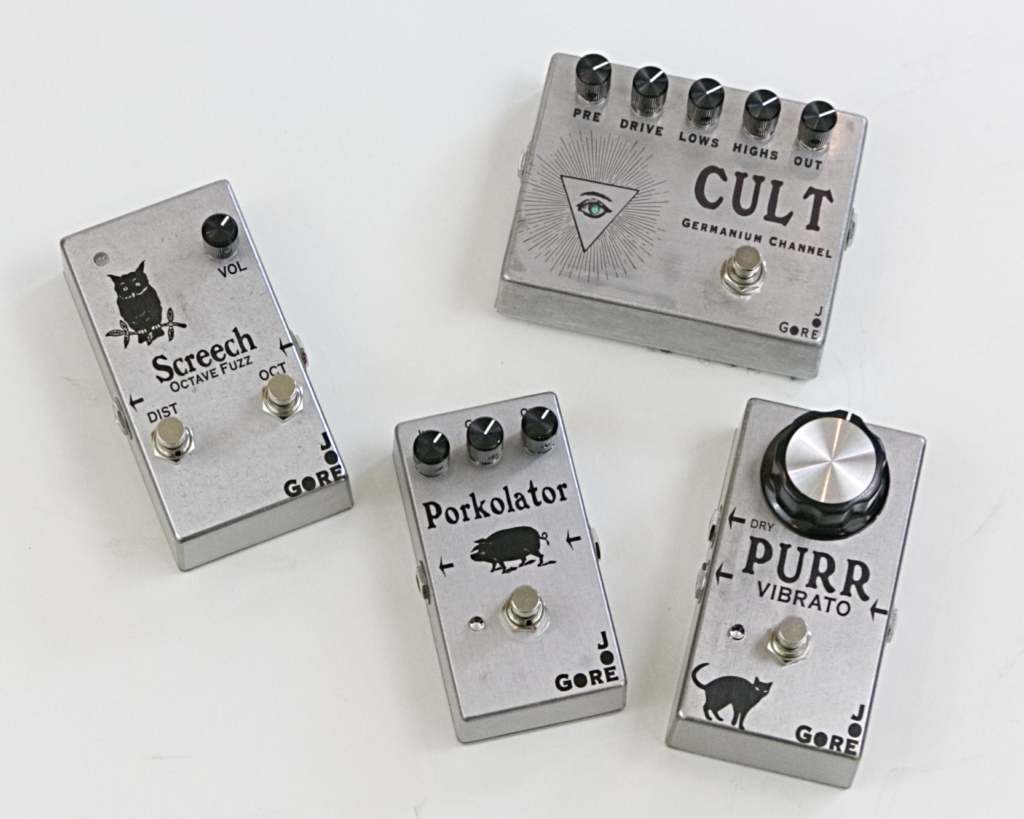
Happy new year, all. Sorry I’ve been so scarce — mostly, I’ve been practicing guitar! I’m trying out lots of challenging new things (for me, anyway) and I’ll share some of them as videos very soon. I’ve also been finalizing the four new Joe Gore pedals I’m debuting at NAMM 2018. Lookit!
They’ve already gone into the production, and they’ll be available via Vintage King very soon. I have yet to make demo videos and detailed spec sheets, and we still haven’t finalized the prices. (It depends how much the damn germanium transistors in Cult Germanium Channel and Porkolator wind up costing.)
In the meantime, here’s the info sheet I’m distributing at NAMM. Also, Premier Guitar is scheduled to record a demo video at the show and post it on their site. (I’ll share the details when that happens.) I hope I sound less like a squirrel on meth than I did for last year’s show-floor video.
If you’re attending the show in Anaheim, please visit me at booth #15517. (It’s a huge booth run by my distributors, M1. I’ll be crammed behind a tabletop somewhere within.) I’d love to say hi.
You know what sucks about attending NAMM as a manufacturer rather than a gear writer? I was epoxied to my booth all day, and I barely saw anything other than my guitar pedals. But on one rare break, I got to hang out with Jannis Anastasakis and his crew from JAM Pedals of Athens, Greece. (I highlighted some of their beautiful work in my pathetically skimpy “NAMM report.”)
Happily, there’s more to celebrate here than great visuals. JAM builds lovely versions of many classic analog effects. Their sounds and production quality are stellar, and JAM often adds modern updates such as realtime expression control, extra knobs, and internal trim pots for customizing tones. It’s quality stuff, used by many a guitar star.
And guess what? Jannis loaned me one of his magnificent Custom Shop analog pedalboards. Γαμώτο!
Sadly, I must now pack up and return this pretty pedalboard. But I’ll be getting my own JAM Delay Llama Supreme, an expanded version of the analog delay heard here, with tap tempo, a cool modulation section, and the almighty infinite-hold switch. (I reviewed it for Premier Guitar a few months ago.)
In the meantime, this experience makes me want to try my own DIY pedalboards. Not as an item for sale — just as a way to group related effects in a single enclosure for stage use. Gears are spinning ….
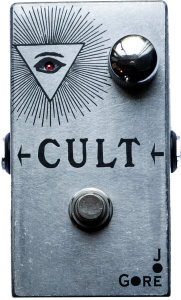
Of the four pedals new I announced at NAMM, Cult is probably closest to my heart— it’s my favorite overdrive circuit. If you’ve watched many of my videos, you’ve heard it. I even built it into a few guitars, including this one, this one, this one, and this one. And now Cult is coming in pedal form.
It’s no secret that 90% of today’s overdrive circuits are derived from the Ibanez Tube Screamer. Screamers are great if you want to compress your signal for consistent and predicable results. But Cult provides the opposite effect, expanding your guitar’s dynamic range rather than compressing it. It’s great for players who vary their touch and guitar-knob settings for maximum tonal variation.
Cult is sort of the mutant grandchild of the single-transistor boosters of the 1960s, including the Dallas Rangemaster. It’s no Rangemaster clone, though — the parts, values, controls, and tones have little to do with that classic treble booster. But Cult has the crackling presence and extreme dynamic response you only get from such minimal germanium-transistor circuits. (Guitar Player magazine went so far as to call it “the most dynamic overdrive we’ve heard.”) The pedal heard in this video is a final factory prototype, and the units now in production look and sound identical.
Have a listen:
As the video demonstrates, Cult lets you veer from crispy-clean to spatter distortion just by adjusting your guitar’s volume control. But my favorite way to use it is to set the gain so that you can go from sparkle to splat just by altering your touch, as heard in this video:
Cult with be available from Vintage King in the next month or two. There’s more info on the Joe Gore Pedals product page.
Thanks again to everyone who chimed in on the “What your favorite mod?” discussion. I got tons of great ideas from your comments.
Like this one, which I’ve been meaning to explore for ages: the Fender TBX tone control circuit, which appears in several Custom Shop instruments, notably the Clapton signature Strats. Like the G&L PTB circuit I’m so apeshit about, it’s a 2-band passive tone control — but one that sounds very different.
The PTB is a two-knob circuit that lets you siphon off highs, lows, or both. I’m agog at how well it works with humbuckers — you can get so many cool sounds by rolling off lows on the way to a fuzz, as heard here.
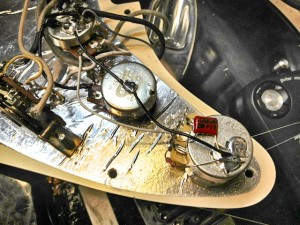
But TBX (it stand for “treble bass expander”) is a one-knob circuit, tbough that single knob rotates two stacked pots. The control has a center detente. Set here, it’s like a regular tone control, wide-open. Turn it counter-clockwise and highs vanish, per usual. (You could “tune” the roll-off frequency with various capacitors, though I went with the stock .022uF.) But when you rotate clockwise, the absence of lows makes glassy highs erupt.
The dual pot cut highs or lows.
Technically, it’s not a boost, but it sure feels like one. Dirk Wacker, my now-colleague at Premier Guitar, dissects the circuit far more capably than I can here. (And he goes way beyond in this subsequent article on TBX mods. Man, I have some catching up to do!) He makes a good case for replacing the stock resistor with another value, but I went with the original 82K to establish a point of reference. I’ll try his mod when I restring, and I’ll update you here.)
BTW, you need the Fender TBX kit for this project — it uses highly customized pots to work its magic, and a standard stacked pot won’t do. But it’s cheap: You can find the TBX kit, with the pot, hardware, and passive components, online for about $15.
I put it into the mongrel strat I’ve been using as my digital synth/looping guitar. I’d been using a Stellartone Tone Styler, a cool Vari-Tone variant that switches between multiple capacitors. I dig it, but it’s the old model which clicks, rather than fades, from setting to setting, and it requires a powerful twist of the wrist to go from maximum to minumum, which I do every time I grab an EBow. Since I hadn’t gotten around to replacing it with the smooth-action version, I figured I’d try the TBX.
And I’m glad I did. It’s a super-easy install, at least to the extent that any job that requires removing both strings and pickguard can be easy.And here’s how it sounds:
I’m going to keep this one around for awhile. You’re hearing it through an analog rig, obviously, but I want to find out whether that extra shot of highs does anything meaningful when playing digitally. I’d also like to experiment with different cap and resistor values.
And now I can’t help wondering whether this would sound cool with humbuckers. Anyone have any experience with that?