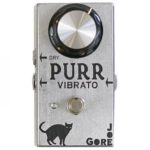
About frickin’ time! I announced this new Vibrato pedal at NAMM 2018. Now it’s time for NAMM 2019, and Purr is finally available and in stock at Vintage King.
Why so long? As soon as we finalized the prototype and designed the new circuit board, a crucial part suddenly became unavailable. ARGH!
It took forever to track down an acceptable substitute. But we finally did, and I’m thrilled with the results. I hope other guitarists dig it too.
Hey, if you’re going to NAMM 2019 in Anaheim next week, please stop by and say hi. Especially since since I’ll be sharing a booth with my my friend James Trussart, creator of some of the loveliest guitars ever conceived. We’ll be in Hall D at Booth 3942.
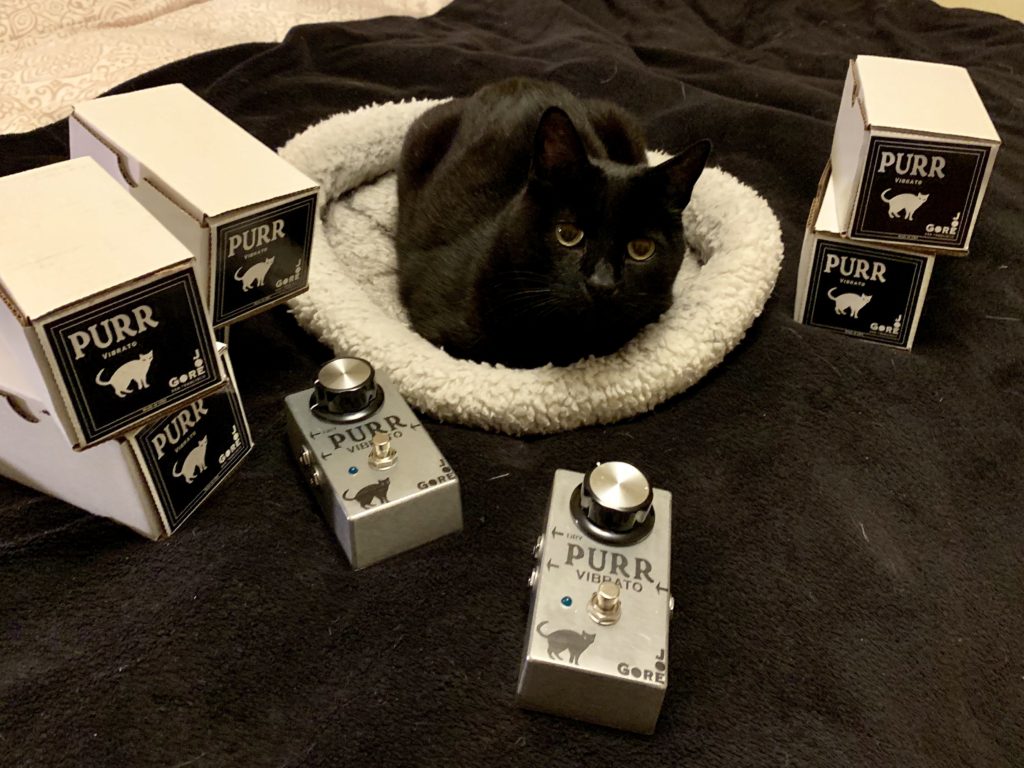
It’s too early to say whether guitarist will dig the Purr pedal. But at least someone I know is excited about the new release!
I’ve just tested the first final production model of my long-promised Cult Germanium Channel. As usual, it sounds even better than my funky hand-built prototypes. These will be available in just a couple of weeks from my distribution partners, Vintage King.
There core circuit is the same as in my Cult overdrive. I’ve added a great-sounding active EQ, tuned to just the right frequencies, plus a new input stage with variable capacitance (translation: a sort of “crisp vs. fat” control). There’s much more info on the Joe Gore Pedals product page.
My apologies that this release has taken so long! I hope some players find it worth the wait.
Well, this is an honor! Guitar Player magazine’s Mike Molenda profiled me and my Gore Pedals line in the magazine’s May 2018 issue. (It’s their annual pedals extravaganza, with good ol’ Adrian Belew on the cover.)
I owe Mike a big thanks, and not only for this story and other kind things he and his colleagues have written about my work. (Just last month Mike singled out my upcoming Cult Germanium Channel and Purr Vibrato pedals as NAMM 2018 highlights.) Mike and his GP colleagues were one of the first audiences for my DIY pedals when I first picked up the soldering iron a decade ago, long before I’d gone commercial. Their initial enthusiasm was a much-needed shot in the arm for a nervous neophyte. Mike was one of the first players to add some of my sketchy gizmos to his gigging pedalboard.
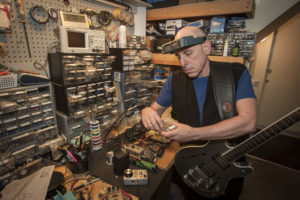
Thanks, too, to staff photographer Paul Haggard, who somehow managed to make it look like I know what I’m doing at the bench. When Paul came by for the shoot, we reminisced about how he was my very first connection to the magazine. I knew Paul’s brother, brilliant guitarist Mark “Mirv” Haggard, from the 1980’s San Francisco punk-funk scene, where he played with the Limbomaniacs and M.I.R.V. Pushing 30 and desperate for work, I contacted Mirv’s brother, Paul, who worked for one of GP‘s sister publications. He connected me to the late Tom Wheeler, who eventually hired and mentored me. (Thanks yet again, Paul!)
It’s been a long time since I contributed to Guitar Player, yet the magazine has always been an important part of my life for 30 years. Today, both the print and music industries are shadows of their former selves, and it’s far harder to sustain a guitar mag than it was when I was on staff. Ad revenue is lower and corporate support is weaker. We had it so easy in comparison! Yet Mike, Paul, and Art Thompson have done heroic work in this often hostile environment, putting out quality issues month after month. I’m so proud to be part of their latest effort.
Oh man — my friends at Premier Guitar just posted a video of me demoing four of my new pedal prototypes at NAMM. I didn’t even think I’d have these ready by showtime, but I powered out at the last minute. (Maybe ’cause I needed something to take my mind of the inauguration.)
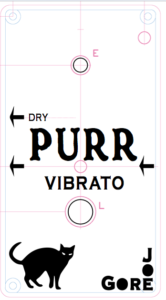
It’s been a busy month since we filmed this. We’ve settled on names, graphics, and specs, and everything is in development. (Though they’re still a few months away from shipping.) I’ve included the first-draft enclosure graphics as well.
Purr is a minimal one-knob optical vibrato. Yep — one knob, which means no independent rate and depth controls. Sound crazy? I agree. But it just sort of works! (I explain my questionable reasoning in the video.)
It’s not a deep, wobbly pitch-shift effect — more like cross between a really warm, pretty tremolo and a subtle optical vibrato. It’ll have the same large knob as my Duh pedal, so you can make adjustments with your foot, assuming you’re not as clumsy as I am.
It’s my fave modulation circuit, one I’ve used on a number of my YouTube videos. Here it’s on throughout at a very subtle setting.
In this video it’s set more strongly, though I toggle it on and off as I loop additional layers.
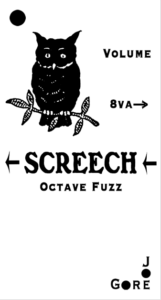
Screech, a mutant spinoff of the Octavia and Green Ringer octave fuzzes, is an outgrowth of the experiments I did did a few years ago, when I built models of every major octave fuzz design, and then attempted a variation of my own. (It’s not too far removed from the final pedal in this video, which appears at the 10-minute mark.)
It’s got the most extreme octave effect I’ve ever heard from an analog octave fuzz, and unlike on an Octavia or Green Ringer, the effect works in all neck positions and at all pickup settings. You can also bypass the octave portion of the circuit for a straight distortion sound. (That’s not a new idea—it’s a popular Octavia mod. But that non-octave Octavia sound is dull as dirt, whereas this, I think, has a bit more character and impact.)
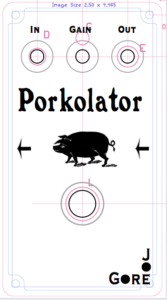
Porkolator also springs from a video demo/experiment of a few years back. It’s my oddball spin on the Interfax Harmonic Percolator, which is already pretty odd to begin with. It uses the same weird combination of negative- and positive-ground transistors for that sort of gravelly, decidedly non-tube-like distortion that Steve Albini loves so much. But all the part values differ, and the gain stages work very differently. There’s also an independent boost stage that can generate tons of extra level if desired. Again, it’s not that far removed from the final example in my octave fuzz video. (It appears starting at 5:55.)
Unlike the other three pedals, Cult Germanium Channel is pretty much finished. (We were originally going to include it among the 2016 releases, but decided that three new products were enough.) Its heart is the same primitive germanium overdrive circuit as in my Cult pedal, but with lots of added doodads: a tone-shaping pre-gain control, great-sounding active 2-band tone control, and an output trim. You can read more about Cult Germanium Channel here.
The NAMM video also features a demo of Kitty Boy, my imaginary vision of a germanium fuzz that should have existed in the 1960s. It’s sort of a cross between a Maestro Fuzz Tone and a Tone Bender Mk. I, which can go from lightly overdriven “Satisfaction” tones to hyper-saturated Ziggy Stardust glory. (It’s inspired by a conversation with Lyle Workman, so thanks, Lyle!)
I hope folks dig these. I’ll keep you posted about release dates and final prices.
Thanks, Jason Shadrick and Perry Bean, for doing such a nice job with the video and squeezing me into a brutal production schedule at the last minute.
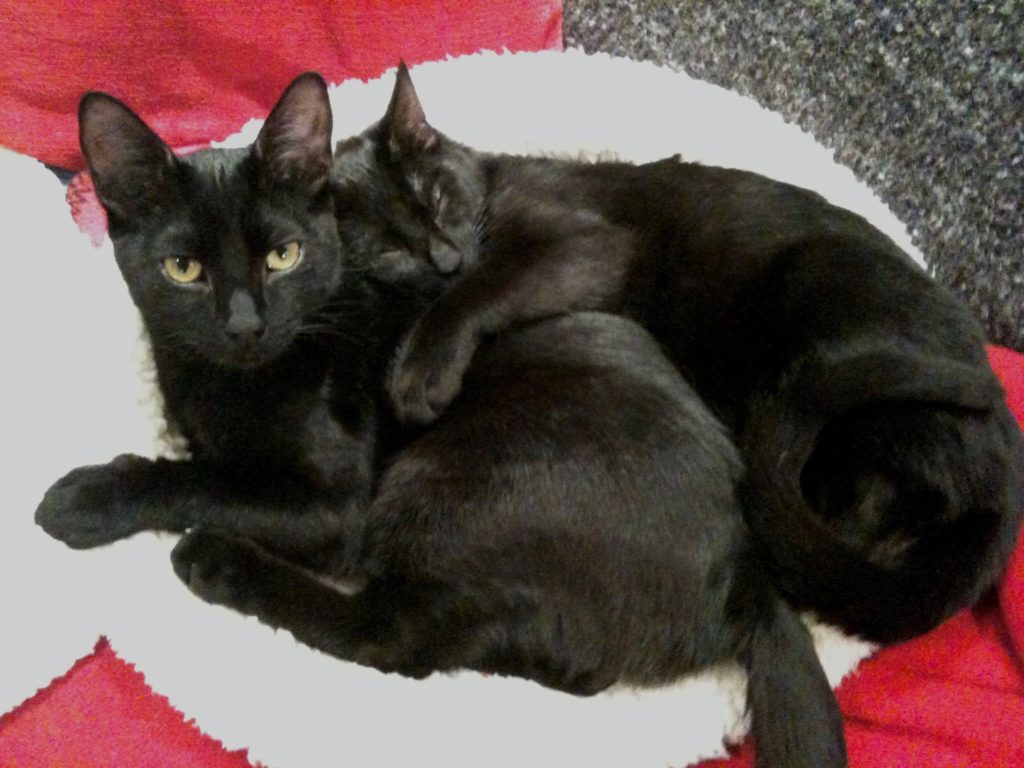
Jet and Kaiju say: “When Joe plugs in those horrible fuzz pedals, we hide in the closet. But that new Purr pedal with the black cat on it isn’t so bad.”
Lookit! My pals and colleagues at Premier Guitar just posted a video demo of my pedals shot at NAMM last month.
It was a trip being on the business end of that gear-review microphone! Shooting this clip was surprisingly nerve-racking. You have to make the gear sound good … try not to play too terribly … speak coherently … and not come off as a dick. It’s a tall order, at least for me.
Thanks to the gang at Voodoo Lab for letting me shoot this in their booth. (Which they did because they’re just plain cool.) Thanks also to Shabat Guitars for letting me borrow this pretty guitar, and to Fryette for letting me plug it into one of their spectacular Aether combo amps. Man, am I a freeloader, or what?
If you’d like to learn more about Gore Pedals, please visit my Gore Pedals page for studio-quality recordings with multiple guitars, more pedal settings, and lots of geeky tech info.
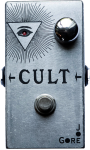
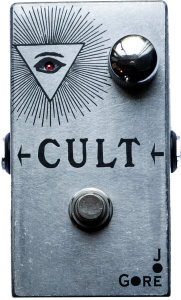
Of the four pedals new I announced at NAMM, Cult is probably closest to my heart— it’s my favorite overdrive circuit. If you’ve watched many of my videos, you’ve heard it. I even built it into a few guitars, including this one, this one, this one, and this one. And now Cult is coming in pedal form.
It’s no secret that 90% of today’s overdrive circuits are derived from the Ibanez Tube Screamer. Screamers are great if you want to compress your signal for consistent and predicable results. But Cult provides the opposite effect, expanding your guitar’s dynamic range rather than compressing it. It’s great for players who vary their touch and guitar-knob settings for maximum tonal variation.
Cult is sort of the mutant grandchild of the single-transistor boosters of the 1960s, including the Dallas Rangemaster. It’s no Rangemaster clone, though — the parts, values, controls, and tones have little to do with that classic treble booster. But Cult has the crackling presence and extreme dynamic response you only get from such minimal germanium-transistor circuits. (Guitar Player magazine went so far as to call it “the most dynamic overdrive we’ve heard.”) The pedal heard in this video is a final factory prototype, and the units now in production look and sound identical.
Have a listen:
As the video demonstrates, Cult lets you veer from crispy-clean to spatter distortion just by adjusting your guitar’s volume control. But my favorite way to use it is to set the gain so that you can go from sparkle to splat just by altering your touch, as heard in this video:
Cult with be available from Vintage King in the next month or two. There’s more info on the Joe Gore Pedals product page.
How to tell holiday season is officially over: It’s time for NAMM 2016! And this will be the first time I attend not as a music magazine writer, but as a guy trying to sell guitar pedals. Or as Ray Liotta put it in Goodfellas: “Just another schnook.”
Not like I can afford a proper booth or anything. I’ll just be wandering around with a sack of goods like some frickin’ crack dealer. I’ll have a pedalboard with new four new releases (plus a couple of surprises) on display at the Vintage King booth in Hall A. But sadly, it won’t be hooked up to anything — there just isn’t enough room for live pedal demos. However, my awesome friends at Voodoo Lab will have my new Filth Fuzz in the demo pedalboard at their booth. (No business connection there — they’re just doing me a favor ’cause they’re cool.) So you can stop by and try it out while sampling Voodoo Lab’s latest and greatest.
If you’re attending NAMM and would like to check out my stuff — or just meet and say hi — drop me a note. I’ll be at the show Thursday, Saturday, and Sunday. (Sorry, I can’t help obtain passes. I had to scuffle for my own like … a regular schnook.)
But I’m skipping the show on Friday. Friday night I’ve got a gig at Taix restaurant in Los Angeles, performing my solo looping material and sharing the bill with my longtime pals, Double Naught Spy Car. I haven’t played L.A. in several years, and this is the first time playing solo. I’ll be stoked if folks stop by.
And during the day, I’m teaching a master class at LACM, where my dear pal Adam Levy oversees the guitar department. The focus is modes — or rather, my irreverent crackpot theories about the most musically profitable ways to regard and use modes. I’ve been kicking around these notions for many years, and I’ll probably adopt them into a tonefiend post soon.
I hope to see some old friends and make some new ones. So don’t be a stranger!
My Filth Fuzz pedal is finally in production and will be shipping within a few weeks. It’s one of three new pedals I’ll be showing at this week’s NAMM show in Anaheim, California. I just finished the demo video, and I’m stoked about how it’s sounding.
I’ll also be debuting three other new pedals: Gross Distortion, Cult Germanium Overdrive, and Boring Boost & Buff. Filth, Gross, Cult, and are finalized and in production, and should be available from my partner, Vintage King, sometime in February. (Vintage King is also currently the sole vendor of my Duh Remedial Fuzz, released last year.) We’re still working out a minor bug in Boring, but it should arrive soon after.
Now, it’s not like I can afford a proper booth or anything, so when I say “I’ll be showing these at NAMM,” I mean I’ll be walking around with a bag of merchandise. I’ll have a pedalboard with all my products on display at the Vintage King booth in Hall A, but sadly, it won’t be set up for demoing — there just isn’t enough space. However, my super-cool friends at Voodoo Labs will have a Filth Fuzz on their demo pedalboard, so you can take it for a spin in their booth while checking out the new stuff from that ever-innovative company. (I have no business connection to Voodoo Labs — they’re just helping me out because they’re nice.)
If you’re going to the show and would like to meet up, contact me and we’ll work something out. 🙂
Here’s what I wrote about Filth on its product page. (If you’re allergic to marketing copy, skip ahead, where I share some interesting backstory on how we arrived at the interface design.)
Man, I love those mad scientist fuzzes with too many knobs! I’ve collected them for decades and used them on a zillion sessions. It got to the point were people were hiring me specifically to make those sort of farting, fried-circuit tones.
But the downside of those complex fuzzes is that they’re a little too wide-ranging, with many settings you’ll probably never use. It’s easy to spend 20 minutes dicking around with the dials without nailing the perfect tone. I’ve always wished for a wild, highly variable fuzz that was a bit more “curated,” with easier access to the tones you’re likeliest to use.
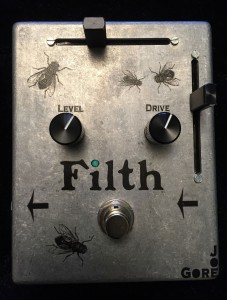
That’s what inspired the Filth Fuzz. It’s only got four controls, but it’s a cornucopia of cool, quirky, and usable fuzz flavors.
The drive and level controls do what you’d expect. But unlike many fuzz drive controls, this one sounds great throughout its range. Extreme settings are molten-lava thick. Lower settings are like…slightly cooled lava, maybe?
But the real action is in the two sliders. They’re tone controls of a sort, but not in the usual way. Most fuzz tone controls are tone-sucking passive circuits situated downstream from the fuzz effect. But here, the sliders alter the voltages at the transistors, radically changing not only the tone, but also the timbre, response, attack, sustain, and compression. In other words, the sliders radically alter the fuzz’s core character, as opposed to simply EQing a single core tone.
TO USE: Set desired gain and output levels. Move the sliders till it sounds awesome.
CAUTIONS: Filth sounds best before any buffered effects. It usually works best at or near the front of your effect chain.
Filth Fuzz was created in San Francisco and is built in Michigan by skilled craftspeople earning a fair wage.
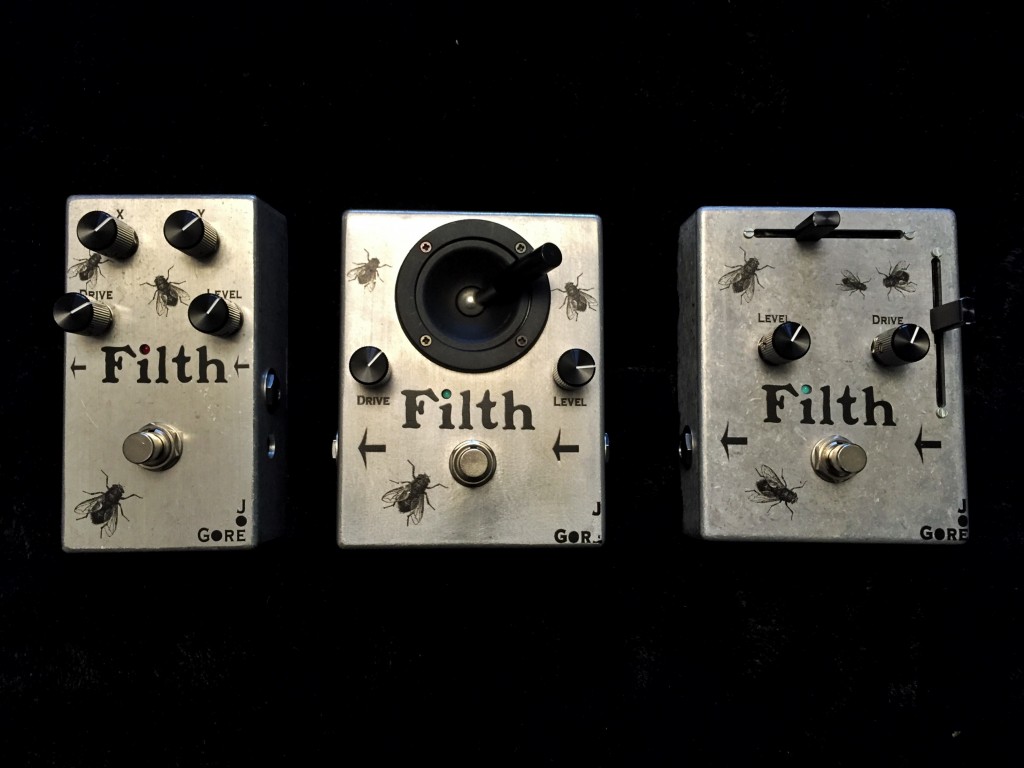
Filth’s sound hasn’t changed since I concocted the circuit on breadboard a few years ago. but the interface has gone through many iterations. It kept changing even after I sent schematics and prototypes to Tony Lott at Cusack Music (my manufacturer). Here’s a pic of three production prototypes:
Three incarnations of Filth Fuzz (in order of appearance).
To dial in tones on Filth, you adjust two highly interactive pots (let’s call them x and y), which tweak the voltages going in and out of the transistors, providing many tone variations. The original version used two standard pots for these x/y controls. It worked okay, but the ergonomics weren’t ideal. I’ve found that the fastest way to refine sounds is to move both pots at once over a sustained note or chord, and it was just a bit awkward having to take both hands off the guitar to turn the controls simultaneously.
So I decided to employ a joystick, which lets you adjust x and y with one hand (and it looks pretty bitchin’). The ergonomics were great, and I thought we’d finalized the format.
But then I showed a joystick prototype at the L.A. Amp Show in October, and for the first time I had a chance to sit back and watch other guitarists interact with the device. Players seemed to have a blast with it, but I kept noticing how often a heavy stompbox foot would land perilously close to the joystick’s none-too-sturdy shaft.
Meanwhile, we discovered that the the only compatible joystick option cost about $25 per unit — enough to jack the retail cost way up. Also, it was tricky to replicate exact setting via the joystick, which would suck if, say, you were trying to get identical tones night after night on tour. (I knew that when I first opted for the joystick, but I’d figured the fun factor would more than compensate.)
Then Miko Mader, a clever guitarist who works for my distributor, M1, came up with the perfect solution: Why not use two sliders instead of pots? Tony at Cusack sourced the perfect part, and we prototyped a third version.
Bingo!The ergonomics were great (check out the demo video to see how quickly you can change sounds with one hand). You can mark exact settings with tape if you need to, easily repeating specific sounds. The two sliders are a fraction of the cost of a single joystick, so we can sell the pedal for far less. (We’re still nailing down the retail price as I write.) There’s no fragile shaft to break. And while I miss the goofy fun of the joystick, the sliders are still pretty darn entertaining. (So thanks, Miko, for your brilliant idea.)
I’m really stoked about this pedal. I hope you enjoy it as well.
Ace sideman and gear demo producer Pete Thorn stopped by and made my pedals sound really good — though a killer Magnatone helped.
I spent the weekend hyping my stompboxes at the long-running LA Amp Show. It was my first visit, and it was a blast in every regard.
It’s a surreal scene. It’s not held at a convention center, but at a generic airport hotel. Exhibitors set up in plain old hotel rooms on three floors. And unlike NAMM, there are no noise restrictions — pity the poor hotel guests who weren’t amp freaks! It was wild, walking down a long hotel corridor, with some high-end amp and guitar blasting through each doorway. But within each room, there was an odd sense of intimacy. It could even be sexy, assuming your erotic ideal is the Line 6 Helix.
Gear highlights? I don’t know! I was on my own, glued to my pedalboard for two days. (Though I got to take a closer look at the Milkman amps crafted by my San Francisco neighbor Tim Marcus.)
But I did get to share Vintage King’s suite with several cool brands: Moog, whose Minifooger pedals I reviewed for Premier Guitar (and loved). Also there: Magnatone. I was plugged into a magnificent Super Fifty-Nine (which I also reviewed and loved). New to me, though, were two killer models from Jackson Ampworks.
It was great to see my onetime boss, Jim Crockett — the man who invented the guitar magazine
But I can tell you two non-gear highlights: For the first time since the late ’80s, I got to hang out with Jim Crockett, who founded Guitar Player in 1967, inventing the guitar mag.
Jim ran the show when the mag hired me in 1988. It was my first real job — till then, I’d only worked as a guitar teacher. Jim was so cool, going out of his way to welcome the nervous new guy, and providing many pats on the back.
The magazine got sold not long after I started, and has changed corporate hand many times since. So while I only worked with Jim for a few months, I’ve spent the last several decades listening to everyone moan, “Man, it was so much more fun when Jim was here.”
Thanks Jim — I’ll never forget your kindness.
Also unforgettable: the mad yo-yo skills of Vintage King’s Dan Serper. Clearly, raging 7-string pro-metal guitar-playing isn’t his only talent! (The background noise is amps blasting from adjacent rooms.)
 How to tell holiday season is officially over: It’s time for NAMM 2016! And this will be the first time I attend not as a music magazine writer, but as a guy trying to sell guitar pedals. Or as Ray Liotta put it in Goodfellas: “Just another schnook.”