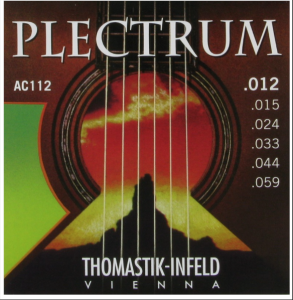
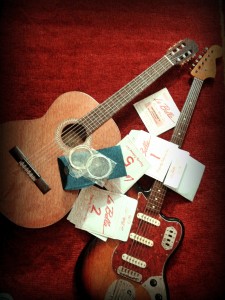
As if I weren’t already blowing enough money on arcane strings, I’ve got a new obsession: Thomastik-Infeld Plectrum series acoustic strings (which sell for $24 in the U.S.).
If you hang out here much, you’ve heard me bitch incessantly about acoustic strings. I hate the way most modern strings are all hyped treble zing and blaring volume, at the expense of deep, decisive fundamentals. With due respect to my vegetarian friends, too many strings are all sizzle and no steak.
Yeah, bright strings can seem energizing in a cocaine-binge sort of way. But all that glassy presence gets fatiguing. Meanwhile, darker bass strings leave sonic space for the treble strings to shine. Even on my teensy-tiny Martin 0-17, these low strings sing in a warm baritone voice, not like some squeaky, poorly Auto-Tuned teen idol.
This pricy Austrian set features brass-coated steel 1st and 2nd strings, while the bass strings are bronze, but with both silk inlays and flexible steel cores. The flatwound 3rd, 4th, and 5th strings nix finger noise and minimize tone contrasts between wound and unwound strings. The polished roundwound 6th string adds a touch of focus to the lowest register, yet introduces no awkward contrasts on melodies played across multiple strings.
The set is low in both tension and volume relative to most U.S.-made strings. Even though the low E is a chunky .059, it has a soft, relaxed feel that makes me want to linger over notes, shaping them. The harmonic range is fantastic, the dynamic range even more so. They’re long-lasting too — this video was recorded three weeks and many playing hours after installing the set.
I’m hooked. Damn it.
(Hey, Mr. Tambourine Man — I don’t want you getting your nasty treble overtones all over my acoustic strings, no matter how frickin’ jingle-jangle the morning happens to be. Just back off, pendejo.)
No longer ridiculously expensive. Now they’re just very expensive.
I spent last week covering the Musikmesse musical instrument trade show in Frankfurt, Germany, for Premier Guitar. I had a blast, and Chris Kies and I posted details and pics of more than 70 new products. (Here’s the short list of our personal faves.) Kies shot lots of video, and will be posting more than 50 demo segments to the PG site in the coming weeks.
But Messe is hellishly loud, far noisier than NAMM. When I finally got home and picked up a guitar, it was an acoustic. I was trying something new, based on info I obtained from Mary Faith Rhoads-Lewis, CEO of Breezy Ridge, a company that distributes several brands for acoustic musicians, including John Pearse strings.
I’d previously geeked out here about about the strangest and most expensive guitar strings I’d ever tried: this “rope core” set from Austria’s Thomastik-Infeld. Reader/cool guy Al Milburn turned me on to them, and I wrote about them here. And I recently posted this video demonstrating how the transformed my old Martin 0-17 into a compelling steel/nylon hybrid with a unique and expressive voice.
Anyway, Ms. Rhoads-Lewis told me that the late John Pearse originally created this set for Thomastik, and that the John Pearse Folk Fingerpicking set [PJ116] is identical to what the Austrian company sells. Best part: You can get them in the States for under $20, as opposed to a walloping $35 for the Thomastiks. She also told me that their magic works in reverse: You can put this relatively low-tension set on a classical guitar for a very different sort of hybrid steel-string sound. (This, she said, is exactly what the great Brazilian player Bola Sete used to do.)
I popped a set on my old Yairi classical. The feel was — totally strange, and in precisely the opposite way as on the Martin. The tone was edgy and exciting, but the tension seemed a little too extreme. If just seemed a little too … high-strung, in every sense. Then I tried lowering the entire tuning a whole step, with the sixth dropped all the way to C.
And … oh, my. Check it out:
Summary: Holy cannoli, I love how this sounds. And there’s something psychologically satisfying about the transformation too. See, this guitar has always been a bit … tragic to me. I got it when I was 16. My classical guitar prof at UCLA said I needed a better instrument, and my every-supportive folks, bless ’em, helped me buy this Alvarez Yairi for around $700 (in 1970s dollars). It was a top-tier model for Alvarez, signed by luthier Kazuo Yairi, and boasting lovely Brazilian rosewood backs and sides. It was a huge upgrade for me, but as I got deeper into classical playing, its shortcomings emerged. Had I not shifted my studies to composition, I’d have needed to upgrade again. I envied the Igancio Fleta y Hijos models my two teachers played, but at around $3,000, they were beyond my budget, even with parental help. (Pity — their current value is approaching $50,000.) So I’ve used this instrument as a limited but decent-sounding model suitable for pop work, if not serious classical concertizing.
It’s the latest chapter in my ongoing search for the right acoustic strings. Most available options simply sound far too harsh and bright to my ears, especially for fingerstyle playing on the small-bodied guitars I favor. Even though the Martin silk-and-steels I used were dramatically quieter than most bronze strings, I dug their warmth and strong fundamentals — and the absence of the hyped sizzle of bronze.
Several of you responded in comments with string suggestions, including several types I barely knew existed. Despite some rather shocking expenditures for these high-end, imported strings, I found much to love. Now I’m rich in tone, if nothing else.
Since I’m hot on the trail of a cool new fuzz circuit, I haven’t yet had time to record demos (and besides, I’d rather wait till the strings wear in a bit). But I’d like to share details about several products that impressed me.
Silk and steel — bad-ass, or strictly for wusses?.
It’s been a long, long time since I’ve tried silk and steel strings.
I’ve always thought of them as a transitional set for students migrating from nylon to steel strings. At least that’s how my mom used to explain them to me back when she was giving me my first lessons. Like many players, I viewed them more as a remedy for tender fingertips than a sound you’d actively seek out.
But over time, almost everything I thought I knew about strings turned out to be wrong. So I figured I’d give silk-and-steels a fresh listen.
This thread over at the Acoustic Guitar Forum seems like a fair summary of common attitudes about these strings. Opinions seems divided between players who simply find silk-and-steel strings too soft and quiet to be of much use, and those who enjoy them for fingerstyle playing, especially on small-bodied guitars.
I’ve been frustrated finding the right strings for the old Martin acoustic I picked up last year. I had a violent reaction against coated bronze strings, which I wrote about here. But I was kind of digging the way Martin Marquis 80/20s bronze strings sounded on the instrument, as heard in this video. Sometimes, though, the tone is just too harsh and clacky, so I wanted to try something lighter and softer.
I slapped down this quick duet performance of “Drewrie’s Accordes,” an anonymous lute duet found in The Jane Pickering Lute Book, a manuscript anthology of late 16th-century lute pieces. (This would have been played on gut strings in its day, and is usually performed on nylon-string classical guitar or lute today. My steel treble strings are definitely not historically correct, though some wire-stringed fretted instruments such as the cittern did exist in the Renaissance.)
Observations after the video.
Compared to all-metal strings, the silk-and-steels are definitely quieter, with less treble bite. I like their soft, malleable feel for intricate fingerstyle playing like this. They offer relatively smooth transitions between unwound and wound strings. They exhibit less clacky string and fingernail noise. Playing aggressively with a pick definitely “overloads” them, and would no doubt destroy the windings in short order. Even when playing exclusively fingerstyle, you get the sense that the bass strings aren’t long for this world. But I enjoy their sweet, quasi-classical tone, which to my ear does indeed split the difference between nylon and all-metal strings.
Still, I’m not sure I want to commit to having these on the guitar all the time. (I wish the guitar had a switch to toggle between a bronze and silk-and-steel sound!) Also, these are lighter than I usually play (the treble is .0115, and I pretty much never go below .012). But the relaxed tension does seem to suit this particular guitar.
How about you guys? Any experience with these soft-spoken strings? Do you think they sound cool, or are they merely a salve for sore fingers? And has anyone tried John Pearse silk-and-bronze strings? (That’s probably the next stop on this particular string quest.)
P.S.: This is also a pretty good example of how I apply lute techniques to steel-string playing, as I mentioned here. For most of the fast bits, I pick alternately using my right-hand thumb and index finger. A proper classical player would be more likely to alternate index- and middle-finger. Also, my right thumb sometimes drifts “behind” my right-hand fingers (that is, closer to the bridge). Classical players rarely position their picking thumbs closer to the bridge relative to the fingers. It’s not conscious on my part — it just what my hand does when I’m trying to brighten the bass notes and darken the trebles.
But I wouldn’t use them on, you know, one of my normal guitars.
But then I recorded that Bartók piece, using the above-mentioned Guid and Bass VI alongside two standard-tuned guitars with roundwounds. The piece has a lot of counterpoint — all these motifs bouncing between the instruments. And the more I listened, the more I realized that I liked the tone of the two flatwound guitars far more than that of the two roundwound guitars.
And then I bottomed out. I put flats on four more guitars. It wasn’t just musically risky — it was economically catastrophic! And that’s what brought me here tonight.
Funny thing about flatwounds: Everytime I pick up a guitar with flats, I react negatively to the dullness of the wound strings. Where’s the shimmer? Where’s the zing?
But the more I listen, the more I get sucked in. Parts layer over each other more readily. Chords speak more clearly. Fuzz and distortion yield sweeter overtones. It’s easier to get a consistent sound from melodies spanning wound and unwound strings. And the feel? Smooth, sleek and sensual.
Sigh. Maybe I’ll try and kick the habit again tomorrow.
Last weekend I went to a memorial service for a music pal I hadn’t seen since the ’80s. Judging by the pictures I saw and the stories I heard, Brett remained the gentle, generous music lover I’d remembered till he died in his sleep a few weeks ago.
I ran into lots of old music friends and bandmates, and we alternately smiled and winced as our old photos and concert videos flashed on the big screen. Were we really that skinny? Did we actually wear that stuff without being coerced at gunpoint?
Like we tend to do at such moments, I left brimming with resolutions: Appreciate life. Cherish friends. Remember that music is a joy as well as a job. And do something nice for my sad old Strat, the guitar in all those old photos and videos.
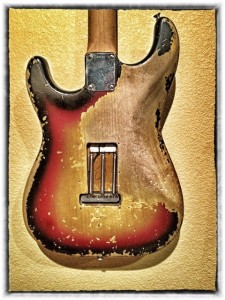
See, back then I only had one guitar — an all-original ’63 Strat I’d picked up in 1980, when pre-CBS Fenders were still perched on the precipice between collectible and affordable. (I paid $450, a staggering investment for me at the time.) It remained my only serious guitar for a decade. It was in near-perfect condition when I bought it, and it was a battered ruin by decade’s end. (The ’80s were a tough time for guitars, what with all those studded belts.) I was a young player with a bad attitude and little concern for collectibility, as opposed to the middle-aged player with a bad attitude and little concern for collectibility that I am today.
I’ll some thoughts about Strats then and now. But first, have a listen:
Like Talos the Giant from <i>Jason & the Argonauts</i>, most modern acoustic strings are made of bronze. Like him, they're loud and strong — but are they too strident and inflexible?
Like Talos the Giant from Jason & the Argonauts, most modern acoustic strings are made from bronze. Like him, they can be cruel and inflexible.
UPDATE: I’ve updated the audio examples to include 80/20 bronze strings, as detailed in this newer post.
Can I share my steel-string psychodrama?
I’m lucky enough to own many electric guitars, but I’ve played one steel-string acoustic almost exclusively for many years — a small-bodied Lowden with a tone that a very famous manufacturer of acoustic pickups once described as “like a f%^$ing cannon!” Its sizzling-bright treble and modest low-end make it a great recording instrument. (Engineers often boost highs and roll off lows when processing acoustic guitar, but this model is practically “pre-EQ’ed.”)
But it’s not an easy guitar to play. It seems to amplify string noise, flubbed notes, and all other playing imperfections. “This is a ‘tough love’ guitar,” muttered one singer/songwriter friend.
So when I bought a second steel-string recently, I wanted something warmer, softer, and more flattering, and I found it in a pretty old small-bodied Martin. The day I bought it, I restrung it with treble strings to record my recent Nashville high-strung demo, then popped on a set of the phosphor-bronze strings I’ve been using for years on the Lowden.
The problem was, my sweet, soft antique suddenly sounded a hell of a lot like the Lowden, with blistering treble and cruel string noise. And I realized in a flash that a lot of the qualities I’d attributed to the Lowden were, in fact, a result of the modern, coated phosphor bronze string I’d been using. So I ordered some alternatives and made a few test recordings to demonstrate how dramatic the differences are.
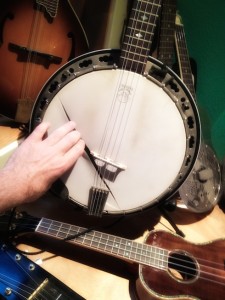
Weird but true: After my experience last week with simulated gut strings, I ordered a banjo set, figuring I’d restring my beautiful Deering with “nylgut” for an old-timey pre-bluegrass sound. But as soon as I tuned up, BANG! The head ripped in two.
I went upstairs and told my wife, “That’s weird — I’ve had that head on there for more than 20 years,” and she said, “That’s really weird — Earl Scruggs just died. Your banjo must be in mourning.”
Maybe. Or maybe Earl was just saying, “Don’t turn your back on bluegrass too fast, now, son.”
I’m not much of a player, though I’ve used the instrument a lot on Tom Waits records. I bring the Deering to sessions, but he always says, “Why don’t you play one of mine?” He has a couple of beat-to-hell early-20th-century open-backs with crusty old strings — a sound he describes as “death banjo.” Which is especially morbid given yesterday’s sad news.
Anyway, I learned as a kid from Scruggs’ 1968 instruction book. I still keep it on my shelf.
"We love candlelight, long walks on the beach, and really expensive old-school strings."
PLUS: New Contest! Name the Classic 6-String Bass Riffs and Win a Seymour Duncan Pickup Booster Pedal!
"We both love candlelight, long walks on the beach, and really expensive old-school strings."
NOTE:The contest is at the bottom of this post. You can skip ahead if you don’t care about rare and expensive guitar strings.
What do the classical guitar and the Fender Bass VI have in common?
Both instruments were developed using types of strings that are practically extinct.
First, let’s talk nylon strings. When these appeared after WWII, classical guitarists, led by Andrés Segovia, ditched gut overnight. Nylon strings were louder and brighter, and they offered better consistency, superior intonation, and longer life.
Few living guitarists have ever actually played gut strings, which really are made from animal guts (usually cows, goats, or sheep). I’ve never tried them myself.
But one of my darkest secrets is the fact that I started out as a teenaged lute player. (I have a photo of myself playing on a hay bale at a Renaissance Faire, wearing a feathered tudor cap and white tights. And you will never, ever see it.) I experimented with gut lute strings, only to run screaming. Total tuning nightmare, especially on an Elizabethan-era axe with friction tuning pegs, not to mention lots of unison- and octave-tuned strings. Guitarists were smart when they ditched the stuff.
But I recently bought a new ukelele, which came strung a set of Aquila strings from Italy. They have several lines of faux-gut nylon strings made from a proprietary material called — wait for it — “nylgut,” which allege to capture the sound of gut without the tears. They sounded cool on the uke, so I ordered a few guitar sets. At between $12 and $21 dollars per set, depending on the bass-string wrap material, they’re pricy, but not crazy expensive — about the same as other high-end, E.U.-made brands, like Savarez or Thomastik-Infeld. (Aquila’s US distributor is Just Strings.)
And holy cow, do I love ’em! They don’t look anything like gut strings, which resemble, well, dried-out intestines. But they really do capture a lot of “gutness.” Their tone is quieter and warmer than conventional nylon, with markedly less string noise (a great thing for a very rusty classical player like me). Check out this demo: