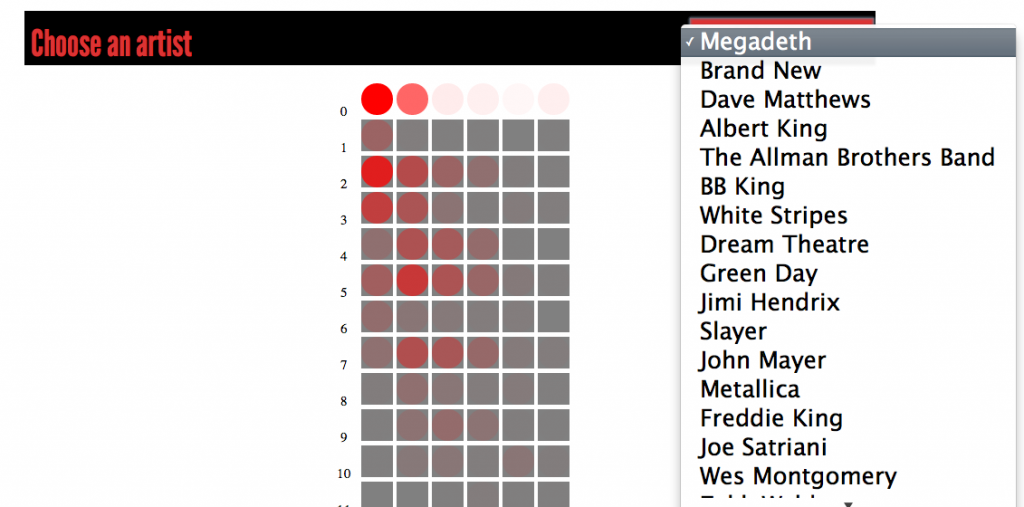
Saw this today on the Guardian‘s site: A clever programmer named Joe Cannatti decided to visualize the fretwork of a 22 well-known players. He used Ruby on Rails code to search the internet for tablature files, and then depicted the data as “fretboard heatmaps” — fretboard graphics with frequently played notes depicted in red. (The redder the note, the more frequently the player uses it.)
You can also view these visualizations on Cannatti’s website, which includes more details about how they were created.
I predict that, like me, you’ll find the results interesting but not surprising. Dave Mustaine and James Hetfield chunk a lot of low E. (James once told me that he could never play a guitar without a low E-string, adding that the only features he finds lacking in his guitars are beer holders of the type found on boats.) Dave Matthews loves open-position D chords. B.B. King doesn’t play many low notes — he’s got a band for that. Satch and Vai are busy beavers, their fretboards a smear of pink.
No less predictable: Damn, we guitarists can be argumentative know-it-alls! Check out the Guardian’s comments section, where dozens of players screech that the data is either meaningless or faulty.
I disagree. These results ring true to me. I’d be shocked if you were to examine the instruments of the guitarists in question and not find exactly the fret-wear patterns suggested here.
Silk and steel — bad-ass, or strictly for wusses?.
It’s been a long, long time since I’ve tried silk and steel strings.
I’ve always thought of them as a transitional set for students migrating from nylon to steel strings. At least that’s how my mom used to explain them to me back when she was giving me my first lessons. Like many players, I viewed them more as a remedy for tender fingertips than a sound you’d actively seek out.
But over time, almost everything I thought I knew about strings turned out to be wrong. So I figured I’d give silk-and-steels a fresh listen.
This thread over at the Acoustic Guitar Forum seems like a fair summary of common attitudes about these strings. Opinions seems divided between players who simply find silk-and-steel strings too soft and quiet to be of much use, and those who enjoy them for fingerstyle playing, especially on small-bodied guitars.
I’ve been frustrated finding the right strings for the old Martin acoustic I picked up last year. I had a violent reaction against coated bronze strings, which I wrote about here. But I was kind of digging the way Martin Marquis 80/20s bronze strings sounded on the instrument, as heard in this video. Sometimes, though, the tone is just too harsh and clacky, so I wanted to try something lighter and softer.
I slapped down this quick duet performance of “Drewrie’s Accordes,” an anonymous lute duet found in The Jane Pickering Lute Book, a manuscript anthology of late 16th-century lute pieces. (This would have been played on gut strings in its day, and is usually performed on nylon-string classical guitar or lute today. My steel treble strings are definitely not historically correct, though some wire-stringed fretted instruments such as the cittern did exist in the Renaissance.)
Observations after the video.
Compared to all-metal strings, the silk-and-steels are definitely quieter, with less treble bite. I like their soft, malleable feel for intricate fingerstyle playing like this. They offer relatively smooth transitions between unwound and wound strings. They exhibit less clacky string and fingernail noise. Playing aggressively with a pick definitely “overloads” them, and would no doubt destroy the windings in short order. Even when playing exclusively fingerstyle, you get the sense that the bass strings aren’t long for this world. But I enjoy their sweet, quasi-classical tone, which to my ear does indeed split the difference between nylon and all-metal strings.
Still, I’m not sure I want to commit to having these on the guitar all the time. (I wish the guitar had a switch to toggle between a bronze and silk-and-steel sound!) Also, these are lighter than I usually play (the treble is .0115, and I pretty much never go below .012). But the relaxed tension does seem to suit this particular guitar.
How about you guys? Any experience with these soft-spoken strings? Do you think they sound cool, or are they merely a salve for sore fingers? And has anyone tried John Pearse silk-and-bronze strings? (That’s probably the next stop on this particular string quest.)
P.S.: This is also a pretty good example of how I apply lute techniques to steel-string playing, as I mentioned here. For most of the fast bits, I pick alternately using my right-hand thumb and index finger. A proper classical player would be more likely to alternate index- and middle-finger. Also, my right thumb sometimes drifts “behind” my right-hand fingers (that is, closer to the bridge). Classical players rarely position their picking thumbs closer to the bridge relative to the fingers. It’s not conscious on my part — it just what my hand does when I’m trying to brighten the bass notes and darken the trebles.
Here’s reader Freddie Lenzel, writing in response to my post on the bizarre late-medieval composition Fumee fume par fumee:
To me, it sort of sounds like The Shaggs from the Dark Ages. But seriously, it’s really interesting. Greetings from Spain, love your blog.
And I love your comment, Freddie! It really strikes a chord (pun intended), because the Shaggs have always sounded medieval to me. And I think I can explain why.
(But first: If you don’t know the Shaggs, stop reading this second and make your acquaintance with the group and their 1969 magnum opus, Philosophy of the World. Kurt Cobain cited it as one of the five-best albums of all time, and Frank Zappa insisted that the Shaggs were “better than the Beatles,” words that inspired this indie-trash tribute album. Meanwhile, NRBQ’s Terry Adams, who launched the Shaggs revival by getting Philosphy re-released in 1980, rightfully compared their homespun sound to Ornette Coleman’s free jazz.)
The Shaggs weren’t the only band to make an album before they knew how to play or write music, but they were one of the best. Many musicians, when first exposed to the Shaggs’ idiot-savant sound, compare it to what might result if you explained music to an alien species unfamiliar with the concept, and then sent them into the studio before letting them hear any actual music. Shaggs songs have no underlying chord structures, no consistent meter, no conventional phrasing, and little harmonization. It’s just odd, meandering “melodies” that stumble along until singer/guitarist Dot Wiggin happens to require a breath. Why, it’s practically…medieval! (more…)
Mitchell “Super-Freq” Hudson, creator of our DIY Fuzz Face project, made a smart suggestion: Dedicated Forum sections for each of the Tonefiend DIY Club projects.
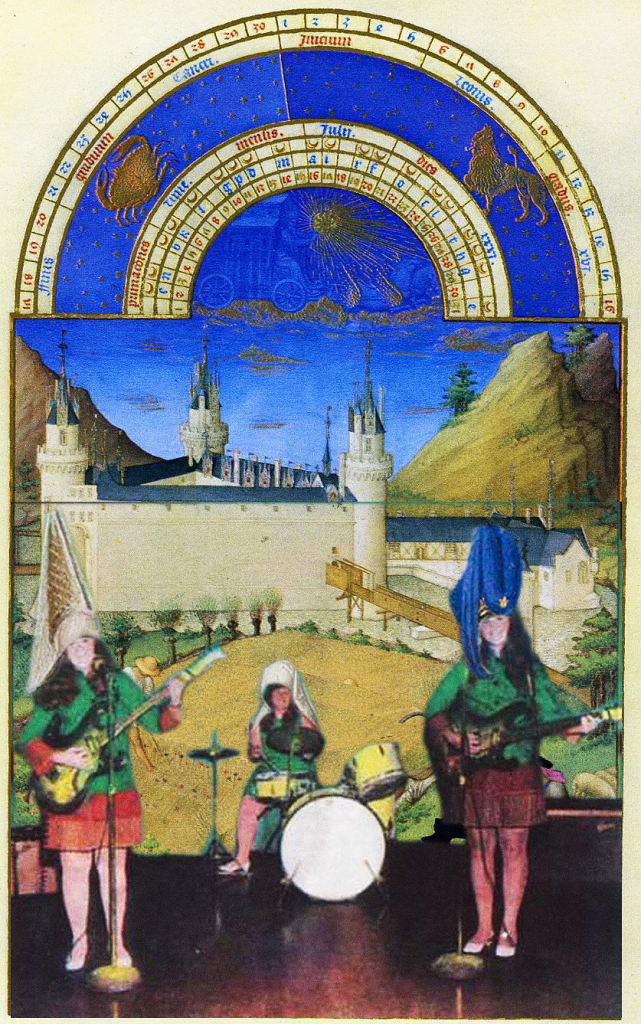
Codex Chantilly: the electrifying page-turner that blew the lid off the perverse musical excesses of the late Middle Ages!
NOTE: I am a known perpetrator of musical hoaxes, but this isn’t one of them. This bizarre composition really is over 600 years old.
As Marsellus Wallace once quipped: “I’m’a get medieval on your ass.”
I’ve been obsessing again on a medieval composition that’s fascinated me since my geeky teens. It’s Fumeux fume par fumee, a bizarre artifact from a bizarre moment in music history: France in the final years of the 14th century.
(If you’re wondering why I was listening to medieval and Renaissance music when I was 17 instead of Zep and Floyd, and what the stuff brings to my guitar playing today, read on. But first, that freaky music!)
The world that produced Fumeux fume par fumee wasn’t your storybook Middle Ages. We’re talking Hundred Years War, Black Death, Papal Schism — and a radical musical style of head-spinning complexity and abstraction. It was dissonant music for dissonant times. The death rattle of the Dark Ages.
The 14th century had witnessed the rise of ars nova, a florid and intellectual style characterized by bold new approaches to counterpoint and musical structure. But by the 1380s or so, ars nova had mutated into ars subtilior, an even more abstract and experimental style.
“Ars nova” means “new art.” It was.
“Ars subtilior” means “more subtle art.” It wasn’t — unless by “subtle,” you mean “characterized by extreme dissonance and chaotic rhythms.” And Fumeux is a perfect embodiment of this radical style.
Here’s what I’m talking about:
WTF, right?
You probably don’t need me to specify why this music is so freaky, but I will anyway: (more…)
We’re far from the first to cover this ground. In fact, I should have mentioned a couple of great articles on Fuzz Face mods. We’ve talked about the technique of using sockets in your build so you can audition multiple components. Years ago DIYer Gary Burchett took this notion to its logical conclusion with the Multi-Face, a Fuzz Face with most of the components socketed. It’s definitely worth trying this. Meanwhile, this Instructables project by randofo explains how to create a super-versatile Fuzz Face using switchable components.
Trust me — despite the simplicity of the circuit and the sheer number of adventurous souls who have deconstructed and reconstructed it, it’s hard not to play around with it and find something cool and new. That too is a truth universally acknowledged!
UPDATE [06.16.2013]:Build instructions updated to v02.
The Fuzz Face has inspired countless spinoffs since Ivor Arbiter unveiled the device in 1966. Some introduced meaningful improvements. Many didn’t.
The goal of this project, created by my friend Mitchell “Super-Freq” Hudson, is to create a pedal very similar to the original. It’s a great way to explore one of the iconic sounds of ’60s rock (and lots of ’60s-influenced rock).
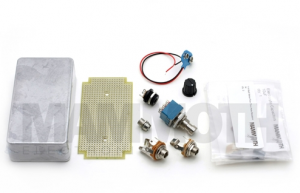
You can order a kit from Mammoth for $45. (Disclosure: Neither tonefiend nor super-freq has any financial stake in these kits. I simply asked the Mammoth guys to create one for your parts-sourcing convenience. All necessary parts are readily available from other vendors.)
But before you attempt the project, please be aware of some of its quirks. (And if you’re curious, you can read about how I customized the pedal I used in my video demo.) (more…)
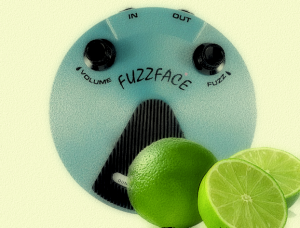
Most sentient guitarists love Hendrix, but not everyone is equally fond of his signature distortion pedal.
So what’s your take on the Fuzz Face?
I used to hate them — but only because my sole exposure to them was via the crappy reissues of the ’70s, ’80s, and ’90s. They sounded so brittle and harsh! Not till this century did I encounter the pedal in its original incarnation.
What a difference!
Vintage-style Fuzz Faces produce tones that are warm, rich, and unbelievably dynamic. It was like the first time I tasted a vintage-style daiquiri. Like the Fuzz Face, the classic daiquiri is a delicate concoction made from a few simple yet complexly interactive ingredients — nothing like those nasty blended drinks that taste like Slurpees spiked with Everclear.
Here’s everything I love about vintage Fuzz Faces, compressed into 60 seconds:
My DIY version is based on inventor Ivor Arbiter’s original 1966 schematic. That’s also the basis for a new DIY project created by my stompbox-buildin’ pal Mitchell Hudson, who runs the cool DIY site Super-Freq. We’ll both be posting it on our sites in the next few days. You can source the parts on your own, or order a kit for less than $50 — not as cheap as some of our other DIY projects, thanks to its two relatively pricy germanium transistors.
Most lore about “mojo” stompbox parts is utter nonsense, but there is something harmonically unique about the germanium transistors used in ’60s fuzz pedals, including original Fuzz Faces. (See my “Germanium Mystique” post/rant for more info.) You don’t need germanium for a good fuzz sound — there are many great tones available via silicon transistors, integrated circuits, and digital modeling. But one problem with those god-awful Fuzz Face reissues was that they often simply substituted high-gain silicon transistors for germanium ones without modifying anything else in the circuit. The result was more gain, but at the cost of harsh, excessively bright tones and inferior dynamic response.
In the last decade or so, builders have wised up. Numerous manufacturers offer authentic ’60s-style replicas. Meanwhile, the DIY community has created countless variations, many of which use post-germanium parts to great effect. These days it’s pretty easy to find a Fuzz Face that doesn’t suck.
I’ve build many Fuzz Face variants, but until Mitchell created his Fuzz Face project, I’d never done a strict original, with positive-ground wiring, PNP transistors, and few latter-day “refinements.” (Don’t sweat it if those terms mean nothing to you — they’re all explained within the project.)
Anyway, that’s the circuit you hear in the video above. It’s not a fuzz for all seasons — it doesn’t have a ton of gain, and its loose, spongy distortion is unsuitable for metal and modern hard rock. But I love its warm, non-macho timbre and phenomenal dynamic response. It’s simple, classic, and delicious, much like this.
If you like reading about internet memes that have just passed their sell-by date, tonefiend is the place to be!
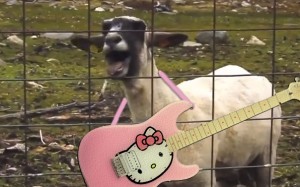
Witness this brief video on triggering goat sound via guitar, created in a fit of desperation when a planned DIY post was delayed divine inspiration.
It’s based, of course, on the unbelievably popular video of unbelievably weird goats making unbelievably human-like sounds. It’s inspired countless spinoffs, including mine. I made these in my hotel room in Frankfurt during Musikmesse, feeling grateful the entire time that I live in an era when you can do crap like this in a German hotel room at midnight. Because trust me, there weren’t a lot of alternatives.
Tech details: homemade Strat, Fishman TriplePlay, Apple MainStage software hosting NI’s Kontakt sampler, goats.
Okay, I promise: tonefiend is not going to become an all-digital blog. I’ve got two new DIY analog pedal projects in the pipe, plus a piece on that delightfully retro technology, the book.
But while there’s more to life than MIDI, for the last few months my particular life has been all MIDI, all the time. I worked on the documentation for the Fishman TriplePlay MIDI guitar system, then demoed the product at MacWorld and Musikmesse. And now that the smoke has cleared and I’m off the Fishman clock, I’m still obsessed with the musical possibilities here. In fact, I’m just getting to the fun part: bending the technology to taste and making weird-ass music for weird-ass people compelling new sounds.
I’m posting two new pieces spun off from my Musikmesse demos. Technical and musical comments after the videos.
In my first TriplePlay demo, I used simple, recognizable acoustic instrument samples. For the second one, I focused on aggressive/distorted sounds. But now I’m getting into what really interests me: solo guitar arrangements featuring hybrid colors, deployed so that it’s often difficult to tell the guitar sounds from the synths and samples.



 Most sentient guitarists love Hendrix, but not everyone is equally fond of his signature distortion pedal.