Let’s not just talk about one-knob gear — let’s design some! Any interest in conspiring to create a minimalist DIY amp?
Frankly, the intensity of the reaction to my recent One Knob Manifesto startled me. I had a general sense there was a growing interest in minimalist gear, but I was no idea the sentiment was so intense. (Though I’d hesitate to draw too many conclusions based on a focus group of the obsessive geeks who hang out here.)
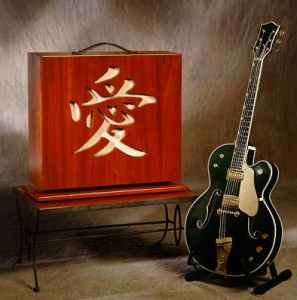
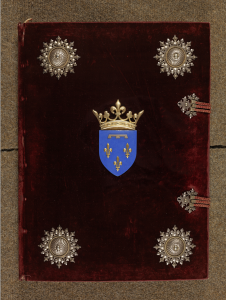
Now, don’t get your hopes up — we probably won’t create anything QUITE this awesome.
The limited edition Love amp fascinates me. Not its ornate furnishings, but the minimal controls: no tone stack, not even a volume control. It’s pretty much exactly what I was talking about when I expressed an interest in an amp with nothing but an on/off switch. That desire became even more focused last week when I reviewed a fabulous amp from a new Colorado Springs company called Toneville. (I’ll link to the Premier Guitar review when it goes live in a couple of weeks.) The Toneville Beale Street model I reviewed features a full compliment of blackface-style controls, but the tone controls are voiced so that the tone stack can largely be removed from the circuit, and there’s also a pot to remove the negative feedback loop for a more tactile/primitive response. As with some other ultra-high-end amps I’ve written about recently (like the Little Walter 50/22 covered here), the tone controls sound great wide-open, and it matters surprisingly little where you set the volume — you just drive it hard enough to warm things up, and then shape the tone from the guitar. With a nicely voiced and biased amp, you need far fewer controls than you might think. And the more crap you omit, more livelier the reponse and the more immediate the tone
The no-controls Mill Hill Love amp.
So why don’t we collectively create something in this vein? A simple but great-sounding tube amp with nothing but an on/off switch? I’ve never designed anything such thing and have little relevant expertise beyond the knowledge that, unlike 9v stompboxes, AC-powered amps can kill you. But I’ve built enough kit amps to know that a one-knob head can be easy, potentially inexpensive (though you could invest in ultra-premium tranformers, vintage tubes, NOS parts, and so on), and it should sound stunning. If we come up with a plan, we can source the parts, create step-by-step instructions, and probably get a vendor to put together a kit for us. (I’m thinking out loud here, so bear with me.)
I’m not firm on many details other than these:
head-only design (at least initially)
low-wattage for home/studio use — something you can crank without self-evicting
should sound big and bad-ass (not a cheap, practice-amp sensibility)
Any interest, folks? And more important, any ideas? And more important, any ideas? What would make this fun, useful, and bitchin’?
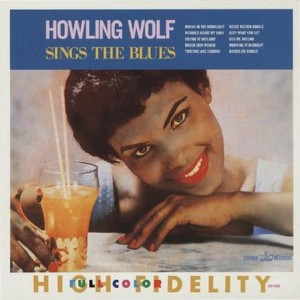
My pal Josh Hecht is making a documentary on Howlin’ Wolf. Josh, a noted engineer and audio instructor who came of age hanging out in Chicago blues clubs in the ’60s and ’70s, has corralled great interviews with the likes of Sam Phillips, Jimmy Page, and the late Hubert Sumlin, Wolf’s longtime guitarist. He also speaks with younger Wolf fanatics such as Dan Auerbach and Kirk Hammett. This work-in-progress will be cool indeed.
(Don’t be surprised that Kirk is a Wolf worshipper. He’s an extremely well-rounded listener, a lifelong guitar student, and an exceptionally cool and smart dude. Long after he became a star, he studied music a San Francisco State University, where Josh was one of his instructors. Josh shot cool footage of Kirk in his practice room, playing “Smokestack Lightning” on a funky old Epiphone — a Coronet, I think.)
Josh dropped me a note yesterday, telling me he was going over to Kirk’s to shoot additional interview footage, and asking whether I had ideas for further questions. Here’s what sprang to mind:
Many of the interviewees point out the things that rock drew from from Wolf: the riff-based composition, the power and aggression, the distortion. But it’s also interesting to consider the ways later players veered from Wolf’s path, and ponder what was left behind.
1. Take groove: Wolf’s rhythms are powerful but rubbery. The beat wobbles and floats like surfboard. The note placement floats relative to the beat, like a skateboard atop the surfboard. Today’s players are more like slot cars speeding along a pre-carved groove. We’re metronomic and predictable in comparison, even when not performing to click. Bands play together in tight lockstep, favoring even note values and motoric rhythms. Where did the looseness go?
2. Or take distortion: We’ve been in an overdrive arms race for decades, using fuzz pedals, heavier amps, aggressive signal processing. But doesn’t the relatively light distortion of Wolf’s guitarists permit tonal nuance, dynamic range, note-per-note color we can’t equal? So many of our tones are always on 10, squeezed to maximum density like toothpaste. What did we surrender to get there?
3. Or phrasing: Consider, say, Sumlin’s solo on “Shake for Me,” full of oddball phrases of uneven length. Today’s players tend to lock into a single type of vibrato. In “Shake,” there aren’t even two notes with identical vibrato. He smears in and out of notes in ways no one seems to do these days. It’s like we’re punching out notes on an assembly line, while Sumlin is carving each one individually from wood.
What happened? How might it have gone differently? Might any of those aesthetics return?
I have no idea whether Josh will use my questions, and if so, what response they may elicit. But what do you think?
Some inspiration:
Sumlin’s solo above isn’t quite as awesome as on the studio version, which may be my fave solo ever. (God knows, I’ve stolen from it often enough.) But still.
Are there any particular guitar solos you’re obsessed with lately?
Here’s one I can’t stop listening to: Jim Hall’s solo on Sonny Rollins’ 1964 recording of “God Bless the Child.”
This may seem like a weird statement, given how much self-indulgent wanking infests this site, but I have a love/hate relationship with guitar solos. (Or more like a hate relationship leavened by occasional stirrings of love.) That’s especially true with singer/songwriter tracks. A good song drags you into its emotional world, and so often it strikes me as emotionally jarring to suspend the drama for a fretwork display. It can be like an ill-timed intermission in a great movie, as if you were watching Citizen Kane or Grand Illusion, and they paused the film two-thirds of the way through to bring out a juggling monkey.
That’s one reason I love this solo so much. Hall just plays beautifully all the way through. He’s like the Loch Ness Monster, undulating continuously just beneath the surface and gently lifting his head above the waterline when his moment comes.
Another is the sheer bravery with which Hall employs silence. Talk about pregnant pauses! It would be fascinating to transcribe only the rhythms of the solo, not even the pitches. The asymmetrical phrases. The late entries. It’s so suspenseful. So poignant. So unpredictable. So frickin’ brilliant.
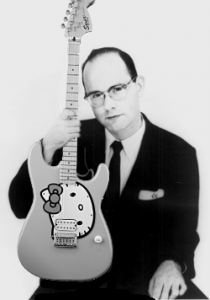
He’s such a genius, I almost feel guilty Photoshopping in a joke guitar.
Equally amazing is liquid blend of chords and melodies. For many players, that’s a binary distinction: Either you’re soloing, or you’re comping. This is just…music.
But the thing that amazes me most of all, I think, is Hall’s mastery of register. Baroque music scholars sometimes refer to a technique known as “compound melody,” best exemplified in the music of — who else? — J.S. Bach. Compound melodies are melodic lines that imply multi-voice counterpoint, even when they’re strictly single notes. A tune might center in one register, then leap high or low, establishing a beachhead in another register before returning to the original one. It then bounces back and forth between the regions, almost as if two tunes were being played simultaneously on adjacent channels, with the listener flicking back and forth between them.
I’m not sure I’ve explained that coherently. But Hall does it.
Jim Hall’s students (including Bill Frisell, whose playing this track so vividly anticipates) report that he kept a sign inside his guitar case that read “Make musical sense.” For many of us, soloing is about practice, practice, practice, and then when the moment comes, we turn off part of our analytical mind and hope that our instincts and muscle memory huck up something acceptable. But I get the sense that Hall, in pursuit of “musical sense,” never turns off his analytical mind. That’s not to say his approach is cold or scientific—he wears his heart on his sleeve here! But he’s always intelligent and thoughtful.
It’s said that improvisation is spontaneous composition. Sure, sometimes. But it’s rarely this spontaneous, or this composerly.
Gotta listen one more time—BRB.
Yeah, it’s still amazing. 🙂
So what are your current guitar solo obsessions? Any style. Any skill level. Anything that makes you feel intense things.
Do you ever get an idea that you just know is going to work out brilliantly? And then discover you were totally wrong?
That’s how it was when I finally reassembled my generic Mexican Strat with Duncan lipstick tube pickups. After I recorded a demoing of it here almost two years ago, the guitar lay in pieces alongside my workbench. I’d stare at decapitated body, feeling guilty and dreaming of all the fantastic mods I’d attempt when I finally got around to reanimating it. I had various ideas for the tone control: Maybe a two-band PTB control? Nope—totally underwhelming results. Perhaps a two-in-one TBX? Meh—even less interesting. I drew a blank, and the guitar wound up with a disappointingly normal tone circuit.
But I did discover some cool twists along the way. Details after the video:
My flatwound string addiction is only getting worse, but this is the first time I’ve combined flats and lipstick tubes. (Has anyone done that since the ’50s?) The results were fascinating. As happens when you put flats on an electric 12-string, you encounter a paradoxical increase in highs, despite the darker-toned bass strings. (Maybe it’s because the treble strings ring truer with less phase-canceling interference from roundwound bass strings.) As you can hear, this instrument doesn’t lack for zing.
The opposite, actually — treble notes explode from the instrument, often more than you’d like. I experimented with various action and pickup height adjustments, but no matter how I set things, it was difficult preventing certain notes from shrieking. The only solution was to play the damn guitar for a few hours and grow accustomed to the touch.
It’s almost always a bad idea to label something a manifesto. It’s pretentious, and it makes you sound like a crank, especially if you were born between 1890 and 1990. But it is dramatic. And would anyone pay attention if I gave this post a more accurate title, like “Please Participate in My Stompbox User Interface Focus Group?”
Anyway, I’ve been having this recurring workbench experience. (No, not the solder burns.) Every time I breadboard a stompbox project, I poke through the circuit, looking for places where I might add a switch or knob to unlock cool sounds. I usually find nice variations and build accordingly. But as soon as I plug in the pedal, I always seem to like one setting a lot more the others. Then I rebuild, hard-wiring the preferred value and ditching the switch or pot. Eventually almost everything I build winds up with only one or two knobs. (Unless I’m making it for personal use, in which case it often has no knobs.) It’s not a love of minimalism, and it’s certainly not an assumption that users are too stupid for anything more complex. It’s just that time and again, the simplest solutions sound best to me.
Meanwhile, I just had an interesting experience reviewing a (gulp) $5,000 amp for Premier Guitar, which crystallized some of my thoughts. The amp in question is a Little Walter 50/22 (which is actually two independent amps in a single housing), and I’ll link to the review when it goes live in a few days. But suffice it to say that Little Walter amps draw their inspiration from the earliest Fender tweeds, and have minimal controls to match: one volume knob and one tone knob. Furthermore, builder Phil Bradbury all but advises against using the tone control, pointing out that vintage-stye tube amp tone controls are strictly subtractive, and that you get maximum impact and richness with the tone circuit wide-open. And Bradbury is right. As on many great vintage amps, the Little Walter controls are practically superfluous. If you locate the right sweet spot, you can park the controls there and make any needed gain or tone adjustments the old-fashioned way: by playing them. Dig in harder for more distortion. Back of the volume to clean up. Use your angle of attack as a tone control. Like that.
But you don’t encounter many new-production amps that adhere to the philosophy. I get the sense that a lot of designers would like to create minimalist amps such as these, but they fear that the public wouldn’t get it. How could the one-knob amp possibly sound as good as the one with 11 knobs? But I suspect that the more experience you have with amps, the likelier you are to believe that simple sounds better. Now I want to build a great-sounding tube amp with only an on/off switch.
Three knobs?! What, do I look like Einstein to you?
I’m finding the same to be true with distortion/fuzz/overdrive stompboxes. For many players, the minimum complement of controls is gain, tone, and master volume. But almost every circuit I’ve explored sounds better without a tone control, and it’s hard to make a gain control sound great throughout its entire range. So more and more I find myself fine-tuning circuits to what I feel are the best gain and tone settings, hard-wiring them there, and then just slapping on a master volume for level-matching. (And if the pedal doesn’t add a great deal of volume, I often skip the master as well.) If you “tune” the distortion, you can control the gain perfectly well via your hands and guitar.
“But,” I hear the inquiring player ask, “don’t you need a tone control so you can use the same pedal with different guitars?” (Sadly, I sometimes believe I’m hearing the voices of inquiring players when I’ve neglected my meds.) Increasingly, I think not. In almost all cases, there’s a sweet spot where a circuit sounds good on everything from a bright Tele bridge pickup to a tubby neck humbucker. Those extremes don’t sound the same, of course. But if you’re playing distorted on a Tele, can’t we assume that you want a bright edge? (And vice-versa with the neck humbucker.) And if you do want to modify the tone, isn’t doing so with via fingers, amp, or mixing board a better solution than using a tone-sucking stompbox tone circuit?
Another example: I spent countless hours pursuing a stompbox vibrato circuit. (I mean true pitch-shift vibrato, not tremolo.) I’d obtained great tones, but I couldn’t get the effect to sound good at all rates and depths, because the perceived depth changes along with the rate. Finally, it occurred to me to go the one-knob route, using only a rate control, and letting that determine the depth. That may sound like a half-assed non-solution, but I’ll be danged if I didn’t suddenly have the most gratifying vibrato pedal I’ve ever played. Like the minimal controls on ’50s amps, the arrangement just worked.
Other factors influence my one-knob attitude: Since I’ve spent much of the last few years in the digital guitar realm, analog guitar has become a refuge from that sometimes math-based approach. When I switch on the analog rig, my goal isn’t maximum user options, but a primal experience. Also, there’s probably an element of advanced-player snob appeal. I don’t know much about cars, bicycles, motorcycles, or sporting goods, but there’s probably a parallel between minimalist musical tools that demand a fair amount of technical finesse, and vehicles and sports gear with stripped-down, featherweight, only-for-pros features. Not every bicycle needs a kick-stand, and not every fuzz pedal needs a gain control. (Or something like that.) Additionally, I hope to bring my pedal designs to market, and what a crowded market it is! Sure, it’s mainly crowded by clones, but many brilliant builders are creating complex mad scientist boxes. Maybe there’s a niche for one-knob mad-scientist boxes…
I’m not sure it’s kosher to conclude a manifesto with questionnaire. But I’m eager to hear your replies to these queries—or anything else you feel inspired to add. Thanks!
Do you tend to change tone settings on amps and pedals when you switch guitars?
How often do you fiddle with stompbox knobs mid-performance?
Do you use your guitars’ tone knobs much? If so, how and why?
Does anyone out there actually use their guitar volume knobs to veer from clean to dirty sounds? Or is just the wishful thinking of pompous guitar “journalists?”
Would you consider using a no-knob stompbox that pretty much requires you to use your guitar’s knobs?
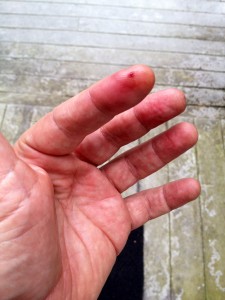
I was trying to decide which self-indulgent experiment fascinating project to demo this week when my hand slipped, driving a sharp soldering iron tip into the meat of my fretting-hand index finger. It didn’t hurt all that much—until I tried to play. Ye-OWCH! (No, of course I wasn’t using the tool properly! I was trying to pick loose a knot of wire with the iron’s tip rather than the recommended wire-picker-thingy.)
So no guitar recordings for me this week while my poor l’il finger recuperates. But I’ll try to compensate for this dog-ate-my-homework post by sharing three works in progress. If they turn out well (and they might!), audio and video will follow.
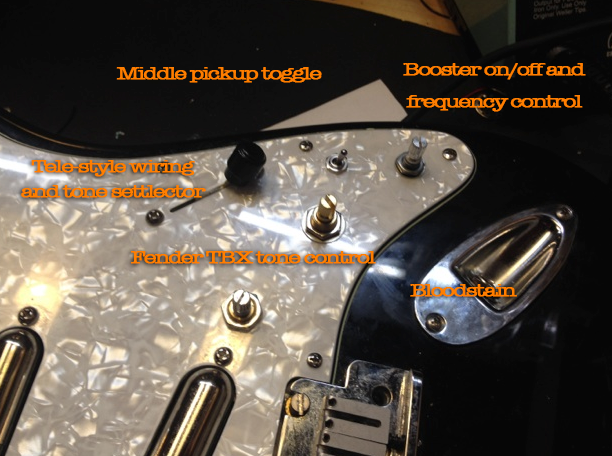
1. Lipstick Tubes Revisited. For more than a year, the generic Mexican Strat I fitted with lipstick tube pickups has lived, disassembled, in a filthy cardboard box next to my workbench, guilt-tripping me every time I fired up the soldering iron. There were a number of experiments I’d been meaning to perform on it, and in a spectacularly bad example of scientific methodology, I incorporated them all at once, making it pretty much impossible to discern what’s doing what. But I hear some things I like. Here’s what’s new (beside the blood spatters):
Not everything is working as desired yet — but there are some promising directions here, and it’s so nice to have a lipstick tube instrument again. :pacman:
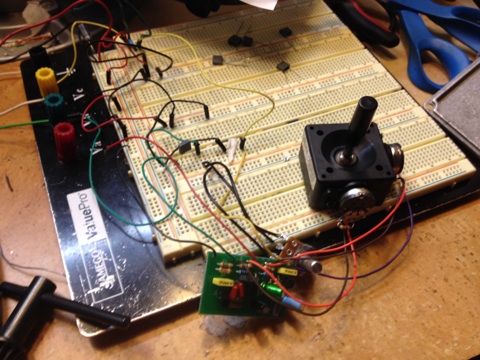
Joystick fuzz: like giving a loaded gun to a monkey.
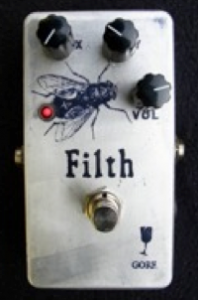
2. The Joy of Stick. Anyone tried a joystick effect, like Devi Ever’s Drone Fuck Drone? I bought a few joysticks from 4Site and have been having a blast. I thought they’d be difficult to wrangle, but it’s really just two pots, each with the standard three-lug connection, deployed in X/Y configuration. Two things to bear in mind, though: They’re generally available only with identical resistance values for each pot, and more important, you need two controls that have meaningful values throughout their ranges. Fortunately, I had just the circuit for it: my Filth Fuzz (which Fuzzbox Girl was kind enough to demo and review in 2011). I’d even labeled the controls X and Y! (I’m not selling these, but I do hope to bring it to market before long. Honest.)
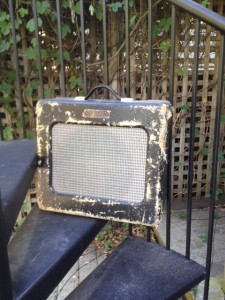
3. A Reanimated Amp. This one’s personal: I’m finally refurbishing the 1951 “TV front” Fender Deluxe amp that I received for as a bar mitzvah present in the ’70s. (I was mature enough not to express my disappointment over getting some crummy old tweed. But how I longed for that shiny post-CBS crap!) My mom procured it from the son of one of her fellow elementary school teachers, who worked at Fender in nearby Fullerton. (Sadly, I’ve forgotten his name.) I also got to pick from three early-’70s Fender guitars: a sunburst Strat, a paisley Tele, and a black Jazzmaster. I, of course, chose the Jazzmaster — at the exact moment when no one on earth gave a crap about that model. And naturally, I sold it just when new wave arrived and Jazzmasters became cool again. See? I established my pattern of buying and selling the wrong things at the wrong times while still in my teens!
I didn’t wreck the amp by myself — the process started with the black paint job it acquired long before I entered the picture. Over the years it received a preamp mod from Paul Rivera, and later got totally ruined by an overambitious repairman who added mods I never requested, and who probably stole most of the original electronic parts. But the cab, chassis, speaker, and output transformer are original, and there’s no reason why it shouldn’t sound bitchin’ after I restore it to its original 5A3 circuit. I’m getting expert help from Tube Depot’s Rob Hull, who helped me source parts and make a grommet board to house the components.
So my apologies for all talk, no audio. My boo-boo is healing, and I should be back able to, like, actually play some of this stuff soon!
This week we’re talking about our favorite guitar/music books. The plan is simple: I discuss a few titles I’ve found particularly enlightening, useful, or entertaining, and then you jump in and do the same. I’ve organized the days of this week by subject matter. Today’s topic is guitar gear.
Guitar gear books seem to fall into three categories:
Pornographic. Lavish publications featuring beautiful photos of rare instruments, often focusing on a single manufacturer or collector.
Encyclopedic. Thick reference books covering wide swaths of guitar history.
Pragmatic. Books that explain the inner workings of guitar technology, with an emphasis on how to turn this info to your musical advantage.
Even if I weren’t a jaded former guitar mag editor, I doubt I’d have much interest in coffee-table guitar porn books (and the occasional guitar porn magazine). Or at least, no more interest than I’d have in photos of, say, beautiful watches, speedboats, or nutcrackers. I’m not a guitar collector.
Not on my coffee table, you don’t!
Hey — stop laughing! Yeah, I own more than 20 guitars. (The exact number depends on whether I count guitars I’ve loaned out indefinitely and ones I’ve borrowed indefinitely.) I appreciate my instruments greatly, and I am very aware of how fortunate I am to have access to so many musical tools. But in the end, they are just tools to me, with little significance beyond their musical applications.
I realize this is a pretty weird attitude for a guitar dude, and one reason why I was probably never a perfect fit as a guitar mag editor. (I must be missing some crucial male gene, because I’m equally blasé about cars and sports. With rare exceptions.)
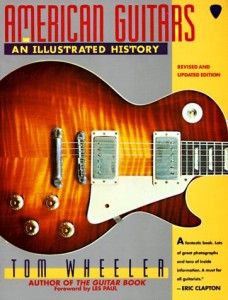
The classic reference book.
Reference books are a different story, especially the books of George Gruhn and Walter Carter, and those of Tom Wheeler. Sure, some of their weightier works have guitar porn aspects, but always paired with vast historical knowledge and the expertise of longtime industry insiders. Gruhn and Carter may know more about American guitars than anyone. But I always gravitate to Tom Wheeler’s books, and not just because he’s a longtime friend and mentor. Tom is a fine writer, an impeccable researcher (he’s been a journalism prof for the last 20 years), and he still conveys a teenager’s passion for the instrument. Tom is my hero.
(Bonus question: Has Wikipedia rendered the guitar reference book obsolete?)
But these days, the gear books that excite me most are the technically slanted, nuts-and-bolts titles. It’s one thing to ogle pretty instruments, and another to explain how they work, why they sound the way they do, and what that all means for the music we make today. And that’s why I love the books of Dave Hunter.
Codex Chantilly: the electrifying page-turner that blew the lid off the perverse musical excesses of the late Middle Ages!
NOTE: I am a known perpetrator of musical hoaxes, but this isn’t one of them. This bizarre composition really is over 600 years old.
As Marsellus Wallace once quipped: “I’m’a get medieval on your ass.”
I’ve been obsessing again on a medieval composition that’s fascinated me since my geeky teens. It’s Fumeux fume par fumee, a bizarre artifact from a bizarre moment in music history: France in the final years of the 14th century.
(If you’re wondering why I was listening to medieval and Renaissance music when I was 17 instead of Zep and Floyd, and what the stuff brings to my guitar playing today, read on. But first, that freaky music!)
The world that produced Fumeux fume par fumee wasn’t your storybook Middle Ages. We’re talking Hundred Years War, Black Death, Papal Schism — and a radical musical style of head-spinning complexity and abstraction. It was dissonant music for dissonant times. The death rattle of the Dark Ages.
The 14th century had witnessed the rise of ars nova, a florid and intellectual style characterized by bold new approaches to counterpoint and musical structure. But by the 1380s or so, ars nova had mutated into ars subtilior, an even more abstract and experimental style.
“Ars nova” means “new art.” It was.
“Ars subtilior” means “more subtle art.” It wasn’t — unless by “subtle,” you mean “characterized by extreme dissonance and chaotic rhythms.” And Fumeux is a perfect embodiment of this radical style.
Here’s what I’m talking about:
WTF, right?
You probably don’t need me to specify why this music is so freaky, but I will anyway:
UPDATE [06.16.2013]:Build instructions updated to v02.
The Fuzz Face has inspired countless spinoffs since Ivor Arbiter unveiled the device in 1966. Some introduced meaningful improvements. Many didn’t.
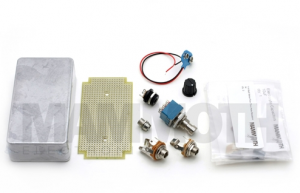
The goal of this project, created by my friend Mitchell “Super-Freq” Hudson, is to create a pedal very similar to the original. It’s a great way to explore one of the iconic sounds of ’60s rock (and lots of ’60s-influenced rock).
You can order a kit from Mammoth for $45. (Disclosure: Neither tonefiend nor super-freq has any financial stake in these kits. I simply asked the Mammoth guys to create one for your parts-sourcing convenience. All necessary parts are readily available from other vendors.)
But before you attempt the project, please be aware of some of its quirks. (And if you’re curious, you can read about how I customized the pedal I used in my video demo.)
If you like reading about internet memes that have just passed their sell-by date, tonefiend is the place to be!
Witness this brief video on triggering goat sound via guitar, created in a fit of desperation when a planned DIY post was delayed divine inspiration.
It’s based, of course, on the unbelievably popular video of unbelievably weird goats making unbelievably human-like sounds. It’s inspired countless spinoffs, including mine. I made these in my hotel room in Frankfurt during Musikmesse, feeling grateful the entire time that I live in an era when you can do crap like this in a German hotel room at midnight. Because trust me, there weren’t a lot of alternatives.
Tech details: homemade Strat, Fishman TriplePlay, Apple MainStage software hosting NI’s Kontakt sampler, goats.