If you like reading about internet memes that have just passed their sell-by date, tonefiend is the place to be!
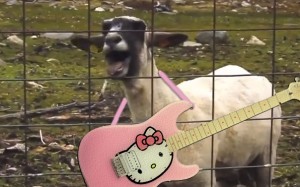
Witness this brief video on triggering goat sound via guitar, created in a fit of desperation when a planned DIY post was delayed divine inspiration.
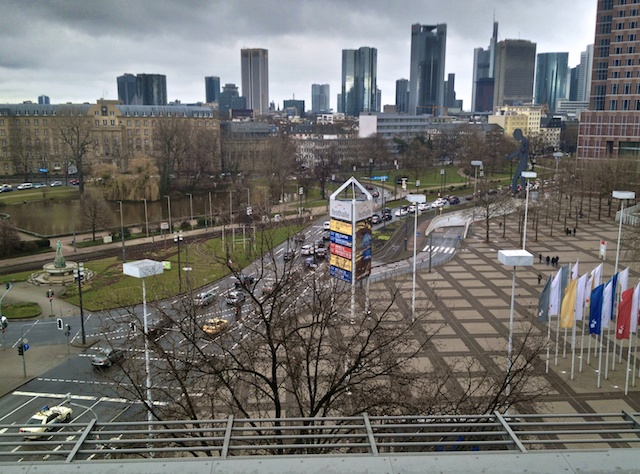
It’s based, of course, on the unbelievably popular video of unbelievably weird goats making unbelievably human-like sounds. It’s inspired countless spinoffs, including mine. I made these in my hotel room in Frankfurt during Musikmesse, feeling grateful the entire time that I live in an era when you can do crap like this in a German hotel room at midnight. Because trust me, there weren’t a lot of alternatives.
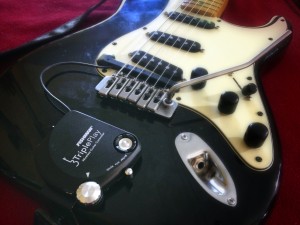
Tech details: homemade Strat, Fishman TriplePlay, Apple MainStage software hosting NI’s Kontakt sampler, goats.
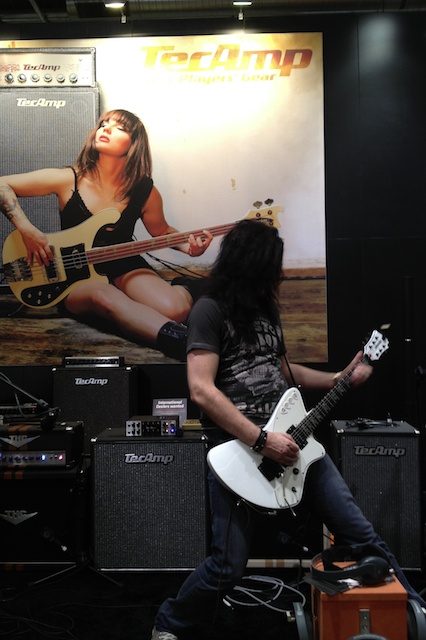
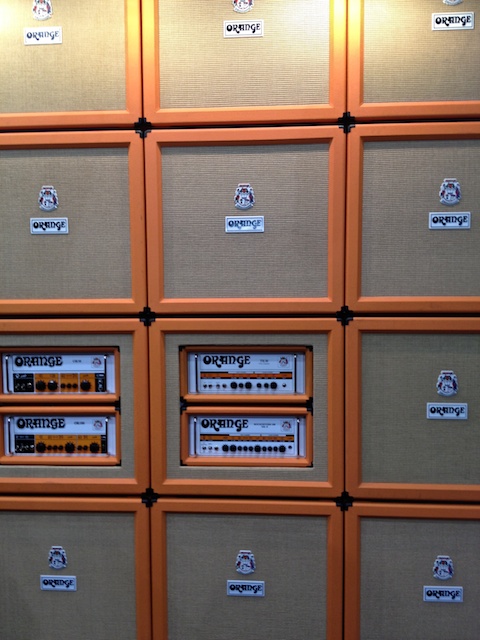
While responsible guitar journalists like my ol’ pal Art Thompson from Guitar Player and the fine young fellows from Premier Guitar scoured Musikmesse 2013 tirelessly and systematically, I did the opposite, randomly stumbling through the vast exhibition halls in a jet-lagged daze between my performances, aiming my iPhone at anything vaguely cool or weird.
The result: this collection of poorly focused images and poorly researched comments. But since I wasn’t being paid to cover the show, I have nothing to lose except your respect, dear reader.
My headline is charitable — this is more of a quarter-assed Musikmesse report. :poop:
Like the African elephant, Musikmesse is huge but endangered. It's way larger than NAMM, but participation decreases year by year. Manufacturers resent the high exhibition costs, and both consumers and instrument companies seem to find the event less essential in the internet era.
When it comes to EDM innovation, Europe leads the way. But in the unbelievably loud electric guitar hall, the vibe is strictly 1993. You don't hear nearly as much bad shred guitar at NAMM these days, but that's pretty much ALL you hear at Messe.
Did I mention that the electric guitar hall was loud? It makes NAMM sound like a library.
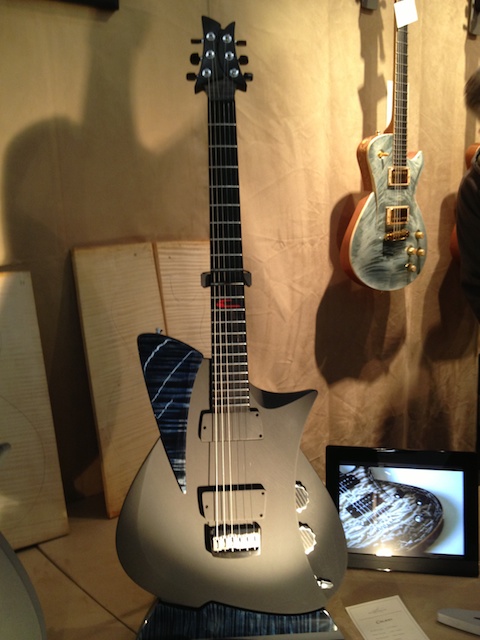
I love the expressionist look of the Caligo model from German luthier Frank Hartung. He's clearly been watching the same movie as Robert Smith.
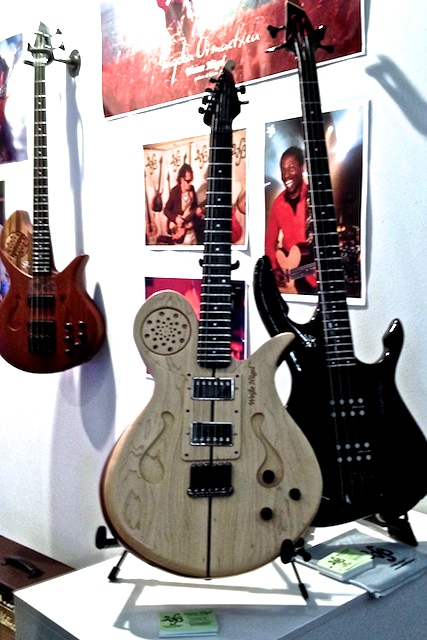
The Amathone model from Barcelona's Weiss-Hügel Guitars looks like a crazy, mad-scientist ax, and it is! I had a blast playing it. That rosette on the upper bout is an adjustable baffle whose setting fine-tunes the high-end content. I don't quite understand it, but the Weiss-Hügel website explains:
"When in Weisse Hügel we consider to make an instrument of hollow box, we think of creating something that was supporting the indispensable qualities of this type of guitars and that, in turn, had the most common problems completely decisive of these: Feedback problematic Final touch, Definition, Frequencies of cancellation (Notes of shade), Is absent of sustain in many cases, besides a relative versatility. The result has been the Amathone."
That should clarify matters.
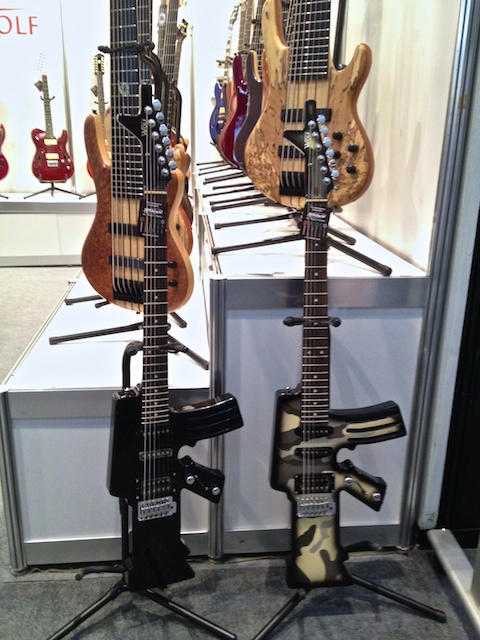
I hope they get these guitars back to South Korea before Kim Jong Un makes his move!
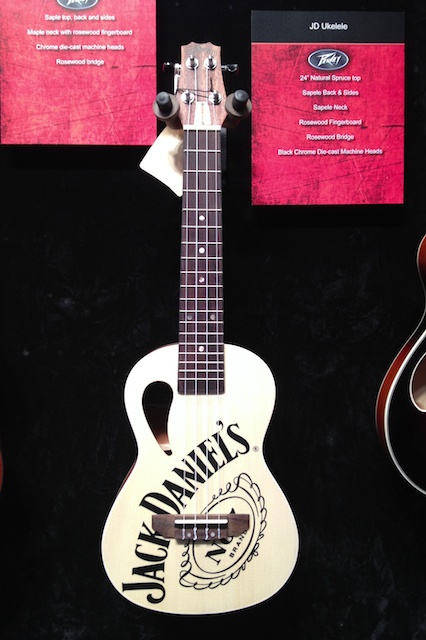
Peavey created this uke for the upcoming FX series Justified Five-O.
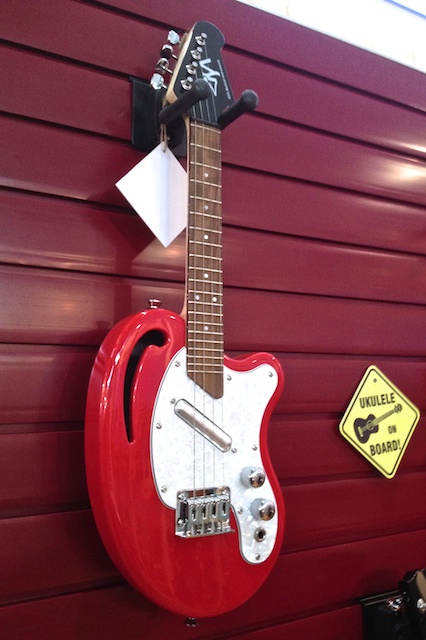
At least you could play surf music on this lipstick-tube electric uke, from Germany's RISA.
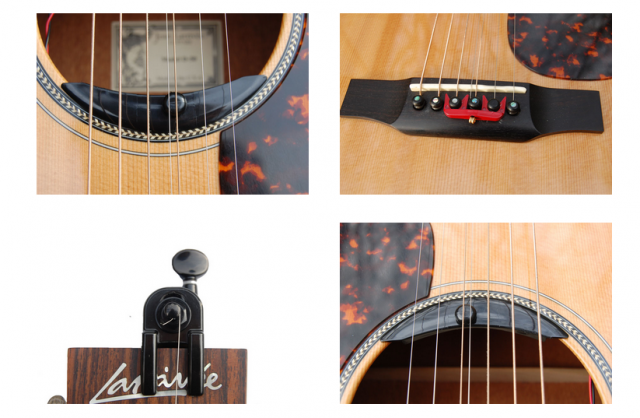
Ever notice how much of the shimmery 12-string effect is really all about the high G string? This clever Dutch gizmo from Addventor mimics the effect via a removable seventh-string. You can even temporarily nix the effect by clipping the added string under the soundhole-mounted button. The only needed guitar modification is an extra notch in the nut.
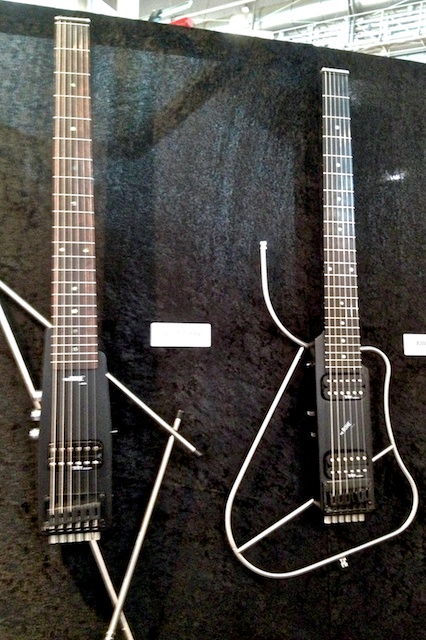
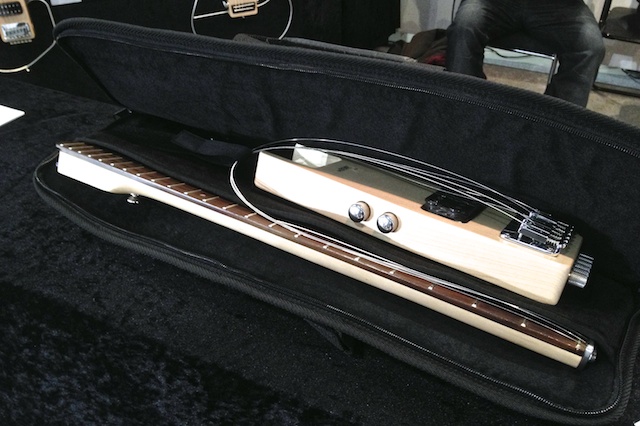
If your Steinberger is feeling too bulky, consider The Bone from Switzerland. These micro-guitars actually sound pretty decent, with more low end than you'd expect. They also make a MIDI guitar and a faux-acoustic with a piezo bridge pickup.
The smallest Bone of all, the Mosquito, weighs in at under three pounds.
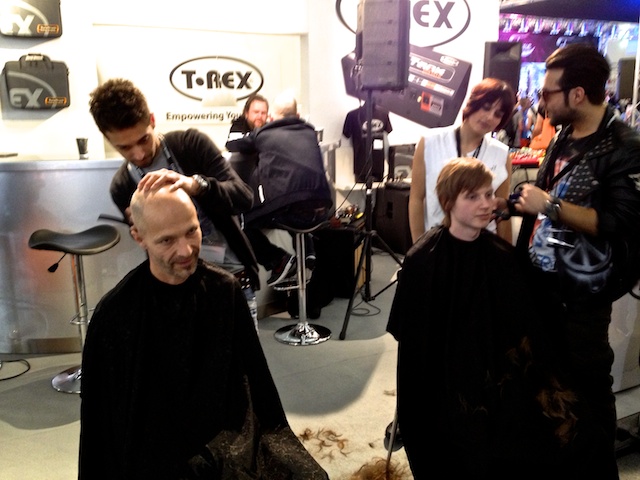
T-Rex Effects was offering free haircuts. I would have taken advantage of the offer if I had hair. Those nice Danish boys were kind enough to loan me a power supply after mine fried on Euro-voltage.
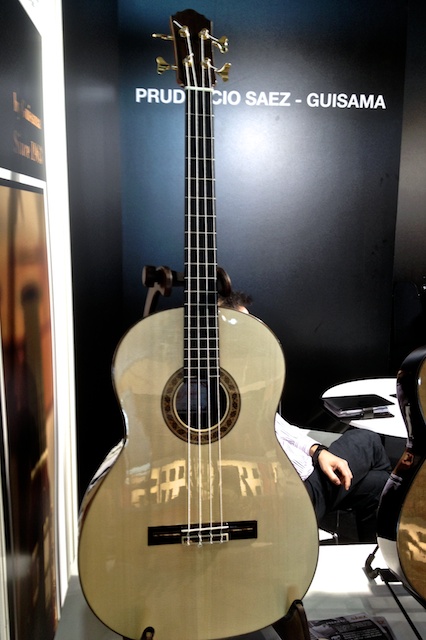
Oh man, I'd love to have a nylon-string classical bass like this one from Prudiencio Saez.
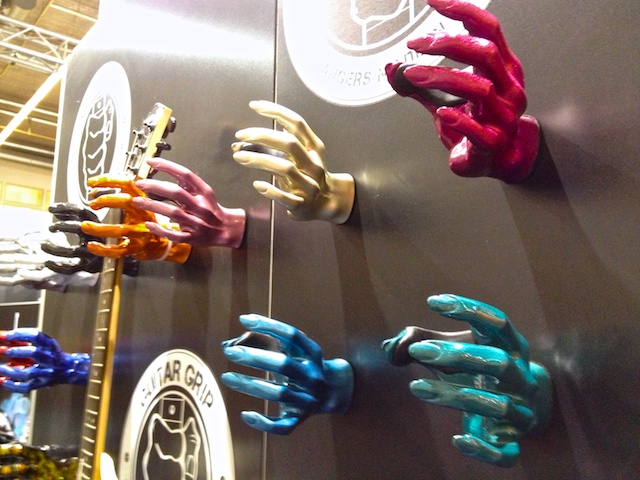
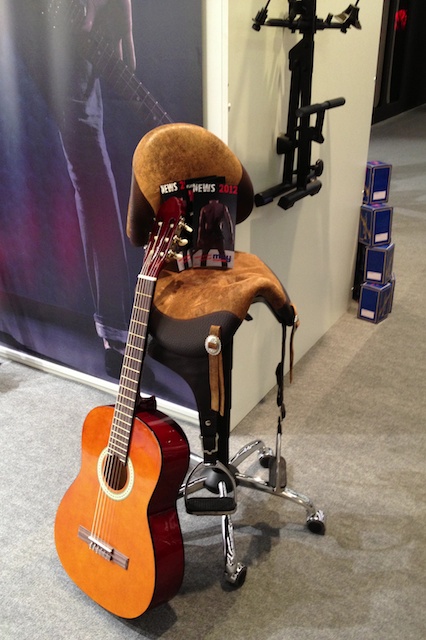
I was set up near this Guitar Grip installation. It received far more attention than I did.
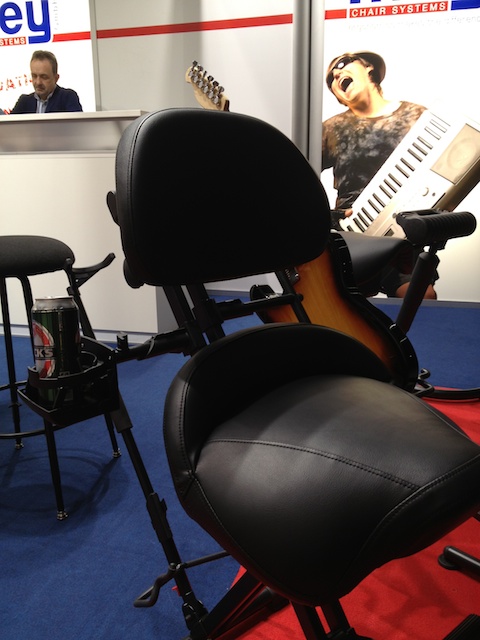
You'll be strumming in style perched in your Mey Chair System, especially if you add the optional guitar and beer holders. They have many styles to choose from . . .
. . . including this special country-and-western edition.
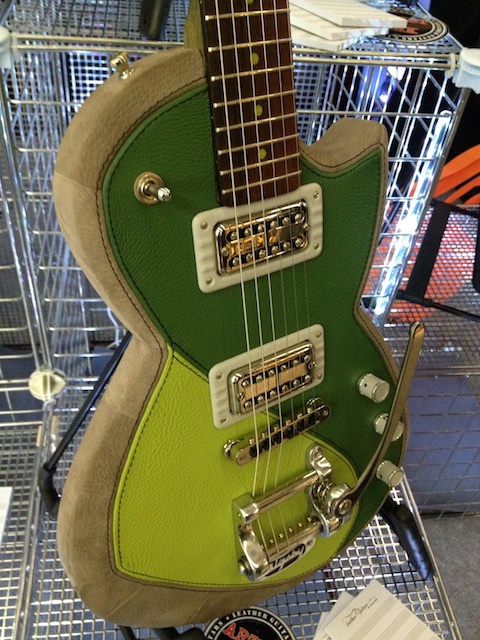
German luthier Georg Beïs specializes in guitars made from nature's finest tonewood: leather! Shown here: the Samaria Nature model.
Folks smoke more in Europe than in the States. As a result, they've developed some highly idiosyncratic tobacco-based practices.
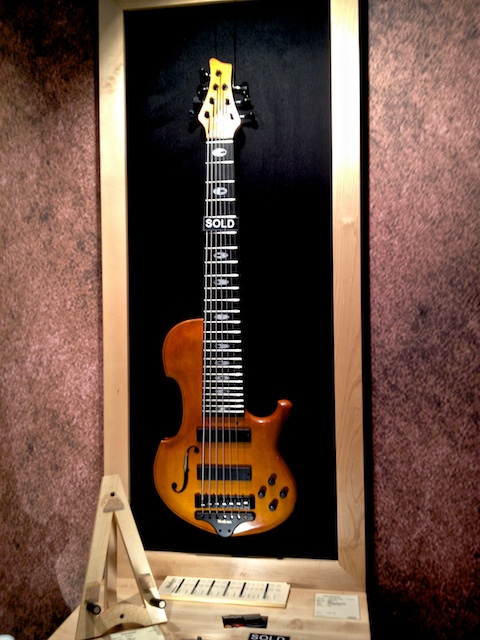
There's a special breed of bassists for whom six strings simply aren't enough. Such players require a Marleaux.
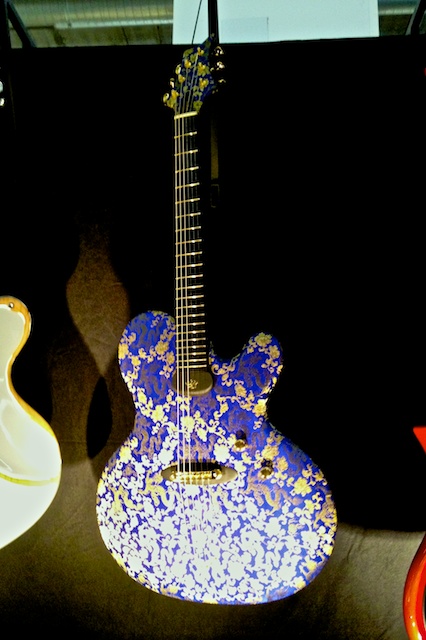
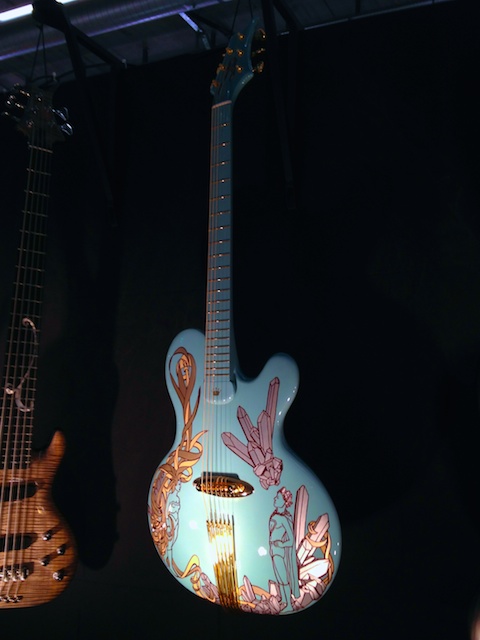
This crappy photo doesn't do justice to the this remarkable damascene finish on this Jens Ritter guitar.
Yeah, I could make some hippie-crystal joke, but Jens Ritter's workmanship is too remarkable to mock.
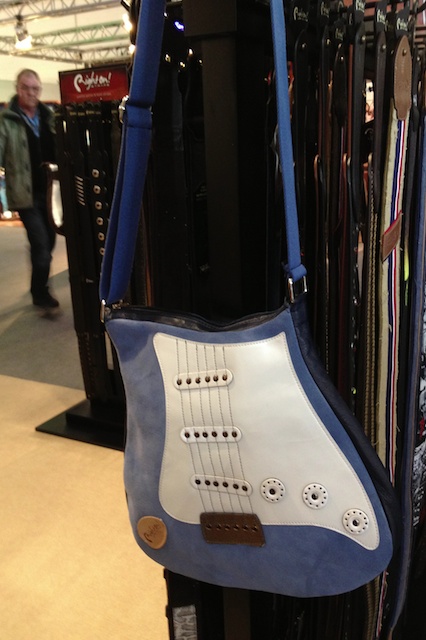
You already knew that Madrid's José Ramirez workshop crafts some of the world's finest classical guitars. But did you also know they made the world's prettiest shopping bag?
Speaking of bags! But now I want a handbag-shaped guitar.
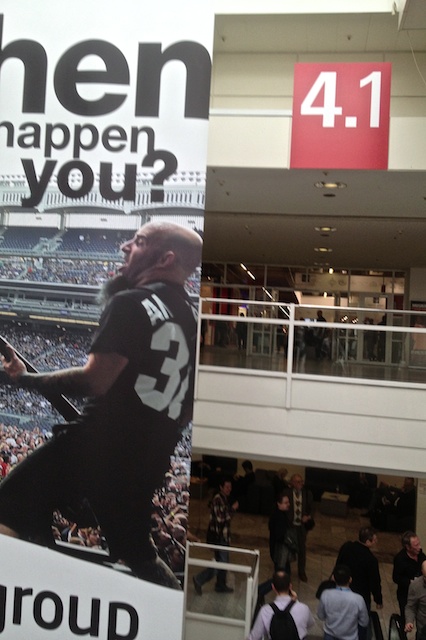
I dig Anthrax's Scott Ian. Especially when he's three stories tall!
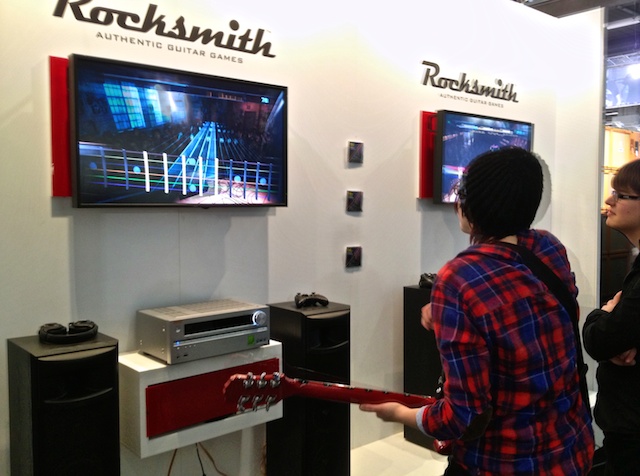
Rocksmith seems to be the opposite of Guitar Hero: a video game where the ability to play is actually an advantage.
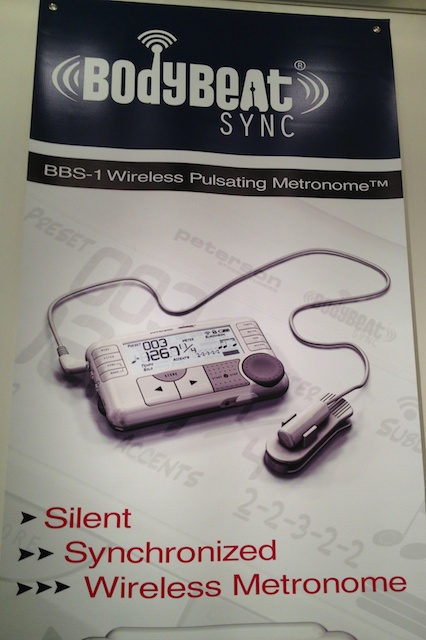
In a perfect world, guitarists wouldn't need help keeping a steady beat. But we live in this world, so the BodyBeat Sync from Peterson Tuners could be a very helpful tool.
From 30,000 feet up, Greenland seems appealingly quiet.
For the first Fishman TriplePlay demo I posted last month, I featured pretty, naturalistic acoustic sounds. This time around I went for something a little less polite.
I’ve been having a blast — albeit a humbling blast — trying to play real-time drum parts from the guitar. I still suck if it’s much more complicated than what I play here, but I can imagine learning to do it well. It’s also fun using the guitar to access the big keyboard sound libraries I’ve built over the years. Perhaps most exciting of all are the hybrid guitar/synth/sample sounds I’m starting to develop. (There aren’t any in this demo — the sounds are either samples or processed guitar, though I blur the lines with guitar-ish samples and guitars processed to sound like machinery. Next time, though, I’ll try to showcase some of those unholy hybrids.)
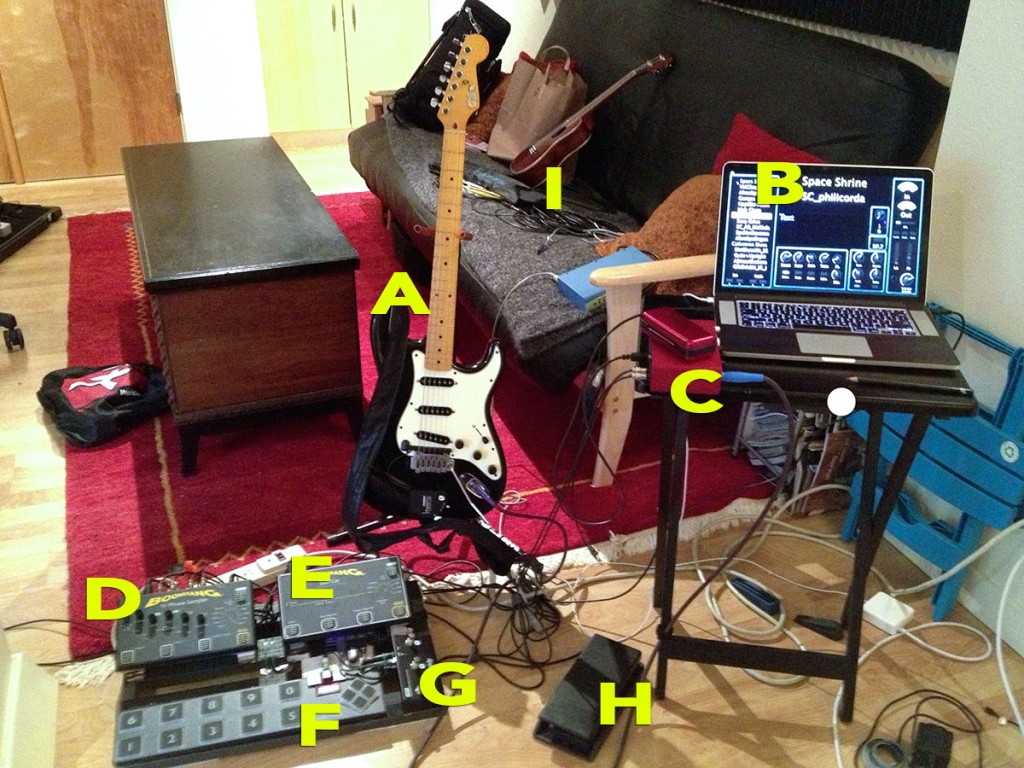
Here’s how the setup looks from my perspective. (I’m not trying to be secretive about what’s on the floor — it’s just hard to fit into the frame, even with a wide-angle lens.)
Joe’s looping/MIDI rig.
Homemade strat with Fishman controller/pickup. MIDI transmitted wirelessly.
MacBook Pro running Apple’s MainStage software. I use a ridiculous number of plug-ins and some ridiculously huge sample libraries. My main sampler is NI Kontakt.
Focusrite Scarlett interface. All the prosumer interfaces sound pretty decent to me these days, though I like the fact that this one isn’t made out of cheapo plastic.
Boomerang III looper. I love its ergonomics and smooth looping points. I screw up my loop points constantly, but I have fewer disasters with the Boomerang than with anything else I’ve tried.
Boomerang Sidecar. Basically just extra buttons for the Boomerang so you can access more features without reprogramming it or performing awkward foot moves.
Keith McMillen SoftStep MIDI controller. Powerful, rugged, feather-light, and not too expensive.
Logidy UMI3. A nice, rugged, and inexpensive USB MIDI controller — just to have a few extra switches.
Generic controller pedal. Its role varies from patch to patch. It might be a mod wheel, a pan pot, a fader, a filter cutoff control, etc.
Piles of crap. These magically materialize every time I start messing with this stuff.
Just to be clear — these sounds are from my collection, and are not included with TriplePlay. Also, I used TriplePlay in “simple mode” for this video — in other words, I’m not using the dedicated TriplePlay application, but simply using TriplePlay as a generic MIDI controller to trigger sounds loaded into MainStage.
BTW, I’m about to head out for Musik Messe in Frankfurt, Germany, where I’ll be demoing this contraption. Oddly, I’ve never been to this vast musical instruments show, which has been described as a much larger NAMM show with more sausage, beer, and accordions. I’ll be sure to tell you about any cool stuff I see!
DISCLOSURE: Fishman, Apple, and Keith McMillen are among my clients, but no one paid me to make or post this video.
But I wouldn’t use them on, you know, one of my normal guitars.
But then I recorded that Bartók piece, using the above-mentioned Guid and Bass VI alongside two standard-tuned guitars with roundwounds. The piece has a lot of counterpoint — all these motifs bouncing between the instruments. And the more I listened, the more I realized that I liked the tone of the two flatwound guitars far more than that of the two roundwound guitars.
And then I bottomed out. I put flats on four more guitars. It wasn’t just musically risky — it was economically catastrophic! And that’s what brought me here tonight.
Funny thing about flatwounds: Everytime I pick up a guitar with flats, I react negatively to the dullness of the wound strings. Where’s the shimmer? Where’s the zing?
But the more I listen, the more I get sucked in. Parts layer over each other more readily. Chords speak more clearly. Fuzz and distortion yield sweeter overtones. It’s easier to get a consistent sound from melodies spanning wound and unwound strings. And the feel? Smooth, sleek and sensual.
Sigh. Maybe I’ll try and kick the habit again tomorrow.
UPDATE, 03.07.13:I should have mentioned a point that several readers noted in comments: The capo only alters the tuning of open strings. Which means that while you can play many harmonies normally available only in dropped tunings, any notes above the capo appear at their usual frets. For example, all barre chords are played exactly as in standard tuning.
After all the digital guitar stuff I’ve been writing about lately, I really wanted to spend an afternoon without plugging in any frickin’ USB cables. So I finally got around to experimenting with the SpiderCapo I picked up last year on a whim.
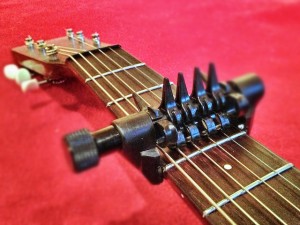
The SpiderCapo his six independently adjustable clamps, each of which can either stop the string or let it ring freely. That means you can dial in most dropped tunings without actually detuning any strings — instead, you transpose the entire voicing up. It’s a lot of fun to play, and seems like it could be a cool composing tool if you’re the sort of musician who gets inspired by unfamiliar tunings. Plus, it looks kind of wicked when you fret the unstopped strings behind the capo.
Here’s a little video I made, noodling around in a few tunings I particularly liked:
Anyone else tried one of these? Or any other “tricky” alternate-tuning capo? How about those gadgets that (unlike the SpiderCapo) can stop strings at differing frets?
For the last few months I’ve been working with Fishman on the documentation for TriplePlay, their long-awaited wireless MIDI guitar system, which will finally ship this quarter. I had a blast demoing TriplePlay at MacWorld a few weeks ago, and I’m looking forward to doing so again at Musikmesse in Frankfurt in April.
But at times, it’s been frustrating. I power up TriplePlay to study some feature, get all excited, and then have to turn it off and write about it instead of going off and playing it for six hours. This little demo was my first real chance to just fool around with the thing. Thoughts and details after the video.
Bartók: Smarter than math-rock — and way more violent.
My Bowie fandom is second to none. Yet I’ve always felt a vague sense of disappointment that the Spiders from Mars didn’t really sound much like spiders from Mars.
On the other hand, the fourth movement from Béla Bartók‘s Fourth String Quartet really does sound like Martian spiders — assuming the critters in question had been force-fed a diet of chord clusters, mathematics, Hungarian folk music, and some of the most astonishing counterpoint this side of J.S. Bach.
And dig it: This white-hot blast of dissonant modernism was composed in 1928!
And how does this string quartet music sound on guitars? Awesome, IMHO — largely because the movement is played entirely pizzicato (plucked, not bowed). Very few modifications were needed to adopt it for four electric guitars.
Since New Year resolutions expire at midnight, January 7th, I’m racing to realize my goal of finally becoming fluent with music notation software before the sands run out.
A new way to feign productivity in cafes!
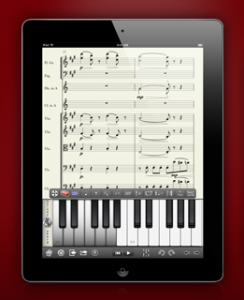
I’d like to share some initial impressions about Notion. This isn’t a full-fledged product review — just a few thoughts about a half-dozen features I dig. (Most also apply to Notion’s sister app, Progression, which compiles all of Notion’s fretted-instrument tools, but omits the orchestral stuff. If you only plan to notate for guitar, the lower-priced Progression is probably all you need.)
1. Appropriate complexity. Two programs, Sibelius and Finale, dominate the music notation field. Both are powerful, deep programs. Most notation pros use them because they’re packed with features essential to “music engraving” (the archaic and pretentious term for the process of preparing music for publication).
I tend to regard the New Year’s resolution like New Year’s drinking: not necessarily a bad tradition, but one I feel no guilt about ignoring most years.
But since I have some specific musical goals in 2013, I figured I’d share ’em — and open the floor to anyone who feels inspired to disclose his or her sonic goals for the coming year. Please post your personal promises to comments!
UPDATE:Here’s a direct link via SoundCloud. The file is downloadable for free. Sheesh — never occurred to me that folks might, like, actually download it and overwhelm my feeble little DropBox account!
While most people are baking cookies or lining up at the grocery store for 45 minutes to buy those frickin’ chives they forgot the other day, Dawn Richardson and I just put the finishing touches on Mental 99’s chaotic cover version of the Doors’ “Hello, I Love You.” (Mental 99 is our digital guitar/analog drums duo band.)
Have a free copy on us! Grab it here. (Download available.)
Why? Because we love you, man!
Seasons best from Mental 99!
(Nerd details: all guitar tracks played on my James Trussart Steelcaster though Apple’s MainStage software. Drums tracked at Fantasy Studio A, Berkeley, California, by Jason Carmer and Alberto Hernandez.)