Categories
Bass DIY guitar Pickups

Cool Prewired Guitar Electronics

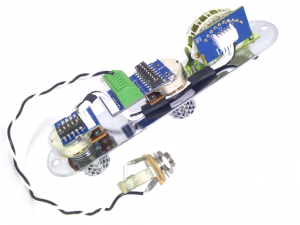
Prewired replacement electronics provide access to many popular wiring mods, minus the soldering.

Larry Santellan of Santellan Sounds, maker of the Elec-Trix tone modules, sent me some samples to check out. These pre-wired circuits offer quick access to some of the “greatest hits” of alternate wiring, with an emphasis on Strats and Teles. He has pop-in modules for 5-way Teles, Vari-Tones, passive overdrives, vintage/modern switching, and more.

I haven’t had the time to try everything Larry sent, but for a few months I’ve had his 4-Way Fat Tone Monster Deluxe Wiring Kit in my Tele-like G&L ASAT. It lets me dial in the three standard sounds, plus that humongous series-pickups BLAT! A push/pull pot bypasses the tone control. (I never hear meaningful differences between bypassed tone controls and wide-open ones, but this setup lets me toggle between a bright, wide-open tone a muted one.)

Installation was relatively easy, and the parts and workmanship are top-notch. If you’re interested in alternate pickup wiring options, but don’t have the skill, patience, or time to solder it yourself, well, check out the Elec-Trix catalog.
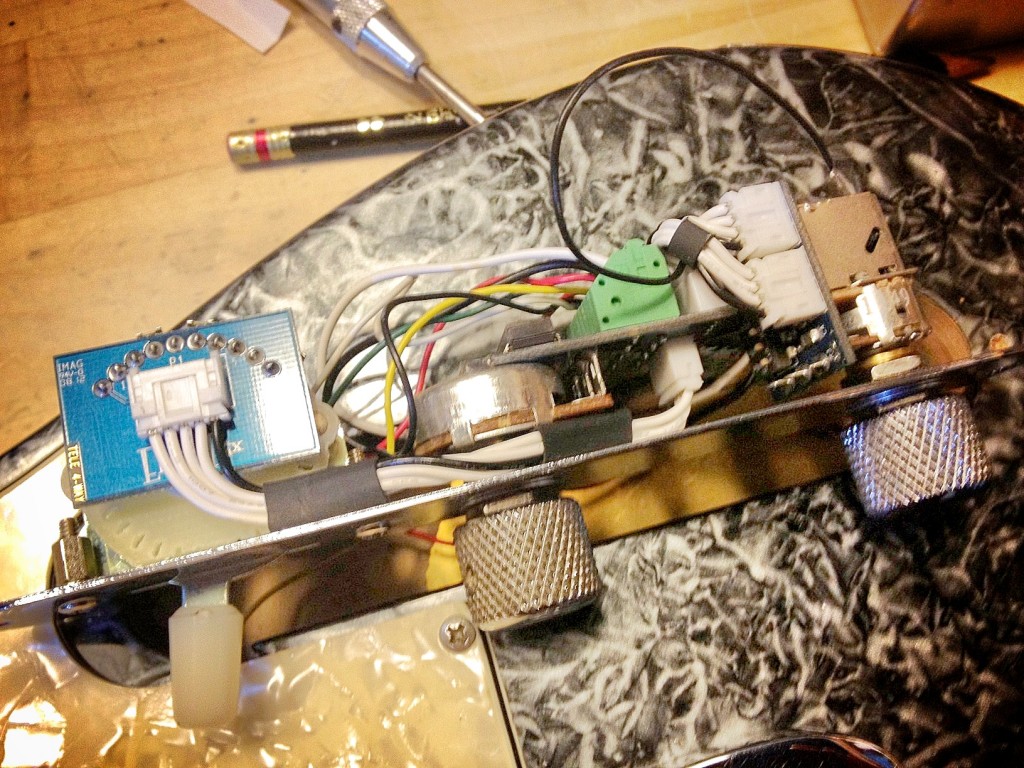

Solder-free configuration via clever ribbon connectors.
Categories
Bass guitar Music Technique

What’s Your “Basic Concept?”

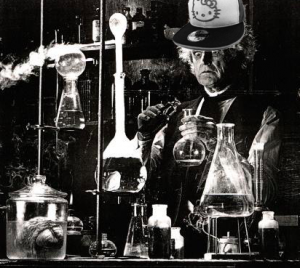
“They call me mad, but I’m actually a HAPPY scientist!”

There’s an interesting thread over on the Forum, started by reader Double D, who asked:

“Do you have a central core concept or inspiration that drives your playing? Are you squirrelled away with obscure harmony texts, or practising modes till your fingers bleed? Do you have go-to chord substitutions that define your sound? Do you have a creamy harmonic centre?”

Like most great questions, it’s really hard to answer (though some folks managed to reply in extremely articulate and compelling ways). I’ve been pondering it myself for the last few days, and the best answer I can come up with is something along the lines of what I hinted at in this recent post on chromaticism, namely a liquid sense of modality based on the notion that most of us Westerners really only perceive two modes — major and minor — but that there’s a vast amount if “wiggle room” when it comes to placing individual scale degrees.

To put it another way, most of what I play is based on simple tonic triads, major or minor, but the placement of all the other scale degrees is highly negotiable. For me, the advantage of viewing scales this way is that they remain grounded in harmony, and vice-versa. As opposed to the way many of us were taught modes: as purely mathematical sets of intervals divorced from their chordal implications — or just a bunch of diatonic scales that start on the “wrong” notes.

Hey, why is everyone nodding off, staring out the window, or checking their phones? Wake up and talk about the methods of your madness!

:cuckoo:

Categories
Bass DIY guitar

How to Clean a Dirty, Filthy, Gross, Disgusting, NASTY Guitar

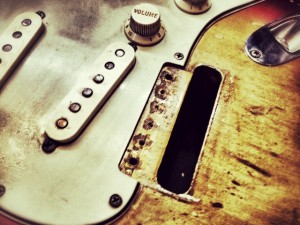
This photo was digitally altered to make the guitar look even dirtier than it was — but not by much.

Sometimes only the threat of public exposure can inspire a proper clean-up job. Case in point: I hadn’t groomed my battered ’63 Strat in years, and when I pupped it from the wall for my recent post on the instrument, the fact that I was about to show it to the world you guys made me finally admit how gross it had become.

Now, it’s not like I wanted it to sparkle or anything — seems to me that an old guitar should look old, and removing 100% of the grime would be a little too much like those octogenarians with preternaturally white teeth. I mainly just wanted to remove the sticky crud that had accu

Categories
Acoustic Amps Bass Digital DIY Effects Gigs guitar Music Pickups Recording Technique The Secret Room Tonefiend DIY Club

Contest: Build the Tonefiend Forum!

tonefiend forum
A sad, desolate place — but not for long!

One cool thing about going indie with tonefiend  is that fact that I can finally host my own geek forum! It’s already up and running — but it’s a sad, vacant space that desperately needs to be populated by cool people and cool ideas.

How to get there? Sleazy bribes! Cool prizes!

Here’s the deal: I’ve pre-populated the forum with a few topics and threads. Just come on over, register, and chime in on any thread that interests you — or better yet, start one of your own. And on September 1st, 2012, the three forum members who have consistently contributed the liveliest content as judged by some dork me will get a bitchin’ stompbox laboriously hand-built by the same dork me. I can’t disclose exactly what the pedals will do, but I can promise they will be cool, useful, and genuinely unique — original designs, not some lame-ass Screamer clones. And if I manage not to vaporize my hand with the TechShop laser-cutter I’ve been learning to use, they’ll even have wicked laser-etched enclosures.

Naturally, I hope the tonefiend forum will also be cool and unique, and that you’ll enjoy geeking out there even when there’s no contest. But hey, I’m not above greasing the skids with free stompboxes as needed.

Please read the forum rules, though.

FORUM RULES: Be cool.

Categories
Acoustic Amps Bass Digital DIY Effects Gigs guitar Music Pickups Recording Technique The Secret Room Tonefiend DIY Club

The Secret Room: Not So Secret Anymore

Now with more secrets — and less secrecy.

Last winter I tried an odd experiment: a website where players were encouraged to post their best tone secrets — the kinds of tricks and techniques that are almost too good to share. But in order to get, you had to give: The site was password-protected, and the password was only sent to those who contributed secrets.

Musicians responded, no doubt encouraged by the cool prizes awarded to the top secrets, as judged by user ratings. I also asked some cool musician friends to contribute the first round of secrets, yielding tips from the likes of composer/virtuoso Lyle Workman, metallurgist-turned jazzbo Alex Skolnick, original Chili Peppers guitarist Jack Sherman, boy genius Blake Mills, and other great players.

Once the contest ended, traffic slowed, but the site has slowly but surely grown. And now, as an experiment, I’ve removed the password protection. Now anyone can visit the Secret Room, AKA tonesecret.com, even if they haven’t coughed up a secret. So please do!

It’s a fascinating document. Naturally, the quality of secrets varies, as does the level of expertise needed to make the most of them. I exerted a light editorial hand — only silly or flat-out-wrong tips were vetoed, and I didn’t do much in the way of spelling and grammar repair. Sometimes the contents are a little repetitious — but trust me, there is much wisdom and originality throughout.

I hope you find something helpful — and I hope you’re moved to contribute some secrets yourself using the site’s submission form. And who knows? There may be more tawdry bribes fabulous prizes lurking around the corner…

Categories
Bass DIY guitar Pickups

How to Install Pickups

“I always forget — which end gets hot?”

Somewhat embarrassingly, I never got around to changing one of my own pickups until I was knocking on senility’s door recently. I owe part of the inspiration to that fabulous DIY Fest known as the Maker Fair, where each year hundreds of little kids learn to solder craft projects at long picnic tables. Or maybe it was the awesome soldering tutorial by 11-year old W0JAK. Well, after a buttload of pickup installs inspired by this blog, I guess I qualify as some sort of solder “expert,” because Seymour Duncan asked me to make a video designed to walk n00bs through the pickup install process for the first time. It was a lot of fun to prepare, and I learned some important things, like the fact that it’s hard to solder, talk, and operate a camera at the same time. Check it out:

Categories
Bass guitar Recording Technique

Those Times When It’s Good to NOT Play Like Yourself…

Can we all agree that it’s a good thing when guitarists and bassists cultivate their own style? Even a jaded old cuss experienced music journalist like me still gets a thrill upon discovering a new player with a startlingly original voice.

I am not any of these people —but I pretended to be them.

But there are times when it’s worth pursuing the opposite approach. (And not just for pragmatic reasons, such as the likelihood that you’ll get canned from your cover band gig if you mix it up too much, or the fact that the jingle client can’t afford to license that Black Keys song, but will happily pay you to record something “similar.”) Sometimes disconnecting your ego and completely immersing yourself in another player’s point of view can make you a better, and paradoxically, more original player. (I’m reminded of a Marc Ribot interview I once edited where the brilliant guitarist talked about learning Chuck Berry songs, clams and all — the “bad” notes, he suggested, were as much a part of Berry style as the “good” ones.)

I had a chance to take this idea to an extreme a few years go when writer/composer Elise Malmberg and I collaborated on a massive internet hoax: a bogus website alleging to be the 50-year history of a “legendary” indie record label. Clubbo Records is easily the most obsessive-compulsive project I’ve undertaken. The site features hundreds of pages of music, bios, photos, and memorabilia memorializing dozens of fictitious artists. Even many external links are fake — we just made a lot of little mini-hoax websites.

(Example: We licensed a photo of a beautiful ’60s blonde in a leopard-skin coat, which inspired a story about Ava & the Avalanches, the best known group of the Swiss Invasion. We wrote a story about how wearing the coat for the photo shoot horrified her, and launched her on a life path of animal activism. Where would she be now, we wondered? Running a big cat rescue charity, of course! Which inspired more than a few queries from journalists, including one from the BBC, asking to put us in touch with the non-existent Ava. And Ava’s signature “hit,” “Ski Baby Ski” has been licensed over and over, most recently for the silly Jonah Hill comedy The Babysitter.)

Categories
Bass guitar Technique

Are Your Sinister — or Dextrous?

“Why is everything upside-down?”

You know the origin of the word “sinister,” don’t you? It’s the Latin word for “left,” which, according to etymologists, became associated with evil, thanks to the medieval belief that left-handed people were deceitful and probably possessed. Meanwhile, “dexterous,” which means adept with your hands or brain, is from the Latin “dexter,” meaning “right.”

What are the odds that a right-handed person came up with those ideas? 😉

Lefty guitarists have it tough. They have fewer instruments to choose from, and they usually can’t just pick up any old guitar and start jamming. When I wrote for Guitar Player, we tried hard not to be “side-ist,” and would always refer to the “picking hand” and “fretting hand” rather than the left and right when discussing technique. But still.

I have left-handedness on the brain because I upgraded a left-handed guitar for a friend. I threw caution to the wind and recorded a demo video upside-down, without restringing. It ain’t pretty — but it sure is interesting! I’ve never undergone any sort of neurological testing, even though I look like the sort of person who should have electrodes permanently attached to his skull. But after playing upside down for a few minutes, I could practically feel parts of my brain pulsating with unaccustomed energy. I held a wine glass in my right hand, and it felt wrong. Then in my left, and it still felt wrong. And man, was it tough typing! It was a weird, disorienting mental high. 

Categories
Bass DIY Effects guitar

How to Install Onboard Effects

UPDATE: I’ve added a page listing all the “How To” posts on this site. Just click the cleverly titled How-To Posts Are Here! box at upper-right of each page.

There’s got to be a better way!

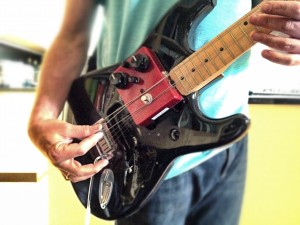
Several readers asked for more specific tech advice on how to wire up battery-powered effects inside a guitar or bass, so I created a step-by-step tutorial, which you can download here.

Some historical background: Since the ’60s, many guitar companies have toyed with the notion of installing battery-operated effects inside guitars.

And “toyed” is probably the perfect verb for it. Onboard effects have earned a reputation as cheesy, low-budget products. In many cases this reputation is justified. (And sometimes it’s not — the Electra guitars of the ’80s were never particularly popular, but their simple onboard distortion circuit has generated hundreds of “boutique” clones, not to mention our own Bad-Ass Distortion project).

And why would you want to put an effect inside a guitar or bass? You can use a stompbox with any electric instrument, but an onboard effect is married to one axe till solder-do-they-part.

I have an ironclad rebuttal to such concerns: 

Categories
Bass DIY guitar

DIY Guitar Picks?

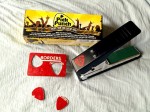
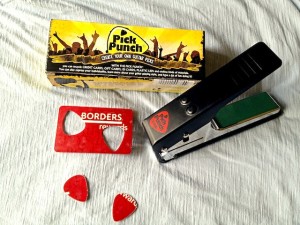
Borders went bankrupt. Now what the heck am I supposed to do with this pretty red card?

Behold my latest gizmo acquisition: the mighty Pick Punch!

It may look like a humble office stapler, but it stamps out standard-sized guitar picks from any compatible material.

I made picks from an old credit card, then another old credit card, and then . . . hey, folks, I need more ideas! What else would be a good, but unconventional, material for DIY picks?

FYI, this thing is sturdy, powerful, and sharp. If you stick your hand in it, you can probably make a decent skin-and-bone pick. When working with less self-destructive plastics, the edges are a little rough and furry, but nothing that a few seconds of sanding or playing wouldn’t sort out.

I found this treasure at the wonderfully silly gift site Think Geek, a nerd-toy emporium that specializes in such life essentials as the Zombie Head Cookie Jar and Alien Chestbuster Plush Toy. You can also order it directly from creator Von Luhmann via PickPunch.com. He also sells blank sheets of plastic advertised as similar to the material used in several popular pick types, plus sanders, inks, and so forth. He also sells a version of the Pick Punch that stamps out smaller, pointer “jazz style” picks. Pricing is reasonable: $24.95 for the Pick Punch, and $3.25 for enough plastic stock to 60 or so picks.

One advantage of buying directly from Luhmann rather than Think Geek: You won’t be tempted to outfit yourself with one of these.

Anyone out there in the habit of making their own picks? Show and tell, please!