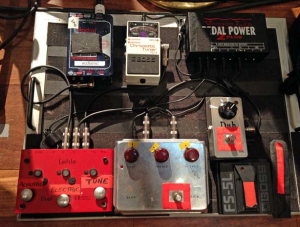
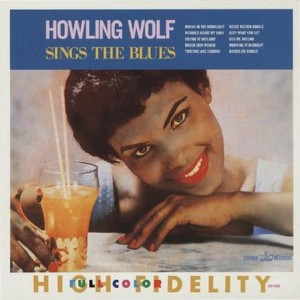
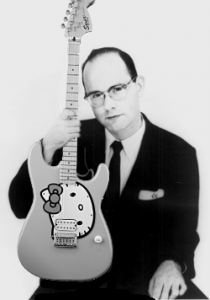
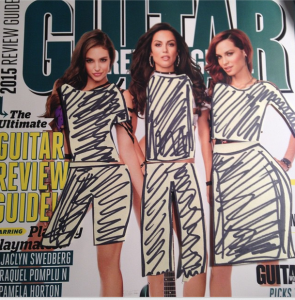
Pedaltrain didn’t dig the cover of the new Guitar World, so they changed it. (View the best Instagram ever here.) I think I’m going to have to go out and buy even more excellent Pedaltrain boards.
Funny thing: My friends outside the guitar biz tend to imagine that it’s some super-hip industry, when in fact, it’s a rather retro community where crap like this is depressingly common. Damn, with so many things in our culture to undermine girls’ confidence, who needs more from music mags?
As a palate cleanser, here’s a video of girls who actually play:
My band recently had the privilege of playing a Bay Area Girls Rock Camp benefit. The between-acts music was all recorded by the campers, and some of it was awesome. I’m not even a parent, yet I’m grateful the organization exists to counter crap like the Guitar World cover.
Are there any similar groups in your area? Do any of the moms and dads among you have thoughts about nurturing and empowering young musicians?
Sorry my blog posts have been a bit scarce lately. A few weeks ago, my super-cool 91-year-old dad (who sometimes posts here) went to Joshua Tree, tripped, and fractured his hip. So to help out, I’ve been shuttling the 400 miles from my home in San Francisco to West Covina, the right-wing, smog-shrouded LA suburb where I grew up, and where Dad still lives with his equally cool wife. (He’s mending well, BTW, and is running his physical therapists ragged.)
On my last road trip, I got to thinking about musical geography in America, and how it once defined our music. Not too many decades ago, we associated musical styles with the regions that produced them. Cities had sounds: Detroit. Frisco. Philly. Memphis. Do those distinctions retain any meaning whatsoever? Or has music succumbed to the mass-media homogeneity that transformed the once vibrant medium of radio into the soulless monolith of Clear Channel, and once-glorious roadside America into an bleak expanse of Walmarts and Olive Gardens?
Should you embrace your hometown influences or flee them? (The dipshits I encountered on my last visit to West Covina made a strong case for “flee.”)
My general question is rhetorical — of course we’ve sacrificed regional color to a beige, big-box economy! But there’s a more specific underlying question: Does where you come from continue to have any bearing whatsoever on what your music sounds like? Is it different for a middle-aged guy like me — who spent at least a few formative years at a time when musical geography mattered — than for young musicians coming up today? And most important, what about you? Is where you learned to play reflected in how you play?
I’d fled LA literally and conceptually by the time I was 20. (A stupid move, perhaps — I’d probably have a more successful career had I stayed.) But do I still have Southern California in my hands? Have subsequent decades in Northern California overwritten them? Or does that stuff even matter anymore?
It’s hard to tell, looking at myself. I conform to some San Francisco musical stereotypes but not others. (I’m freaky and free-spirited, but I hate meandering stoner jams.) Meanwhile, LA continues to represent much I loathe musically, but I bear the permanent mark of the kitschy SoCal pop of the ’60s my mom played when I was a little kid. The Association, Herb Alpert, the Fifth Dimension. (You know — the real sound of the ’60s.) And while I’m probably just flattering myself, I’ve always felt a kinship with the warped perspectives on roots music provided by outsider Southern Californians like Waits, Cooder, and Van Vliet.
How about you? Does your country, state, or city color your music? Can we hear where you’re from when you strum?
I just watched an amazing documentary on Netflix: The Source Family, the story the early-’70s cult led by James “Father Yod” Baker. Baker’s Sunset Strip restaurant, the Source, was a fixture of my LA youth — a popular hang for both hippies and music-industry types. (You’ve probably seen it as the backdrop for the breakup scene in Woody Allen’s Annie Hall.)
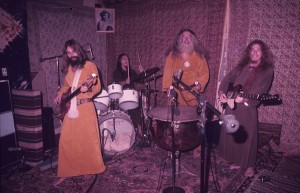
The hell with cowbell! We need more tympani! James “Father Yod” Baker (with mallets towards none) fronting Ya Ho Wa 13.
One of Baker’s less eccentric notions was to blow a fortune on music gear and a pro studio, where his self-styled “band,” Ya Ho Wa 13, reportedly recorded 65 albums’ worth of improvised music, much of which has been reissued in recent years. Prolific, chaotic, and fueled by a philosophy comprehensible only to its creator, the body of work is a bit reminiscent of Sun Ra’s, minus the talent.
Perhaps the best thing you can say about Baker is that he was no Manson. I don’t know that anyone died on his watch other than Baker himself (in an idiotic stunt I’ll refrain from sharing so as not to spoil the film’s stupefying denouement, though you can devour the details here if you like).
But he was a serial psycho-sexual abuser who acquired 14 very young wives while liberating hundreds of starry-eyed acolytes from their worldly possessions and cruising LA in a white Rolls Royce. Among the film’s most remarkable scenes are Ya Ho Wa 13’s recruiting concerts held at well-to-do West Side high schools and colleges, including my alma mater. Just … wow.
To its credit, though, the film isn’t moralistic in the slightest — directors Maria Demopoulos and Jodi Wille tell the story via the words of its witnesses, supplemented by film and photos of the cult’s own Isis Aquarian, Baker’s anointed archivist. (They report — you gawp in astonishment.) Many surviving members appear onscreen, as do such rock admirers as Billy Corgan and Don Bolles of the Germs.
Fictional mugshots of our fictional band’s fictional 1969 arrest, along with their fictional cult leader.
I knew the general outlines of the Source story, but not the hundreds of bizarre details that make it so compelling. Elise Malmberg and I drew from it a decade ago while creating Clubbo Records, our “music fiction” project. We concocted the Fold, a fictional hippie cult band, using bits pilfered from various spiritual scams of the era, including the Source and the equally fascinating Process Church. (A fictionalized Process Church also figures in Last Days, a darn good horror novel by Adam Nevill, though not quite as awesome as Nevill’s The Ritual, with its Scandinavian black metal underpinnings. It’s as scary/funny as actual black metal.)
Naturally, our fake story isn’t one-tenth as interesting as the shit that actually happened. But it did produce “Into the Fold,” one of our best bits of counterfeit music, featuring the brilliant Chuck Prophet singing the Morrison-esque role of Gary “Shep” Shepheard, who fronted the Fold’s rock band under the direction of cult leader Maestro Ludgang. (Elise wrote the song, and I played the music, except the drums, which are by Patrick Campbell. Other friends served as photo models.)
Meanwhile, I’ve been working on a new piece that has some sounds and phrases I like, but has steadfastly refused to take shape. I tried recording it the other night, but every soloistic element I added sounded stupid. When live-looping, I’m so self-conscious about excessive repetition that I use every trick I can muster to vary the sound and move things along. This time, though — under the spiritual influence of The Source Family, perhaps? — I just let the loops roll, visualized my ego dissolving into a pool of pearlescent light, and dug on the trance. Man.
It’s called “Unfolded,” after the Fold, of course.
But please, folks — if I start calling myself Maestro Ludgang Aquarian, do me a favor and stage an intervention.
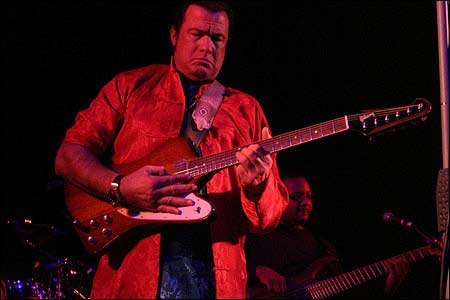
Actor Steven Seagal, who belongs to the homophobic (yet oddly homoerotic) Vladamir Putin cult, plays a reverse Firebird like the one that Ya Ho Wa 13 used. Coincidence?
UPDATE [06.16.14]: Okay, this is too great: I just shared this post with my pal/fellow Premier Guitar editor Charlie Saufely, who told me he played for a Ya Ho Wa 13 tribute band that performed in front of original band members when this film premiered at San Francisco’s Roxy Theater. Afterwards he got to jam with Djin, the guitarist. “It was a thrill,” Charlie says. “He was way more into skronking than blues jamming. We kinda went off on a Thurston-and-Lee, hail of sonic scree barrage. He had the Firebird … it was surreal. He reached over at one point and started scraping my strings with his fingernails. That was pretty sweet!”
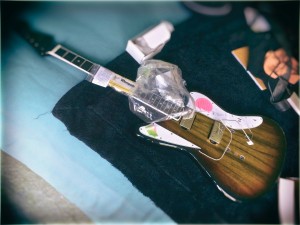
I just received from Warmoth all the parts for my next DIY guitar. I loved testing eight sets of P-90 pickups for Premier Guitar, but I don’t own any P-90-eqipped guitars.I will soon, though!
This one will be a bit of a platypus — as opposed to, you know, all my other other platypi. (The actual plural of “platypus” is “platypuses,” but “platypi” is more fun to type.) It’s built from Warmoth’s “split Jazzmaster” template, with a korina body, bound neck, Tune-o-matic/stop-tailpiece bridge, and a pair of hum-cancelling Fralin P-92s. Yeah, it’s kind of a stab-in-the-dark experiment, and not a inexpensive one. But hope springs eternal. Prepare to be bored with details!
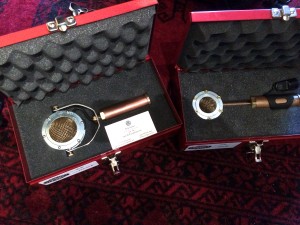
I’ve also just received an amazing-looking pair of condenser mics from Portland, Oregon’s Ear Trumpet Labs. ETL kingpin Philip Graham’s business card identifies him as “proprietor and bricoleur.” Bricolage, of course, is the ten-dollar word for “making stuff out of junk and other found objects.” Dig the steampunk vibe of that repurposed hardware! I haven’t even plugged these in yet (though the reviews I’ve read have been stellar). I just like staring at them! But I’m going to try them out at my monthly Strung Out! show tonight.
Ear Trumpet Labs’ Edwina and Edna models: a higher calling for found objects!
Which brings me another of this week’s highlights: I got to perform last night with my dear friends Teja Gerken and Adam Levy. Teja is an astonishing acoustic fingerstylist and a fine composer. His vocabulary has hints of Bensusan, Hedges, and classical, but he’s molded those influences into a thoroughly unique sound. And Adam, who I’ve known since my Guitar Player magazine days, is equally renowned for his jazz work and for accompanying such singer/songwriters as Norah Jones and Tracy Chapman. (I get to play some of Adam’s cool parts when I gig with Tracy.) These days Adam’s focusing on songwriting, and he his sings his “smart Americana” songs (my description, not Adam’s) in a sweet, soulful voice. Man, what a treat to hear both of them up close. And tonight, Adam, Shelley Doty, and I perform at my local dive, El Rio. Can life get any better?
Apparently so! Yesterday Premier Guitar posted John Bohlinger’s piece on the Pixies, which includes a pic of Charles “Frank Black/Black Francis” Thompson’s pedalboard, with my grubby, hand-built Duh fuzz pedal front and center. I’d originally made if for Joey Santiago, the other Pixies guitarist, but I guess Charles swiped it. Hey, I’d be honored if either guy spat on the thing! They’ve been heroes since I first heard the band in a small San Francisco club back in ’88. (Everyone went to hear the Sugarcubes, but left talking about that awesome opening act from Boston.)
Frank Black’s pedalboard: Lookit! I’m Pixies-approved!
It’s funny, because I really was thinking “Pixies” when I sound-designed the Duh. I was going for “bubblegum metal” — a thick, heavy sound, but not a macho one. The tone is too fizzy and funny for 100% sincere heavy rock, IMHO. It’s more of a “greasy kid stuff” distortion. (Note to readers under 45: That was once the tagline for a “dry look” mens hair product, referring to the outdated coiffures that would return with a vengeance when punk broke a few years later.) It’s a vaguely Muff-like sound, but with less compression, less scoop, and one big, stupid knob. I also like building that circuit into guitars. Like this one:
So it’s been a grand week, but a hectic one. Thanks for reading this far. Next week I promise a proper post, and not another collection of … odds & ends.
BBC dumbaas: "What are you going to do when you leave school? Take up skiffle?"
Aha! Now we know why no one has developed a cancer cure! It’s because young James Page took that skiffle thing a little too seriously.
Yep — it’s Jimmy Page at 13 in 1957. (He turned 70 this week.) Imagine how different the world would be had he followed his stated goal of becoming a cancer researcher. We’d probably have eliminated cancer 30 years ago, but our music would be a lot crappier.
As much as I love Pagey’s playing, I’ve long felt his greatest influence was as a producer. He defined what rock sounds like, largely via his unprecedented innovations in exploiting and manipulating reverberant spaces. Zep sounds like modern rock. Nothing before does.
Condescending BBC presenter: “What are you going to do when you leave school? Take up skiffle?”
Many years ago I was kicking that notion around with my friend Andrew Goodwin, the brilliant British media studies scholar. He expanded our ramblings into a journal paper, and gave me an entirely undeserved co-author credit. To this day, it’s my only academic publication. Andrew went on to create a Led Zeppelin course at the University of San Francisco. He was working on a Zep book when he died in a freak apartment fire a few month ago. I assume he was aware of this clip, though I’m not certain. He definitely would have loved it! I miss him.
What’s your favorite Pagey moment? I think mine is from one of those leaked studio outtakes, an excerpt from “Heartbreaker.” You hear the amp close-miked and claustrophobic-sounding. Then you hear it miked from a distance, spooky and reverberant. Then you hear both sounds together. Voilà — modern rock guitar.
My fave Pagey solo is — hehe — “Sympathy for the Devil.” Yeah — I still think he played that one.
Earlier this year I got to do a couple of shows with Marianne Faithfull, who prompted the song in the first place when she gave Mick a copy of Bulgalkov’s brilliant novel The Master and Margarita. We were talking about the song, so I figured it was my moment to finally solve the mystery.
“So who played the solo?” I asked.
She rolled her eyes and sighed. “I just knew you were going to ask me something idiotic like that.”
My pal Josh Hecht is making a documentary on Howlin’ Wolf. Josh, a noted engineer and audio instructor who came of age hanging out in Chicago blues clubs in the ’60s and ’70s, has corralled great interviews with the likes of Sam Phillips, Jimmy Page, and the late Hubert Sumlin, Wolf’s longtime guitarist. He also speaks with younger Wolf fanatics such as Dan Auerbach and Kirk Hammett. This work-in-progress will be cool indeed.
(Don’t be surprised that Kirk is a Wolf worshipper. He’s an extremely well-rounded listener, a lifelong guitar student, and an exceptionally cool and smart dude. Long after he became a star, he studied music a San Francisco State University, where Josh was one of his instructors. Josh shot cool footage of Kirk in his practice room, playing “Smokestack Lightning” on a funky old Epiphone — a Coronet, I think.)
Josh dropped me a note yesterday, telling me he was going over to Kirk’s to shoot additional interview footage, and asking whether I had ideas for further questions. Here’s what sprang to mind:
Many of the interviewees point out the things that rock drew from from Wolf: the riff-based composition, the power and aggression, the distortion. But it’s also interesting to consider the ways later players veered from Wolf’s path, and ponder what was left behind.
1. Take groove: Wolf’s rhythms are powerful but rubbery. The beat wobbles and floats like surfboard. The note placement floats relative to the beat, like a skateboard atop the surfboard. Today’s players are more like slot cars speeding along a pre-carved groove. We’re metronomic and predictable in comparison, even when not performing to click. Bands play together in tight lockstep, favoring even note values and motoric rhythms. Where did the looseness go?
2. Or take distortion: We’ve been in an overdrive arms race for decades, using fuzz pedals, heavier amps, aggressive signal processing. But doesn’t the relatively light distortion of Wolf’s guitarists permit tonal nuance, dynamic range, note-per-note color we can’t equal? So many of our tones are always on 10, squeezed to maximum density like toothpaste. What did we surrender to get there?
3. Or phrasing: Consider, say, Sumlin’s solo on “Shake for Me,” full of oddball phrases of uneven length. Today’s players tend to lock into a single type of vibrato. In “Shake,” there aren’t even two notes with identical vibrato. He smears in and out of notes in ways no one seems to do these days. It’s like we’re punching out notes on an assembly line, while Sumlin is carving each one individually from wood.
What happened? How might it have gone differently? Might any of those aesthetics return?
I have no idea whether Josh will use my questions, and if so, what response they may elicit. But what do you think?
Some inspiration:
Sumlin’s solo above isn’t quite as awesome as on the studio version, which may be my fave solo ever. (God knows, I’ve stolen from it often enough.) But still.
Oh man — I got to open for Television last night in San Francisco, accompanying storyteller Dennis Driscoll. These days the band includes original members Tom Verlaine, Billy Ficca, and Fred Smith, plus Jimmy Rip filling in quite capably for original guitarist Richard Lloyd. They’ve been doing shows where they play their debut album, Marquee Moon, in its entirety (though they mixed and matched songs last night).
Television recorded other cool records, including a lovely 1992 reunion album. But Marquee Moon is one of those instances in which an artist’s aesthetic is etched in stone from the beginning. The two-guitar interplay … the abstract, almost architectural arrangements … the contrasts between stiff and loose time … Verlaine’s free-floating rhythm and quavering 16th-note-triple vibrato—all were present from the get-go 36 frickin’ years ago.
Of course this picture of Television sucks—I took it! L-R: Fred Smith, Tom Verlaine and Jimmy Rip, with a little bit of Billy Ficca’s hair in the background.
I couldn’t help comparing Television’s artistic arc to that of their contemporaries, Talking Heads. Sure, the latter’s debut, Talking Heads ’77, is a classic, but had the band stopped recording after its release, we’d have only a vague inkling of what the group would become. More than once Jerry Harrison has told me that today’s bands rarely have the luxury of defining themselves over the course of several albums as Talking Heads did, slowly finding their audience and refining their sound. Today’s music business demands spectacular success from the start. A latter-day Talking Heads (if you can imagine such a thing) wouldn’t have the luxury of recording three albums before releasing a bona-fide hit like Remain in Light.
Most great musicians evolve over time—imagine how we’d regard the Beatles, the Stones, Springsteen, Prince, or Dylan if they’d thrown in the towel after one album. That, I think, seems intuitive to most of us. The talent is there—it simply needs time to reach its apogee.
But artists who seem to materialize fully formed mystify and fascinate me. I’m not just talking about Mozart syndrome, prodigies who display phenomenal talent while very young. Mozart grew artistically throughout his brief life. His juvenile works barely hint at the later masterpieces.
On the other hand, consider Charlie Christian, whose style was fully realized from his first recordings with Benny Goodman in 1939, soon after the guitarist’s 23rd birthday. At his initial audition/gig, this kid from Oklahoma was mocked by the Goodman band hipsters for his hick cowboy clothes—until he blew them off the bandstand with 20 consecutive choruses of “Rose Room.” It was the most radical guitar sound the musicians had ever heard. From his first sessions to his last a mere two-and-half years later, Christian’s style never evolved. It was perfect from Day 1.
Dig it! (Charlie’s solo starts at 1:10.)
Another fascinating case: I’ve always had a soft spot for Cheap Trick, though I don’t know their music exhaustively. Like many listeners, I relate more to the relatively raw live versions of their hits on the Budokan album than to the tepid studio originals. The Budokan version of “I Want You to Want Me” has so much more power and passion than the slow, limp, overdub-laden version on In Color. But it wasn’t till 1996’s Sex, America, Cheap Trick compilation that I encountered the original demo of “I Want You to Want Me.” And holy crap—it’s simply one of the most perfect rock and roll tracks ever.
Wow. No overdubs. Monster groove. Fabulous lead vocal. A perfect distillation of Elvis, Chuck Berry, and the Beatles. With all due respect to this long-running and hard-working band, I don’t believe they ever again nailed it quite like this.
Since I’m already probably picking fights, I may as well blurt out that I view the first Doors album and Are You Experienced? in a similar light. Not that Strange Days and Electric Ladyland aren’t great—just that both Hendrix and the Doors entered the public consciousness with their artistry fully formed, and that they never recorded anything that wasn’t implicit in those initial recordings.
Why do some artists just seem to come out of the chute fully mature, while others need time to realize their potential? And which ones would you include on a “Getting It Right the First Time” list?
Are there any particular guitar solos you’re obsessed with lately?
Here’s one I can’t stop listening to: Jim Hall’s solo on Sonny Rollins’ 1964 recording of “God Bless the Child.”
This may seem like a weird statement, given how much self-indulgent wanking infests this site, but I have a love/hate relationship with guitar solos. (Or more like a hate relationship leavened by occasional stirrings of love.) That’s especially true with singer/songwriter tracks. A good song drags you into its emotional world, and so often it strikes me as emotionally jarring to suspend the drama for a fretwork display. It can be like an ill-timed intermission in a great movie, as if you were watching Citizen Kane or Grand Illusion, and they paused the film two-thirds of the way through to bring out a juggling monkey.
That’s one reason I love this solo so much. Hall just plays beautifully all the way through. He’s like the Loch Ness Monster, undulating continuously just beneath the surface and gently lifting his head above the waterline when his moment comes.
Another is the sheer bravery with which Hall employs silence. Talk about pregnant pauses! It would be fascinating to transcribe only the rhythms of the solo, not even the pitches. The asymmetrical phrases. The late entries. It’s so suspenseful. So poignant. So unpredictable. So frickin’ brilliant.
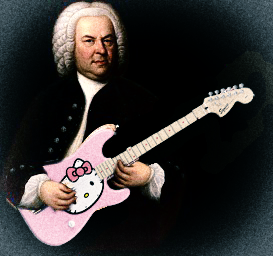
He’s such a genius, I almost feel guilty Photoshopping in a joke guitar.
Equally amazing is liquid blend of chords and melodies. For many players, that’s a binary distinction: Either you’re soloing, or you’re comping. This is just…music.
But the thing that amazes me most of all, I think, is Hall’s mastery of register. Baroque music scholars sometimes refer to a technique known as “compound melody,” best exemplified in the music of — who else? — J.S. Bach. Compound melodies are melodic lines that imply multi-voice counterpoint, even when they’re strictly single notes. A tune might center in one register, then leap high or low, establishing a beachhead in another register before returning to the original one. It then bounces back and forth between the regions, almost as if two tunes were being played simultaneously on adjacent channels, with the listener flicking back and forth between them.
I’m not sure I’ve explained that coherently. But Hall does it.
Jim Hall’s students (including Bill Frisell, whose playing this track so vividly anticipates) report that he kept a sign inside his guitar case that read “Make musical sense.” For many of us, soloing is about practice, practice, practice, and then when the moment comes, we turn off part of our analytical mind and hope that our instincts and muscle memory huck up something acceptable. But I get the sense that Hall, in pursuit of “musical sense,” never turns off his analytical mind. That’s not to say his approach is cold or scientific—he wears his heart on his sleeve here! But he’s always intelligent and thoughtful.
It’s said that improvisation is spontaneous composition. Sure, sometimes. But it’s rarely this spontaneous, or this composerly.
Gotta listen one more time—BRB.
Yeah, it’s still amazing. 🙂
So what are your current guitar solo obsessions? Any style. Any skill level. Anything that makes you feel intense things.
But for better or worse, I like being reminded that superhuman geniuses weren’t necessarily super in every regard. Maybe because it gives the rest of us hope or reassurance? Plus, it’s too easy to typecast artists into archetypes, like so:
…regardless of historical truth. Which is inevitably more interesting.
So What’s your fave bit of Bach? I can’t stop listening to the Wachet Auf cantata. Especially the famous part that happens at 14:40 in this recording. It’s kinda my favorite melody right now. :pacman:
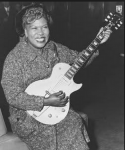
Sister Rosetta Tharpe — the most criminally underappreciated guitarist in rock?
NOTE:Nothing controversial about this post — it only involves race, gender, and religion!
A few decades ago, the standard history of rock and roll went something like this: In the mid 1950s. black R&B and white country music collided. White kids went apeshit. Rock happened.
That may hold a bit of water as sociological history, in the sense that, yes, white kids got hip to R&B in the ’50s, and the term “rock & roll” was adopted to describe the resulting craze. But as musicological analysis, it’s bullshit.
Today the knowledgable listener is likelier to realize that all the ingredients of early rock and roll percolated throughout African-American music decades before Elvis. (How can anyone with ears not perceive Louis Jordan’s 1949 recording of “Saturday Night Fish Fry” as a fully realized rock & roll track?)
Nowhere is “white guy-centric” rock history more apparent than when discussing the legacy of Sister Rosetta Tharpe (1915-1973). How is it that she is perceived as anything other than a genre-defining rock guitar innovator? If you don’t know Tharpe’s astonishing guitar work, check this out (especially the segment that starts around 1:45):
Watching the footage of Tharpe’s 1964 performance in Manchester, England, you can practically feel her spawning a thousand British rock bands. (And how telling is it that one of her goldtop Les Pauls wound up in the possession of Big Jim Sullivan, the preeminent British session player of the ’60s?)
![Should you embrace your hometown influences? Or flee them? [Pictured: West Covina dipshits.]](https://tonefiend.com/wp-content/uploads/West-Covina-300x210.jpg)