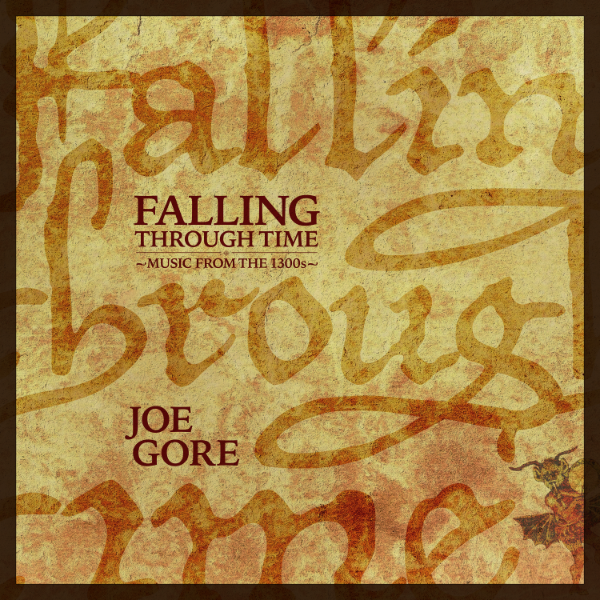
I’ve worked on many projects by many artists, but this is my first release under my own name. And it only took me 50 years!
It’s a back-to-the-roots project for me, though I have some fairly strange roots. When I was a teen I wanted to go into academia, specializing in early music (that is, European classical music from before 1650). Fate choose a different path for me, but I’ve always been fascinated by ancient music, especially the bizarre stuff that emerged toward the end of the Middle Ages. So this is a collection of music composed during the 1300s.
I followed a simple but strict “rule book”: I played only the notes and rhythms the composers specified, but I allowed myself total freedom in applying modern instrumentation and production. (As opposed to when I was young, when my goal, like that of most early music practitioners, was to perform the music as authentically as possible.) The resulting album is surreal, psychedelic, and, for better or worse, unlike anything I’ve ever heard.
This is a digital-only release for now, though I’ll do a vinyl pressing if there’s enough interest.
Me at age 17, playing my 15-string lute at — where else? — a Renaissance Faire. Yes, I was a dork even by 1970s standards.
I could say a lot more about the project, but I already did: I created a little booklet with credits, liner notes, background, and lots of amazing 14th-century images. It’s a free download from here:
I’ve been nursing the idea of arranging this most exquisite of Brian Wilson songs for multiple guitars for a long time. But two recent developments spurred me to finally do it.
Spirit of ’67 The first was my plan to record my first-ever solo album — a collection of heavily reinterpreted songs from 1967, tentatively titled Sixty-Seven Ghosts, marking the 50th anniversary of that memorable musical year. I was eight years old then, too young to play the music, but old enough that the music’s “ghosts crowded the young child’s fragile eggshell mind.” (I quote Jim Morrison, one of many crucial artists who debuted in that year.)
When I started playing music seriously a few years later, I had a sense that I’d missed the party, and that the music of ’67 was simply more meaningful than my early-’70s middle-school soundtrack. (I was wrong, of course. Subsequent decades have proven that if anything, the first years of the new decade produced at least as much great stuff. Yet 1967 had a mythic aura for me, and much of that year’s music has pursued me for a half-century.)
I wasn’t hip to “Surf’s Up” till those middle-school years, when the Beach Boys belatedly included the track on their 1971 album of the same title. The FM radio hits from that disc were “Long Promised Road” and “Feel Flows” — “Surf’s Up” was simply the record’s quirky coda. A few years later I discovered “Surf’s Up” lyricist Van Dyke Parks’ solo albums, with their similarly surreal lyrics and left-field song structures.
The Smile Mythos But I had no inkling of the song’s true provenance till some 20 years later, when pop fans began to grow obsessed with Pet Sounds and its “follow-up that never was,” Smile. Only then did I learn that “Surf’s Up” was originally from ’67, the intended centerpiece for that literally legendary album. By then we all knew the Brain Wilson crackup story, with its echoes of Greek tragedy. He’d held the music of the gods in the palm of his hand — so legend had it — only to have it ripped away by demons of self-doubt. Madness and self-destruction ensued.
My personal Smile mythology was heavily influenced by Lewis Shiner’s 1993 novel Glimpses (which I wrote about here). In it, a modern music fan realizes he can go back in time to the moments when great musical masterpieces were lost. (Sounds silly, but trust me — it’s not.) The highlight for me was the Wilson sequence, where our protagonist meets Brian at his peak moment of genius and fragility, right before everything went off the rails. The scene where Brian played the brilliant new songs for his hater bandmates haunted me: (more…)
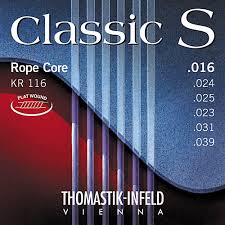
Ordinarily, these Thomastik-Infeld Classic S strings sound more like nylon strings than steel ones.
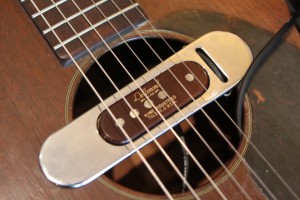
But their cores ARE steel — which means you can play through a magnetic pickup and mutilate the tone with amps and effects. I’m playing through effects designed for Apple’s MainStage software. (Some of them are in Logic Pro’s included sound library.)
I’m working on this version of Leonard Cohen’s “Suzanne” as part of album in progress: a collection of radically reinterpreted songs from 1967. I haven’t nailed down the final song list. (If you review the list of amazing songs from that year, you’ll understand why. And that link only cites the songs that charted, and doesn’t include classics like the first Velvet Underground album, some great Jobim tunes, random stuff like “Some Velvet Morning,” and lots more.) By hook or by crook, I hope to have the project done before year’s end in time to cynically capitalize on pay tribute to the 50th anniversary of that musically monumental year.
Some interesting tech notes: I’ve you followed this blog, you’re no doubt sick to death of my evangelizing for Thomastik-Infeld rope-core strings. But this is the first time I’ve put them on my Lowden S-25, my main acoustic guitar for nearly 20 years. Its default tone is super loud and bright. (Larry Fishman once referred to it as “a fucking cannon.”) But these days my ears are drawn to darker, softer tones. The Classic S transformed this laser-bright acoustic into an expressive crooner.
Meanwhile, I’ve become a bit alienated from traditional nylon strings over the years, but these, with their hybrid nylon/steel sound, hit just the right sweet spot for me. They’re extremely quiet (though they don’t sound like it when close-miked like this), but they have vast dynamic range and a smooth, sexy feel.
I’d previously written that this set is the same as the (cheaper in the U.S.) John Pearse Folk Series Fingerpicking strings, but I was mistaken. The story I hear was that the late Mr. Pearse, working with Thomastik-Infeld, devised this set for Brazilian guitar monster Bola Sete. But on the current Pearse set, the bass strings have nylon cores, while the Classic S bass strings have steel cores. That means you can use the TI set with a magnetic soundhole pickup, allowing you to plug into amps and effects. (I’ll be posting an example soon as a companion piece to this video.) But both sets sound lovely, and both allow you to bend strings as you would on an electric guitar — something you definitely can’t accomplish on conventional classical strings.
I don’t have a ton to add about the sublime Leonard Cohen. But “Suzanne” has always exerted a deep emotional spell on me — even, as here, minus the lyrics.
I recently reviewed the gorgeous little Veillette Avante Gryphon for Premier Guitar and liked it so much that I bought one. This was my first opportunity to record it in my studio.
The Avante Gryphon is a relatively low-cost version of Woodstock luthier Joe Veillette’s Gryphon, an 18.5″-scale 12-string designed to be tuned a minor seventh (an octave minus two frets) above standard. But while 12-string guitars feature octave-tuned string pairs, here all six courses are unisons, as on a mandolin. In fact, the Avante Gryphon sounds a lot like a mandolin, but with a wider range and guitar-like tuning. And unlike the couple of janky plywood mandolins I own, it plays gloriously in tune. It’s made (very nicely!) by Korean CNC robots and sells for $1,400, as opposed to $4K+ for Veillette’s hand-built models.
For years I’ve been looking for the right upscale mandolin, but now I’m happy I found this instead. My original motivation was a high-tuned soprano instrument for multi-guitar arrangements, or for magic-fairy-dust studio overdubs. But the thing is so fun — and sounds so darn pretty — that I can’t stop playing it solo. This Bach prelude, for example:
I won’t recap my review here—check it out if you’re curious. Instead, let’s yak about Johann Sebastian! (more…)
I needed a 12-string acoustic in a hurry for a session, so I picked up a new Taylor 150e for under $700. It wasn’t a review model or anything — I just ordered one online, sight unseen and sound unheard.
This model has been generating much buzz as an affordable yet good-sounding 12-string. It’s savvy positioning on Taylor’s part: I suspect there are many players who, like me, would love to have a nice 12-string, but aren’t about to spend $2,000+ for that occasional color. Anyway, I’m duly impressed. Have a listen!
I’ve got it strung with a super-heavy set from Pearse, and it’s a bit too macho for me. I dig the volume and harmonic richness, but it’s a beast to maneuver, at least for complex fingerstyle stuff. Either I’ll restring with something lighter, or consider testosterone supplements.
I haven’t owned a 12-string acoustic since I was 13. My first decent acoustic guitar was a late-’60s Fender Villager 12-string purchased for under $200. I loved it, but unfortunately, the shop that worked on it removed the tone bar, an essential brace. Uh oh — after a couple of weeks, I opened the case to find that the guitar had imploded on itself overnight. Instead I got a Yamaki 6-string, a crappy Yamaha knockoff. I’ve spent years in therapy working through the trauma.
The 150e is a Mexican-made instrument with a solid spruce top and a layered sapele body. I didn’t even realize till I received the guitar that it included onboard electronics. I almost never use that stuff, but before typing this, I went to plug it in. And guess what? It’s a surprisingly decent-sounding system that relies on an internal microphone. It doesn’t sound as good plugged in as it does in the video, but it’s totally acceptable for stage use. I didn’t expect it to sound half as good.
Anyone tried one of these? Any other acoustic 12-string recommendations, observations, or rants? What’s the coolest 12-string riff? And who’d win in a fight: Leo Kottke, Ralph Towner, or Leadbelly?
No longer ridiculously expensive. Now they’re just very expensive.
I spent last week covering the Musikmesse musical instrument trade show in Frankfurt, Germany, for Premier Guitar. I had a blast, and Chris Kies and I posted details and pics of more than 70 new products. (Here’s the short list of our personal faves.) Kies shot lots of video, and will be posting more than 50 demo segments to the PG site in the coming weeks.
But Messe is hellishly loud, far noisier than NAMM. When I finally got home and picked up a guitar, it was an acoustic. I was trying something new, based on info I obtained from Mary Faith Rhoads-Lewis, CEO of Breezy Ridge, a company that distributes several brands for acoustic musicians, including John Pearse strings.
I’d previously geeked out here about about the strangest and most expensive guitar strings I’d ever tried: this “rope core” set from Austria’s Thomastik-Infeld. Reader/cool guy Al Milburn turned me on to them, and I wrote about them here. And I recently posted this video demonstrating how the transformed my old Martin 0-17 into a compelling steel/nylon hybrid with a unique and expressive voice.
Anyway, Ms. Rhoads-Lewis told me that the late John Pearse originally created this set for Thomastik, and that the John Pearse Folk Fingerpicking set [PJ116] is identical to what the Austrian company sells. Best part: You can get them in the States for under $20, as opposed to a walloping $35 for the Thomastiks. She also told me that their magic works in reverse: You can put this relatively low-tension set on a classical guitar for a very different sort of hybrid steel-string sound. (This, she said, is exactly what the great Brazilian player Bola Sete used to do.)
I popped a set on my old Yairi classical. The feel was — totally strange, and in precisely the opposite way as on the Martin. The tone was edgy and exciting, but the tension seemed a little too extreme. If just seemed a little too … high-strung, in every sense. Then I tried lowering the entire tuning a whole step, with the sixth dropped all the way to C.
And … oh, my. Check it out:
Summary: Holy cannoli, I love how this sounds. And there’s something psychologically satisfying about the transformation too. See, this guitar has always been a bit … tragic to me. I got it when I was 16. My classical guitar prof at UCLA said I needed a better instrument, and my every-supportive folks, bless ’em, helped me buy this Alvarez Yairi for around $700 (in 1970s dollars). It was a top-tier model for Alvarez, signed by luthier Kazuo Yairi, and boasting lovely Brazilian rosewood backs and sides. It was a huge upgrade for me, but as I got deeper into classical playing, its shortcomings emerged. Had I not shifted my studies to composition, I’d have needed to upgrade again. I envied the Igancio Fleta y Hijos models my two teachers played, but at around $3,000, they were beyond my budget, even with parental help. (Pity — their current value is approaching $50,000.) So I’ve used this instrument as a limited but decent-sounding model suitable for pop work, if not serious classical concertizing. (more…)
This post is inspired by in interview I just did with Mississippi Allstars guitarist Luther Dickinson, a cool dude and a deep player. I’m digging the band’s new album, World Boogie is Coming. (And for better or worse, that praise comes from someone who hates almost all modern blues albums.) You can read the interview here.
Anyway, Luther was talking about how his entire style is a quest to create a loud, electric version of acoustic country blues. He mentioned how he was more drawn to the Mississippi blues players who went electric by slapping DeArmond pickups on their acoustics, as opposed to, say, Muddy Waters, who swapped his acoustic for a Telecaster. Luther also mentioned that DeArmonds are still his favorite way to amplify an acoustic guitar
At some point it occurred to me that I’d never actually played an acoustic with a DeArmand. So I picked up a 1950s RHC-B and popped it into my old Martin 0-18. Have a listen:
I’m a longtime fan of magnetic pickups on acoustic guitars. I had a Sunrise in my Lowden for 15 years and loved it, but it croaked last year. I replaced it with one of those hybrid models that combine a mag pickup with an internal mic, and it works fine. But after a year or so, I don’t think I’ve ever used the mic sound. I just like the way the mag pickup sounds.
But is it still acoustic guitar? I’m not sure. I increasingly view amplified acoustic as a guitar category unto itself, residing somewhere between acoustic and archtop.
And the DeArmond? Between its noisiness and reticent highs, it’s probably not the best choice for every occasion. It’s also a bigger pain to install and remove than modern mag pickups. But I dig how it sound in the video, and I’m definitely keeping it!
So what’s you experience with amplifying your acoustic guitars?
Tonefiend Book Week is simple: I discuss a few titles I’ve found particularly enlightening, useful, or entertaining, and then you jump in and do the same. I’ve organized the days of this week by subject matter. Today’s topics are repair and DIY.
I’m indispensable.
Sorry in advance if my faves in this category are a bit predictable!
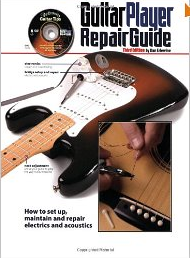
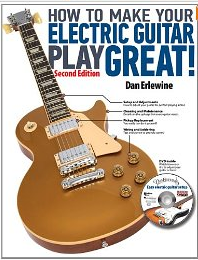
For any repair topic, I turn to the redoubtable Dan Erlewine. Dan knows his stuff like no one else, plus he’s a terrific writer, with a rare talent for explanation and a charming sense of humor.
Dan has serviced the instruments of countless great players. (I’d insert a list, but it might wear out my comma key.) Better yet, he makes comprehensive notes and measurements. You learn much about, say, Albert King, just by studying Dan’s numbers.
Now, I’m the furthest thing from a guitar tech. (Just ask San Francisco’s brilliant Gary Brawer, who regularly rescues my guitars from clumsy abuse and ill-considered DIY attempts.) But for players who simply need help with basic setup, maintenance, and modification tasks, Erlewine’s books — The Guitar Player Repair Guide and How to Make Your Electric Guitar Play Great — are godsends. Get ’em both. You won’t be sorry. (The digital versions live on my iPad for workbench reference.)
I’m indispensable too!
I never had the pleasure of editing Dan’s columns when I worked at Guitar Player — Jas Obrecht jealously guarded that privilege. But the entire staff would laugh itself silly over Dan’s April Fools columns, like the one where he explained how to install a Floyd Rose tremolo on a pre-War Martin. (If I recall correctly, the process involved filling the body with cement.) Another year, he suggested using kitchen objects as lutherie tools. The photos included a kitchen table used as a clamp for a glue job on some über-valuable axe. (Touch of genius: The pic showed the poor guitar being crushed by a weighty trestle table, where Dan’s kids sat enjoying large bowls of breakfast cereal.) That one prompted a very famous guitar maker to write a shrill letter to the editor. (“It’s highly irresponsible for Mr. Erlewine to recommend using a heavy kitchen table as a clamp. Proper clamps don’t even cost that much!”) The luthier followed this with a frantic phone call, explaining that someone had alerted him to the joke, and begging us not to run the letter. We didn’t. (Dagnabbit!) (more…)
Next week at tonefiend we’ll be talking about our favorite guitar/music books. I’ll write about some of the titles I find especially useful, inspiring, or entertaining, and I hope you’ll chime in with some of your recommended reading.
Since there’s so much potential material here, I suggest we focus on a different book category each day. Here’s my proposed schedule:
Friday, June 7th: Fiction (guitar mag product reviews don’t count)
Tonefiend Book Week is strictly an experiment, and a selfish one at that. If the past is any guide, the obsessive geeks experienced and sophisticated players who frequent this site will introduce us to lots of lively lutherie-linked literature. And I’ll do my best to keep up!
So scour your bookshelves, real and virtual. This shit is about to get real promises to be a most edifying conversation.