I’ve just tested the first final production model of my long-promised Cult Germanium Channel. As usual, it sounds even better than my funky hand-built prototypes. These will be available in just a couple of weeks from my distribution partners, Vintage King.
There core circuit is the same as in my Cult overdrive. I’ve added a great-sounding active EQ, tuned to just the right frequencies, plus a new input stage with variable capacitance (translation: a sort of “crisp vs. fat” control). There’s much more info on the Joe Gore Pedals product page.
My apologies that this release has taken so long! I hope some players find it worth the wait.
Here’s the info from the product page at gorepedals.com. Pardon then obnoxious use of the third-person.
OVERTONE OVERDOSE
The Joe Gore Screech is descended from vintage octave fuzzes like the Ampeg Scrambler and Dan Armstrong Green Ringer, but it’s not a clone. It provides much clearer octave overtones, and you don’t need an extra booster for great results.
Most octave fuzzes work best when you play near the 12th fret using the neck pickup. But Screech provides potent octaves regardless of neck position or pickup setting. It also does fine non-octave fuzz. A common mod for octave fuzzes is to add a switch that switches of the diodes, removing the octave effect. The problem is, the resulting sound is dull as dirt. Here, though, though non-octave fuzz is sufficiently fiery and dynamic to stand on its own.
Unlike most things Joe Gore makes, Screech is not especially dynamic. It needs consistently heavy gain for its powerful octave effects. But as on many vintage octave fuzzes, you get freaky harmonics and other interesting noises when you lower your guitar’s volume control.
Screech runs on standard 9-volt batteries or power supplies. It was created in San Francisco by Joe Gore and is built in Michigan by skilled craftspeople paid a fair wage. It comes with a lifetime warranty.
TO USE: The single knob is a master volume. (There’s no gain control because this circuit demands high gain to generate such strong octaves.) When you hit the DIST footswitch without the octave (OCT) engaged, the LED glows red. With the octave on, the light is yellow. (You can’t use the octave section without DIST activated.)
When Screech is bypassed, you can specify whether the octave will be engaged when you activate the pedal. If the LED glows green, the octave will be engaged when you hit DIST. If the LED isn’t glowing, you’ll get non-octave fuzz when you step on DIST.
BACKGROUND INFO FOR PEDAL GEEKS: Here’s an article and video I put together a few years ago, demonstrating all the classic octave fuzz circuits. Toward the end I show an early prototype of the circuit that would become Screech. It’s evolved since then, so don’t consider this a proper demo. It’s just some amusing pedal geekery. 🙂
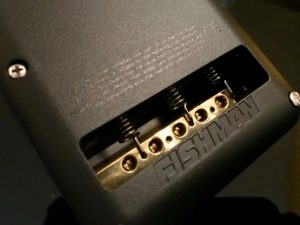
I’ve been following the story of Fishman Fluence pickups and their radical pickup design for a few years. From the beginning, I’ve thought Fluence pickups sounded great in the hands of some other guitarist, but this is the first chance I’ve had to experiment with my own set.
Most of the tech details are in the video. But in brief: These are active pickups with magnets, but no wire coils. Instead, the “coils” are printed on thin pieces of circuit board glued together like plywood. This design removes all noise and hum — chances are these are the quietest single-coil-sounding you’ll find. (Fishman also makes humbuckers and Tele pickups.) They can run on 9-volt batteries or (this is the other interesting part) a separately sold battery pack that replaces the trem cavity back plate. (There are other battery configurations for other guitars.) Another marquee feature: Each Fluence set includes a push/pull pot to switch between vintage voicing and a hotter “modern” sound.
This technology originated at an aerospace company. Someone there realized that their printed coils might work on musical instruments, and they contacted a leading pickup manufacture, who passed on the idea. Next it went to Larry Fishman, who was all over it from the get-go. He refined the idea and came up with lots of clever engineering to make it work in guitars. [DISCLAIMER: I have been paid in the past as a freelance contributor to Fishman products, but no one paid me to post this.]
To my ear these sound perfectly authentic, though the fact that they’re active is problematic for me personally. (That’s because I use so many retro stompboxes that don’t play well with the active pickups, which are buffered. The same goes for most of the pedals I sell.)
Killer, indeed!
While installing this in my much-abused MIM Strat, I also added a heavyweight bridge, trem block, and claw from Killer Guitar Components. I’m not kidding when I say “heavyweight” — it’s a formidable piece of metal, beautifully tooled. It feels like a major improvement on the standard design, and I think it sounds great as well (though it’s hard to be definitive about that without side-by-side comparisons). My favorite feature is the way the string inserts are chamfered — strings pop in correctly every time, which. as any Strat player can tell you, it not always the case. Killer, indeed!
It was a longer and harder process than I’d ever imagined, but the first of my four new pedals is finally released and in stock now at Vintage King.
Here’s my product demo:
And here’s a just-posted “First Look” video from John Bohlinger at Premier Guitar:
Man, it’s always such a trip when you tinker with an effect and play it in isolation for years, and then hear it being played by someone else. But I couldn’t be luckier: The first person who ever played one beside me was the stupefyingly talented Blake Mills. (He dug it, and he got the very first production model). And now, another performance by another of my favorite players. Pinch me!
There’s lots more info about Porkolator on the Joe Gore Pedals product page. As I explain, this is a highly mutated version of a circuit that was pretty bizarre to begin with: the Interfax Harmonic Percolator. There is so much bad info about the original pedal floating around. Everyone seems use a couple of phrases over and over: “tube-like” and “even-order harmonics.” Wrong and wrong! Everyone’s just copying something (incorrect) they read somewhere else.
A few years ago, I did a story on the Harmonic Percolator and its boutique DIY spinoffs. Even if you don’t especially dig the pedal, it’s an interesting study in how an effect gets tweaked and modernized. Here’s the accompanying video.
At the end I demonstrate an early version or Porkolator, though it’s changed so much that you can’t really compare. I gave this original to famous drummer and not-as-famous guitar player Matt Chamberlin during a film score session. Like many of my hand-built prototypes, it promptly broke. Fortunately, the new ones are built by the talented professional at Cusack Music. I just designed the damn things.
Fender’s Telecaster Deluxe has had an interesting and checkered history. Once regarded as yet another mediocre product from the company’s era of CBS ownership, these turn-of-the-seventies instruments now fetch huge prices on the collector’s market. I’ve never owned own. But when singer/songwriter Greer Sinclair loaned me one of Fender’s 2010 reissues, it was time for research — and experimentation.
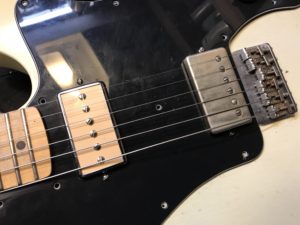
The made-in-Mexico 1972 Deluxe reissue is a cool guitar. It replicates many details of the original: the oversized headstock, the Strat-like belly cut and fixed Strat-style bridge, and the big-ass pickguard. But its pickups are definitely a departure. In lieu of the original’s large-format “Wide Range” pickups, it employs a P-94R (a humbucker-sized P-90 spinoff) at the neck, and a conventional Gibson-style humbucker at the bridge.
The Wide Range pickup was a unique beast. Fender had commissioned Seth Lover, the man who invented the Gibson humbucker, to create a Fender humbucker in hopes of cashing in on the growing popularity of hard rock. With DC resistance in the 10k range, the new Wide Range pickup was a bit hotter than a vintage Gibson humbucker. Wide Range pickups appeared in several of the era’s models, including the Tele Thinline, Tele Custom, and semi-hollowbody Starcaster.
Gibson humbuckers have a bar magnet within, but the pole pieces are not magnetic. But on Wide Range pickups, the pole pieces are magnetic, as on Fender’s single-coil pickups. Situating individual magnets closer to the strings yield a brighter sound with greater note defition and string-to-string separation — characteristics we associate with vintage Fender pickups. So the Wide Range pickup lent a uniquely “Fender” twist to the Gibson design.
Wide Range pickups are slightly larger than conventional humbuckers. Most of Fender’s circa-1970 Tele reissues substitute generic humbuckers of the standard size. Standard humbuckers can sound superb in a Tele, but they’re horses of different colors. Fender has also created some reissues with the larger-sized pickups, but these are also garden-variety humbuckers — the larger format is purely cosmetic. The pole pieces of the factory humbucker on Greer’s guitar don’t align with Fender’s wider string spacing. (But one thing I’ve leaned from my various Fender/Gibson hybrid experiments is that sonically, this can matter very little.)
The P-94R’s cream-colored top looks wicked against the guitar’s finish. It’s a warm, full-sounding pickup from the mellower side of the P-90 spectrum. Actually, it doesn’t sound all the different from a traditional Telecaster neck pickup. (Like that pickup, it works quite well for jazz.) Note, though, that its dimensions differs substantially from those of a Gibson P-90, as you can the in the photo where it sits alongside a historically accurate Lollar P-90. When you change the size of a pickup’s components, you inevitably alter the sound. The tones can be for better or worse — but they will be different.
Despite being obsessed with Charlie Christian for decades, I’ve never played a Gibson ES-150, the guitar he made famous. I’ve never even messed with a “Charlie Christian pickup,” even though it’s been a fairly common retrofit ever since the late Danny Gatton installed one in his Tele’s neck position. But I’ve always wondered: Could the C.C. pickup work in styles other than jazz? How would it sound in the bridge position? (The ES-150 had only a neck pickup.) And most of all, how would it sound with nasty fuzz?
Lollar Pickups helped me answer those questions with a loaner of three humbucker-sized Charlie Christian pickups. These differ cosmetically from the originals, lacking the cumbersome mounting hardware and the ornamental top plate. But they’re convincing sound-alikes, with similar magnets, wires, windings, blades, and modest output. (Their DC resistance is just under 3k ohms). Here’s what I discovered!
Clearly, it’s not a pickup for every rock guitarist (though it’s perfect for a swing-era jazz sound). Still, I found its non-jazz sounds strange and compelling, and I can definitely imagine using them in the studio. What do you think?
While making comparisons, I spend hours reacquainting myself with Charlie’s recordings, of which there are only a few dozen. His career was absurdly brief — it was less than three years from his first recordings with Benny Goodman through his death from tuberculosis (and probably other bad stuff) at age 25. But that was long enough to forever alter the guitar’s history.
Here’s a new guitar I put together using Warmoth parts and Lollar Gold Foil pickups.
Around the time I started assembling the Resistocaster, I reviewed the cool new Supro Westbury — another guitar with gold-foil pickups — for Premier Guitar. It was an interesting juxtaposition, because the Lollar pickups are cloned from the models in vintage Teisco guitars from Japan, while the nouveau Supro pickups are based on the gold foils made in the ’50s and ’60s by Chicago-based Valco and used in several of the brands the company produced.
While the two sets don’t sound identical, they have much in common. Both provide full-frequency tones, with warm, cushy bass and open-sounding highs. Like vintage lipstick tube pickups, they have an attractively “hollow” character that always reminds me of an acoustic guitar. Gold foils are gorgeous for clean sounds, while overdriven tones are big and buttery, albeit it rather loose-sounding. (Though adding a bass-cut circuit to this guitar let me dial in tighter sounds.)
Another odd property: With almost all pickups, pulling back the guitar’s level cleans up tones on overdriven amps and dynamically responsive distortion pedals. (That behavior is pretty much the entire premise of my Cult pedal demo.)
But with gold foils, that just doesn’t work! As you lower the guitar volume when playing through distortion-producing gear, tones don’t clean up — they get a little quieter, then sputter out in the pot’s lower range. This isn’t intrinsically a good or bad thing, but as a player who tries to exploit the tonal shifts produced by varied guitar output, I was startled by this property.
At NAMM, I mentioned this behavior to Ken Calvet of Roadhouse Pickups, who created the Valco-style gold foils for the new Supros. He nodded in acknowledgement, and said it was due to the idiosyncrasies of the rubber magnets used in gold foils. (I probably wouldn’t understand the science even if he’d had time to explain it to me.)
But while it took me a while to get comfortable with the gold foils’ unusual dynamic behavior, I needed zero time to fall in love with their warm, character-rich tones. (This, by the way, is the same set of gold foils I recently demoed in my alternative Strat pickups video.
I love how this guitar turned out, and I expect to use it a lot this year. 🙂
I should have been out buying nice presents for you all. Instead I sat around inhaling solder fumes. When the smoke cleared (mostly, anyway) I’d tested ten unusual Strat pickups in the same poor guitar.
Verdicts? I dig them all, and not just ’cause I’m too polite/chicken to say otherwise.
I love the Lollar Gold Foils so much I’m assembling a new parts guitar to surround them. I’m going to keep the Fralin Big Singles in the demo Strat, at least till the next Mongrel Strat Project. I’m going to try putting the mini-humbuckers in a “parts” Tele at some point. I originally reviewed the Lollar P-90 set for Premier Guitar (where I evaluated them the “right” way: in a Gibson guitar), so they go back to manufacturer, though I’d sure like to own a set someday. Meanwhile, the Allparts set isn’t in the same league as its high-end competitors, but at a mere $30 per pickup, it costs about 1/4 the price of its expensive rivals. You could definitely do a lot of lo-fi damage with a pair of these surprisingly solid-sounding pickups!
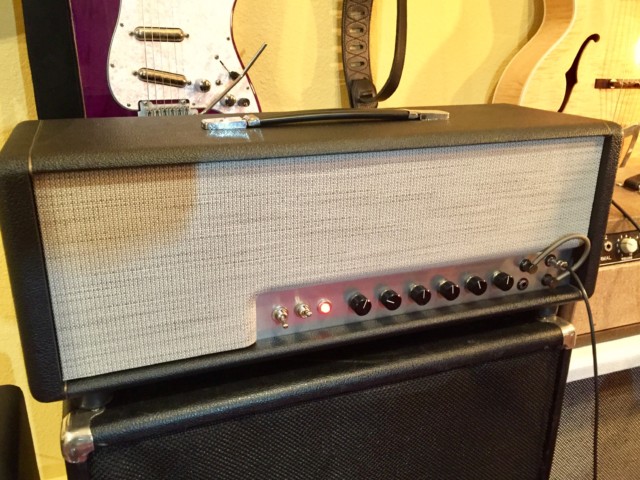
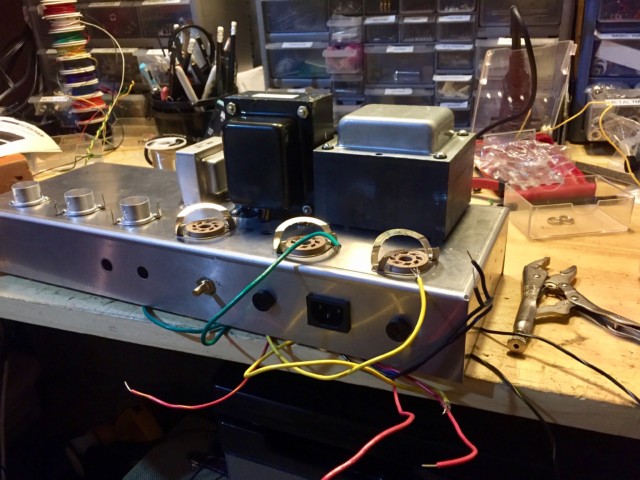
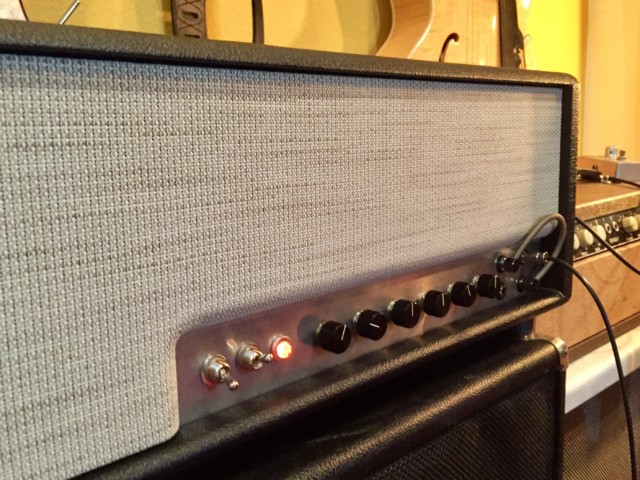
I almost always play small combo amps of 20 watts or less. But I wanted something with a bit more clean headroom for a possible upcoming project — and to demo my stompboxes. I’ve always enjoyed playing JTM-45s when I’ve reviewed them for guitar mags, so I ordered Monotone’s British 45 kit.
I’d previously had a great experience building Mojotone’s Marshall 18 watt clone kit when I reviewed it for Premier Guitar a couple of years ago. It turned out great, and I use it regularly.
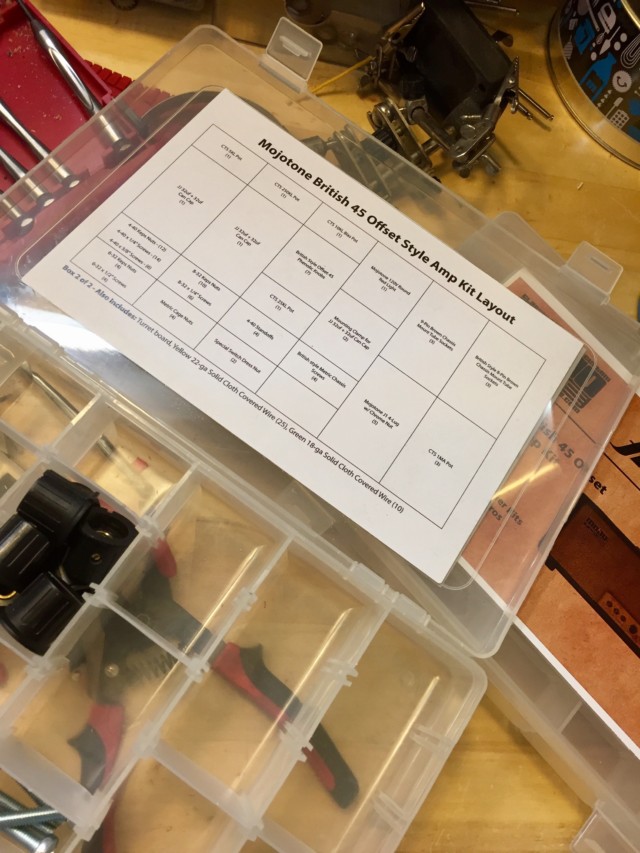
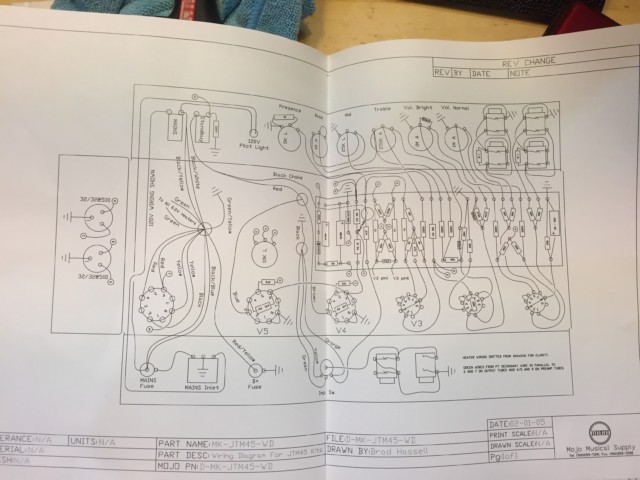
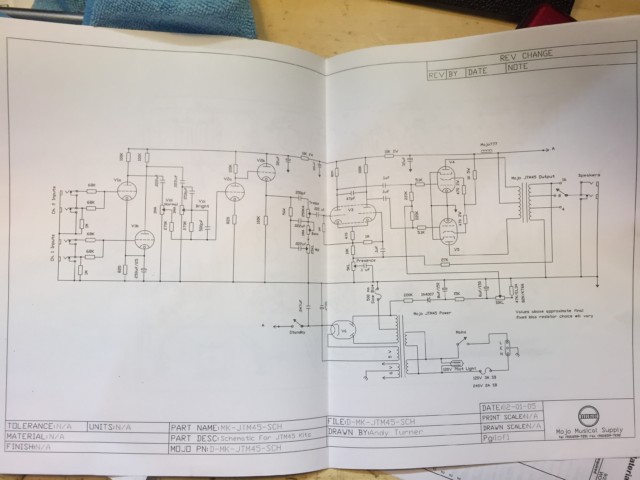
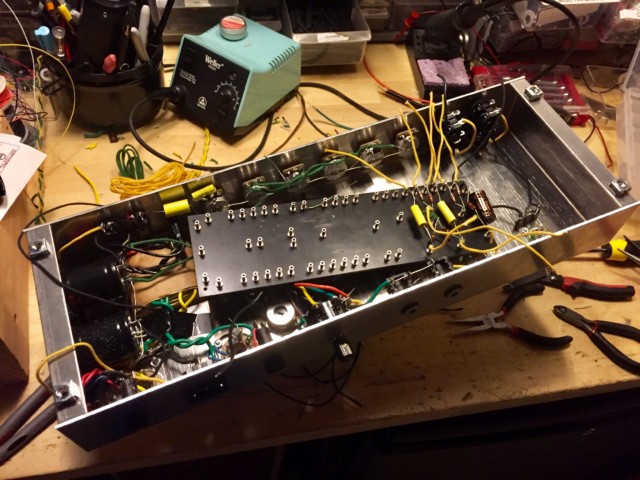
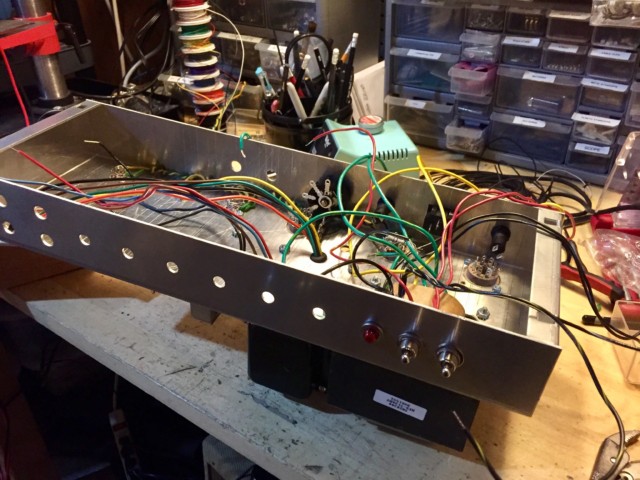
Mojotone provides high quality parts, nearly labelled and organized in plastic compartmented boxes. But beware: The company provides no build instructions — just a layout diagram and a schematic. You need amp building experience or help from an expert. Click play for a slideshow about he build:
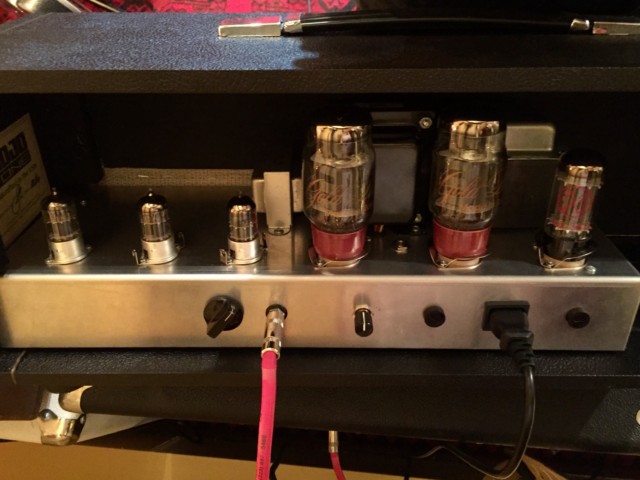
This is Mojotone's new offset head cabinet. (The amp chassis first in other Mojotone cabinets as well.)
The two power tubes can be either EL-34s or KT-66s. (I chose the latter, just for a new experience.)
The parts come neatly labeled and organized in plastic bins — a BIG help!
Warning: the kit includes no build instructions — just this layout diagram and a schematic.
I ALMOST managed to assemble it, but I needed a rescue at the end. (Thanks to Bruce Clement of BC Audio, a brilliant boutique builder here in San Francisco.)
Mojotone supplies their own branded transformers (which sound fab).
It's a turret board build. (The board and turrets are pre-made, as opposed to some kits, which require you to insert the turrets yourself.)
This is probably not a good first build — maybe start with a nice little tweed Champ kit?
The a plexi faceplate, which I left omitted. I also substituted my own knobs.
I nearly made it through myself. (Translation: I soldered everything together and it didn’t work.) So I had to hire Bruce Clement of BC Audio here in San Francisco to rescue me. (Bonus: Bruce loaned me one of his JTX50 heads. Man, it’s one of the best-sounding Marshall derivatives I’ve ever heard. It’s among his Octal-Plex series amps, which use octal preamp tubes in Marshall-inspired designs.)