Categories
DIY Effects guitar

Fuzz Face:
The Daiquiri of Distortion Pedals?

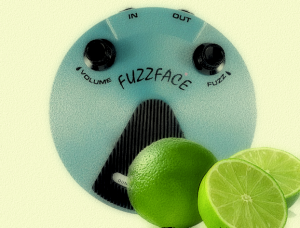
fuzzlimeMost sentient guitarists love Hendrix, but not everyone is equally fond of his signature distortion pedal.

So what’s your take on the Fuzz Face?

I used to hate them — but only because my sole exposure to them was via the crappy reissues of the ’70s, ’80s, and ’90s. They sounded so brittle and harsh! Not till this century did I encounter the pedal in its original incarnation.

What a difference!

Vintage-style Fuzz Faces produce tones that are warm, rich, and unbelievably dynamic. It was like the first time I tasted a vintage-style daiquiri. Like the Fuzz Face, the classic daiquiri is a delicate concoction made from a few simple yet complexly interactive ingredients — nothing like those nasty blended drinks that taste like Slurpees spiked with Everclear.

Here’s everything I love about vintage Fuzz Faces, compressed into 60 seconds:

My DIY version is based on inventor Ivor Arbiter’s original 1966 schematic. That’s also the basis for a new DIY project created by my stompbox-buildin’ pal Mitchell Hudson, who runs the cool DIY site Super-Freq. We’ll both be posting it on our sites in the next few days. You can source the parts on your own, or order a kit for less than $50 — not as cheap as some of our other DIY projects, thanks to its two relatively pricy germanium transistors.

Most lore about “mojo” stompbox parts is utter nonsense, but there is something harmonically unique about the germanium transistors used in ’60s fuzz pedals, including original Fuzz Faces. (See my “Germanium Mystique” post/rant for more info.) You don’t need germanium for a good fuzz sound — there are many great tones available via silicon transistors, integrated circuits, and digital modeling. But one problem with those god-awful Fuzz Face reissues was that they often simply substituted high-gain silicon transistors for germanium ones without modifying anything else in the circuit. The result was more gain, but at the cost of harsh, excessively bright tones and inferior dynamic response.

In the last decade or so, builders have wised up. Numerous manufacturers offer authentic ’60s-style replicas. Meanwhile, the DIY community has created countless variations, many of which use post-germanium parts to great effect. These days it’s pretty easy to find a Fuzz Face that doesn’t suck.

I’ve build many Fuzz Face variants, but until Mitchell created his Fuzz Face project, I’d never done a strict original, with positive-ground wiring, PNP transistors, and few latter-day “refinements.” (Don’t sweat it if those terms mean nothing to you — they’re all explained within the project.)

Anyway, that’s the circuit you hear in the video above. It’s not a fuzz for all seasons — it doesn’t have a ton of gain, and its loose, spongy distortion is unsuitable for metal and modern hard rock. But I love its warm, non-macho timbre and phenomenal dynamic response. It’s simple, classic, and delicious, much like this.

Categories
DIY Effects guitar

The MacGuyver Flanger & Other Goodies

MacGuyver Flanger

My pal Jeff Cross from Apple sent me a brief email:

please tell me you’ve seen these…

https://www.youtube.com/watch?v=PSsl1h8RhqU

https://www.youtube.com/watch?v=XT7bsX2qNWQ

https://www.youtube.com/watch?v=rC170m-Hcyg

No, I had not. And they’re soooo good. All three are from YouTube user MotorGoblin. I don’t know anything about him, beyond the fact that he’s clever, funny, and very musical.

Anyone have any similar techniques to share? (I’ve been meaning to do a post on my “plastic tube Leslie”…)

Categories
Digital DIY Effects guitar Music

Pinn Panelle’s Derek Song:
12 Million Views and Counting

Pinn Panelle's Derek Song.
Pinn Panelle’s Derek Song.

A highlight of this year’s NAMM show was hanging out with Derek Song, a 23-year-old digital guitarist whose band, Pinn Panelle, has racked up an astonishing 12.5 million YouTube views with their realtime cover versions of electronic music hits, especially their version of Skrillex’s “Scary Monster and Nice Sprites”

Song, a Berklee College of Music grad, is DIY personified. He’s developed his own innovate guitar controllers and written custom software to milk them to the max. Those hit videos were shot on a shoestring. A Kickstarter campaign financed the Pinn Panelle’s last tour, where they brought live-band energy to DJ-driven EDM concerts and festivals. And the group has created two full albums without help from a label, including the just-released Ghosts and Liars. (However, days before the album’s release, the group’s bassist and keyboardist left the band. Now Derek and drummer Justin Conway are plotting their next moves, though Derek says Pinn Panelle will continue.)

Derek, a blisteringly smart guy with a friendly, unpretentious attitude, was kind enough to let me drag him into a relatively quiet corner of the NAMM show, shove a recorder in his face, and bark questions at him.

But first, that video again:

You’re a music-school dude.

I grew up in Glenview, Illinois, but moved Boston to go to Berklee because I knew I wanted to pursue music and new ideas. When I got there, I figured out that I would waste the least amount of money by pursuing electronic music production rather than performance. I’m not docking performance — some kids get so good at it! But I’ve always been more of a self-learner. I’m a terrible student, especially when I’m given exercises. I just want to play the ideas I have in my mind, and as long as I have the facility to do that, I don’t care about additional technique. But the Electronic Production and Design program at Berkeley had so many cool avenues for exploration, and I knew that technology was the future.

Did you always tinker with tech?

Well, one thing that influenced me as a composer and technologist was the fact that my dad used to fix TVs. Later on, when I started developing my own controllers, I’d work on them with him, and that’s really inspired me musically. When I first started playing in bands, my dad and I invested in a Boss GT-6 multi-effect pedal. I never used stompboxes because I could never afford them! But I read the Boss manual till I knew that thing like the back of my hand, and I still use that GT-6. Basically, I hacked it. I discovered some functions under the surface that open up a lot of opportunities for controlling specific effect parameters.

For example?

Categories
DIY Effects

A Generic Stompbox Wiring Diagram

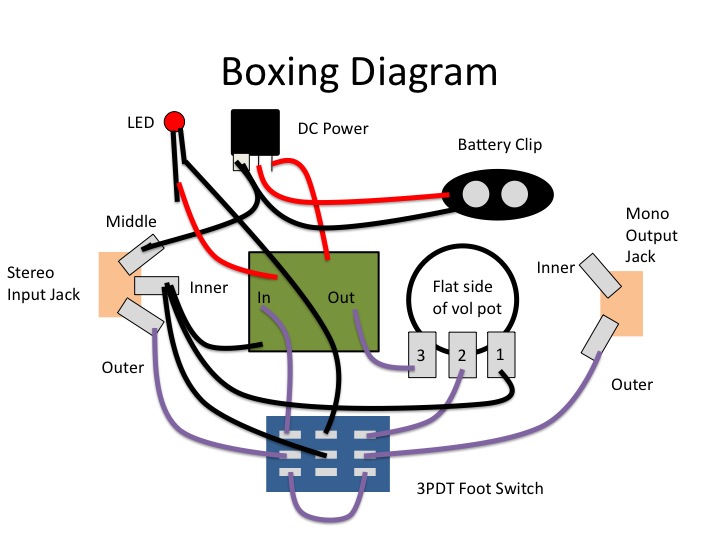
I had to share this image sent by reader Gerald Good. (Thanks, man!)

BoxingDiagram
Gerald Good made this pretty picture. (Click to embiggen.)

It’s a handy stompbox wiring diagram that’ll work with all the stompbox project on this site, and most other simple circuits. It’s not the only way to do it — there are other good options, especially for wiring that diabolical 3PDT footswitch. (You’ll find some of them here.)

But I like the configuration Gerald chose to illustrate, because it’s the most idiot-proof. And everything I touch need serious idiot-proofing. I’m embarrassed to admit how many pedals I had to build before I had these basic connections committed to memory. The footswitch wiring alone nearly used to bring me to tears. I kept an ugly, hand-drawn diagram glued to a plank alongside my breadboard for ages.

This is nicer. Print it out and post it at your workbench! :beer:

Categories
Acoustic Amps Bass Digital DIY Effects guitar Recording

NAMM I Am

It's that time again, folks.
It’s that time again, folks.

“It’s the most won-der-ful time of the year…”

Oh wait — that was last month. Now it’s January. NAMM time!

I’ll be there for the duration, partly to hang out with my Pure Guitar pals, and partly to meet with Fishman about the upcoming TriplePlay release. But mostly to gawp at the weird shit admire the musical instrument industry’s latest offerings. :oogle:

I’ll be posting my findings here, and also doing a little write-up for my friends at Create Digital Music, one of my fave musician sites.

Actually, I have this perverse fantasy of spending an entire show in Hall E: the Anaheim Convention Center’s low-rent basement/dungeon, a dark, inhospitable region where Fender and Gibson fear to tread. That’s where the industry leaders of tomorrow rub elbows with mad scientists and perennial laughingstocks (AKA “my peeps”).

Any of you guys going? And if not, anything special you’re curious about?

Categories
DIY Effects guitar

New Frontiers in Fuzz:
The Devi Ever Interview

Some boutique stompbox builders pursue endless refinements of classic pedal designs, developing ever-more-suave iterations of the Tube Screamer and Ross Compressor.

And some just want to blow shit up.

Guess which category Portland, Oregon’s Devi Ever falls into? Hint: Her extensive line of guitar and bass pedals includes such anarchy boxes as the Little Shit, the Ruiner, the Heroin Lifestyle, and the Truly Beautiful Disaster.

Here’s what I’m talking about: Check out Devi’s video demo for her Shoe Gazer fuzz…

…or this one of Wilco’s mighty Nels Cline giving Devi’s Soda Meiser a workout:

Categories
Acoustic Amps Bass Digital DIY Effects Gigs guitar Music Pickups Recording Technique

Who Dares Predict Our Fretboard Future?

“We are all interested in the future, for that is where you and I are going to spend the rest of our lives.” — Criswell, Plan 9 from Outer Space

UPDATE: Wow, I can’t believe all the cool stuff folks have been posting to comments. I find myself feeling quite inspired about the future of instrument — when I’m not laughing so hard I spit coffee all over my laptop. Thanks for all great ideas. Keep ’em coming! 🙂 :thumbup:

Prophecy is for suckers. Who’s stupid enough to go on record with bold prognostications about the future of music and music-making, given the near-certainty that the words will reappear someday to bite you on the ass?

Well, me. And, I hope, you.

So I invite my fellow foolhardy loudmouths to join me in sharing their half-assed guesses wise and well-informed predictions about our brave new fretboard future.

The author of the most compelling prediction wins one of my hand-built stompboxes. So does the author of the one that makes me laugh hardest.

Post your predictions to comments. I’ll go first. 🙂

Categories
DIY guitar Music Pickups

The Great Epiphone Swindle

You don’t have to spend $6,706 to sound like a punk. And don’t ask what the six cents are for!

My pal Linda B. is a killer rock and roll drummer who also plays a pretty mean guitar. She’s decided to form an all-female Sex Pistols cover band, with her assuming the duties of guitarist Steve Jones.

An avid rock historian, Linda did her research, which quickly led her to Gibson’s limited edition Steve Jones signature model Les Paul Custom, a slavishly accurate replica of Steve’s iconic axe.

(The original, which had previously belonged to New York Doll Sylvain Sylvain, was not used on the Sex Pistols’ early singles or the Never Mind the Bollocks album, but was his main stage instrument.)

Just one problem: the $6,706 price tag.

So Linda bought a used white Epiphone Les Paul Custom for $299, ordered the same pickups that are in the original and the signature model (a Gibson 498T “Hot Alnico” humbucker in the bridge position, and a 496R “Hot Ceramic” humbucker at the neck), and found some sketchy online vendor who sells replicas of the original’s pinup-girl stickers, plus an even sketchier vendor who sells fake Gibson logos. We popped in the pickups, slapped on the stickers, and made a darn good replica for a bit over $500.

Wanna hear it?

Categories
Amps DIY

Review: Tube Depot Tweed Champ Kit

When you make DIY stompboxes powered by 9-volt batteries, your biggest fear is a solder burn (or dropping your drill on your iPad, but that’s another story). DIY amps are different: AC voltage can kill you, so a klutz like me approaches amp builds with caution.

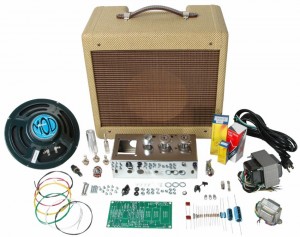
Which brings me to one of the great things about Tube Depot’s Tweed Champ Vacuum Tube Amp Kit: the fantastic assembly manual. Other great things include the price ($499, roughly half the price of a non-kit Champ clone of comparable quality). The design (which follows the original circuit, but substitutes an intelligently designed circuit board layout for the original turret board). And most of all, the tone.

I’ve got lots more to say about the kit, the fun I had building it, the lore of the 5-watt ’58 Champ, and the pros and cons of Class A amps (the Champ is the only Fender classic that merits the classification). But first, have a listen!

Categories
Amps DIY guitar Recording

Small Amps for Small Spaces?

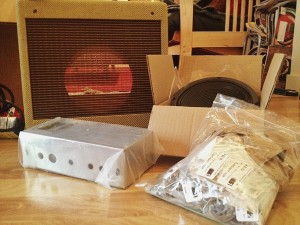
I’ve got a Tweed Champ kit, and I’m not afraid to use it. Or at least not VERY afraid.

Why do they make amps so damn loud?

It’s not just a cranky question from a guitarist who’s drawing depressingly close to the “Get off my lawn!” years. I ask sincerely: Why?

Big amps make total sense — but only if a) it’s 1969, b) you’re playing venues with Jurassic sound reinforcement, and c) you’re a guitarist in danger of being drowned out by Keith Moon or John Bonham.

Okay, end of harangue — I’ll have time for that when I’m chasing kids off my lawn (after I move to the suburbs and GET a lawn). But as I get psyched up to build this review model of Tube Depot’s Tweed Champ kit in the coming days, I figured I’d ask what folks are using these days to get cool amp tones in their bedrooms and basements. Not dedicated practice amps, necessarily, but great-sounding stuff that happens to be ultra-low-wattage? Name your petite-amp poison!

Anyway, I’m stoked about this kit. I’ve already completed a few amp clones from Ceriatone. They were fun to build and sounded great. But I can tell right off the bat that this Tube Depot kit has at least one major advantage over its Malaysian cousins: This one comes with a fabulous 40-page instruction manual. (Most clone vendors simply link you to a schematic.)  Having  created a few step-by-step instruction manuals myself, I can testify how much painstaking work these entail. Hats off to Tube Depot’s Rob Hull for doing it right!

Details and build report to follow. But now, let’s talk tiny-amp tone!