Categories
Digital Effects Recording

Echoes of Ancient Greece

I’ve just returned from a vacation to Southern Italy and Sicily. It was a nerdy scholarly tour, with an emphasis on ancient Greek archaeological sites. (There are apparently more and better preserved Greek ruins in Italy and Sicily than on the Greek peninsula.) It was terribly serious — my wife and I spent a lot of time photographing Roman play figurines in front of Greek ruins, adding the occasional dinosaur and Vespa, just to go the extra mile in pursuit of historical accuracy.

IMG_4841
This is EXACTLY how it looked 2,400 years ago.

But I had also music on my mind. I can’t go 100 yards in Italy without flashing on some piece of trivia from my college music history days. You can barely turn around without bumping into La Scala or whatever. Nearly every town along the train tracks triggered some music-geek memory. “Lookit,” I’d blurt at my ever-patient wife. “Arezzo! That’s where the most important music theorist of the Middle Ages invented staff notation and conceived the Guidonian Hand!” (If you’re ever forced to travel with me, bring snug-fitting, noise-cancelling headphones.)

I’d been to Sicily a couple of times before, but only to Taormina and Siracusa in the east. This time we started in Palermo. (Man, I love that city! So vibrant, funky, and delicious.) We then worked east, stopping at one Greek or Roman ruin after another. My favorite, I think, was Selinunte, a vast city of 30,000 until those Ba’al-worshippin’ Carthaginians trashed the place around 400 B.C. The peak population was triple that of Pompeii (which I also just visited for the first time), but unlike those ruins, Selinunte is nearly tourist-free, and you can freely clamber over and through the remains of ancient homes.

The Ear of Dyonisius—or Spock? (Creative Commons photo by Larel Lodged)
The Ear of Dyonisius—or Spock? (Creative Commons photo by Laurel Lodged)

When we arrived at Siracusa, I had a mission: When I first visited some 35 years ago, I was, like most visitors, awed by the remarkable echoes within the Orecchio di Dionisio (“Ear of Dionysius”). This tall, narrow, S-shaped grotto is part of the limestone quarries into the hillside behind Siracusa’s famed Greek theater. which is also chiseled into solid limestone. The space produces a remarkable echo, a series of strong, clear slapbacks that melt into moist-sounding reverberation.

On this visit, I was armed to capture the sound as an impulse response so I could mimic the effect in software. I carried a small digital recorder and (on the advice of blog reader Shizmab Abaye, in reply to my last attempt to capture historic ambience) an old-fashioned clipboard with a spring loaded clip.

(I’ve written about impulse responses before. In a nutshell: You record a percussive sound in an ambient space, and then process the recording in software so that you can mimic the ambience after the fact—for example, make it sound like you’re playing guitar in an ancient limestone cavern. How does it work? Easy—magic!)

However, your recording needs to be as free of other noises as possible. When we got to the grotto, it was full of tourists, one of whom was singing.

It sounded beautiful. I felt like a shit for just wishing he’d shut up. He eventually did. When the cavern grew relatively quiet, I started snapping the clipboard and recording.

A week or so later I was back in the studio. I scoured the recordings for the clearest clipboard snaps with the least background noise, and dropped the resulting files into an IR reverb plug-in. (I used both Audio Ease’s Altiverb and Space Designer, the convolution reverb included with Apple’s Logic Pro.) I got the best result from a snap recorded about 10 feet from the clipboard. Here’s how it sounded when applied to a couple of spooky guitars (low-tuned classical and a Dobro played acoustically with EBow.)

It’s not a precise replica of the space (even a touch of background noise compromises the results), but it’s a cool, eerie reverb that definitely doesn’t sound like some factory preset.
IMG_4852
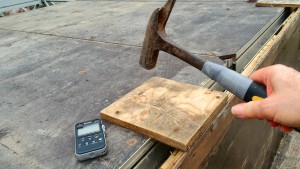
Someone left this hammer just SITTING here! It’s like leaving a loaded gun where a monkey can grab it.

I also snagged some other evocative IRs. In Taormina, we visited the Greco-Roman theater. (I’d played a gig there with Tracy Chapman in 2006. It was amazing to perform on that ancient stage with Mt. Etna looming in the background! We stayed an extra day, and that evening Italy won the World Cup. The rioting that night put to shame the meager outpouring of emotion in my neighborhood when our local baseball franchise wins the World Series.)

Naturally, I’d forgotten my clipboard on my recent visit, but they were dismantling the performance stage at the end of the concert season, and some worker conveniently left a hammer and some planks just lying around. I tried capturing the reverb as heard from the stage, plus a stronger echo in one of the side archways providing access to the stage and seats.

Finally, a not-so-ancient ambience: In Sorrento we stayed at the Hotel Tramontano, a fusty, old-school place with a remarkable history. It was a regular stopping point on the 19th-century Grand Tour. Prior guests included Byron, Shelley, and Keats. Ibsen wrote Ghosts while camping out there. Ernesto de Curtis even composed that sodden Italian restaurant warhorse “Torna a Surreinto” while lounging on the clifftop balcony. (You may know the tune as Elvis Presely’s “Surrender.”) Amazingly, I was in this beautiful tourist town for three days and didn’t hear it once. Life can be kind.

Anyway,  I captured a spooky reverb in one of the stairwells.

Besides having a couple of new sound design tools, I’ve also got unique souvenirs: Mediocre sound recordings to counterpoint all my mediocre photos!

Got an IR reverb plug-in? Want to try these out? Download them for free here. Then just drop them into your IR ’verb of choice.
Categories
Effects

Amp Show a Go Go

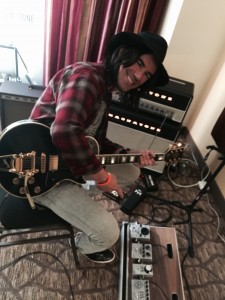
Ace sideman and gear demo producer Pete Thorn stopped by and made my pedals sound really good. :)
Ace sideman and gear demo producer Pete Thorn stopped by and made my pedals sound really good — though a killer Magnatone helped.

I spent the weekend hyping my stompboxes at the long-running LA Amp Show. It was my first visit, and it was a blast in every regard.

It’s a surreal scene. It’s not held at a convention center, but at a generic airport hotel. Exhibitors set up in plain old hotel rooms on three floors. And unlike NAMM, there are no noise restrictions — pity the poor hotel guests who weren’t amp freaks! It was wild, walking down a long hotel corridor, with some high-end amp and guitar blasting through each doorway. But within each room, there was an odd sense of intimacy. It could even be sexy, assuming your erotic ideal is the Line 6 Helix.

Gear highlights? I don’t know! I was on my own, glued to my pedalboard for two days. (Though I got to take a closer look at the Milkman amps crafted by my San Francisco neighbor Tim Marcus.)

But I did get to share Vintage King’s suite with several cool brands: Moog, whose Minifooger pedals I reviewed for Premier Guitar (and loved). Also there: Magnatone. I was plugged into a magnificent Super Fifty-Nine (which I also reviewed and loved). New to me, though, were two killer models from Jackson Ampworks.

2015-10-04_13-09-23
It was great to see my onetime boss, Jim Crockett — the man who invented the guitar magazine

But I can tell you two non-gear highlights: For the first time since the late ’80s, I got to hang out with Jim Crockett, who founded Guitar Player in 1967, inventing the guitar mag.

Jim ran the show when the mag hired me in 1988. It was my first real job — till then, I’d only worked as a guitar teacher. Jim was so cool, going out of his way to welcome the nervous new guy, and providing many pats on the back.

The magazine got sold not long after I started, and has changed corporate hand many times since. So while I only worked with Jim for a few months, I’ve spent the last several decades listening to everyone moan, “Man, it was so much more fun when Jim was here.”

Thanks Jim — I’ll never forget your kindness.

Also unforgettable: the mad yo-yo skills of Vintage King’s Dan Serper. Clearly, raging 7-string pro-metal guitar-playing isn’t his only talent! (The background noise is amps blasting from adjacent rooms.)

Categories
Effects

Blatant Self-Promo: New Joe Gore Pedal Premieres

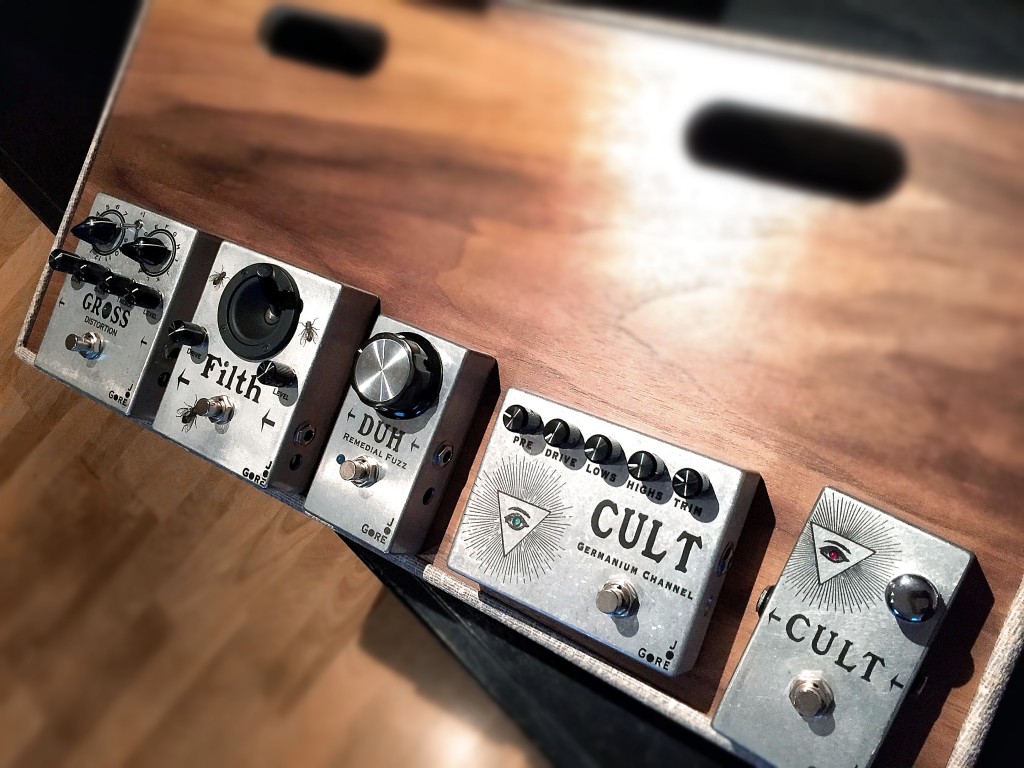
Joe-Gore-Pedalboard_Snapseed

UPDATE: I just posted detailed pedal descriptions at gorepedals.com

Anyone going to the big LA Amp Show this weekend? I’ve never been, though I’ve heard it’s a blast. (Literally: Unlike at NAMM, exhibitors set up in separate hotel suites, reportedly without noise restrictions.) I always like geeking out at musical instrument trade shows, but this one is special for me: It’s my pedal premiere, the public debut of my next four stompboxes. They’re not shipping quite yet (except Duh, available here), though they’ll be out in time for a crunchy-as-hell Kwanzaa.

The pedals pictured may look like my usual sketchy handmade stuff, but they’re actually slick factory-made versions, painstakingly styled to look like sketchy handmade stuff. (Michigan’s Cusack Effects is my manufacturer.) They sound like my handmade prototypes, but are less likely to break every 15 minutes.

I’ll be showing them off in the Vintage King suite. (They’re my production partners, and for now, my sole retailer, though the pedals will eventually make their way to hip guitar shops.) Magnatone, Jackson Ampworks, and Moog pedals will also share the VK suite, so my pedals will be in lofty company.

I’ve already written about Filth, Cult, and Cult Germanium Channel, though I haven’t yet finished their demo videos. (If you’ve spent any time on this site or my YouTube channel, you’ve heard them.) But I think this is the first time I’ve mentioned Gross Distortion, a twisted new take on a cool old crunch circuit. Here’s a demo I just made:

… and here’s how I describe it on the upcoming product page:

There’s never been a distortion pedal quite like Gross—so it needs an explanation.

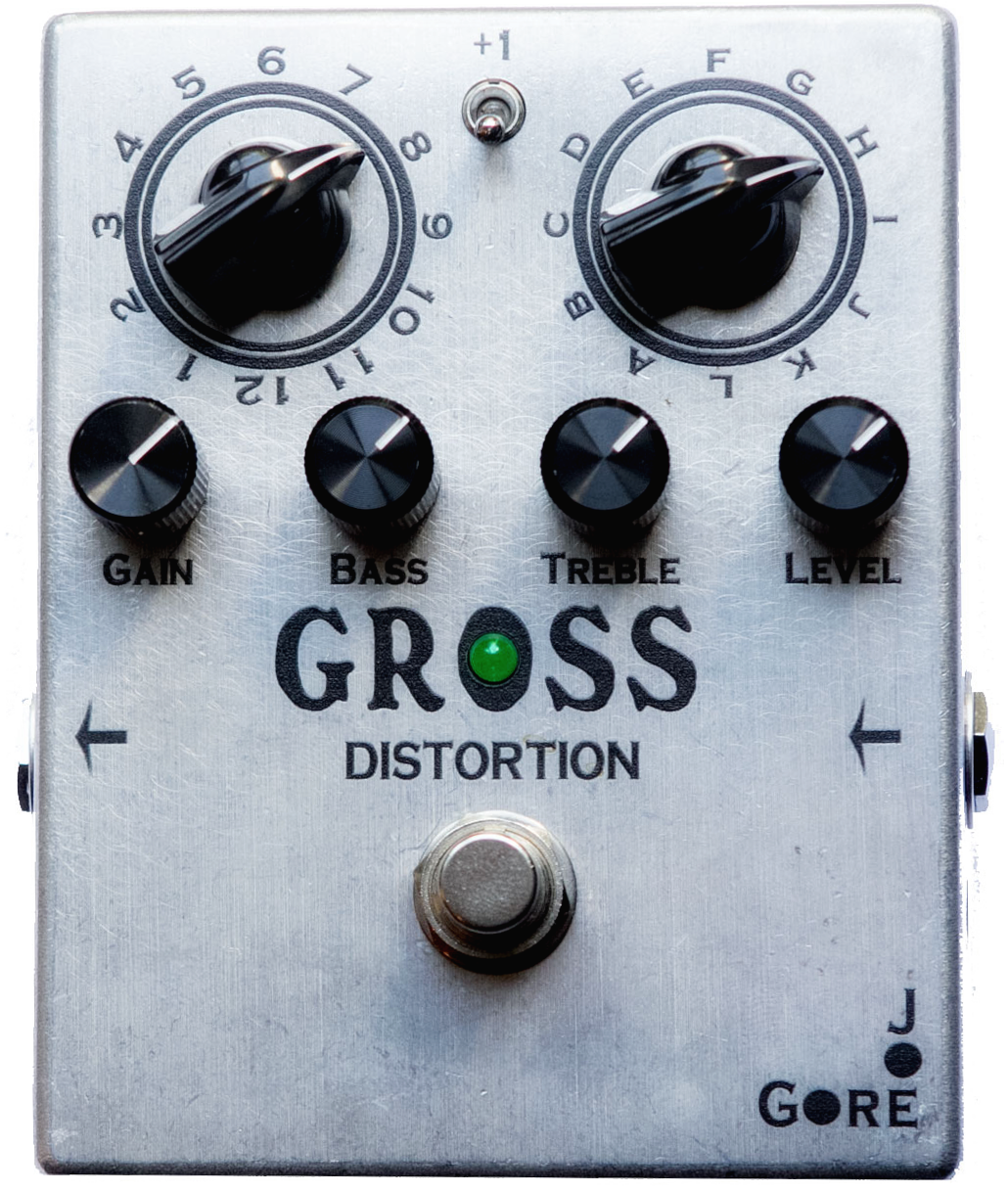
Gross_crop

At its heart, Gross is a simple, one-transistor distortion from the same family tree as the Electra circuit. This simple yet powerful effect was built into Electra guitars in the late ’70s, and was later adopted by many boutique stompbox builders. For good reason: It’s a lively, dynamically responsive circuit with less compression than most modern IC-based distortion pedals. The transistor boosts the level, and then the signal hits a pair of clipping diodes, which provide the signature distortion.

Every diode combination sounds slightly different. In fact, several boutique pedal companies have based their businesses on creating Electra derivatives with slightly varied diode choices. (Just Google “Electra distortion clone.”)

Gross isn’t an Electra clone. I’ve changed parts and values for a fatter sound and even greater dynamic response. I also added an active 2-band tone control—something seldom, if ever combined with primitive distortion like this. The distortion isn’t too “gainy.” It’s more about definition than sheer power—one reason it pairs well with other gain pedals. The character of your guitar and fingers always comes through.

The oddest feature is the diode section. Instead of a fixed diode pair, two 12-position rotary switches select from 24 diodes for 78 possible diode combinations! An additional switch adds a third diode for asymmetric distortion, which makes156 possible shades. My target number was 144—that’s why I called it Gross, though that may have happened the other way around.

Some combinations are as different as night and day. Others are only as different as noon and 12:05. But this network of germanium, silicon, and LED diodes provides many crunch colors.

With its labeled and detented selector knobs, you can call up favorite settings onstage. But for me, Gross’s forte is as a studio tool. It’s great for “texturizing” guitar overdubs—just spin the dials till you find a tone that sits perfectly in the track. It’s especially useful for doubling.

Gross Distortion was created in San Francisco and is built in Michigan by skilled craftspeople earning a fair wage. Available soon from Vintage King!

TO USE: Set the desired gain and level. Grab the big knobs and start spinning. Toggle the +1 switch frequently for asymmetric distortion—the changes can be dramatic! When you hear a cool tone, refine it with the bass and treble knobs. (Note: the higher the gain setting, the more dramatic the diode-tone contrast.)

I hope you find it useful.

–Joe Gore, San Francisco

If you make it to the show, stop by and say hi! 🙂

Categories
Effects

Heaviest. Stompbox. Ever.

I’ve been breathlessly awaiting one of these since I saw this. It’s Korg’s Miku Stomp, a spinoff from the company’s Vocaloid voice synthesizer. It tracks your pitch as you play and responds with a synthetic voice that forms various syllables and phrases.

There’s some cheating here: The effect’s latency is quite severe, so I had to slide the Miku track back in time while mixing. Its triggering is also inconsistent, so I replaced a few notes. Miku tracks best when playing melodies on a single string, hence my awkward, position-jumping fingering. (Actually, it tracks pretty well when you play slow melodies full of sustained notes. But steady eighth-notes at 155 BPM as heard here is a major challenge.)

One of the pedal’s most interesting aspects is the way it interprets slurs. When there’s no break between notes, Miku sings a sort of pseudo diphthong. Detached notes get a syllable with a clear transient.

IMHO, the inescapable facts that Miku is silly and doesn’t work terribly well doesn’t diminish her total awesomeness. No doubt about it: heaviest stompbox ever.

The tune, of course, is “Georgy Girl,” which I’ve loved since forever. It was a blast recording the backing tracks with classical guitar, ukulele, ukulele bass, 12-string, toy piano, M-Tron Pro, and a mix of live and sampled percussion. And of course, gobs of my favorite reverb effect: Universal Audio’s EMT140 plate simulation. Yum.

Categories
DIY Effects guitar Pickups

Ultimate Lipstick-Tube Guitar (with experimental tone control & onboard overdrive)

Okay, it’s not the ultimate lipstick-tube guitar for everybody, but it probably is for me. It’s my third lipstick-tube pickup experiment — and definitely my favorite.

You may have heard some of these parts before: I used the neck for all my Mongrel Strat projects, and the Strat-sized Seymour Duncan pickups appeared in my previous lipstick-tube experiments. (I love Duncan’s lipstick-tubes. To my ear, they sound way better than the ones in new-school Danelectros.) The new body is Warmoth’s Hybrid Tele model, in purple with butterfly stickers. It’s très macho. (Better not use if for gigs in Indiana and Arkansas.)

My previous lipstick tube experiments used a MIM Strat body, but I wanted something a little more distinctive, and with a built-in battery compartment (because nothing is a bigger pain than changing batteries in a traditional Strat control cavity). Also, I like how the design evokes both Strat and Tele, since the guitar has three-Strat sized pickups and a whammy, but is wired more like a Tele.

About that wiring: The 3-way pickup selector chooses neck, bridge or both pickups, like on a Tele. Meanwhile, a SPDT switch toggles the middle pickup on and off regardless of the pickup selector, so you get six settings: neck, bridge, neck + bridge, neck + middle, bridge + middle, and all at once. It’s a pragmatic variation on “Nashville Tele” wiring with a switch rather than a pot. That means you can’t dial in varying amounts of middle pickup—it’s all or nothing. But on the plus side, I can jump instantly to an out-of-phase sound from any pickup-selector setting, and it freed up space for the other weird crap I put in this guitar. (Yo, electrical engineers: Don’t bother telling me that combined-pickup settings aren’t really out-of-phase True, they’re not out-of-phase electronically, but they are acoustically, and the distinctive “hollow” sound of combined settings is precisely the result of phase cancellation from two pickups at different positions.)

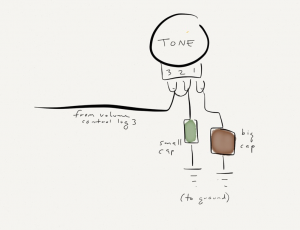
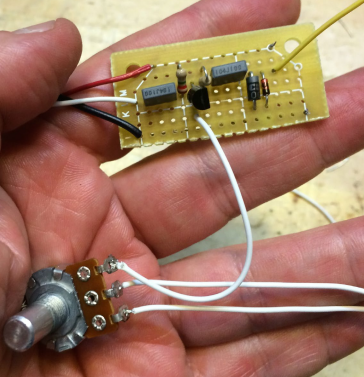
The weirdest detail is what I call a “cap-fade” tone control. It’s an idea I speculated about back in January, and to which many of you contributed cool perspectives. I pretty much followed the scheme in the original diagram:

cap-fade tone control

The idea again: Instead of sending varying amounts of signal to ground via a tone cap, the pot here fades between a small-value cap (which defines the minimum cut when the control is engaged) and a larger one (defining the frequency of the maximum cut). In other words, instead of sending varying amounts of signal to ground, this circuit always sends everything above the cutoff frequency to ground, with the pot determining the frequency.

Categories
Effects Recording

A Quick Compressor Class

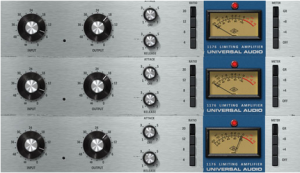
UA Compressors

Do compressors confuse you? And who don’t they confuse?

My just-posted Premier Guitar column covers some basics and walks you through a typical guitar compression scenario (with many audio examples).

Using a variation on a technique borrowed from engineer Michael Paul Stavrou’s cool recording technique book, Mixing with Your Mind, I start with extreme settings that make it easy to hear the compressor’s effect, and then back the processing down to realistic levels.

If you ever find yourself twiddling those inscrutable knobs while remaining unclear exactly what, if anything, is changing, this case study may clarify the process. I hope it’s helpful! :pacman:

Categories
Digital Effects guitar Music

The Live Looping Lesson

This one’s a labor of love: Premier Guitar just published my live looping lesson. Included are most of the hard-won looping techniques I’ve acquired over the last few years. I crashed and burned 100 times onstage so you don’t have to! 😉

The percentage of my life spent looking at this exact view is too depressing to contemplate.

The 20 audio clips embedded in the article were trickier than usual to prepare. Ordinarily when I record music mag demos, it’s simply a matter of plugging in a guitar, amp, or pedal and noodling around while trying to make it sound good. But here I had to demonstrate techniques that unfold over time, which is harder than it sounds, at least for me. But I’m reasonably satisfied with how they turned out.

My emphasis throughout is going beyond looping cliches and defying listener expectations. That too is difficult — by definition, loops are predictable! But I’ve been racking my brain for years, trying to come up with ways to bust out of the usual patterns. Most of my ideas appear here. Hope you find them useful!

Categories
Effects

Lookit — My New Pedals!

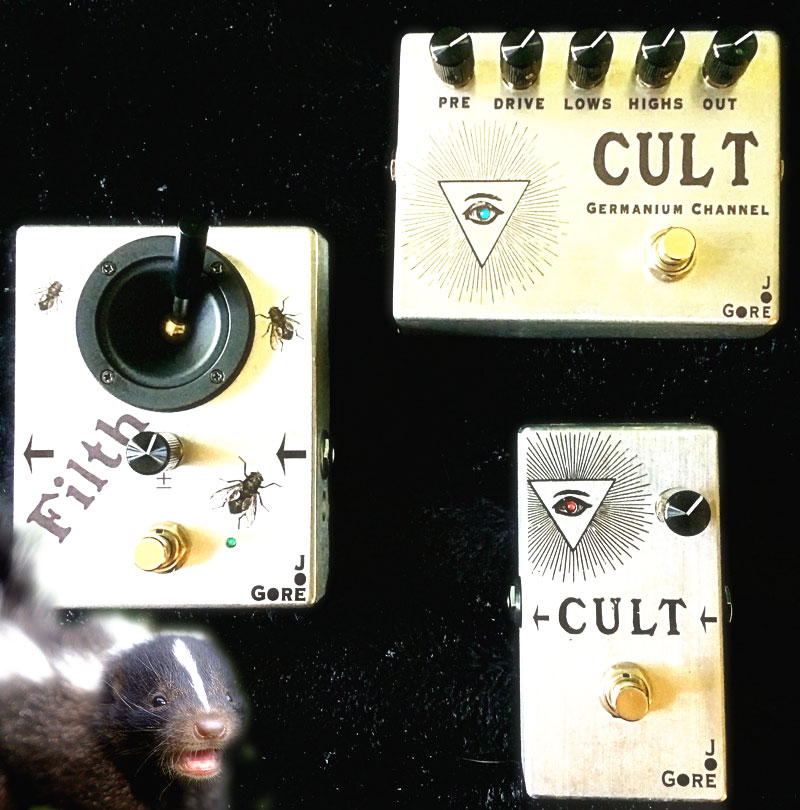
Awesome! I just received production prototypes for my next three stompbox releases, in the wake of last month’s launch of my Duh Remedial Fuzz. I’m still making minor tweaks, but these should be available in just a few weeks. Whee!

New-Pedals_skunk
Filth is a freaky joystick fuzz. Cult is my oddball take on Rangemaster-style single-transistor overdrive. It’s my absolute favorite distortion device, and the same one heard in many of my videos and gear reviews. The Cult Germanium Channel supplements this simple but deadly circuit with extra controls and an active EQ stage.
(Baby skunk sold separately.)


Filth. I love whack-job fuzz boxes like the Z. Vex Fuzz Factory and the countless “sick fuzz” pedals it’s inspired over the last two decades. But here my goal was to create one with a higher percentage of “likely to use” settings — I wanted to make it easier to find the good stuff. Topologically, the circuit’s nothing tricky — basically a Fuzz Face descendent coupled with an extra JFET boost stage (though it doesn’t sound remotely like any Fuzz Face you’ve ever heard). The main innovation is the x/y control, which jiggers the transistor biasing, producing a broad array of timbres. It’s not a conventional tone control, though it’s arranged so that it’s easy to summon smooth, chubby tones or angry, brittle ones.

There was a lot of interest in this a couple of years ago when Fuzz Box Girl posted a demo (apparently no longer online) of one of my handmade ones. She focused on the pedal’s maximum-gain, My Bloody Valentine side, which was fine — Filth can definitely make your amp melt like a Salvador Dali timepiece. But now it’s easier to dial in crisp, lower-gain tones.

I’m making two Filth versions: the joystick model [pictured], and one with three conventional knobs. They sound identical — only the interfaces differ. The three-knob is good if you want to mark an exact setting for use onstage, while the joystick is more fun when concocting new sounds. (I don’t know the exact pricing yet, but the joystick model will cost more, because that’s an expensive part!)

I’m far from the first builder to create a joystick stompbox, but you usually encounter them on crazy noisemaker effects, or deployed as conventional EQ controls. I’m not aware of another pedal where it regulates the fuzz’s fundamental timbre this way. But then, I don’t get out as much as I should.

Cult. If you’ve seen my videos or heard my audio demos, you’ve probably heard Cult. I’ve built it into several guitars (while others have a built-in Duh fuzz). It’s a one-germanium-transisor boost descended from the Dallas Rangemaster of the 1960s, though the apple has rolled far from the tree: All part values differ, the EQ profile is modernized, and the gain control works in an unconventional way. But like a Rangemaster, it boasts spectacular dynamic response and electrifying tones that crackle with presence.

To my (admittedly odd) ear, no other distortion sounds as bitchin’ as a single-transistor boost between a good guitar and a great amp. The weird thing is, while most players know the countless ’60s rock tracks produced with such primitive boosters, many  have never tried this sort of circuit. I love faithful Rangemaster clones, and I love many of the variations I’ve explored over the last five years. But Cult is my very favorite recipe.

Cult Germanium Channel. This one pairs the Cult circuit with relatively modern active EQ/boost stage, with proper tone controls that don’t suck tone. The added circuitry sacrifices a touch of Cult’s explosive presence, but it provides a greater range of tones. There’s also more gain on tap, so it’s better for those high-testosterone rawk tones that I’m far too much of an prissy, effete San Franciscan to use myself.

Thanks a Lott. As mentioned, these are manufactured by Cusack Music in Michigan, under the expert eye of engineer Tony Lott. Cusack builds pedals for numerous  boutique brands you know, many of whom prefer to keep the fact a secret. But I’m proud of the relationship, because Tony and his team improve everything I submit. (More about the collaborative process below. It’s fascinating stuff, assuming you’re a geek — which I do assume, since you’re here.)

Categories
DIY Effects

DIY Zero Hour!

PG Distortion pic
You can build an awesome-sounding designer distortion pedal for about $45. (Joe’s hand sold separately.)

Have you been reading about DIY guitar effect projects for years and thinking about giving one a shot?

Here’s a good excuse: Premier Guitar just published my “Build Your Own Stompbox” article, which just may be the most ambitious project I’ve ever undertaken for a guitar mag. And there’s more to it than just building a great-sounding distortion pedal from scratch: It’s practically a “how to build your own guitar effects” course, covering everything from sourcing parts and prototyping through boxing and troubleshooting. You’ll learn how all the key components work, and how to choose the ones that best suit your needs. Most important, you’ll start customizing the circuit from the project’s first stages using techniques you can apply to all your future builds.

The project is based on the simple but powerful Electra distortion circuit, the same one used in many boutique overdrives. Yup — it’s the same circuit that I’ve been featuring as Project #1 in Tonefiend DIY Club for a couple of years. But this revised and expanded version is far superior to the original, thanks to lots of help from my talented PG colleagues. Art Director Meghan Molumby did an amazing job assembling the massive build guide PDF (which you can download for free here). The layout is incredibly user-friendly, and you’ve never seen nicer-looking schematics and diagrams. The text got a thorough going-over from ace editors Andy Ellis and Shawn Hammond, so there are far fewer of my usual boneheaded typos. And there’s a cool video demo by Nashville ace John Bohlinger, so for once, you don’t need to watch one of my twitchy performances to hear how it sounds. What’s not to like?

But wait, there’s more: My pals at Mammoth Electronics have put together a $45 prepackaged kit to spare you the hassle of sourcing all those pesky little parts and drilling your own enclosure. There are lots of cool optional upgrades, like painted enclosures, premium switches, and bitchin’ knobs. Details here. (Neither I not Premier Guitar have any financial stake in the kit. I just asked Mammoth to create one as a convenience.)

Seriously — this one’s good. If you’re finally ready to burn your house down master that soldering iron, well, zero hour is here!

Categories
Effects

Duh for Days

Duh Pedals

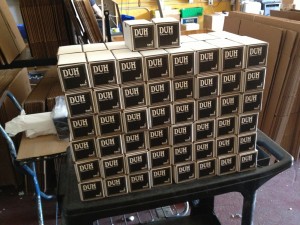
Wow — I can’t believe my eyes! After years of planning, scheming, and screwing around, my very first batch of production fuzz pedals has arrived at my distributor, ready for sale. Will they gather dust or sell like hotcakes? That depends on you, dear reader!

You can read about the Duh Remedial Fuzz, hear a demo, and place orders from the product page at Vintage King. (For now, Vintage King is my sole distributor.) If you’ve been following my videos, you’ve heard Duh already — I’ve got the circuit mounted inside some of my favorite guitars, including the Hello Kitty! and lipstick-tube Strats.

Excuse me for quoting again from the great review I got in Guitar Player — I’m just a proud pedal papa! Have a cigar.

“Remarkable … responsive dynamics and simultaneously fierce and expressive tone. This is a pedal that doesn’t give up even one less-than-spectacular sound. It reminds me of ’60s records where the fuzz sound jumped right out of the grooves and changed my world.” [Editor’s Pick Award recipient.] — Guitar Player magazine, 2014