Categories
DIY Effects guitar Pickups

Hello Kitty Strat: Not for Pussies!

Would this be anything less than awesome? I think not.

As I gloated last week, Jane Wiedlin gave me her Hello Kitty Stratocaster  — the most bitchin’ $99 guitar ever conceived! I finally had a chance to destroy/customize it yesterday, in what will no doubt be the first of many desecrations/enhancements.

I’d ordered one of those Synyster Gates Duncan Invaders with the pretty white pole pieces for the guitar, but just couldn’t wait to experiment, so I browsed through the ol’ pickup collection, and found a nice Duncan Phat Cat I’d used in a Les Paul experiment some months ago.

I don’t generally recommend choosing pickups because of their names, but come on! Kitty + Cat? How could I resist?

Turns out it was a lucky choice. I hadn’t planned to install a pickup that was actually lower in output than the stock humbucker, but it lets me get nicer clean sounds, and coughs up more than enough crunch when goosed with distortion. Speaking of which: the other custom feature is a built-in-distortion circuit activated via push-pull pot (I took lots of pics of the process for a DIY built-in-effects tutorial I’ll be posting very soon.)

View the carnage in this little video. Thanks, Jane Weidlin! Sorry, Stevie Nicks!
Categories
Bass DIY guitar

DIY Guitar Picks?

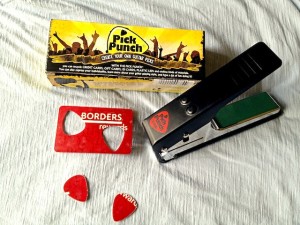
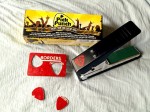
Borders went bankrupt. Now what the heck am I supposed to do with this pretty red card?

Behold my latest gizmo acquisition: the mighty Pick Punch!

It may look like a humble office stapler, but it stamps out standard-sized guitar picks from any compatible material.

I made picks from an old credit card, then another old credit card, and then . . . hey, folks, I need more ideas! What else would be a good, but unconventional, material for DIY picks?

FYI, this thing is sturdy, powerful, and sharp. If you stick your hand in it, you can probably make a decent skin-and-bone pick. When working with less self-destructive plastics, the edges are a little rough and furry, but nothing that a few seconds of sanding or playing wouldn’t sort out.

I found this treasure at the wonderfully silly gift site Think Geek, a nerd-toy emporium that specializes in such life essentials as the Zombie Head Cookie Jar and Alien Chestbuster Plush Toy. You can also order it directly from creator Von Luhmann via PickPunch.com. He also sells blank sheets of plastic advertised as similar to the material used in several popular pick types, plus sanders, inks, and so forth. He also sells a version of the Pick Punch that stamps out smaller, pointer “jazz style” picks. Pricing is reasonable: $24.95 for the Pick Punch, and $3.25 for enough plastic stock to 60 or so picks.

One advantage of buying directly from Luhmann rather than Think Geek: You won’t be tempted to outfit yourself with one of these.

Anyone out there in the habit of making their own picks? Show and tell, please!

Categories
DIY guitar Pickups

“Vintage” Les Paul Wiring: BS or BFD?

Which sounds better: modern or vintage wiring? The experts disagree!

There’s a wealth of information online about the relative merits of “vintage” vs. “modern” wiring in Les Pauls. And after reading page after page on the topic, I was more confused than when I started. So here’s an attempt to pinpoint the sonic differences in a meaningful and relatively “scientific” fashion.

For those new to the debate, here are the basics: Nowadays tone pots in electric guitars usually connect to lug 3 of the volume pot, the same junction as the input from the pickup or pickup selector. Wired this way, the tone control siphons off highs before the volume control siphons off level. But in ’50s Les Pauls, the tone control often connects to lug 2, so treble is nixed after the volume pot does its thing. (I say “often,” because, as in so many other regards, vintage Gibson aren’t 100% consistent.) Here are some comparative schematics.

Most online sources manage to pinpoint the most basic difference: with vintage-style wiring, your tone retains more brightness as you lower the volume. But beyond that, there’s a buttload of b.s., including the frequent claim that vintage tone capacitors sound better or different from new ones. (They don’t.)

Anyway, I’ve made some comparative recording and measurements. After digesting all this geeky goodness, you’ll probably know whether ’50s wiring is an attractive option for you.

Categories
guitar

It Pays to Have Cool Rock Star Friends!

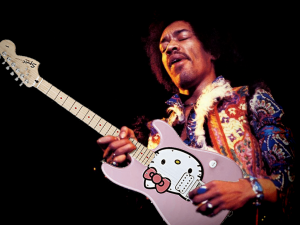
Sadly, it's ony Photoshop. Jane just WISHES she had a Hello Kitty triple-neck!

It was a perfect weekend here in SF: Unseasonably warm weather. BBQ in the garden. A fun recording session for a new project by Jane Wiedlin and Belinda Carlisle of the Go-Gos. And there was something else. . .

Oh yeah — Jane frickin’ gave me her Fender Hello Kitty Strat! Yes, the very same model played by Jimmy Page, John Lennon, Keith Richards, and Johnny Marr. (At least in my imagination.)

I love you, Jane!

So of course we started talking about how to customize it. Travis Kasperbauer, Jane’s engineer/husband, proposed installing an Seymour Duncan Invader pickup (maybe one of those white-capped Synyster Gates models…)

Jane suggested blinging it out with lots of beads and jewels and other eye-catching decor. And Jane know her eye-catching decor — her place is filled to bursting with mid-20th century kitsch, and her steampunk-themed studio could be the Addams Family basement where Wednesday and Pugsley rehearse with their punk band while Lurch runs Pro Tools. How often do you get to record 12-string overdubs while sitting next to a disembodied brain floating in a tank?

Categories
Digital guitar Recording

Adventures in Direct Recording

Hey man — what happened to your amps?

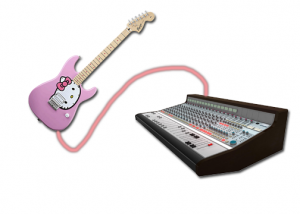
No question about it: Amps are awesome, and guitarists will be plugging into them for a long time to come. But as threatened in this post from last week, I’ve been experimenting with direct- recorded guitar sounds. I’m not talking amp simulators, but the sound of electric guitar recorded straight into a mixing board with no attempt to replicate the tone of an amp. After all, some of the most iconic guitar riffs of all time — including Zep’s “Black Dog,” the Byrds “Mister Tambourine Man,” Chic’s “Le Freak,” and most ’60s Motown hits — were tracked not through amps, but through great old analog preamps, compressors, and mixing boards.

Not that I own any great old ’60s and ’70s analog recording gear. But I wanted to see how close I could get using modern preamps and compressors, plus plug-ins that simulate vintage gear.

And how close did I get? Um…kinda close, and I could have gotten closer if I had an attention span longer than five minutes dedicated sufficient time to the pursuit.

Wanna hear what I came up with?

Categories
DIY guitar Pickups

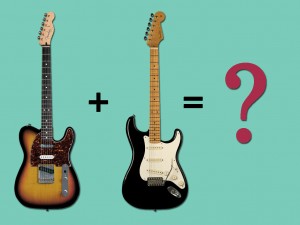
“Nashville” Tele Wiring . . . in a Strat?!

What do you get when you cross . . .

I’ve been coveting one of those “Nashville-Style” Telecasters — you know, the hot-rodded, three-pickup versions popularized by Nashville session superhero Brent Mason, and now a regular Fender production model.

Then it dawned on me: Since some of Mongrel Strats I’ve been playing with have strong Tele tendencies, why not flip the equation? Instead of a Tele that acts like a Strat, why not a Strat that thinks it’s a Tele?

The Fender version replaces the usual Tele 3-way switch with a 5-way, as shown in this wiring diagram, though many players prefer to keep the 3-way switch and add the middle pickup via a blend knob, as in this other wiring diagram.

I took the latter approach, and I am flipping out over all the new tones it unlocks. Check out this little video demo:

Categories
guitar Music Recording

No Stinkin’ Amps (or Amp Simulators)

An advanced technical diagram.

No videos or audio examples today — I’m in the midst of “reconfiguring” my studio. (That’s the technical term for pulling stuff out of racks, tangling all your cables, making an ungodly mess, and dissolving into a puddle of bitter, frustrated tears.)

But the good news is, I got some cool new stuff. I’m switching over a pair of large Pro Tools and Apogee systems to a minimalist Universal Audio Apollo setup, an audio interface that doubles as a plug-in host. UA makes killer plug-ins, but I’ve never owned any, since they’ve always run off of proprietary PCI cards, and the card slots in my computers have always been filled to capacity. Now that I have the UA stuff in my grubby mitts, I’m obsessing on the idea of exploring non-amped guitar tones, especially distorted ones. And I’m not talking amp simulators, but the distortion you get from overdriving a recording console’s preamps.

Categories
Bass DIY Pickups

A Cool Alternative Tone Control for Bass

Looks vintage, but it ain't.

After auditioning so many different tone-control schemes over the course of the Mongrel Strat Project, I wound up with more tone circuits than I have Strats, so I figured I’d victimize a bass — specifically, a 1954 Fender P-Bass reissue with a Seymour Duncan Quarter-Pound pickup, which I’ve written about here. It’s a minimalist one-pickup model with basic volume and tone controls.

I was eager to audition a multi-capacitor tone control like I wrote about here. (Actually, it’s literally the same tone control — the guitar where it used to reside now houses the Stellartone ToneStyler tone pot covered here.) And while I had the patient on the operating table, I figured I’d also install the Black Ice distortion cube I wrote about here. (My friends in the medical profession assure me that patients always appreciate it when surgeons indulge in improvisational operating-theater mods.)

Demo and details after the break:

Categories
Bass DIY guitar

PRINT Your Own Guitar Parts?!

Yes, it's bad Photoshop. You can't REALLY print a guitar at home . . . not quite yet, anyway.

UPDATE: Check out the comments, where reader J links to videos of a 3D-printed guitar and violin.It’s cool and INTENSE.

Last weekend I got to enjoy one of my favorite things in the universe: the Maker Faire, held each year in San Mateo, California, outside San Francisco.

The event, which draws 100,000 people each year (not counting the thousands who attend satellite fairs in NYC, Detroit, and other cities), was launched by Make magazine, the closest thing to a house publication for the international DIY movement. Adherents of maker culture — or just plain “makers” — are a loose aggregation of artists, geeks, hackers, Steampunks, subversive ETSY craftspeople, and others who embrace various facets of DIY culture. “If you can’t open it, you don’t own it” is one of many unofficial mottos. Another is “Void your warranty, violate a user agreement, fry a circuit, blow a fuse, poke an eye out…”

And who isn’t in favor of poking out a few eyes? 😉

The Faire, now in its eighth year, is a joyous affair, assuming you derive joy from things like flashing Van der Graaf generators, 50-foot-tall kinetic sculptures that spew fire, the Faire’s iconic cupcake cars, and the sight of hundreds of cute kids learning to solder DIY projects at rows of workstations.

Each year there’s more new stuff than you can possibly consume, but even even amidst the ear-pounding experimental music and eye-pounding LED art, one development seemed to dominate: 3D printers are getting faster, smarter, and cheaper (as in, several DIY kits sell for less than $500). And it’s difficult to imagine them not changing how we will create and mod our musical instruments in the very near future.

Categories
DIY guitar

Two-Band “PTB” Tone Control:
Useful, Easy, Cheap & AWESOME!

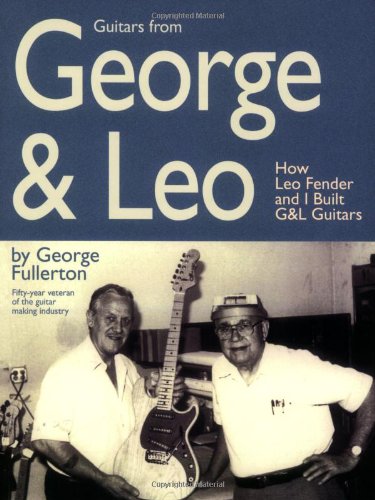
The PTB Circuit was one of many G&L innovations.

After the frantic soldering fest that was The Pagey Project, I figured it might be time for a nice, simple DIY wiring project. At the suggestion of tonefiend reader JH, I played with variations on the 2-band tone control that appeared in some G&L guitars. And I am over the moon with the results!

This circuit, sometimes called “PTB” (for “passive treble and bass”) combines a standard treble-bleed tone knob with a bass-cut control. The latter has a huge effect on the way distortion pedals and amps respond to the pickups, especially with humbuckers. Cutting some bass makes the pickups sound cleaner, airier, and more dynamic (i.e., less compressed). To my ear, the bass pot is not so much a tone control as a clarity knob.

Check out this brief demo video: