This is an exciting post for me, and not just because I get a desperately needed break from Klons and Screamers. I’m thrilled to bits about Logic Pro X and MainStage 3, though I’m still wrapping me head around them. (Yeah, I worked as a developer for both products, but I didn’t get a proper program-wide view until last week’s release.)
Also, it’s my first story for Premier Guitar, whose staff I’ve just joined as a senior editor. I’m stoked because it reunites me with PG editor Shawn Hammond and senior editor Andy Ellis, both of whom I remember fondly from my Guitar Player magazine days.
There’s much talent and coolness on the staff. I’m a happy little guitar nerd. Plus, the schedule is loose enough that I can still record, perform, and continue to work with audio/software clients.
What does the gig mean for this blog? Good things. I have no plans for a major course change — there are too many things I can only cover on a non-commercial site, including some of the topics closest to my heart. Meanwhile, working with PG will keep me more up-to-date on new music, new gear, and scurrilous guitar community gossip. In some cases, though, I may link to a PG article I’ve written rather than duplicate the work here. Today, for example. 🙂
D’oh! I omitted a circuit from the Fuzz Detective video. It’s the germanium version of the Shin-Ei Companion Fuzz FY-2. So here’s a brief Fuzz Detective Appendix.
The silicon version of the FY-2 is a cult item, a nasty little thing best known for its appearance on Jesus and Mary Chain’s Psychocandy album. The germanium version (which I didn’t even know existed until reader Bear pointed it out!) is a very different beast. Most notably, it lacks the silicon version’s signature midrange scoop, delivering a thicker, fatter sound.
As noted in the video, I replaced the stock B50K gain pot with a B5K. (The overall range of tones is pretty much the same, but this way, all the variations aren’t crammed into 10% of the knob’s range.) Construction details and testing procedures are the same as they were for the 12 Fuzz Detective pedals.
Silk and steel — bad-ass, or strictly for wusses?.
It’s been a long, long time since I’ve tried silk and steel strings.
I’ve always thought of them as a transitional set for students migrating from nylon to steel strings. At least that’s how my mom used to explain them to me back when she was giving me my first lessons. Like many players, I viewed them more as a remedy for tender fingertips than a sound you’d actively seek out.
But over time, almost everything I thought I knew about strings turned out to be wrong. So I figured I’d give silk-and-steels a fresh listen.
This thread over at the Acoustic Guitar Forum seems like a fair summary of common attitudes about these strings. Opinions seems divided between players who simply find silk-and-steel strings too soft and quiet to be of much use, and those who enjoy them for fingerstyle playing, especially on small-bodied guitars.
I’ve been frustrated finding the right strings for the old Martin acoustic I picked up last year. I had a violent reaction against coated bronze strings, which I wrote about here. But I was kind of digging the way Martin Marquis 80/20s bronze strings sounded on the instrument, as heard in this video. Sometimes, though, the tone is just too harsh and clacky, so I wanted to try something lighter and softer.
I slapped down this quick duet performance of “Drewrie’s Accordes,” an anonymous lute duet found in The Jane Pickering Lute Book, a manuscript anthology of late 16th-century lute pieces. (This would have been played on gut strings in its day, and is usually performed on nylon-string classical guitar or lute today. My steel treble strings are definitely not historically correct, though some wire-stringed fretted instruments such as the cittern did exist in the Renaissance.)
Observations after the video.
Compared to all-metal strings, the silk-and-steels are definitely quieter, with less treble bite. I like their soft, malleable feel for intricate fingerstyle playing like this. They offer relatively smooth transitions between unwound and wound strings. They exhibit less clacky string and fingernail noise. Playing aggressively with a pick definitely “overloads” them, and would no doubt destroy the windings in short order. Even when playing exclusively fingerstyle, you get the sense that the bass strings aren’t long for this world. But I enjoy their sweet, quasi-classical tone, which to my ear does indeed split the difference between nylon and all-metal strings.
Still, I’m not sure I want to commit to having these on the guitar all the time. (I wish the guitar had a switch to toggle between a bronze and silk-and-steel sound!) Also, these are lighter than I usually play (the treble is .0115, and I pretty much never go below .012). But the relaxed tension does seem to suit this particular guitar.
How about you guys? Any experience with these soft-spoken strings? Do you think they sound cool, or are they merely a salve for sore fingers? And has anyone tried John Pearse silk-and-bronze strings? (That’s probably the next stop on this particular string quest.)
P.S.: This is also a pretty good example of how I apply lute techniques to steel-string playing, as I mentioned here. For most of the fast bits, I pick alternately using my right-hand thumb and index finger. A proper classical player would be more likely to alternate index- and middle-finger. Also, my right thumb sometimes drifts “behind” my right-hand fingers (that is, closer to the bridge). Classical players rarely position their picking thumbs closer to the bridge relative to the fingers. It’s not conscious on my part — it just what my hand does when I’m trying to brighten the bass notes and darken the trebles.
Codex Chantilly: the electrifying page-turner that blew the lid off the perverse musical excesses of the late Middle Ages!
NOTE: I am a known perpetrator of musical hoaxes, but this isn’t one of them. This bizarre composition really is over 600 years old.
As Marsellus Wallace once quipped: “I’m’a get medieval on your ass.”
I’ve been obsessing again on a medieval composition that’s fascinated me since my geeky teens. It’s Fumeux fume par fumee, a bizarre artifact from a bizarre moment in music history: France in the final years of the 14th century.
(If you’re wondering why I was listening to medieval and Renaissance music when I was 17 instead of Zep and Floyd, and what the stuff brings to my guitar playing today, read on. But first, that freaky music!)
The world that produced Fumeux fume par fumee wasn’t your storybook Middle Ages. We’re talking Hundred Years War, Black Death, Papal Schism — and a radical musical style of head-spinning complexity and abstraction. It was dissonant music for dissonant times. The death rattle of the Dark Ages.
The 14th century had witnessed the rise of ars nova, a florid and intellectual style characterized by bold new approaches to counterpoint and musical structure. But by the 1380s or so, ars nova had mutated into ars subtilior, an even more abstract and experimental style.
“Ars nova” means “new art.” It was.
“Ars subtilior” means “more subtle art.” It wasn’t — unless by “subtle,” you mean “characterized by extreme dissonance and chaotic rhythms.” And Fumeux is a perfect embodiment of this radical style.
Here’s what I’m talking about:
WTF, right?
You probably don’t need me to specify why this music is so freaky, but I will anyway:
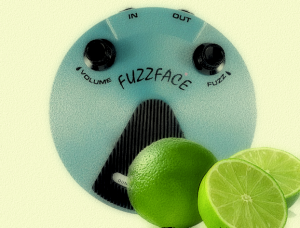
Most sentient guitarists love Hendrix, but not everyone is equally fond of his signature distortion pedal.
So what’s your take on the Fuzz Face?
I used to hate them — but only because my sole exposure to them was via the crappy reissues of the ’70s, ’80s, and ’90s. They sounded so brittle and harsh! Not till this century did I encounter the pedal in its original incarnation.
What a difference!
Vintage-style Fuzz Faces produce tones that are warm, rich, and unbelievably dynamic. It was like the first time I tasted a vintage-style daiquiri. Like the Fuzz Face, the classic daiquiri is a delicate concoction made from a few simple yet complexly interactive ingredients — nothing like those nasty blended drinks that taste like Slurpees spiked with Everclear.
Here’s everything I love about vintage Fuzz Faces, compressed into 60 seconds:
My DIY version is based on inventor Ivor Arbiter’s original 1966 schematic. That’s also the basis for a new DIY project created by my stompbox-buildin’ pal Mitchell Hudson, who runs the cool DIY site Super-Freq. We’ll both be posting it on our sites in the next few days. You can source the parts on your own, or order a kit for less than $50 — not as cheap as some of our other DIY projects, thanks to its two relatively pricy germanium transistors.
Most lore about “mojo” stompbox parts is utter nonsense, but there is something harmonically unique about the germanium transistors used in ’60s fuzz pedals, including original Fuzz Faces. (See my “Germanium Mystique” post/rant for more info.) You don’t need germanium for a good fuzz sound — there are many great tones available via silicon transistors, integrated circuits, and digital modeling. But one problem with those god-awful Fuzz Face reissues was that they often simply substituted high-gain silicon transistors for germanium ones without modifying anything else in the circuit. The result was more gain, but at the cost of harsh, excessively bright tones and inferior dynamic response.
In the last decade or so, builders have wised up. Numerous manufacturers offer authentic ’60s-style replicas. Meanwhile, the DIY community has created countless variations, many of which use post-germanium parts to great effect. These days it’s pretty easy to find a Fuzz Face that doesn’t suck.
I’ve build many Fuzz Face variants, but until Mitchell created his Fuzz Face project, I’d never done a strict original, with positive-ground wiring, PNP transistors, and few latter-day “refinements.” (Don’t sweat it if those terms mean nothing to you — they’re all explained within the project.)
Anyway, that’s the circuit you hear in the video above. It’s not a fuzz for all seasons — it doesn’t have a ton of gain, and its loose, spongy distortion is unsuitable for metal and modern hard rock. But I love its warm, non-macho timbre and phenomenal dynamic response. It’s simple, classic, and delicious, much like this.
Okay, I promise: tonefiend is not going to become an all-digital blog. I’ve got two new DIY analog pedal projects in the pipe, plus a piece on that delightfully retro technology, the book.
But while there’s more to life than MIDI, for the last few months my particular life has been all MIDI, all the time. I worked on the documentation for the Fishman TriplePlay MIDI guitar system, then demoed the product at MacWorld and Musikmesse. And now that the smoke has cleared and I’m off the Fishman clock, I’m still obsessed with the musical possibilities here. In fact, I’m just getting to the fun part: bending the technology to taste and making weird-ass music for weird-ass people compelling new sounds.
I’m posting two new pieces spun off from my Musikmesse demos. Technical and musical comments after the videos.
In my first TriplePlay demo, I used simple, recognizable acoustic instrument samples. For the second one, I focused on aggressive/distorted sounds. But now I’m getting into what really interests me: solo guitar arrangements featuring hybrid colors, deployed so that it’s often difficult to tell the guitar sounds from the synths and samples.
No, I had not. And they’re soooo good. All three are from YouTube user MotorGoblin. I don’t know anything about him, beyond the fact that he’s clever, funny, and very musical.
Anyone have any similar techniques to share? (I’ve been meaning to do a post on my “plastic tube Leslie”…)
For the first Fishman TriplePlay demo I posted last month, I featured pretty, naturalistic acoustic sounds. This time around I went for something a little less polite.
I’ve been having a blast — albeit a humbling blast — trying to play real-time drum parts from the guitar. I still suck if it’s much more complicated than what I play here, but I can imagine learning to do it well. It’s also fun using the guitar to access the big keyboard sound libraries I’ve built over the years. Perhaps most exciting of all are the hybrid guitar/synth/sample sounds I’m starting to develop. (There aren’t any in this demo — the sounds are either samples or processed guitar, though I blur the lines with guitar-ish samples and guitars processed to sound like machinery. Next time, though, I’ll try to showcase some of those unholy hybrids.)
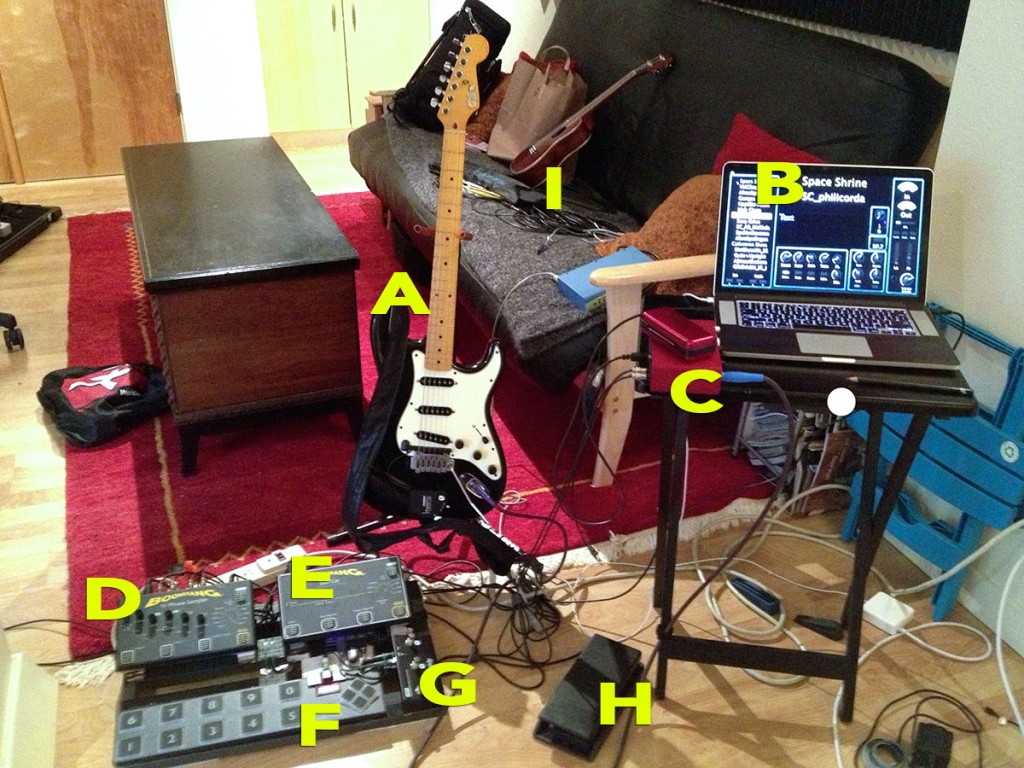
Here’s how the setup looks from my perspective. (I’m not trying to be secretive about what’s on the floor — it’s just hard to fit into the frame, even with a wide-angle lens.)
Joe’s looping/MIDI rig.
Homemade strat with Fishman controller/pickup. MIDI transmitted wirelessly.
MacBook Pro running Apple’s MainStage software. I use a ridiculous number of plug-ins and some ridiculously huge sample libraries. My main sampler is NI Kontakt.
Focusrite Scarlett interface. All the prosumer interfaces sound pretty decent to me these days, though I like the fact that this one isn’t made out of cheapo plastic.
Boomerang III looper. I love its ergonomics and smooth looping points. I screw up my loop points constantly, but I have fewer disasters with the Boomerang than with anything else I’ve tried.
Boomerang Sidecar. Basically just extra buttons for the Boomerang so you can access more features without reprogramming it or performing awkward foot moves.
Keith McMillen SoftStep MIDI controller. Powerful, rugged, feather-light, and not too expensive.
Logidy UMI3. A nice, rugged, and inexpensive USB MIDI controller — just to have a few extra switches.
Generic controller pedal. Its role varies from patch to patch. It might be a mod wheel, a pan pot, a fader, a filter cutoff control, etc.
Piles of crap. These magically materialize every time I start messing with this stuff.
Just to be clear — these sounds are from my collection, and are not included with TriplePlay. Also, I used TriplePlay in “simple mode” for this video — in other words, I’m not using the dedicated TriplePlay application, but simply using TriplePlay as a generic MIDI controller to trigger sounds loaded into MainStage.
BTW, I’m about to head out for Musik Messe in Frankfurt, Germany, where I’ll be demoing this contraption. Oddly, I’ve never been to this vast musical instruments show, which has been described as a much larger NAMM show with more sausage, beer, and accordions. I’ll be sure to tell you about any cool stuff I see!
DISCLOSURE: Fishman, Apple, and Keith McMillen are among my clients, but no one paid me to make or post this video.
But I wouldn’t use them on, you know, one of my normal guitars.
But then I recorded that Bartók piece, using the above-mentioned Guid and Bass VI alongside two standard-tuned guitars with roundwounds. The piece has a lot of counterpoint — all these motifs bouncing between the instruments. And the more I listened, the more I realized that I liked the tone of the two flatwound guitars far more than that of the two roundwound guitars.
And then I bottomed out. I put flats on four more guitars. It wasn’t just musically risky — it was economically catastrophic! And that’s what brought me here tonight.
Funny thing about flatwounds: Everytime I pick up a guitar with flats, I react negatively to the dullness of the wound strings. Where’s the shimmer? Where’s the zing?
But the more I listen, the more I get sucked in. Parts layer over each other more readily. Chords speak more clearly. Fuzz and distortion yield sweeter overtones. It’s easier to get a consistent sound from melodies spanning wound and unwound strings. And the feel? Smooth, sleek and sensual.
Sigh. Maybe I’ll try and kick the habit again tomorrow.
UPDATE, 03.07.13:I should have mentioned a point that several readers noted in comments: The capo only alters the tuning of open strings. Which means that while you can play many harmonies normally available only in dropped tunings, any notes above the capo appear at their usual frets. For example, all barre chords are played exactly as in standard tuning.
After all the digital guitar stuff I’ve been writing about lately, I really wanted to spend an afternoon without plugging in any frickin’ USB cables. So I finally got around to experimenting with the SpiderCapo I picked up last year on a whim.
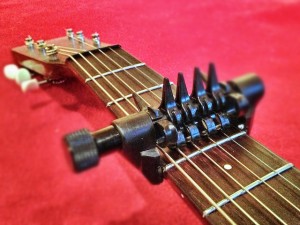
The SpiderCapo his six independently adjustable clamps, each of which can either stop the string or let it ring freely. That means you can dial in most dropped tunings without actually detuning any strings — instead, you transpose the entire voicing up. It’s a lot of fun to play, and seems like it could be a cool composing tool if you’re the sort of musician who gets inspired by unfamiliar tunings. Plus, it looks kind of wicked when you fret the unstopped strings behind the capo.
Here’s a little video I made, noodling around in a few tunings I particularly liked:
Anyone else tried one of these? Or any other “tricky” alternate-tuning capo? How about those gadgets that (unlike the SpiderCapo) can stop strings at differing frets?
 As promised: an overview of Apple’s new Logic X Pro, with an emphasis on what’s new and cool for guitarists and bassists. Lots of movies and audio!

 Most sentient guitarists love Hendrix, but not everyone is equally fond of his signature distortion pedal.