Categories
Acoustic Recording

Tribute to Leonard Cohen

I’m working on this version of Leonard Cohen’s “Suzanne” as part of album in progress: a collection of radically reinterpreted songs from 1967. I haven’t nailed down the final song list. (If you review the list of amazing songs from that year, you’ll understand why. And that link only cites the songs that charted, and doesn’t include classics like the first Velvet Underground album, some great Jobim tunes, random stuff like “Some Velvet Morning,” and lots more.) By hook or by crook, I hope to have the project done before year’s end in time to cynically capitalize on pay tribute to the 50th anniversary of that musically monumental year.

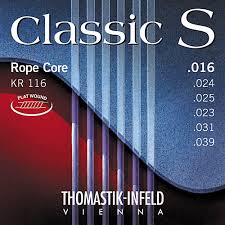
Some interesting tech notes: I’ve you followed this blog, you’re no doubt sick to death of my evangelizing for Thomastik-Infeld rope-core strings. But this is the first time I’ve put them on my Lowden S-25, my main acoustic guitar for nearly 20 years. Its default tone is super loud and bright. (Larry Fishman once referred to it as “a fucking cannon.”) But these days my ears are drawn to darker, softer tones. The Classic S transformed this laser-bright acoustic into an expressive crooner.

Meanwhile, I’ve become a bit alienated from traditional nylon strings over the years, but these, with their hybrid nylon/steel sound, hit just the right sweet spot for me. They’re extremely quiet (though they don’t sound like it when close-miked like this), but they have vast dynamic range and a smooth, sexy feel.

classic_s

I’d previously written that this set is the same as the (cheaper in the U.S.) John Pearse Folk Series Fingerpicking strings, but I was mistaken. The story I hear was that the late Mr. Pearse, working with Thomastik-Infeld, devised this set for Brazilian guitar monster Bola Sete. But on the current Pearse set, the bass strings have nylon cores, while the Classic S bass strings have steel cores. That means you can use the TI set with a magnetic soundhole pickup, allowing you to plug into amps and effects. (I’ll be posting an example soon as a companion piece to this video.) But both sets sound lovely, and both allow you to bend strings as you would on an electric guitar — something you definitely can’t accomplish on conventional classical strings.

I don’t have a ton to add about the sublime Leonard Cohen. But “Suzanne” has always exerted a deep emotional spell on me — even, as here, minus the lyrics.

Categories
Uncategorized

Be My Friend, Friend!

kitty_friends

I haven’t been able to post much here at tonefiend.com recently because I’ve been overwhelmed by two big-ass projects that have occupied most waking hours, plus some sleeping hours as well. (I’ll share the details as soon as I’m allowed.)

Yet somehow, I’ve found time to post various things to Facebook. I know some of you are already pals with me there. But please — anyone with the patience for my pontification, send me a Facebook friend invite. (I’m not picky. I’ll be friends with anyone who doesn’t post spam, or racist/sexist/homophobic shit.)

If you’re not an FB type, believe me, I get it! I’ve got issues with the service myself, even if Mark Zuckerberg lives in my San Francisco neighborhood (in a much larger house, though I bet he doesn’t own a Hello Kitty! guitar, the loser). But if you ever hang out there, please befriend me. I’ve got lots of interesting music/guitar pals, many of whom know a hell of a lot more about this stuff than I do. We often have … um … lively conversations. Hope to see you!

this-one

Oh — if you type my name into the FB search field, you’ll see both my accounts. Pick the one with the Hello Kitty! guitar. The one with the green face is the account I use to hide from keep in touch with relatives and such.

BTW, I’m have no intention of abandoning this site! I just haven’t been able to put together the longer-form pieces I like to post, and probably won’t be able to for the next couple of months. (Meanwhile, I come here every day to respond to question/comments.)

Categories
Effects

Pinch Me. My Three New Pedals Are Finally Out!

Pedals In Stock

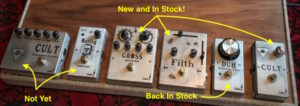
Holy crap, I can’t believe it! My three new pedals are actually in stock and for sale at Vintage King.

The new arrivals are Filth Fuzz, Cult Germanium Overdrive, and Gross Distortion. (Meanwhile, Duh Remedial Fuzz, which debuted last year, is back in stock after the last batch sold out.)

Here’s an overview video that my pals at Premier Guitar shot at the NAMM show last January.

As always, I’m grateful to the friends who helped make this happen, especially Miko Mader from M1, my distributor, and Tony Lott, who oversaw production at the Cusack Music facility in Michigan. In addition to displaying superhuman patience during the long development period, Miko and Tony made many suggestions that improved my original designs. Thanks also to my pal Tom Menrath, who introduced me to Miko and Tony. (Tom used to work at Vintage King, but now he’s with pro audio champs Cutting Edge Audio and Video.)

I’ve posted demo videos for each pedal here before. But I’m reposting them after the jump in case you need a memory refresher. (I certainly do!) And I couldn’t resist including a couple of brag-worthy quotes from some of my early adopters. Thank you all!

Categories
Music

“God Only Knows”: A Golden Anniversary Tribute

It probably wins my vote for prettiest pop-rock song of all time, and it’s a far-from-controversial opinion. “God Only Knows” and all the other great tracks from the Beach Boys’ incomparable Pet Sounds album are 50 years old. (The album was released on May 26th, 1966.)

I owe a big thanks to my pal Mark Goldenberg who inspired me to really learn the entire tune. Mark performs an exquisite solo version, far more lyrical and poetic than my relatively motoric reading. He and I are also preparing a duo version for an album project in the works.

I say “really learn” because you don’t appreciate the number of perverse composition tricks in the tune until you study it bar by bar. Example: the jarring leap into the bridge after the second verse. Or the way that chromatically snaking bridge seems to usher in a return to the chorus, but it’s only a three-bar tease (and in the “wrong” key at that) before a exquisite harmonic pirouette into the final verse. Or the fact that many, if not most, chords in the song don’t feature their root note in the bass. (Especially that verse! The voice leading simply makes no sense on paper, but it’s perfection in practice.) And while countless musicians have praised the outro’s beautiful choral polyphony, I haven’t got much to add, except to say that it’s frickin’ hard trying to cover all those parts! (I didn’t succeed — I only played as many as I could cram into my left hand.)

And oh, the guitar: It’s the latest installment in the ongoing Mongrel Strat Project.I’ve been hacking away at the same sad parts for years. Literally hacking, in this case: I had to route out the pickup cavity to accommodate a pair of über-retro PAFs (a Duncan Joe Bonamassa signature set). Yeah, a Strat with humbuckers isn’t a new idea. But the pickups used are almost always high-gain models designed for macho soloing. I wanted to try something low-gain and unpotted for relatively bright, resonant sounds not quite so far removed from traditional Strat tones. I’m finishing up a video about the project, and I’ll post it in the next few days.

Anyway: Happy birthday, beautiful. You wear your age well.:)

Categories
Amps

My Favorite New Amps: Carr Skylark & Lincoln

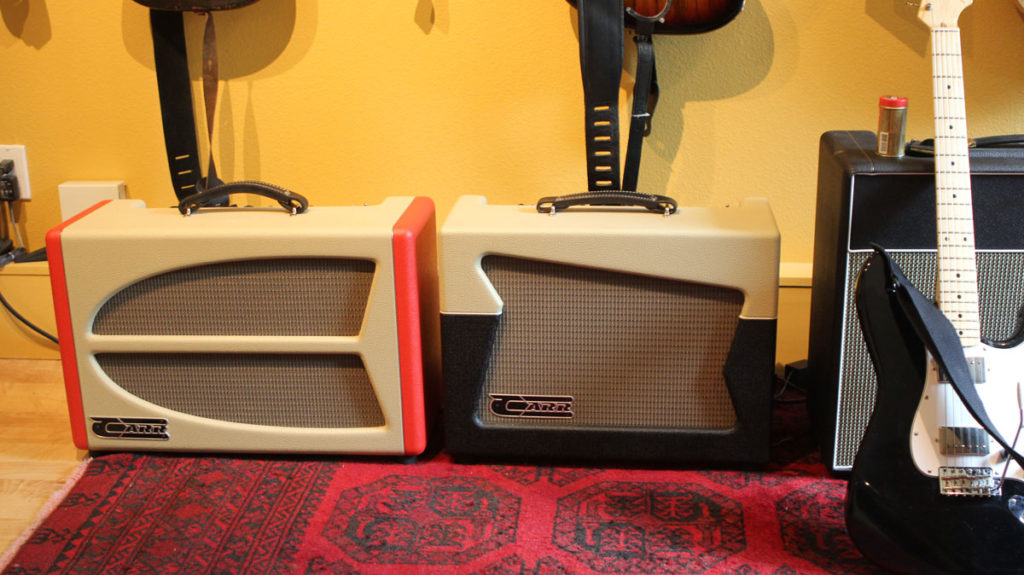
Carr Lincoln and Skylark amps.

I’ve been using my Carr Skylark amp incessantly for the last 18 months or so. I’d originally reviewed it for Premier Guitar magazine, and then I bought one for myself. I dig the fact that, while Skylark is inspired by 1960s Fender amps, builder Steve Carr made numerous departures from the Fullerton template. To my ear Skylark sounds better than my ’60s originals. That’s especially true of its re-voiced tone stack, where the ranges are smaller and subtler than on vintage Fenders, with more of a Matchless-style “no bad settings” sensibility.

For better or worse, history repeated itself earlier this year when I reviewed Carr’s Lincoln in PG. Lincoln is to Vox what Carr is to Fender — not a clone, but vintage-inspired model with its own character and unique twists. Its dual EL-84 architecture makes it a cousin of the AC-15. But I think of it more as a “fantasia on a theme by Vox.” It’s captures the Vox qualities I dig, minus the ones that can make dealing with vintage Voxes a major drag.

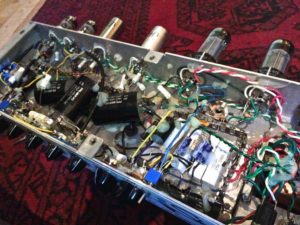
Carr-Skylark-Wiring-WEB
Skylark features true point-to-point wiring, with no circuit or turret board. (Lincoln, however, uses bits of circuit board for non-audio functions such as channel-switching.)

If you’ve listened to many of my videos and demo clips from the last year or so, you’ve heard these amps, so I figured I’d focus on them. For tech details, see the reviews. This video is more about how the amps inspire me musically.

From their flawless cabinetry to their ravishing tones, these amps are simply stunning. Cheap, they ain’t, but I felt like I was (RATIONALIZATION ALERT!) investing in musical art. Or maybe I’m making up for not buying a Trainwreck amp back in the ’90s when they were affordable.

I especially love how these Carr amps sound with my flatwound-strung guitars, and I used them on most of the demos for my pedals because they’re so very flattering. Ironically, I thought I’d given up buying new amps, because I was having so much fun building from kits. But trust me — both these instruments sound way better than any of my kit amps. Have a listen!

Categories
Music

“Eleanor Rigby” Rehearsal

Lucky me: I just started rehearsing for a duo project with one of my guitar heroes, the brilliant Mark Goldenberg. Here’s a run-through of “Eleanor Rigby,” one of the tunes we’re working on. It’s pretty rough still, and the recording quality ain’t great. But I love Mark’s playing so much here that I couldn’t resist sharing.

I’ve only known Mark a year or two, but we hit it off as soon as we met at one of Teja Gerkin’s solo guitar events. Mark played ravishing solo version of so many of my favorites: “God Only Knows,” “Shenandoah,” “Wichita Lineman,” “Mood Indigo,” and more. I love his ultra-dynamic touch and beautiful Bill Evans-style harmonies. Plus he’s just an cool guy.

And it turns out we both studied with the same teacher: the late Ted Greene. (I took lessons from Ted as a teen, with a few more sessions 20 years later. Mark studied with Ted long after he became a leading LA sideman and session player.) You can read more about Mark on his website. He’s recorded and toured with Jackson Browne, Bonnie Raitt, Linda Ronstadt, Eels, Natalie Imbruglia, Chris Isaak, Waylon Jennings, Willie Nelson, Peter Frampton and — hehehe — William Shatner. It’s a real thrill to collaborate with such an inspired player.

I’m playing a Gretsch TV Jones baritone on loan from my pal Xander Soren. Mark’s playing his magnificent mahogany Collings.

Categories
Effects

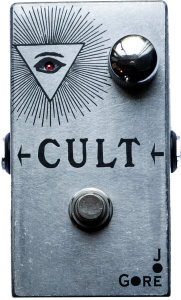
Cult Is Coming!

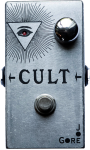
Cult_crop

Of the four pedals new I announced at NAMM, Cult is probably closest to my heart— it’s my favorite overdrive circuit. If you’ve watched many of my videos, you’ve heard it. I even built it into a few guitars, including this one, this one, this one, and this one. And now Cult is coming in pedal form.

It’s no secret that 90% of today’s overdrive circuits are derived from the Ibanez Tube Screamer. Screamers are great if you want to compress your signal for consistent and predicable results. But Cult provides the opposite effect, expanding your guitar’s dynamic range rather than compressing it. It’s great for players who vary their touch and guitar-knob settings for maximum tonal variation.

Cult is sort of the mutant grandchild of the single-transistor boosters of the 1960s, including the Dallas Rangemaster. It’s no Rangemaster clone, though — the parts, values, controls, and tones have little to do with that classic treble booster. But Cult has the crackling presence and extreme dynamic response you only get from such minimal germanium-transistor circuits. (Guitar Player magazine went so far as to call it “the most dynamic overdrive we’ve heard.”) The pedal heard in this video is a final factory prototype, and the units now in production look and sound identical.

Have a listen:

As the video demonstrates, Cult lets you veer from crispy-clean to spatter distortion just by adjusting your guitar’s volume control. But my favorite way to use it is to set the gain so that you can go from sparkle to splat just by altering your touch, as heard in this video:

Cult with be available from Vintage King in the next month or two. There’s more info on the Joe Gore Pedals product page.

Categories
Uncategorized

NAMM and Not NAMM 2016

Screenshot 2016-01-19 08.08.08How to tell holiday season is officially over: It’s time for NAMM 2016! And this will be the first time I attend not as a music magazine writer, but as a guy trying to sell guitar pedals. Or as Ray Liotta put it in Goodfellas: “Just another schnook.”

Not like I can afford a proper booth or anything. I’ll just be wandering around with a sack of goods like some frickin’ crack dealer. I’ll have a pedalboard with new four new releases (plus a couple of surprises) on display at the Vintage King booth in Hall A. But sadly, it won’t be hooked up to anything — there just isn’t enough room for live pedal demos. However, my awesome friends at Voodoo Lab will have my new Filth Fuzz in the demo pedalboard at their booth. (No business connection there — they’re just doing me a favor ’cause they’re cool.) So you can stop by and try it out while sampling Voodoo Lab’s latest and greatest.

If you’re attending NAMM and would like to check out my stuff — or just meet and say hi — drop me a note. I’ll be at the show Thursday, Saturday, and Sunday. (Sorry, I can’t help obtain passes. I had to scuffle for my own like … a regular schnook.)

But I’m skipping the show on Friday. Friday night I’ve got a gig at Taix restaurant in Los Angeles, performing my solo looping material and sharing the bill with my longtime pals, Double Naught Spy Car. I haven’t played L.A. in several years, and this is the first time playing solo. I’ll be stoked if folks stop by.

And during the day, I’m teaching a master class at LACM, where my dear pal Adam Levy oversees the guitar department. The focus is modes — or rather, my irreverent crackpot theories about the most musically profitable ways to regard and use modes. I’ve been kicking around these notions for many years, and I’ll probably adopt them into a tonefiend post soon.

I hope to see some old friends and make some new ones. So don’t be a stranger!

Categories
Effects

Filth Fuzz is (Almost) Here …

Filth

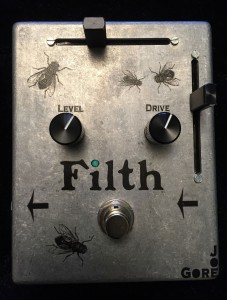
My Filth Fuzz pedal is finally in production and will be shipping within a few weeks. It’s one of three new pedals I’ll be showing at this week’s NAMM show in Anaheim, California. I just finished the demo video, and I’m stoked about how it’s sounding.

I’ll also be debuting three other new pedals: Gross Distortion, Cult Germanium Overdrive, and Boring Boost & Buff. Filth, Gross, Cult, and are finalized and in production, and should be available from my partner, Vintage King, sometime in February. (Vintage King is also currently the sole vendor of my Duh Remedial Fuzz, released last year.) We’re still working out a minor bug in Boring, but it should arrive soon after.

Now, it’s not like I can afford a proper booth or anything, so when I say “I’ll be showing these at NAMM,” I mean I’ll be walking around with a bag of merchandise. I’ll have a pedalboard with all my products on display at the Vintage King booth in Hall A, but sadly, it won’t be set up for demoing — there just isn’t enough space. However, my super-cool friends at Voodoo Labs will have a Filth Fuzz on their demo pedalboard, so you can take it for a spin in their booth while checking out the new stuff from that ever-innovative company. (I have no business connection to Voodoo Labs — they’re just helping me out because they’re nice.)

If you’re going to the show and would like to meet up, contact me and we’ll work something out. 🙂

Here’s what I wrote about Filth on its product page. (If you’re allergic to marketing copy, skip ahead, where I share some interesting backstory on how we arrived at the interface design.)

Man, I love those mad scientist fuzzes with too many knobs! I’ve collected them for decades and used them on a zillion sessions. It got to the point were people were hiring me specifically to make those sort of farting, fried-circuit tones.

But the downside of those complex fuzzes is that they’re a little too wide-ranging, with many settings you’ll probably never use. It’s easy to spend 20 minutes dicking around with the dials without nailing the perfect tone. I’ve always wished for a wild, highly variable fuzz that was a bit more “curated,” with easier access to the tones you’re likeliest to use.

That’s what inspired the Filth Fuzz. It’s only got four controls, but it’s a cornucopia of cool, quirky, and usable fuzz flavors.

The drive and level controls do what you’d expect. But unlike many fuzz drive controls, this one sounds great throughout its range. Extreme settings are molten-lava thick. Lower settings are like…slightly cooled lava, maybe?

But the real action is in the two sliders. They’re tone controls of a sort, but not in the usual way. Most fuzz tone controls are tone-sucking passive circuits situated downstream from the fuzz effect. But here, the sliders alter the voltages at the transistors, radically changing not only the tone, but also the timbre, response, attack, sustain, and compression. In other words, the sliders radically alter the fuzz’s core character, as opposed to simply EQing a single core tone.

TO USE: Set desired gain and output levels. Move the sliders till it sounds awesome.

CAUTIONS: Filth sounds best before any buffered effects. It usually works best at or near the front of your effect chain.

Filth Fuzz was created in San Francisco and is built in Michigan by skilled craftspeople earning a fair wage.

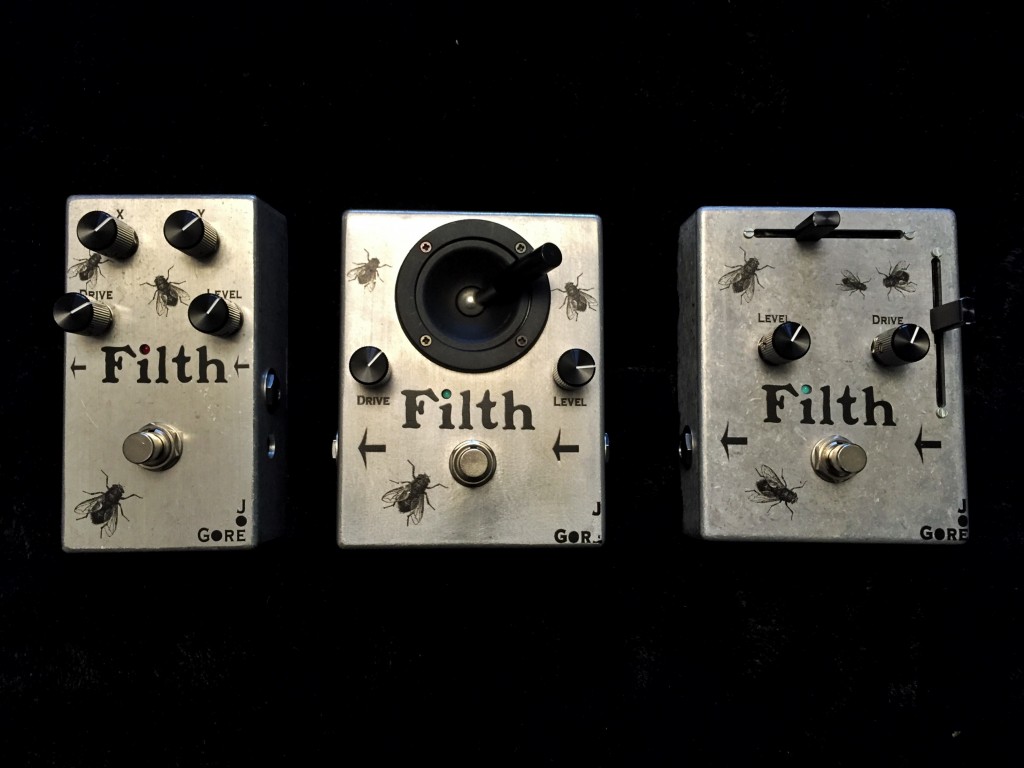
Filth’s sound hasn’t changed since I concocted the circuit on breadboard a few years ago. but the interface has gone through many iterations. It kept changing even after I sent schematics and prototypes to Tony Lott at Cusack Music (my manufacturer). Here’s a pic of three production prototypes:

Filth Fuzz
Three incarnations of Filth Fuzz (in order of appearance).

To dial in tones on Filth, you adjust two highly interactive pots (let’s call them x and y), which tweak the voltages going in and out of the transistors, providing many tone variations. The original version used two standard pots for these x/y controls. It worked okay, but the ergonomics weren’t ideal. I’ve found that the fastest way to refine sounds is to move both pots at once over a sustained note or chord, and it was just a bit awkward having to take both hands off the guitar to turn the controls simultaneously.

So I decided to employ a joystick, which lets you adjust x and y with one hand (and it looks pretty bitchin’). The ergonomics were great, and I thought we’d finalized the format.

But then I showed a joystick prototype at the L.A. Amp Show in October, and for the first time I had a chance to sit back and watch other guitarists interact with the device. Players seemed to have a blast with it, but I kept noticing how often a heavy stompbox foot would land perilously close to the joystick’s none-too-sturdy shaft.

Meanwhile, we discovered that the the only compatible joystick option cost about $25 per unit — enough to jack the retail cost way up. Also, it was tricky to replicate exact setting via the joystick, which would suck if, say, you were trying to get identical tones night after night on tour. (I knew that when I first opted for the joystick, but I’d figured the fun factor would more than compensate.)

Then Miko Mader, a clever guitarist who works for my distributor, M1, came up with the perfect solution: Why not use two sliders instead of pots? Tony at Cusack sourced the perfect part, and we prototyped a third version.

Bingo!The ergonomics were great (check out the demo video to see how quickly you can change sounds with one hand). You can mark exact settings with tape if you need to, easily repeating specific sounds. The two sliders are a fraction of the cost of a single joystick, so we can sell the pedal for far less. (We’re still nailing down the retail price as I write.) There’s no fragile shaft to break. And while I miss the goofy fun of the joystick, the sliders are still pretty darn entertaining. (So thanks, Miko, for your brilliant idea.)

I’m really stoked about this pedal. I hope you enjoy it as well.

Categories
Music

My Brushes with Bowie

My morning, like everyone’s, started with a devastating gut-punch: “David Bowie died.”

I can’t say I knew Bowie, but I was lucky enough to spend a few hours with him back in the ’90s. And he was every bit as cool as his music.

bow1I’d done a Guitar Player interview with Reeves Gabrels after the release of Tin Machine in 1989, and we’d stayed in touch. When Tin Machine II came out in September 1991, the band came to San Francisco to play at a music conference. My future wife Elise and I offered to show Reeves around the city. And Reeves invited David along, accompanied by an amiable bodyguard. We spent the afternoon tooling around town in my dumpy Mazda two-door hatchback with David perched astride the back-seat hump. (He insisted on taking the most uncomfortable seat.)

David was charming and unpretentious, yet freakishly charismatic. This is going to sound a bit woo-woo, but he just seemed to scintillate with some weird luminous energy. That probably sounds like the typical star-struck reaction of a lifelong fan. But I’ve met several members of the super-famous tribe over the years — Madonna, Springsteen, Ringo, Steve Jobs — and never encountered anything remotely like David’s spark.

Some stars have a gift for dimming their light as needed. For example, I used to see Robin Williams around my San Francisco neighborhood back in the ’80s. He’d be walking down Haight St. close to the building fronts, slouching a bit with his hands in his coat pockets and his face downcast. You wouldn’t notice him till the instant he slinked past. David was the opposite: When he’d round a street corner, it was as if everyone on the block instantly felt the energy shift. It was uncanny.
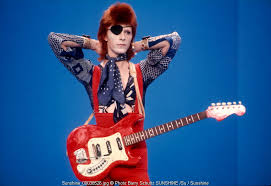
UnknownDavid and Reeves wanted to get piercings. First we grabbed lunch in Japantown (David had pork katsu, and treated everyone. His credit card was in his real name: David Jones.) Then we took them to the Gauntlet, SF’s premier piercing parlor at the time. It was David’s first piercing. He told us that he and his wife-to-be Iman were both getting simple single-ear piercings. It was an old sailor’s tradition, he said: The departing seaman and his love who stayed behind would get matching piercings as a symbol they’d be reunited some day.

David confessed to being a bit scared. As we scaled the stairway to the second floor, he jokingly clutched the bannister as if hauling himself up against the wishes of his legs. Naturally, the guy behind the counter recognized him within milliseconds. He was too hip to make a fuss, but you could literally see his eyes widen. After the guys got their piercings, the wide-eyed dude explained the maintenance procedure, recommending that David rotate the stud to keep the hole from scabbing over. David initially misunderstood and thought he had to remove the stud from his ear. “No,” Piercing Guy explained. “Leave it in there and just rock it.” He paused for two comically perfect seconds. “You know how to do that.”

We drove up and down the city’s hills, climbing out at viewpoints and talking San Francisco lore. David was easy to chat with. Unlike many of the super-famous, he’d actually listen to what you’d say and would usually respond with something fascinating. At the same time, it was exhausting. I felt like 33% of my mind was on the words. Another third was studying his eyes with their famously mismatched pupils. And everything else was OHMYGODI’MTALKINGTODAVIDBOWIE.

Everywhere we went, shy fans would approach David, thanking him or seeking autographs. Without exception, David would pause what he was doing, take a moment to chat, and humbly thank them. It was like a master class on the right way to be a rock star. What a gentleman!

David-BowieBut the gentlemanly feat that most floored me was purely physical. By that point, Elise insisted that David, the out-of-towner, sit up front while she sat on the hump. When we got out to enjoy some view, David helped her out of the rear seat. It wasn’t just extending a hand — it was a deft and complex balletic gesture, as if levitating her out of the car, bowing slightly, and ushering her on her way. I can’t quite describe the impossibly graceful maneuver, and I couldn’t begin to replicate it. It was like something a 17th-century French courtier might do.

Our last stop was a funky hat shop in North Beach. I jokingly urged David to try on an orange plastic pith helmet with a Grateful Dead sticker front and center. Instead, he asked to see a green felt fedora. “How does this look?” he asked, turning and striking a smoky 1940s film star pose. Elise and I swear we felt an electrical shock. We’d almost relaxed by that point, and suddenly David Bowie was standing there! (And yes, he bought the hat.)

Later, back home, we were exhausted. Elise theorized that there’s something vampiric about that sort of charisma. David didn’t just emanate energy — he seemed to soak it up it from those around him. Yeah, woo-woo again. But that’s how it felt.

My second encounter was in 1995, when I flew to NYC to interview Reeves and David separately and together for a Guitar Player cover story. I got to sit in on a rehearsal, where David was calm, kind, and focused with his band. We also went to a Rosie O’Donnell Show taping where the group played live at some decidedly un-rock n’ roll morning hour. Again, David was the very picture of modesty and graciousness.

My solo interview with David was as fascinating as you’d imagine. The focus, of course, was guitar playing. He had compelling things to say about his great accompanists: Mick, Earl, Carlos, Robert, Stevie Ray, Adrian, and, of course, Reeves. But we also spent a lot of time talking about David’s own underrated playing. Did you know he was the sole guitarist on the Diamond Dogs album? And have you listened to that record lately? Those grinding, clanking guitars are like Sonic Youth 15 years ahead of schedule. And that’s David playing the immortal riff from “Rebel Rebel.” He said it came to him in a flash, and when it did, he looked up at the sky and thanked God.

2001-07TotalGuitar-BowiewithEccleshall12-stringAt one point David made an arch comment about a then-huge band he’d shared a flight with — something like, “They were nice enough kids, and I’m told they’re quite popular.” Back in my hotel room after the interview, the phone rang. “Oh, one thing,” said David. “Would you be so kind as to leave that comment out of the story? It wasn’t a nice thing to say, and I wouldn’t want to hurt anyone’s feelings.” I did as asked.

I almost had a third encounter later that year when I was touring with PJ Harvey. David contacted Polly, asking her to duet with him and his band on “The Man Who Stole the World” for some TV or award show. Polly being Polly, she said she’d only do it if she could use her own band, and we even rehearsed a dirge-like version of the tune. (Without David, of course.) In the end David nixed the idea, opting to perform his song with the musicians of his choice.

I could write reams about David’s music from the perspective of a naïve young fan (I’m old enough to have had Hunky Dory on my radar when it was new), as an aspiring music student during his Berlin era, and from the jaded perspective of a middle-aged music journalist. I probably will at some point. But now I’m just feeling grief for our collective loss, and gratitude for my brushes with Bowie — and getting to spend some time with that remarkable gentleman genius.