Prewired replacement electronics provide access to many popular wiring mods, minus the soldering.
Prewired replacement electronics provide access to many popular wiring mods, minus the soldering.
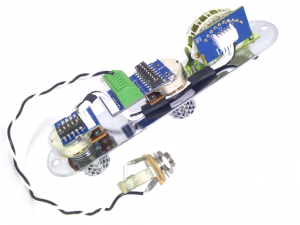
Larry Santellan of Santellan Sounds, maker of the Elec-Trix tone modules, sent me some samples to check out. These pre-wired circuits offer quick access to some of the “greatest hits” of alternate wiring, with an emphasis on Strats and Teles. He has pop-in modules for 5-way Teles, Vari-Tones, passive overdrives, vintage/modern switching, and more.
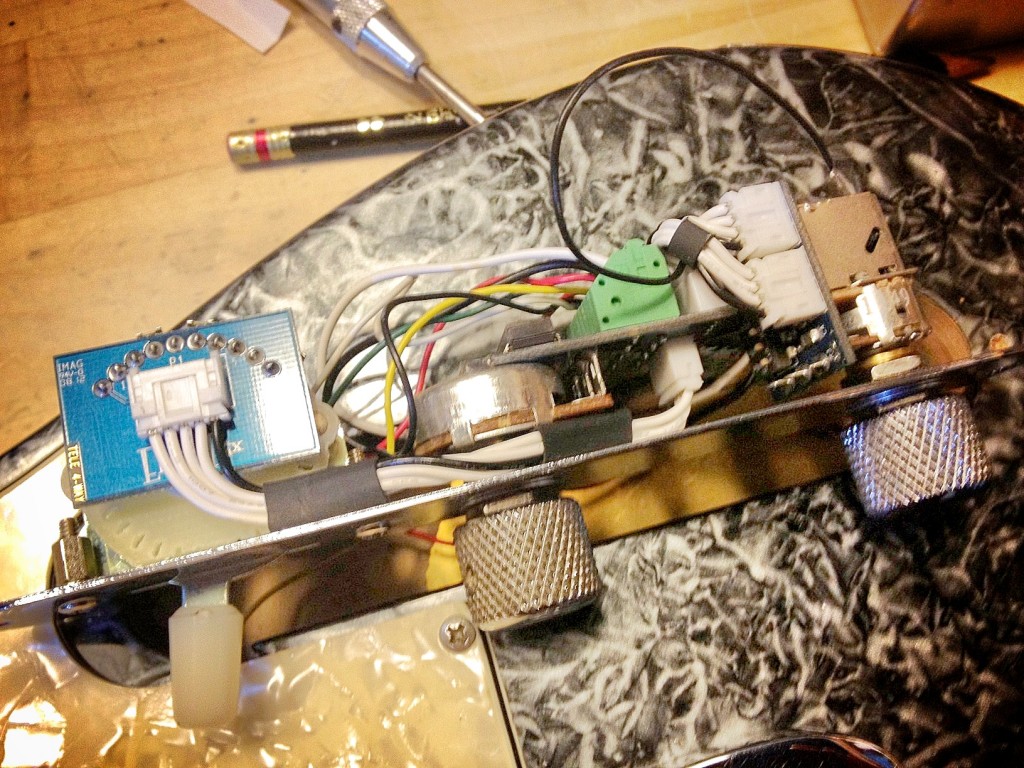
I haven’t had the time to try everything Larry sent, but for a few months I’ve had his 4-Way Fat Tone Monster Deluxe Wiring Kit in my Tele-like G&L ASAT. It lets me dial in the three standard sounds, plus that humongous series-pickups BLAT! A push/pull pot bypasses the tone control. (I never hear meaningful differences between bypassed tone controls and wide-open ones, but this setup lets me toggle between a bright, wide-open tone a muted one.)
Installation was relatively easy, and the parts and workmanship are top-notch. If you’re interested in alternate pickup wiring options, but don’t have the skill, patience, or time to solder it yourself, well, check out the Elec-Trix catalog.
Solder-free configuration via clever ribbon connectors.
Is it just me, or do many guitarists these days find themselves alternating between separate analog and digital setups?
I’m posting some pics of my current pedalboards (bearing in mind that, for reasons I’ll get into in a sec, my pedalboards only tend to stay “current” for a few days at a time). Both were assembled using store-bought housings, though I’ll talk a bit about total DIY boards as well.
First, the mostly analog setup (the exception, of course, is the digital Boomerang III looper).
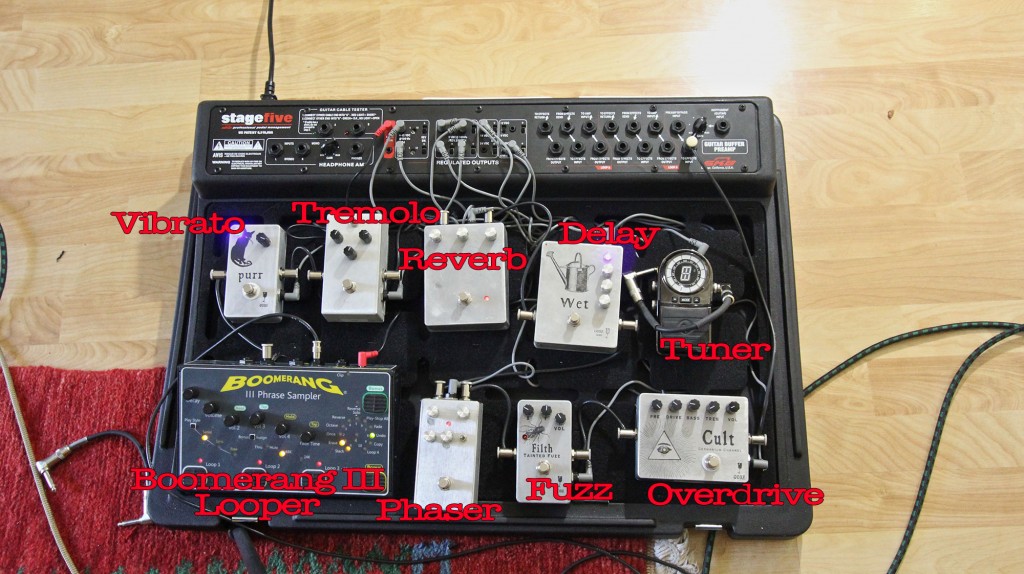
Joe Gore’s mostly analog pedalboard.
The case is a newly purchased SKB Stage Five, a full-featured unit in a relatively rugged molded plastic case. These retail for a whopping $540, but you can find them heavily discounted. (I forget the exact price I paid for mine, but it was under $300.) It’s loaded with cool features, like dual effect loops, a built-in buffered preamp, and support for 9- through 24-volt DC power, plus 9V AC for those digital pedals like Line 6 modelers and many loopers. There are even trim pots on a few power jacks to simulate dying batteries. I’m less impressed by some of the fittings (like the cheapo plastic jacks), though I suppose they keep the weight down. And make no mistake: This thing is heavy!
Verdict: Too early to tell, since I haven’t subjected it to road abuse, but I trust it enough to at least give it a go. I think I’d be a bit disappointed had I paid full pop, but it strikes me as a fair deal if you can find it at a 40+% discount.
Thank heaven I became a guitar geek shortly before my 12th birthday. If I hadn’t, I probably would have requested a minibike for my bar mitzvah present a year later, instead of my first electric guitar. And today I’d be an over-the-hill biker instead of an over-the-hill guitarist.
My schoolteacher mom had a colleague whose son worked at Fender in Fullterton, California, not far from where I grew up. (Sadly, I’ve forgotten his name). Shortly before my big day, we visited his mobile home (let’s face it: the musical instrument industry has never been lucrative) to audition some decidedly post-CBS guitars he was selling. I opted for a black Jazzmaster, though I was tempted by the paisley Tele. It was my sole electric throughout high school, though I sold it at exactly the wrong time: five minutes before new-wave guitarists such as Tom Verlaine and Elvis Costello made it cool again. (Though I shouldn’t complain, since I managed to procure my pre-CBS Strat around that time.)
The Fender guy didn’t have extra amps on hand, but I slavered over the oversized amps in the early-’70s Fender catalog.Which sleek silver combo would greet me on the big day?
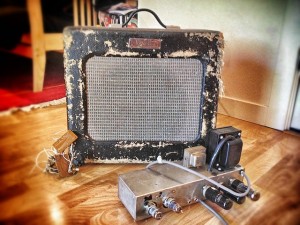
To my horror, I received an ancient, teensy-weensy combo amp, an ugly thing spray-painted black. I was mature enough not to express anything other than delight, but my heart ached. I wanted an amp as big and loud as my dreams, not this sad relic. They told me I was a man when I turned 13 — but I didn’t feel like one without the Dual Showman of my dreams.
My disappointing amp was a tweed 1952 Deluxe — which makes it sound like this story will have a happy ending. Sadly, no.
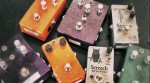
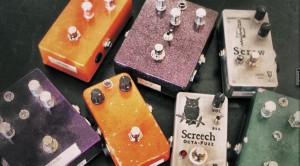
These funky homemade pedals represent all the leading octave-fuzz circuits.
These funky homemade pedals represent all the leading octave-fuzz circuits.
I had no idea I had so many octave fuzz pedals! I had no idea they sounded so different! And after spending way too much time auditioning and recording them, I have no idea when I’m ever going to be able to stand listening to them again!
Naw, just kidding — I had lots of fun putting together this octa-fuzz fest. It features no name-brand pedals, just DIY clones based on old circuits. But hey, most of today’s octave fuzzes are also clones of old circuits.
In fact, imitation has always been the name of the game here. The Roger Mayer Octavia used by Jimi Hendrix was inspired by a circuit found in a British mixing console. The US-made Tycobrahe Octavia was a ripoff of Mayer’s circuit, though tone snobs tend to regard it as the superior unit. It’s certainly one of the rarest and most valuable stompboxes ever. The name “Octavia” has also been slapped on many other variations of the circuit, including some particularly dismal models. The Prescription Electronics Experience and Lovetone Ultimate Octave are based on the Foxx Tone Machine. The Dan Armstrong Green Ringer was based on the Ampeg Scrambler, and I used the Green Ringer circuit as a jumping-off point for some of my own designs. The sincerest form of flattery abounds here.
If you make it through this seven-circuit survey, you’ll encounter most of the major players, and if you hear something that particularly interests you, you can build it yourself using readily available schematics, or buy a nice kit or boutique clone.
Now, don’t confuse this effect with modern digital devices that actually transpose the notes you play. Octave fuzzes use an electronic trick to cancels out much of the fundamental of each note, making the octave overtone stand out more prominently. The process is called full-wave rectification, and ever-knowledgable reader mwseniff explains it far more capably than I in a comment following my previous post on this topic. It’s an odd, glitchy effect that tends to require specific playing techniques for the best results. And for better or worse, it’s an effect that has so far been difficult to mimic digitally. Sure, some of the modeling boxes out there have interesting-sounding octave-fuzz effects, but they tend to score low on the analog-realism scale.
Check out the video. The post-mortem comes after, as post-mortems usually do.
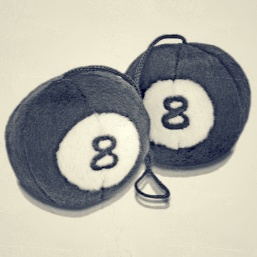
Eight as in octave. Fuzzy as in fuzz. Get it? Oh, never mind.
They’re fuzzy eight balls, okay? Eight as in octave. Fuzzy as in fuzz. Get it? GET IT? Oh, never mind.
Anyone have any strong feelings about octave fuzz? I’m guessing so, because not many effects produce stronger feelings. It’s not a path for the faint-hearted. Or control freaks. Or frankly, most guitar players.
I rounded up all my octave fuzz pedals and made an amazing discovery: I have way too many of them! I’m putting together a video demo of some faves, and will post it in a couple of days. But I couldn’t wait to start talking about it this quirkiest of effects.
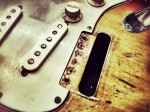
This photo was digitally altered to make it look even dirtier — but not by much.
This photo was digitally altered to make the guitar look even dirtier than it was — but not by much.
Sometimes only the threat of public exposure can inspire a proper clean-up job. Case in point: I hadn’t groomed my battered ’63 Strat in years, and when I pupped it from the wall for my recent post on the instrument, the fact that I was about to show it to the world you guys made me finally admit how gross it had become.
Now, it’s not like I wanted it to sparkle or anything — seems to me that an old guitar should look old, and removing 100% of the grime would be a little too much like those octogenarians with preternaturally white teeth. I mainly just wanted to remove the sticky crud that had accu
One cool thing about going indie with tonefiend is that fact that I can finally host my own geek forum! It’s already up and running — but it’s a sad, vacant space that desperately needs to be populated by cool people and cool ideas.
How to get there? Sleazy bribes! Cool prizes!
Here’s the deal: I’ve pre-populated the forum with a few topics and threads. Just come on over, register, and chime in on any thread that interests you — or better yet, start one of your own. And on September 1st, 2012, the three forum members who have consistently contributed the liveliest content as judged by some dork me will get a bitchin’ stompbox laboriously hand-built by the same dork me. I can’t disclose exactly what the pedals will do, but I can promise they will be cool, useful, and genuinely unique — original designs, not some lame-ass Screamer clones. And if I manage not to vaporize my hand with the TechShop laser-cutter I’ve been learning to use, they’ll even have wicked laser-etched enclosures.
Naturally, I hope the tonefiend forum will also be cool and unique, and that you’ll enjoy geeking out there even when there’s no contest. But hey, I’m not above greasing the skids with free stompboxes as needed.
Last winter I tried an odd experiment: a website where players were encouraged to post their best tone secrets — the kinds of tricks and techniques that are almost too good to share. But in order to get, you had to give: The site was password-protected, and the password was only sent to those who contributed secrets.
Musicians responded, no doubt encouraged by the cool prizes awarded to the top secrets, as judged by user ratings. I also asked some cool musician friends to contribute the first round of secrets, yielding tips from the likes of composer/virtuoso Lyle Workman, metallurgist-turned jazzbo Alex Skolnick, original Chili Peppers guitarist Jack Sherman, boy genius Blake Mills, and other great players.
Once the contest ended, traffic slowed, but the site has slowly but surely grown. And now, as an experiment, I’ve removed the password protection. Now anyone can visit the Secret Room, AKA tonesecret.com, even if they haven’t coughed up a secret. So please do!
It’s a fascinating document. Naturally, the quality of secrets varies, as does the level of expertise needed to make the most of them. I exerted a light editorial hand — only silly or flat-out-wrong tips were vetoed, and I didn’t do much in the way of spelling and grammar repair. Sometimes the contents are a little repetitious — but trust me, there is much wisdom and originality throughout.
I hope you find something helpful — and I hope you’re moved to contribute some secrets yourself using the site’s submission form. And who knows? There may be more tawdry bribes fabulous prizes lurking around the corner…
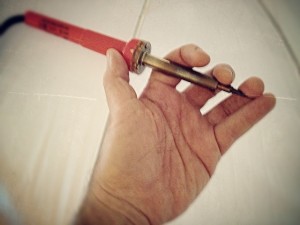
Somewhat embarrassingly, I never got around to changing one of my own pickups until I was knocking on senility’s door recently. I owe part of the inspiration to that fabulous DIY Fest known as the Maker Fair, where each year hundreds of little kids learn to solder craft projects at long picnic tables. Or maybe it was the awesome soldering tutorial by 11-year old W0JAK. Well, after a buttload of pickup installs inspired by this blog, I guess I qualify as some sort of solder “expert,” because Seymour Duncan asked me to make a video designed to walk n00bs through the pickup install process for the first time. It was a lot of fun to prepare, and I learned some important things, like the fact that it’s hard to solder, talk, and operate a camera at the same time. Check it out:
I’ve said it so many times, I feel like the parrot of pickups, but here goes again: These days the weakest links on inexpensive Asian and Mexican guitars are invariably the pickups. Upgrading them often yields a princely axe at a pauperly price.
A perfect example is the Ibanez Art Star archtop I just upgraded for my friend Dusty. These aren’t especially sought-after models — they seem to sell used here in the States for for between $400 and $500.
The guitar looked cool and played well, but the pickups were murky and undistinguished. I replaced them with a pair of Duncan ’59s, and man — a merely decent guitar suddenly became very good.
Dusty’s not really a jazz player — more a cool indie-rock-pop guy — so I figured he’d like the option of a brighter, single-coil sound. I requested the ’59 model with four-connector cable (plus chrome covers to maintain the retro look), and used push/pull pots from StewMac for humbucker/single-coil switching. That was also my rationale for choosing “vintage-style” wiring, which keeps the tone relatively bright, even when rolling back the tone pots. Dusty also wanted to keep the guitar’s flatwound string as a departure from his usual roundwounds, which was all the more reason to keep the tone as bright as possible.
Just one disclaimer before you view the demo: Dusty is left-handed, and I am not. I foolishly bravely recorded the performance playing the guitar upside-down without restringing. So you’re going to have to imagine how it would sound played confidently and comfortably! (It was an interesting experience, to say the least, one I wrote about it here.)