Categories
Digital Recording

Logic Pro X:
What’s New for Guitarists & Bassists?

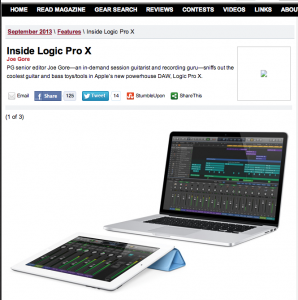
Inside Logic Pro XAs promised: an overview of Apple’s new Logic X Pro, with an emphasis on what’s new and cool for guitarists and bassists. Lots of movies and audio!

It’s here.

This is an exciting post for me, and not just because I get a desperately needed break from Klons and Screamers. I’m thrilled to bits about Logic Pro X and MainStage 3, though I’m still wrapping me head around them. (Yeah, I worked as a developer for both products, but I didn’t get a proper program-wide view until last week’s release.)

Also, it’s my first story for Premier Guitar, whose staff I’ve just joined as a senior editor. I’m stoked because it reunites me with PG editor Shawn Hammond and senior editor Andy Ellis, both of whom I remember fondly from my Guitar Player magazine days.

There’s much talent and coolness on the staff. I’m a happy little guitar nerd. Plus, the schedule is loose enough that I can still record, perform, and continue to work with audio/software clients.

What does the gig mean for this blog? Good things. I have no plans for a major course change β€” there are too many things I can only cover on a non-commercial site, including some of the topics closest to my heart. Meanwhile, working with PG will keep me more up-to-date on new music, new gear, and scurrilous guitar community gossip. In some cases, though, I may link to a PG article I’ve written rather than duplicate the work here. Today, for example. πŸ™‚

Categories
Effects guitar Recording

Klon vs. Screamer Test:
The Results Are In!

As promised, the correct answers to the Klon vs. Screamer blind listening test posted exactly a week ago:

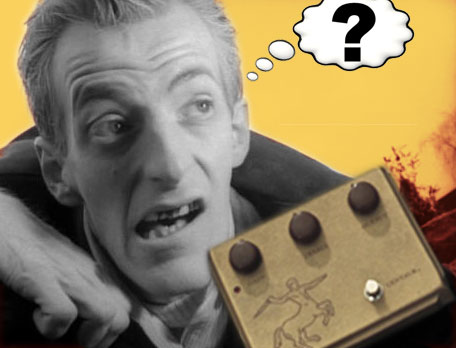
klon_zombie

Example 1: medium gain, medium tone

Pedal A = BYOC clone
Pedal B = Klon Centaur

Example 2: high gain, medium tone

Pedal A = BYOC clone
Pedal B = Klon Centaur

Example 3: low gain, medium tone

Pedal A = Klon Centaur
Pedal B = BYOC clone

Example 4: medium gain, bright tone

Pedal A = Klon Centaur
Pedal B = BYOC clone

Example 5: medium gain, dark tone

Pedal A = Klon Centaur
Pedal B =BYOC clone

And the winners are…

Categories
Bass Digital Effects guitar Recording

Logic X is Here!

Nnnggg...pedals.
Nnnggg…pedals.

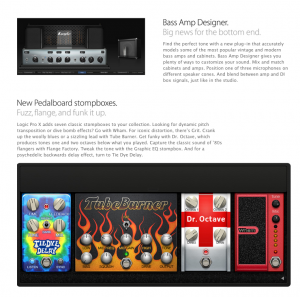
Apple released the long-awaited Logic X a few minutes ago. And it’s dripping with cool new guitar and bass stuff: a fabulous bass amp modeler. Lots of new virtual stompboxes. Vast new libraries of guitar tones, and newer, smarter ways of accessing them. More product info here.

FYI, I’m the furthest thing from an unbiased source: Apple is one of my clients, and I was a major indie developer for this product. But hey β€” the guitar features here are seriously bitchin’.

More details and examples in the coming days!

Categories
Effects guitar

NEW CONTEST: Klon vs. Screamer
Identify the Audio Clips and Win!

Left: Klon Centaur #309, worth over $2,000.Right: BYOC Overdrive 2, a $95 Tube Screamer clone.
Left: Klon Centaur #309, worth over $2,000.
Right: BYOC Overdrive 2, a $95 Tube Screamer clone.

It’s hardly a new idea: YouTube is full of Klon vs. Screamer comparison videos.

But this one is different.

Using the same “reasonably scientific” techniques deployed in my recent germanium fuzz survey, I’ve created a blind listening test that removes as many variables as possible from the equation.

The video details the testing procedures. But basically, the A/B recordings are identical save for the use of one pedal or the other. The rival pedals are Klon Centaur #309 (the unit reviewed in Guitar Player back in the ’90s) and a new BYOC Overdrive 2, a DIY Tube Screamer clone kit with extra knobs and pots to provide the most popular boutique mods.

This Klon would fetch north of $2,000 on EBay. You can order the Overdrive 2 online for $95.

Now, these two pedals are NOT identical circuits. (The key differences are covered in the video.) But they share the same topology and sonic character. It’s not an apples and oranges comparison β€” more like two apples of distinct but related varieties.

For the video I dialed in five different sounds from across the Klon’s range, and then tried to duplicate them with the BYOC Screamer clone. You’ll hear the same material ten times, like so:

Example 1: medium gain, medium tone

Pedal A =
Pedal B =

Example 2: high gain, medium tone

Pedal A =
Pedal B =

Example 3: low gain, medium tone

Pedal A =
Pedal B =

Example 4: medium gain, bright tone

Pedal A =
Pedal B =

Example 5: medium gain, dark tone

Pedal A =
Pedal B =

To compete, just fill in the blanks and copy your answers into the comments thread below.

The pedals might not appear in the same order for each pair of audio clips. Other than that, there are no sneaky tricks. (For example, you really do hear two different pedals for every example.)

Β 

The first three contestants to submit perfect scores before Tuesday, July 23rd, 2013, will each win fabulous prizes one of my hand-built stompboxes. On that date I’ll post the answers and announce the winners here, assuming there are some. You can still test your ears after that by watching this video and not peeking at the answers β€” but sorry, no more prizes.

Only one entry per person. Anyone caught circumventing this rule via multiple identities may be subject to global ridicule.

I’ll hold off on any sonic observations till I post the correct answers next week.

Good luck, and may the best ears win some gnarly stompbox.

Categories
Effects

An Unhappy Klon Buyer

Thanks, Bear, for sharing this:

Categories
Gigs guitar Music

The Jon Herington Interview

Soloist, Sideman & Steely Dan’s Guitarist of Choice

One unexpected pleasure of my recent Marianne Faithful mini-tour was getting to hear guitarist Jon Herington at the Kate Wolf Music Festival.

Jon Herington with his Gibson ES-336. [Photo: Tony Kukulich.]

Since 1999, Herington has been best known to audiences as Steely Dan’s touring and recording guitarist. He also performs with The Dukes of September Rhythm Review, an all-star band featuring Donald Fagen, Michael McDonald, and Boz Scaggs. And when he’s home in New York, he sings and plays with his trio, the Jon Herington Band, whose material blend bluesy raunch with sly, jazz-informed harmonies in a way that Steely Dan fans are likely to love. (Their latest release is Time on My Hands.) He’s also worked with many other jazz and pop luminaries (partial discography here).

Angel-voiced Madeleine Peyroux was onstage when out van pulled up at the festival. She was performing a set of intimate chamber jazz, complete with strings and a whisper-quiet rhythm section. We couldn’t see the band, but man, could we hear them! When the guitarist took flight with a ravishingly lyrical slide solo β€” in standard tuning, no less β€” my bandmate Rob Burger and I turned to each other. “Who is that?” I mouthed. More lovely guitar work wafted from the stage: a fluent bop solo. Sublimely understated rhythm guitar work straight out of a 1940s session. “Seriously,” I muttered. “Who is that?”

It was Jon, of course. As he left the stage, I plied him with as many questions as the quick set change permitted. How did he get those tones? How did he wring such a great slide sound from that Gibson ES-336 using conventional tuning and a standard setup? I was also curious about the demands of the Steely Dan gig, and not merely the challenge of performing a vast catalog of complex guitar parts for the notoriously demanding duo of Walter Becker and Donald Fagen. How, I wondered, would a player approach those oh-so-varied riffs and solos? How would a guitarist honor those beloved solos without making them sound canned?

I didn’t have time to ask half those questions. But Jon, a charming, articulate fellow, agreed to an email interrogation upon his return home, even though he’s busy with Steely Dan rehearsals in advance of the band’s summer tour.

Categories
Gigs guitar

Well, THAT Was Quite a Week!

8x Marianne

Wow, what a week!

On Thursday I met Marianne Faithfull for the first time at rehearsal, and then played two shows with her this weekend. It was intense. It was musically challenging. It was amazing.

Ten facts about Marianne Faithfull:

  • She’s written countless great songs, including the Stones’ “Sister Morphine.” Her songwriting collaborators have included Nick Cave, Polly Harvey, Jon Brion, Angelo Badalimenti, Beck, Roger Waters, Dave Stewart, Damon Albarn, Jarvis Cocker, and many others.
  • Many great songs were written about her: The Stones’ “Let’s Spend the Night Together” and “You Can’t Always Get What You Want.” The Beatles’ “And Your Bird Can Sing.” “Carrie Anne” by the Hollies.
  • Many great songs were written for her, including “As Tears Go By,” which she recorded before the Stones, and “Strange Weather” written for her by Tom Waits.
  • She portrayed God on the TV series Absolutely Fabulous.
  • She portrayed the devil in the stage production of Tom Waits’ The Black Rider.
  • She is hereditary Austrian nobility, the Baroness Sacher-Masoch. Her great uncle was Leopold Sacher-Masoch, author of the perv novel Venus in Furs and the man whose name inspired the word “masochism.”
  • In the early ’70s she was a junkie who lived homeless on the streets of London’s Soho district for two years.
  • She appears as one of the hangers-on in the seminal Bob Dylan documentary, D.A. Pennebaker’s Don’t Look Back.
  • She’s written two riveting memories: 1990’s Faithfull: A Biography (with David Dalton) and 2008’s Memories, Dreams, and Reflections.
  • She has collaborated with an astonishing list of great guitarists. Jimmy Page played on her earliest sessions. The week before last, she performed in Vienna, Paris and London with Bill Frisell, who’s worked with her for almost 30 years. Her other guitarists have included Keith and Ronnie from the Stones, Marc Ribot, Ry Cooder, Barry Reynolds, Chris Spedding, and Polly Harvey. So no pressure there.

Marianne Β is one of my musical heroes β€” and would be even if she’d done nothing more than record 1979’s Broken English, for my money one of the bravest albums of all time. She is cool, gracious, witty, generous, and generally brilliant. What an experience!

Preparing for the shows presented a number of technical hurdles (beyond the usual difficulties of having to learn much music in little time). We performed as a trio, with just me and my old pal Robbie Burger on piano. I made a number of technical discoveries, both in terms of playing and gear. I’ll share some of them with you in upcoming posts. πŸ™‚

I love my hometown.
I love my hometown.

All this unfolded against the delirious backdrop of San Francisco Pride Week, with the entire city exulting in the US Supreme Court ruling that nullified California’s homophobic Proposition 8. I strive to keep this blog apolitical, but I must speak out here, since the issue of marriage equality affects my family, friends, co-workers, bandmates, teachers, and mentors. My eyes teared up when I saw the pics of anti-Prop 8 plaintiffs Sandy Steir and Kris Perry getting hitched in the beautiful SF City Hall rotunda, where my wife and I exchanged vows 20 years ago.

Like I said: a hell of week. :beer:

Categories
Effects guitar

Fuzz Detective Appendix 1.0

D’oh! I omitted a circuit from the Fuzz Detective video. It’s the germanium version of the Shin-Ei Companion Fuzz FY-2. So here’s a brief Fuzz Detective Appendix.

The silicon version of the FY-2 is a cult item, a nasty little thing best known for its appearance on Jesus and Mary Chain’s Psychocandy album. The germanium version (which I didn’t even know existed until reader Bear pointed it out!) is a very different beast. Most notably, it lacks the silicon version’s signature midrange scoop, delivering a thicker, fatter sound.

As noted in the video, I replaced the stock B50K gain pot with a B5K. (The overall range of tones is pretty much the same, but this way, all the variations aren’t crammed into 10% of the knob’s range.) Construction details and testing procedures are the same as they were for the 12 Fuzz Detective pedals.

Categories
Effects guitar

Fuzz Detective:
The Case of the 12 Germanium Fuzzes

As threatened, the Fuzz Detective video:

WHAT: Twelve germanium fuzz circuits compared and analyzed. These represent the sounds of almost every fuzz pedal introduced between 1962 and 1968.

WHY: A tool to help players identify the circuits most relevant to their musical needs. This isn’t about particular brands of pedals, but the circuits they employ. If you hear something you like, you can either do as I did and build a clone from the schematic, or buy one based on that particular design. (The relative merits of rival clones is another story.) Of course, if you’re rich and you desire an ancient pedal that probably doesn’t sound as good as a new clone, you can always purchase a vintage original. πŸ˜‰

HOW: I tried to establish a “level playing field” by removing as many sonic variables as possible. I used the same signal chain, the same guitars, the same musical material, etc. (Tech details below.)

WHO:

  1. Maestro FZ-1 Fuzz Tone
  2. Sola Tone Bender Mk 1
  3. Hornby-Skewes Zonk Machine
  4. Sola Tone Bender “Mk 1.5” (similar to Vox Tone Benders)
  5. Dallas-Arbiter Fuzz Face
  6. WEM Pep Box Rush
  7. Sola Tone Bender Mk II (same as Marshall Supafuzz)
  8. Mosrite Fuzzrite (germanium version)
  9. Orpheum Fuzz (germanium version)
  10. Selmer Buzz Tone
  11. Sola Tone Bender Mk III (same as Park Fuzz Sound, Carlsbro Fuzz)
  12. Baldwin-Burns Buzzaround.

WHEN: Like, now, man!

Categories
Effects

Fuzz Detective: The Plot Thickens!

Man, I’m glad I announced my intentions about this project! Thanks to your links and suggestions, the “Fuzz Detective” project has grown vastly more ambitious. I need a few more days to make my test recordings are assemble the results, but I believe this will be the most complete and “scientific” audio comparison of 1960s fuzz circuits yet attempted. I’m posting this update to share my current plans β€” and solicit last-minute suggestions for improving them. β€”Joe

Wanker's Dozen: twelve Germanium fuzz pedals compete on a level playing field.
Wanker’s dozen: twelve germanium fuzz pedals will finally compete on a level playing field.

I’ve been a busy little solder monkey! Dig my new pedals:

1. Maestro Fuzz Tone FZ-1 clone
2. Sola Tone Bender “Mk I” clone
3. Sola Tone Bender “Mk 1.5” clone (near-twins: Vox Distortion Booster, Italian Vox Tone Benders)
4. Dallas-Arbiter Fuzz Face clone (very similar to Tone Bender Mk 1.5)
5. Hornby-Skewes Zonk Machine clone (near-twin: Tone Bender Mk 1)
6. Sola Tone Bender “Mk II” clone (near-twin: Marshall Supafuzz)
7. Orpheum Fuzz clone
8. WEM Pep Box Rush clone
9. Mosrite Fuzzrite clone (germanium version)
10. Selmer Buzz-Tone clone
11. Sola Tone Bender Mk III (“3-knob”) clone
12. Baldwin-Burns Buzzaround clone

About the Fuzz Detective project:

I’m attempting to create a comprehensive comparative sound library of germanium-transistor fuzz pedal circuits.

There’s no shortage of audio clips and demo videos featuring the great stompboxes of the ’60s and their modern clones. Yet it’s difficult to make qualitative comparisons between circuits because there are so many other variables at play. Who performed the examples? Using what gear? Were the examples recorded in a pro studio or on a mobile phone? Are the pedals ’60s originals or modern clones? What’s the condition of the transistors? And so on.

This isn’t about, say, deciding who makes the best Fuzz Face clone. The focus is the circuits themselves. The Fuzz Detective project aims to “level the playing field” by removing as many variables as possible.