Categories
Uncategorized

Turkey and Stuff

thanksgiving_2013_02

It’s that time of year when we stop practicing, turn off the soldering irons, and pretend to relate to spend precious time with our loved ones. I’m off to Santa Fe for a visit with my wife’s family (it’s okay — they’re mostly musicians), and I’m especially looking forward to hanging out with my super-cool nephews. So please pardon this zero-effort post.

Reflexive snark aside, I’d like to thank all of you who have contributed your time, effort, musicality, and ingenuity to tonefiend since the last time I posted a poorly Photoshopped turkey image. If it weren’t for you, this site would be nothing more than a bunch of self-important pontification, instead of what it is: a bunch of self-important pontification leavened by your wit and wisdom.

Thanks, too, to you lurkers — I know you’re there! Truth be told, I’m a habitual lurker who rarely contributes to his favorite blogs, so I get where you’re coming from and invite you to lurk to your hearts’ content. (Though if you ever do feel like introducing yourself, I promise you a friendly welcome.)

I’ve got lots of interesting stuff coming up after the holiday. Your responses and suggestions to the Let’s Design a DIY Amp post have helped focus that notion, and I’m speaking with some smart people about creating a project/kit. I’ll also be reporting on some of the new digital gizmos and soundware I’ve been exploring in preparation for a performance at Strung Out!, a monthly San Francisco solo guitar event I’m launching with friend/acoustic virtuoso Teja Gerken.

And frankly, I’m glad to be powering down the soldering iron for a few days, because I just completed all the tech work for a massive pickup review I’m preparing for Premier Guitar, which includes recordings of eight rival humbucker-sized P-90 pickup sets, all tested in the same guitar/signal chain. The results are fascinating, and I managed to perform a couple of dozen pickup changes with only one second-degree burn and two small puncture wounds. (Yep — you heard it here first: The next big thing in humbuckers is hum!) I’ll link to the story when it goes live in a few weeks.

I’m thankful for having so many of you to thank. Have a lovely holiday, everyone!

Categories
Bass Digital Effects guitar Recording

Logic X is Here!

Nnnggg...pedals.
Nnnggg…pedals.

Apple released the long-awaited Logic X a few minutes ago. And it’s dripping with cool new guitar and bass stuff: a fabulous bass amp modeler. Lots of new virtual stompboxes. Vast new libraries of guitar tones, and newer, smarter ways of accessing them. More product info here.

FYI, I’m the furthest thing from an unbiased source: Apple is one of my clients, and I was a major indie developer for this product. But hey — the guitar features here are seriously bitchin’.

More details and examples in the coming days!

Categories
DIY guitar Music

Tonefiend Book Week 2013: Epilogue

Monday: Theory and Technique
Tuesday: Gear
Wednesday: Repairs and DIY
Thursday: Biography
Friday: Fiction

Thanks to all my smart and cool readers who contributed to the first (maybe annual?) Tonefiend Book Week! I loved chatting about some old favorite books, and getting exposed to so many cool new ones.

An encyclopedia of rad.
An encyclopedia of rad mods.

I have just two quick additions: the first concerns an exciting new acquaintance, and the other a sad departure.

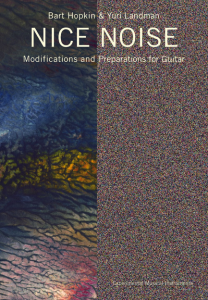
In comments to Tuesday’s post on DIY and repair books, reader smgear mentioned Nice Noise, a book on prepared guitar by Bart Hopkin and Yuri Landman. I immediately ordered a copy, and received it the other day. I’m blown away. It’s a small-format book, a mere 72 pages, but it is a veritable encyclopedia of alternate guitar treatments.

Hopkin (he edited the journal Experimental Musical Instruments and wrote the fabulous alternate instrument books Gravikords, Whirlies & Pyrophones and Orbitones, Spoon Harps & Bellowphones) and Landman (he builds mutant guitars for Sonic Youth, Liars, Melt Banana, and other artists) discuss pretty much every avant-garde guitar mod I’ve ever heard of, and many besides. It’s not just a catalog — it’s a detailed how-to, meant to be consumed alongside the pair’s online audio library of musical examples. I’m sure you’ll be reading about it more here, because I’m definitely going inflict some of these rad alterations on some unwitting guitars.

One of the finest rock-and-roll novels.
A great rock-and-roll novel.

An a sadder note, the death of Scotland’s Iain Banks this weekend reminded me of a book that should have been inclued in Friday’s installment on musical fiction. Both funny and moving, his 1987 novel, Espedair Street, is simply one of the finest rock-and-roll novels ever. Its protagonist is a fabulously successful rock star (think Floyd or Fleetwood Mac in their prime) who must process his own past while grappling with the prospect of suicide.

Readers in the UK, where Banks is hugely popular, may be surprised to learn he’s strictly a cult figure in the States. While Espedair Street is his only work to focus on the music world, he wrote many fine novels marked by wry humor and vast empathy. (The Crow Road and Whit are two other favorites of mine.) He also wrote scads of science fiction under the name Iain M. Banks. Banks, 57, had only recently learned he was dying of cancer. In April he composed a final communique to his readers, writing:

I’ve asked my partner Adele if she will do me the honour of becoming my widow (sorry – but we find ghoulish humour helps). By the time this goes out we’ll be married and on a short honeymoon. We intend to spend however much quality time I have left seeing friends and relations and visiting places that have meant a lot to us.

Categories
Amps Effects guitar Music

Tonefiend Book Week 2013
Tuesday: Guitar Gear

Monday: Theory and Technique
Tuesday: Gear
Wednesday: Repairs and DIY
Thursday: Biography
Friday: Fiction

This week we’re talking about our favorite guitar/music books. The plan is simple: I discuss a few titles I’ve found particularly enlightening, useful, or entertaining, and then you jump in and do the same. I’ve organized the days of this week by subject matter. Today’s topic is guitar gear.

Guitar gear books seem to fall into three categories:

  1. Pornographic. Lavish publications featuring beautiful photos of rare instruments, often focusing on a single manufacturer or collector.
  2. Encyclopedic. Thick reference books covering wide swaths of guitar history.
  3. Pragmatic. Books that explain the inner workings of guitar technology, with an emphasis on how to turn this info to your musical advantage.

Even if I weren’t a jaded former guitar mag editor, I doubt I’d have much interest in coffee-table guitar porn books (and the occasional guitar porn magazine). Or at least, no more interest than I’d have in photos of, say, beautiful watches, speedboats, or nutcrackers. I’m not a guitar collector.

Not on <i>my</i> coffee table, you don't!
Not on my coffee table, you don’t!

Hey — stop laughing! Yeah, I own more than 20 guitars. (The exact number depends on whether I count guitars I’ve loaned out indefinitely and ones I’ve borrowed indefinitely.) I appreciate my instruments greatly, and I am very aware of how fortunate I am to have access to so many musical tools. But in the end, they are just tools to me, with little significance beyond their musical applications.

I realize this is a pretty weird attitude for a guitar dude, and one reason why I was probably never a perfect fit as a guitar mag editor. (I must be missing some crucial male gene, because I’m equally blasé about cars and sports. With rare exceptions.)

The classic reference book.

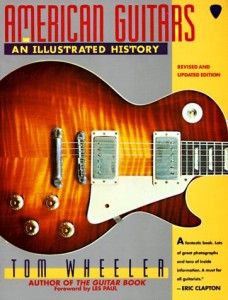
Reference books are a different story, especially the books of George Gruhn and Walter Carter, and those of Tom Wheeler. Sure, some of their weightier works have guitar porn aspects, but always paired with vast historical knowledge and the expertise of longtime industry insiders. Gruhn and Carter may know more about American guitars than anyone. But I always gravitate to Tom Wheeler’s books, and not just because he’s a longtime friend and mentor. Tom is a fine writer, an impeccable researcher (he’s been a journalism prof for the last 20 years), and he still conveys a teenager’s passion for the instrument. Tom is my hero.

(Bonus question: Has Wikipedia rendered the guitar reference book obsolete?)

But these days, the gear books that excite me most are the technically slanted, nuts-and-bolts titles. It’s one thing to ogle pretty instruments, and another to explain how they work, why they sound the way they do, and what that all means for the music we make today. And that’s why I love the books of Dave Hunter.

Categories
guitar Music Technique Uncategorized

Tonefiend Book Week 2013
Monday: Theory and Technique

Monday: Theory and Technique
Tuesday: Gear
Wednesday: Repairs and DIY
Thursday: Biography
Friday: Fiction

This week we’re talking about our favorite guitar/music books. The plan is simple: I discuss a few titles I’ve found particularly enlightening, useful, or entertaining, and then you jump in and do the same. I’ve organized the days of this week by subject matter. Today’s topics are theory and technique.

Tonefiend Book Week 2013 is an entirely selfish project. I expect to reap tons of great new info from you, smart readers. So don’t be shy about chiming in.

1. Ted Greene’s complete works

Yes, it's true — I studied guitar with Bigfoot!
This week on Finding Bigfoot, the BFRO team visits Encino, California.

Ted Greene’s jazz guitar books have haunted me since the ’70s. Chord Chemistry, Modern Chord Progressions, and Jazz Guitar Single Note Soloing Vols 1 & 2 remain in print, and are available in both paper and digital editions.

Ted’s books helped me understand the fretboard, tackle jazz harmony, and perhaps most of all, grasp the concept of voice-leading — that is, the ability to perceive chords not as static blocks, but as volatile structures resulting from dynamic melodies. Ironically, even though Ted’s books are divided into chordal and single-note topics, they go a long way toward erasing such distinctions. Melody generates harmony, Ted teaches, and harmony generates melody.

Not that I’ve completely digested Ted’s books. Has anyone? These tomes are dauntingly dense and complex. I just cracked open Modern Chord Progressions at random, and this confronted me:

Categories
Amps Effects guitar Music

NAMM 2013: The Analog Edition

NAMM

UPDATE: My apologies if this page failed to load properly before. After a much screaming and crying some careful troubleshooting, it seems to be working correctly now.

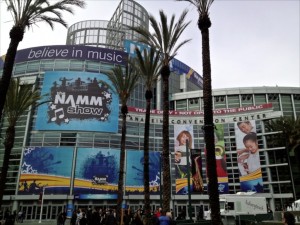
I put together a little slideshow of some of the interesting things I saw last week at the 2013 NAMM show in Anaheim.

I covered some of the coolest new digital gear in this post. This time, the focus is analog guitars, amps, and effects. Plus: an ultra-rare sighting of a true California celebrity!

Categories
Digital guitar Music

NAMM 2013: Digital Discoveries

This first installment of my 2013 NAMM report focuses on products for the digital guitarist. In the coming days I’ll be doing posts on analog amps, guitar, stompboxes, and accessories. (But maybe not as quickly as I’d like, because I’ve also got to cover MacWorld in San Francisco this weekend.) This is cross-posted from Create Digital Music, one of the few music sites I visit every frickin’ day. 

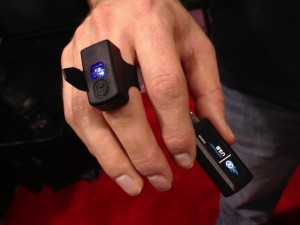
Source Audio's Hot Hand USB wireless controller.
Source Audio’s Hot Hand USB wireless controller.

We guitarists tend to be a technologically conservative bunch, yet there was no shortage of forward-looking products at NAMM 2013.

Not that everyone was looking in the same direction. Guitar processors are getting smarter, but they’re doing so in different ways. Are we entering an era when every guitar, amp, and pedal in our effect chain will boast powerful processors and a dedicated editing environment? Or will we just simply centralize everything in some future i-device? (I suspect that latter, and tend to think that smart pedals and smart amps represent an evolutionary cul-de-sac. But that cul-de-sac might be a real nice place to hang out for a couple of years.)

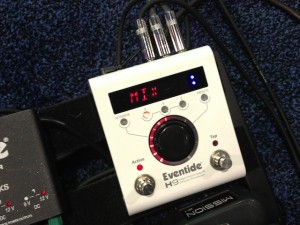
Eventide's H9 can play all the sounds from the company's software-intensive stompboxes, and you can edit and control them wirelessly.
Eventide’s H9 can play all the sounds from the company’s software-intensive stompboxes, and you can edit and control them wirelessly.

One release I found particularly telling was Eventide’s H9, the latest addition to the company’s software-intensive stompbox line. The H9 has few new sounds, but can run all the DSP algorithms from Eventide’s other guitar stompboxes. The $499 box will ship late this quarter, preloaded with 9 of Eventide’s 43 current algorithms. Players hungry for more will be able to purchase them а la carte from an online store. (Eventide hasn’t yet finalized the add-on pricing.) The H9 also includes a handsome and full-featured iOS app for editing and managing patches via Bluetooth. There are no current plans to release an editor for OSX or Windows.

Categories
Bass guitar Music

Resolutions, Anyone?

Resolutions 2013

I tend to regard the New Year’s resolution like New Year’s drinking: not necessarily a bad tradition, but one I feel no guilt about ignoring most years.

But since I have some specific musical goals in 2013, I figured I’d share ’em — and open the floor to anyone who feels inspired to disclose his or her sonic goals for the coming year. Please post your personal promises to comments!

Here’s my short list: