Happy 2016! I hope everyone’s holidays were epic, and that you got lots of good stuff.
There’s no better way to ring in the new year than to highlight the … um … peculiar culture that somehow got attached to our instrument. You can’t make this shit up.
Hard to believe, but this mastur class is totally real — at least in the mind of its creator. From the master:
Only a master guitarist and master guitar teacher understand both mastery of these concepts and how to break down complex and advanced ideas into easy-to-understand lessons that you can begin to learn and use right away in your own guitar playing.
I’ve been asked to teach on this topic by students again and again over the years. So I decided to create a 4-part master class video series. In fact, people travelled from all over the world, with great anticipation, to be part of this master class while it was being filmed.
Does it really work? It sure does! 🙂 When I filmed the master class, I called up several volunteers (all students of mine) to come forward and try the concepts I shared with everyone. And, as you will see for yourself on these videos, whenever any of these students implemented these specialized concepts, every woman in the room was not only paying complete attention, but all were smiling constantly. We could all see the effect it was having directly on them!
But don’t worry, this is not a bunch of childish obscene gimmicks or noises that you make with your guitar. This is about REAL guitar playing mastery! In other words, you won’t get slapped in the face when you play this way for women… but they’ll definitely feel what you are expressing in a good way!
This, apparently, is the sort of music that does the trick.
Oh, no, the mistletoe! On a rainy December afternoon I prepared a little antidote to holiday music poisoning: a mashup of two of the most summery songs ever. It’s Bob Marley’s “Stir It Up” vs. “Crimson and Clover” by Tommy James and the Shondells.
I was polishing up my solo solo version of this lesser-known Mancini tune, and I was reminded once again of the late composer’s genius. Sure, we all know he was a great tunesmith and brilliant orchestrator. But the deeper you dig into his compositions, the more remarkable things you uncover.
Even though Mancini worked exclusively in pop idioms, I rank Hank as one of the 20th century’s greatest composers. Everything he composed seems to have some remarkable and unlikely compositional twist, even the best-known tunes we take for granted. Consider the slippery chromaticism and crunchy minor-3rd modulations of the Pink Panther theme. Or the familiar “Baby Elephant Walk” melody — if you take a step back, you realize how bizarre it is, rocketing up as an arpeggio before leaping down to a dissonant note. It’s also easy to forget how shocking the Peter Gunn theme was, with those violent dissonant accents, not to mention its unprecedented fusion of brainy Stan Kenton harmonies and greasy guitar rock. (Jobim is the only parallel I can draw in terms of writing wildly original chromatic themes that somehow become universally beloved pop melodies.)
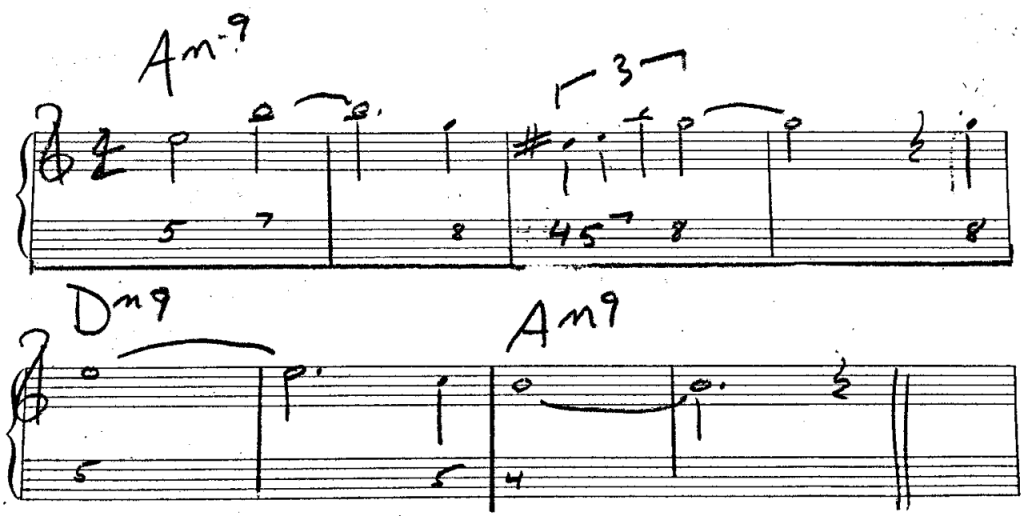
This song is Mancini’s take on the exotica style created by the likes of Martin Denny and Les Baxter. (Mancini was far too tasteful to include exotica’s signature big-call effects, but I lack such restraint.) But check out the cool melody and the way is straddles the underlying harmonies:
We’re in A minor, but no A notes appear in the main melody. Instead, the tune lingers on the 9th, emphasizing B over the Am7 chord and E over the Dm7. Eventually an A does appear — but not till the downbeat of the B second, by which point we’ve embarked on a long, twisted trail of chromatic modulation.
My Mancini obsession goes way back. In the ’90s, I was privileged to play in Oranj Symphonette, a jazz group lead by cellist Mat Brubeck (yeah, Dave’s son) that also included peerless keyboardist Robbie Burger, mad multi-instrumentalist Ralph Carney, and drum titan Scott Amendola (later replaced by the equally awesome Pat Campbell). Sadly, our two Rykodisc albums are out of print, but there’s buttloads of our stuff on YouTube.
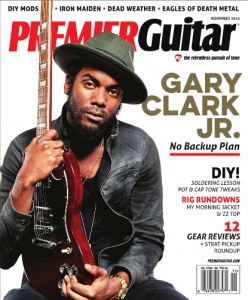
I’d like to call out several items of interest in the November issue or Premier Guitar. The first one is personal: As head honcho Shawn Hammond mentions in his monthly editor’s letter, I’m changing roles at the magazine. After two years as a part-time senior editor, I’m going part-part-time as a contributing editor.
It was a tough call for me — it was a fun gig working with awesome people on subjects I love. But I’ve felt an increasing need to dedicate more time to my own projects: playing, recording, writing, developing gear, and trying to make my tonefiend.com blog and YouTube channel seem a bit livelier than something you’d encounter at Urban Ghosts. (It’s one of my favorite websites, but not the attitude I’m aiming for here.)
If you’ve enjoyed the articles I’ve contributed to PG, well, first of all, thanks! And second, note that I’ll actually be contributing more columns and reviews than before. That may sound contrary to the laws of physics, but it’s possible because I will no longer be editing material by other writers. (I’d been processing an average of 35 stories per month in addition to my bylined pieces.) Picking up the slack will be new hire Ted Drozdowski, a fine writer and player, a lovely guy, and one of the music journalists I looked up to when I got into the guitar mag racket decades ago. (Ted was part of the now-legendary Musician magazine of the ’80s and ’90s.) Meanwhile, I’ll be contributing my Recording Guitarist column and at least three major gear reviews per issue.
Also in the issue are several tech-oriented pieces that I found particularly interesting. My old pal Frank Falbo — a leading pickup designer and master luthier — contributed a great piece on pot and capacitor substitutions. More than anything I’ve read, Frank’s article nails down exactly what changes to expect when swapping out part values, documented via audio files.
For me, the most fascinating part is how varying tone-pot values change your guitar’s tone, even when the tone knob is wide-open. Yeah, a lot of us would expect some change, because pots of varying resistances exert different loads on your pickups. But as far as I know, no one has ever nailed down the exact differences the way Frank has.
Others generalize. Frank Falbo nails it down.
Spoiler alert: The differences are massive — it’s a far bigger deal than I’d always assumed. Check out Frank’s first set of sound clips and prepare to be impressed.
It’s not a new idea that you can shift the overall tone of a guitar “bright-ward” or “dark-ward” by swapping pots, but Frank makes explicit how dramatic such changes can be, and what to expect from the likeliest substitutions.
I also learned much from two articles I wrote. The first is a shootout between five sets of ultra-vintage-style Strat replacement pickups, featuring models by Amalfitano, Fender, Klein, Manlius, and Mojotone. (Spoiler alert #2: They all sound pretty great, though the Kleins and Mojotones were my personal faves.)
I only realized after evaluating tones that the two sets I loved most don’t deploy a hotter pickup in the bridge position, while the other three do. (I don’t mean some blazing-hot bridge pickup, but one just a tasteful tad louder than the others, an approach many Strat players seem to love.) In the Klein and Mojotone sets, the middle pickup is loudest. Food for thought.
There are good reasons why few guitar mags run serious pickups reviews, and almost never compare models directly: It’s labor-intensive, and it’s damned hard to establish a level playing field. Here, I tried to remove as many variables as possible, installing all the pickups in the same test guitar, scrupulously measuring everything from pickup height to mic position, and laboring mightily to create identical demo performances for each set. My favorite part appears on the final page of the article, where you can directly compare each pickup from each manufacturer side-by-side.
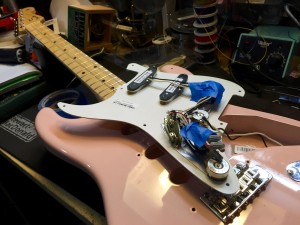
This poor pink Strat got one hell of a workout.
Finally, you might find interesting the audio clips in my latest Recording Guitarist column. It’s about is direct recording, a topic I’ve been covering since this blog began. I got cool sounds using a JHS Colour Box (a dumbed-down Neve channel in stompbox form) and especially with the Neve preamp simulations in the latest Universal Audio software. I’m hardly the first to point this out, but wow! Some recent plug-ins are so stupefyingly realistic that they can mimic analog gear pushed to extremes — a longstanding weak link in faux-analog plug-ins. I found it easy to create cool and compelling sounds without amps or amp simulators. Let me know what you think.
Okay, now I’m nodding off from jet lag. I just returned from a two-week trip to Italy, which generated some interesting musical thoughts and discoveries that I’ll share here soon. 🙂
Ace sideman and gear demo producer Pete Thorn stopped by and made my pedals sound really good — though a killer Magnatone helped.
I spent the weekend hyping my stompboxes at the long-running LA Amp Show. It was my first visit, and it was a blast in every regard.
It’s a surreal scene. It’s not held at a convention center, but at a generic airport hotel. Exhibitors set up in plain old hotel rooms on three floors. And unlike NAMM, there are no noise restrictions — pity the poor hotel guests who weren’t amp freaks! It was wild, walking down a long hotel corridor, with some high-end amp and guitar blasting through each doorway. But within each room, there was an odd sense of intimacy. It could even be sexy, assuming your erotic ideal is the Line 6 Helix.
Gear highlights? I don’t know! I was on my own, glued to my pedalboard for two days. (Though I got to take a closer look at the Milkman amps crafted by my San Francisco neighbor Tim Marcus.)
But I did get to share Vintage King’s suite with several cool brands: Moog, whose Minifooger pedals I reviewed for Premier Guitar (and loved). Also there: Magnatone. I was plugged into a magnificent Super Fifty-Nine (which I also reviewed and loved). New to me, though, were two killer models from Jackson Ampworks.
It was great to see my onetime boss, Jim Crockett — the man who invented the guitar magazine
But I can tell you two non-gear highlights: For the first time since the late ’80s, I got to hang out with Jim Crockett, who founded Guitar Player in 1967, inventing the guitar mag.
Jim ran the show when the mag hired me in 1988. It was my first real job — till then, I’d only worked as a guitar teacher. Jim was so cool, going out of his way to welcome the nervous new guy, and providing many pats on the back.
The magazine got sold not long after I started, and has changed corporate hand many times since. So while I only worked with Jim for a few months, I’ve spent the last several decades listening to everyone moan, “Man, it was so much more fun when Jim was here.”
Thanks Jim — I’ll never forget your kindness.
Also unforgettable: the mad yo-yo skills of Vintage King’s Dan Serper. Clearly, raging 7-string pro-metal guitar-playing isn’t his only talent! (The background noise is amps blasting from adjacent rooms.)
UPDATE: I just posted detailed pedal descriptions at gorepedals.com
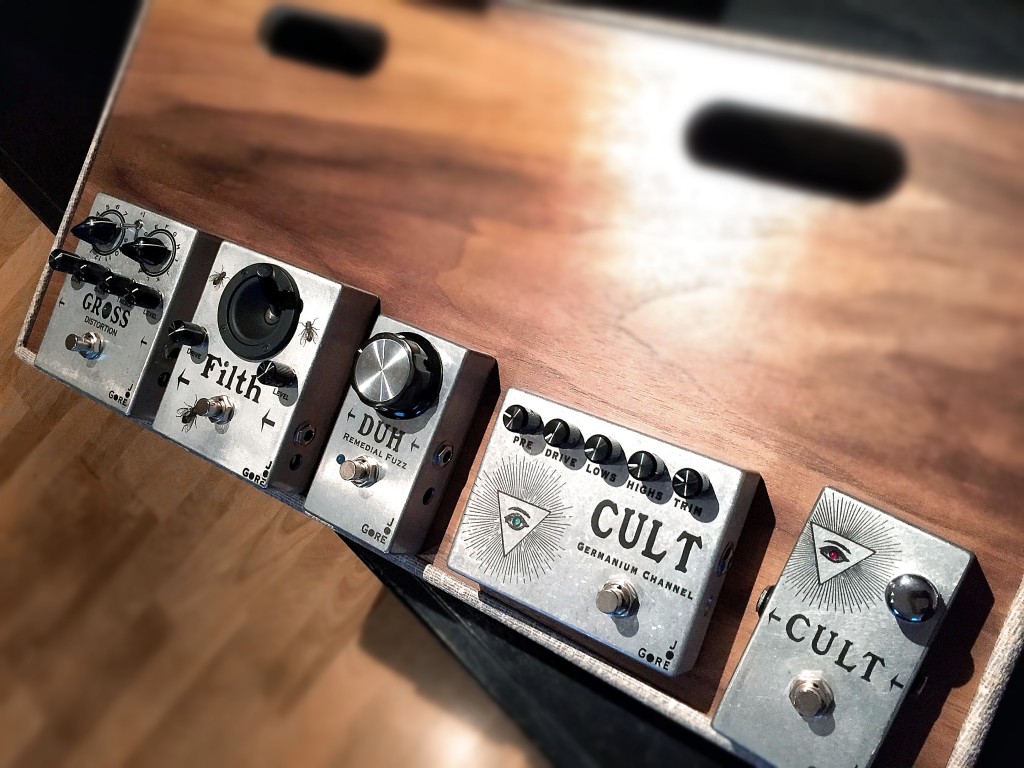
Anyone going to the big LA Amp Show this weekend? I’ve never been, though I’ve heard it’s a blast. (Literally: Unlike at NAMM, exhibitors set up in separate hotel suites, reportedly without noise restrictions.) I always like geeking out at musical instrument trade shows, but this one is special for me: It’s my pedal premiere, the public debut of my next four stompboxes. They’re not shipping quite yet (except Duh, available here), though they’ll be out in time for a crunchy-as-hell Kwanzaa.
The pedals pictured may look like my usual sketchy handmade stuff, but they’re actually slick factory-made versions, painstakingly styled to look like sketchy handmade stuff. (Michigan’s Cusack Effects is my manufacturer.) They sound like my handmade prototypes, but are less likely to break every 15 minutes.
I’ll be showing them off in the Vintage King suite. (They’re my production partners, and for now, my sole retailer, though the pedals will eventually make their way to hip guitar shops.) Magnatone, Jackson Ampworks, and Moog pedals will also share the VK suite, so my pedals will be in lofty company.
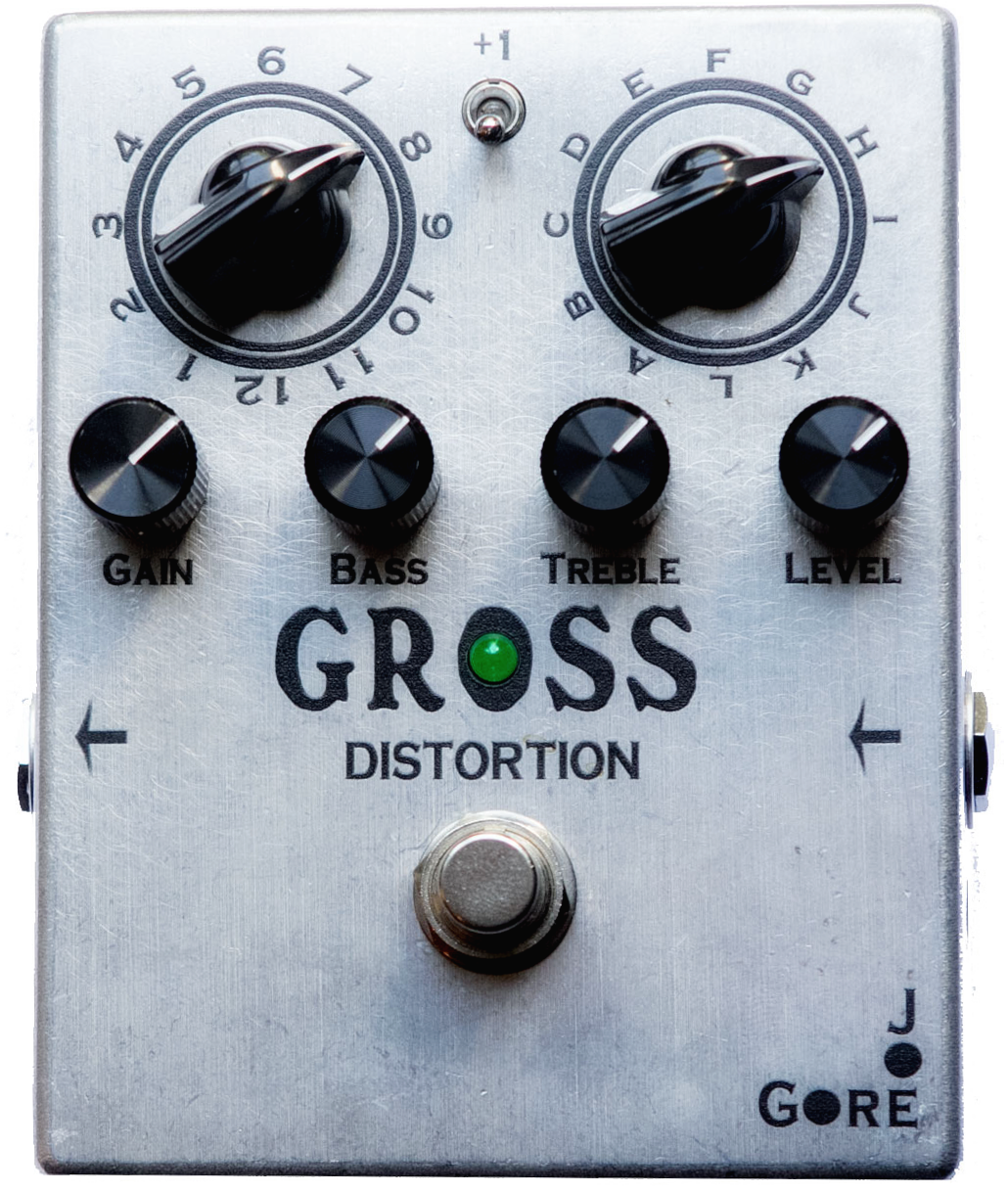
I’ve already written about Filth, Cult, and Cult Germanium Channel, though I haven’t yet finished their demo videos. (If you’ve spent any time on this site or my YouTube channel, you’ve heard them.) But I think this is the first time I’ve mentioned Gross Distortion, a twisted new take on a cool old crunch circuit. Here’s a demo I just made:
… and here’s how I describe it on the upcoming product page:
There’s never been a distortion pedal quite like Gross—so it needs an explanation.
At its heart, Gross is a simple, one-transistor distortion from the same family tree as the Electra circuit. This simple yet powerful effect was built into Electra guitars in the late ’70s, and was later adopted by many boutique stompbox builders. For good reason: It’s a lively, dynamically responsive circuit with less compression than most modern IC-based distortion pedals. The transistor boosts the level, and then the signal hits a pair of clipping diodes, which provide the signature distortion.
Every diode combination sounds slightly different. In fact, several boutique pedal companies have based their businesses on creating Electra derivatives with slightly varied diode choices. (Just Google “Electra distortion clone.”)
Gross isn’t an Electra clone. I’ve changed parts and values for a fatter sound and even greater dynamic response. I also added an active 2-band tone control—something seldom, if ever combined with primitive distortion like this. The distortion isn’t too “gainy.” It’s more about definition than sheer power—one reason it pairs well with other gain pedals. The character of your guitar and fingers always comes through.
The oddest feature is the diode section. Instead of a fixed diode pair, two 12-position rotary switches select from 24 diodes for 78 possible diode combinations! An additional switch adds a third diode for asymmetric distortion, which makes156 possible shades. My target number was 144—that’s why I called it Gross, though that may have happened the other way around.
Some combinations are as different as night and day. Others are only as different as noon and 12:05. But this network of germanium, silicon, and LED diodes provides many crunch colors.
With its labeled and detented selector knobs, you can call up favorite settings onstage. But for me, Gross’s forte is as a studio tool. It’s great for “texturizing” guitar overdubs—just spin the dials till you find a tone that sits perfectly in the track. It’s especially useful for doubling.
Gross Distortion was created in San Francisco and is built in Michigan by skilled craftspeople earning a fair wage. Available soon from Vintage King!
TO USE: Set the desired gain and level. Grab the big knobs and start spinning. Toggle the +1 switch frequently for asymmetric distortion—the changes can be dramatic! When you hear a cool tone, refine it with the bass and treble knobs. (Note: the higher the gain setting, the more dramatic the diode-tone contrast.)
I just started a Tonefiend Instagram feed, ’cause I know there’s not enough junk in your inbox. If you’re an Instagram user, feel free to follow. (Or just friend me on Facebook, where all the Instagram images also appear. I’m not picky—I’ll friend anyone, at least till they start posting links to $19 Prada handbag knockoffs.)
Often I don’t post here at tonefiend.com till I’ve cobbled together a relatively substantial item, which means the site can fester for weeks without an update. But for better or worse, I plan to post a steady stream of square cell phone pics compelling images and trivial pithy thoughts on Instagram/FB/Twitter.
On Instagram, I’m starting out with two weekly posts. Both are pretty silly, but each has inspired some surprisingly cool conversations. The first series is “Name That Gear,” which is simply a close-up shot of some music gizmo, but with some telling detail that reveals its identity. Not much too it, but it can be fun.
Page vs. Wagner: Who’d Win in a Fight?
The other recurring item is “Who’d Win in a Fight?” These are deliberately absurdist: The first post matched Jimmy “Hammer of the Gods” Page against Richard “Twilight of the Gods” Wagner. But amazingly, it inspired a long, fascinating, and drop-dead funny Facebook conversation. (Thanks for my wife for suggesting both ideas.)
Naturally, I’ll also be using those feeds to shamelessly flog my music and gear. I’m going to be showing the first five Joe Gore Pedals stompboxes at the LA Amp Show in Van Nuys, California on October 3rd and 4th—just a couple of weeks from now! The product announcements aren’t quite ready yet, but trust me—I bombarding you with them very soon. 🙂
Man, pontificating ain’t easy! KMI, who make the SoftStep controller I use almost every day, solicited a “Albums That Meant a Lot to You” list for their website, and I replied with “Ten Albums That Made My Head Explode,” which just went live on their site. And that made me want to hear your lists.
I don’t know why exercises like this can be so hard. First you can’t think of enough … and then too many … and then you worry you forgot an important one … and then you spend an hour reflecting on whether Joni Mitchell or Béla Bartók is more important … and then you read the whole thing through and realize how insufferably pretentious you sound. At some point, you just surrender and hit SEND. And that’s the moment you start second-guessing the whole thing.
For such a low-stakes effort, the pressure is high! And now I’m putting the pressure on you: I’d love to read your lists of mind-exploding music. Please post them to comments below, and add as much detail as you like. (And feel free to use the “runners up” dodge — I certainly did.)
I’m not sure if there’s much difference between “music that altered my mind” and “best music” lists. I guess it depends on how much importance you place on music that leaves brain specks all over your walls. For me, the brain-speck stuff usually is the best music.
I realized after the fact that only about half my picks have audible guitar parts. How about yours?
No, I don’t mean like, “What’s better: B-flat or F-sharp?” Rather, is there a single note from a great recording or performance that haunts your dreams?
Here’s what go me on the topic: One of my Premier Guitar colleagues, Gary Ciocci, recently turned me on to El Twanguero (aka Diego Garcia), a brilliant Spanish-born, Argentina-based electric guitarist who’s created a head-spinning fusion of classic Latin jazz and rockabilly guitar. The only thing I don’t worship about the great Afro-Caribbean music of the 1950s and ’60s is the fact that it rarely includes guitar. But in Garcia’s retro fantasia, it’s as if the great Cuban and Puerto Rican mambo kings had migrated to Memphis instead of settling in NYC.
Diego “El Twanguero” Garcia: ¡Bien tocado, señor!
When I explored Garcia’s YouTube channel, I immediately clicked on his version of “Cherry Pink and Apple Blossom White,” a Perez Prado classic that topped the charts in 1955. (You probably know the tune even if you don’t recognize the title — it’s been in a zillion movie soundtracks.) I was eager to hear how Garcia would interpret the famous trumpet slur — perhaps the booziest single note ever recorded. (Yes, theory sticklers — I’m using the word “note” to mean a single articulated note, even when it spans multiple pitches over its duration.)
The tipsy note appears right at the top — it’s the fourth pitch in the trumpet melody. But it gets boozier and woozier with each repetition, and by its dead-drunk appearance at 2’27”, it’s amazing anyone’s still standing up.
Okay, try to convince me that it isn’t the sleaziest note ever! (Just for fun, here’s a live performance, where you can see what Prado looks like when emitting his signature grunt.)
How the hell would you render that on guitar without period-inappropriate distortion and locking tremolo? Take it away, Sr. Garcia!
Love it! ¡Bien tocado, Señor!
That got me thinking about other favorite notes. My #1 choice was easy — it comes at the end of this post. But two others also sprang to mind.
George Harrison’s “It’s All Too Much” used to be considered one of the Beatles’ least important tracks, though it seems to have been critically rehabilitated over of the course of the last few psychedelic revivals. It was cut in 1967 between the recording and release of Sgt. Pepper, just when the Beatles were discovering LSD. (It shows). But it wasn’t issued until 1969, when it appeared as a throwaway on the Yellow Submarine soundtrack — the first album I ever purchased with my own money. (And I’ve never recovered from the horror of discovering that side B features no Beatles material — just George Martin’s twee orchestral soundtrack.) But that blast of sustained feedback carved its way into my consciousness.
The experts say George played it, though I doubt anyone present was coherent enough to recall. I’m not saying it ain’t George, though I can’t help noting that whenever you investigate a particularly ferocious bit of Beatles guitar work, the perpetrator always seems to be Paul. (Examples: “Helter Skelter” and the solos on “Taxman” and “Good Morning.”) I dunno — maybe acid unleashed Harrison’s inner beast.
Another note that’s possessed me for decades is from Miles Davis’s heartbreaking take on Rogers and Hart’s “It Never Entered My Mind.” (From Workin’ — the first jazz album I bought with my own cash, at age 14.) Man, you could write a dissertation on the first eight bars of Miles’ solo, and someone probably has. Even though the notes are few and far between, I dare you to try playing along, matching the trumpet phrasing. But the highlight for me is the sublimely out-of-tune note in the fifth bar of the trumpet head. (It first appears at 0’33” in this clip.)
The performance is in A-flat, and the special note is a very flat E-flat — about halfway to D-natural. Man, how does something so wrong feel so … not just right, but transcendent?
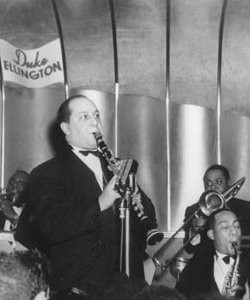
That was my favorite note for many years, until I became a born-again Ellingtonian. Friend/genius Stephen Yerkey turned me on to Ellington’s 1938 remake of his own “Black and Tan Fantasy,” whose original 1927 version is universally regarded as one of the most important early jazz discs. But the 1938 remake is equally brilliant. Duke’s band was at or near the height of its powers. The orchestration is sublime. The piano work is radical. Each solo is a jewel. And then there’s THE NOTE.
Now, there’s nothing I find more musically distasteful than a cheesy, star-searchin’ vocalist wowing the crowd with a long sustained note. I hate it just as much when operatic singers do it (as did many of the great opera composers). And using the national anthem at ball games as a pretext is just plain nauseating.
Did Barney Bigard play the greatest note ever?
Yes, THE NOTE is impossibly long and difficult. But there’s more here than sheer virtuosity. The painfully slow glissando literally makes you dizzy, as if the world were tilting off-axis. (It’s more psychoactive than the Beatles on acid!) It exerts exquisite tension against the backing harmonies, and it lets Duke display his most Debussy-like side in his watery, chromatic piano accompaniment. And the dismount is astonishing: Another wind player would be gasping on the floor, but incomparable clarinetist Barney Bigard (also featured on the 1927 original) concludes with a soft, casual phrase, as if he had all the time and breath in the world. For me, this is the ultimate musical embodiment of “cool” in its most profound African diaspora sense.
Play it, Mr. Bigard! The miracle commences right after 1’15” (but please, treat yourself to the entire performance).
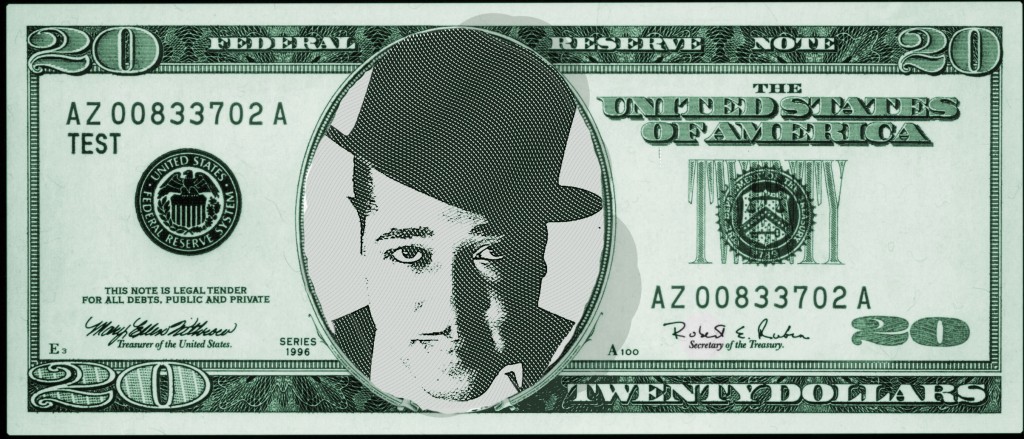
(I know I’ve said this about 50 times on this blog, but I repeat it whenever possible: In much of the civilized world — Europe in particular — the arts are considered precious, and musicians routinely appear on currency. If Americans gave a crap about culture, our greatest composer would grace the $20 bill, not genocidal Jackson. Though admittedly, there’s a strong case for Harriet Tubman.)
Okay, enough of my yakkin’! What’s your favorite note?
I’ve long been obsessed with Sam “The Man” Taylor’s epic sax solo on the Chords seminal 1954 rock ’n’ roll hit, “Sh-Boom.” But I never got around to learning, transcribing, and analyzing it till now. I heard it about 100 times while making and editing this video, and it still thrills me on every listen.
If you’re like me, you know it’s wise to study performances by non-guitarists, but seldom get around to doing it systematically. For once I followed through, and — at risk of sounding like a pedantic dork — I’ve analyzed what I heard and suggested ways to incorporate the concepts in styles far removed from the original doo-wop context.
You can download my transcription (in standard notation and guitar tab) here.
The final part of the video is a rant about how segregation shaped the course of early rock and roll, in which I piss all over the Crew Cuts’ tepid cover version of “Sh-Boom.” (Spoiler alert: It blows.) This was partially inspired by recent despicable comments from musical felon Pat Boone. I’ve linked to the following videos before, but I’m posting them again because the cost of quality music is eternal vigilance against sonic shit-shovelers.
Holy crap! It’s the coolest man in the universe! This foreshadows Hendrix, Prince, and the Beatles. Even lip-synched, it’s everything badass in one minute and 50 seconds. (And it speaks volumes about segregation in midcentury America.)
And then there’s this:
Unholy crap! It’s the least cool man in the universe. And this foreshadows nothing except the worst music of the last 60 years (though it too speaks volumes about race in 20th-century America).
Why beat this dead horse? Why pick on ol’ Pat 60 years after the fact? Maybe he regrets his musical misdeeds. Maybe he’s even developed a more nuanced view of race and racism.
Naw. When self-avowed white supremacist Dylann Roof murdered nine African-American churchgoers on June 17th, 2015, Boone leapt into action, penning an angry editorial that condemned … politicians who dared to refer to the atrocity as “racist.”
FUPB. There’s no statute of limitations on your crimes.