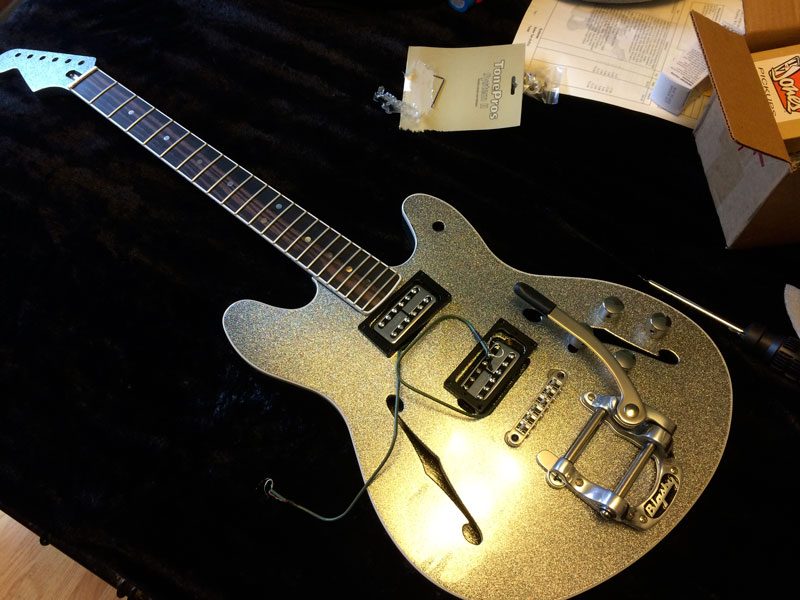
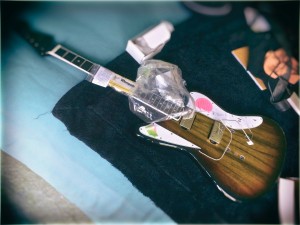
Look what UPS left on my porch: the neck and body for my latest ill-advised “parts” guitar project. I’ll be slapping it together in the coming days, but I couldn’t resist showing off the pretty parts. The body is Warmoth’s Mooncaster model, which is based on Fender’s semi-hollowbody Starcaster, a quirky cult guitar if ever there was one. But for the neck, I swiped an idea from Warmoth’s Josh Spataro, and substituted a reverse angled Strat neck. The tacky silver finish and extravagant binding are solely the result of my bad taste. (Josh compared it to a pinky ring, which is pretty accurate.) The body is korina, the neck mahogany.
If my last Warmoth parts guitar was a sort of Fender/Gibson hybrid, this one is more Fender/Gretsch. I’m planning to install a set of TV Jones pickups, and this will be my chance to try out a very different type of tone control scheme, one I’ve been thinking about for a while. If it turns out well, I’ll write about it. If not, I’ll probably delete the last few sentences and deny they ever existed.
This is my third Warmoth parts project since starting this blog. As before, I’m 100% delighted with the materials and build quality. Since I requested expensive options (like the vulgarly bound and finished neck) and I’m using fancy parts, the guitar probably won’t be vastly cheaper than if I’d bought it already made. But it should be unique and fun. Stay tuned — and I’ll hope the guitar does too.
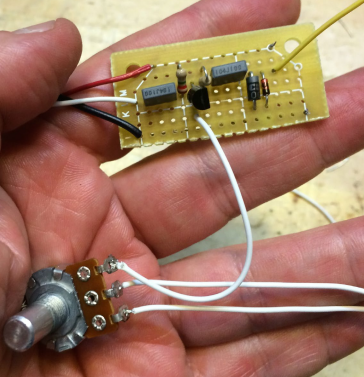
You can build an awesome-sounding designer distortion pedal for about $45. (Joe’s hand sold separately.)
Have you been reading about DIY guitar effect projects for years and thinking about giving one a shot?
Here’s a good excuse: Premier Guitar just published my “Build Your Own Stompbox” article, which just may be the most ambitious project I’ve ever undertaken for a guitar mag. And there’s more to it than just building a great-sounding distortion pedal from scratch: It’s practically a “how to build your own guitar effects” course, covering everything from sourcing parts and prototyping through boxing and troubleshooting. You’ll learn how all the key components work, and how to choose the ones that best suit your needs. Most important, you’ll start customizing the circuit from the project’s first stages using techniques you can apply to all your future builds.
The project is based on the simple but powerful Electra distortion circuit, the same one used in many boutique overdrives. Yup — it’s the same circuit that I’ve been featuring as Project #1 in Tonefiend DIY Club for a couple of years. But this revised and expanded version is far superior to the original, thanks to lots of help from my talented PG colleagues. Art Director Meghan Molumby did an amazing job assembling the massive build guide PDF (which you can download for free here). The layout is incredibly user-friendly, and you’ve never seen nicer-looking schematics and diagrams. The text got a thorough going-over from ace editors Andy Ellis and Shawn Hammond, so there are far fewer of my usual boneheaded typos. And there’s a cool video demo by Nashville ace John Bohlinger, so for once, you don’t need to watch one of my twitchy performances to hear how it sounds. What’s not to like?
But wait, there’s more: My pals at Mammoth Electronics have put together a $45 prepackaged kit to spare you the hassle of sourcing all those pesky little parts and drilling your own enclosure. There are lots of cool optional upgrades, like painted enclosures, premium switches, and bitchin’ knobs. Details here. (Neither I not Premier Guitar have any financial stake in the kit. I just asked Mammoth to create one as a convenience.)
Seriously — this one’s good. If you’re finally ready to burn your house down master that soldering iron, well, zero hour is here!
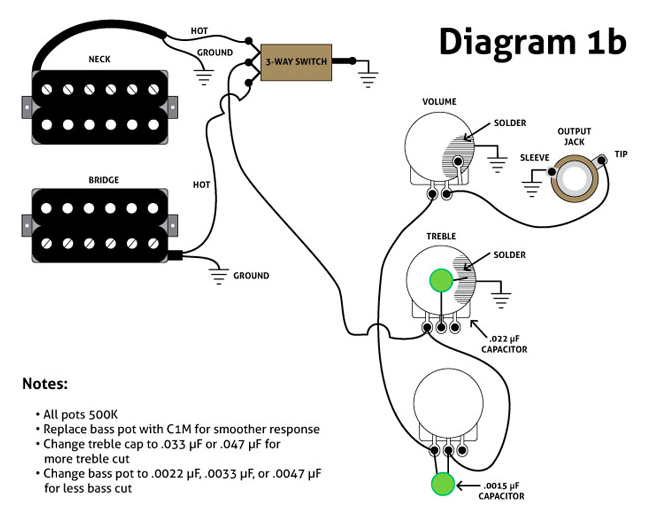
Premier Guitar just posted my new article on three favorite electric guitar wiring mods. The concepts won’t be new to anyone who hangs out here — I’ve pretty much flogged them all to death! But the new article includes the step-by-step walkthroughs that I never got around to creating for this site, and PG art director Meghan Molumby created beautifully clear tech diagrams like this one:
The descriptions and instructions in the new story are clearer and more detailed than my original posts here, plus I’ve refined some details, so I suggest working from the new PG versions.
My three choices:
Yup, the ol’ PTB tone control, the coolest mod I know, at least for players who love distortion. The new version of the project uses the 500K pots you probably already have in your guitar rather than the more eccentric G&L values.
I also revisited the Strat version of the “Nashville-style” Tele wiring popularized by Brent Mason and other Music City cats. It performs brilliantly in a Strat, and IMHO its benefits (vastly more blended-pickup options plus a musical and intuitive control layout) for outweigh the costs (loss of the middle-pickup-alone setting, cost of a 3-way switch). Not to launch a protracted Strat-vs.-Tele battle, but I love the whole notion of “Tele-fying” a Strat via wiring, control layout, and pickup choice.
In the article’s comments thread, several savvy readers also mention Strat wiring systems that provide the sounds of the Nashville mod without sacrificing any others. They’re right — but the more I mess with this stuff, the more I value simplified operation. I’m less concerned with having all options than with having the coolest ones, ergonomically organized. Still, there are many ways you can go here.
Finally, I’m once more beating the dead Varitone horse exploring variations on Gibson’s Varitone concept, updated for modern players. I added a new twist in the PG story: deploying these ideas via toggle switches, rather than a big, clunky rotary switch.
It was fun when PG editor Shawn Hammond asked me to choose my favorite mods. It was easy to decide though — these are the three I keep coming back to, and all three deliver dramatic results, unlike many better-known mods.
So which electric guitar mods would be on your short list? Wiring, hardware, whatever. How do you make your guitars cooler?
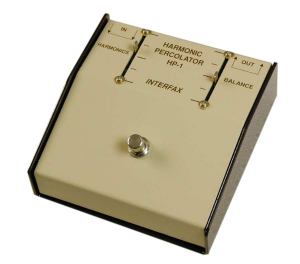
Few guitar pedals can rival the cult cachet of the Harmonic Percolator, a singularly ugly distortion stompbox produced in minuscule numbers in the early ’70s by Interfax, a small company based in Milwaukee, Wisconsin. And guess what? They sound ugly too, though they’re ugly in a cool and useful way.
They don’t get much rarer — or uglier. (This is a cosmetically faithful reproduction from Theremaniacs.)
I’ve been wanting to write about these for years, but was hindered by the fact that I don’t have access to one. No one does! Well, except the pedal’s best-known user, producer/guitarist Steve Albini. (Steve has posted several popular YouTube videos in which he sings the praises of the original and evaluates it against modern clones.)
But I revisited the idea recently when Christian Magee, who runs Tube Depot, sent me a couple of old 2N404A transistors from a stash he recently acquired. This rare PNP germanium transistor appeared in the original, along with an NPN 2N3565 (also rare, but not as ridiculously rare as the 2N404A). Yes—this pedal uses both a positive-ground germanium transistor and a negative-ground silicon transistor in the same circuit. (Another Fuzz Face/Tone Bender clone, this ain’t!)
I whipped up several variants:
• a clone using the original parts
• a near-clone using more readily available alternatives
• a Harmonic Jerkulator, an all-silicon/no-diodes variation created by DIY stompbox titan Tim Escobedo
I just received from Warmoth all the parts for my next DIY guitar. I loved testing eight sets of P-90 pickups for Premier Guitar, but I don’t own any P-90-eqipped guitars.I will soon, though!
This one will be a bit of a platypus — as opposed to, you know, all my other other platypi. (The actual plural of “platypus” is “platypuses,” but “platypi” is more fun to type.) It’s built from Warmoth’s “split Jazzmaster” template, with a korina body, bound neck, Tune-o-matic/stop-tailpiece bridge, and a pair of hum-cancelling Fralin P-92s. Yeah, it’s kind of a stab-in-the-dark experiment, and not a inexpensive one. But hope springs eternal. Prepare to be bored with details!
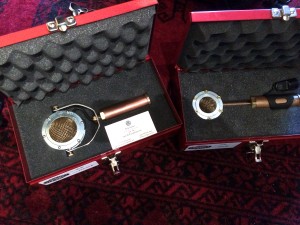
I’ve also just received an amazing-looking pair of condenser mics from Portland, Oregon’s Ear Trumpet Labs. ETL kingpin Philip Graham’s business card identifies him as “proprietor and bricoleur.” Bricolage, of course, is the ten-dollar word for “making stuff out of junk and other found objects.” Dig the steampunk vibe of that repurposed hardware! I haven’t even plugged these in yet (though the reviews I’ve read have been stellar). I just like staring at them! But I’m going to try them out at my monthly Strung Out! show tonight.
Ear Trumpet Labs’ Edwina and Edna models: a higher calling for found objects!
Which brings me another of this week’s highlights: I got to perform last night with my dear friends Teja Gerken and Adam Levy. Teja is an astonishing acoustic fingerstylist and a fine composer. His vocabulary has hints of Bensusan, Hedges, and classical, but he’s molded those influences into a thoroughly unique sound. And Adam, who I’ve known since my Guitar Player magazine days, is equally renowned for his jazz work and for accompanying such singer/songwriters as Norah Jones and Tracy Chapman. (I get to play some of Adam’s cool parts when I gig with Tracy.) These days Adam’s focusing on songwriting, and he his sings his “smart Americana” songs (my description, not Adam’s) in a sweet, soulful voice. Man, what a treat to hear both of them up close. And tonight, Adam, Shelley Doty, and I perform at my local dive, El Rio. Can life get any better?
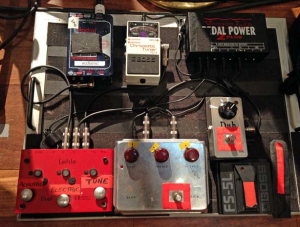
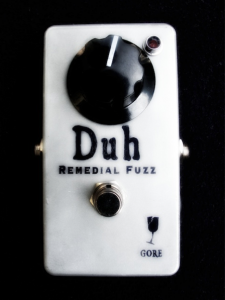
Apparently so! Yesterday Premier Guitar posted John Bohlinger’s piece on the Pixies, which includes a pic of Charles “Frank Black/Black Francis” Thompson’s pedalboard, with my grubby, hand-built Duh fuzz pedal front and center. I’d originally made if for Joey Santiago, the other Pixies guitarist, but I guess Charles swiped it. Hey, I’d be honored if either guy spat on the thing! They’ve been heroes since I first heard the band in a small San Francisco club back in ’88. (Everyone went to hear the Sugarcubes, but left talking about that awesome opening act from Boston.)
Frank Black’s pedalboard: Lookit! I’m Pixies-approved!
It’s funny, because I really was thinking “Pixies” when I sound-designed the Duh. I was going for “bubblegum metal” — a thick, heavy sound, but not a macho one. The tone is too fizzy and funny for 100% sincere heavy rock, IMHO. It’s more of a “greasy kid stuff” distortion. (Note to readers under 45: That was once the tagline for a “dry look” mens hair product, referring to the outdated coiffures that would return with a vengeance when punk broke a few years later.) It’s a vaguely Muff-like sound, but with less compression, less scoop, and one big, stupid knob. I also like building that circuit into guitars. Like this one:
So it’s been a grand week, but a hectic one. Thanks for reading this far. Next week I promise a proper post, and not another collection of … odds & ends.
It’s a holiday miracle! The 30-minute Bigsby tremolo installation.
Sometimes it pays to write for a guitar magazine!
My old pal and Premier Guitar colleague Andy Ellis hipped me to the Vibramate, an adapter that allows you to install a Bigsby tremolo on many types of guitars with no drilling or other permanent modifications to your instrument.
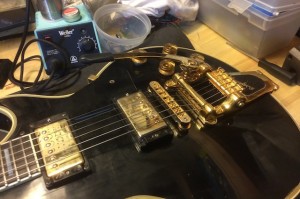
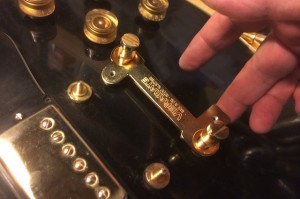
A Bigsby and Vibramate were a centerpiece of a cool makeover project the magazine concocted, transforming a beat-up ’70s Epiphone in a bitchin’ Bigsby-bedecked bombshell. Inspired, I decided to give myself the shakes for Xmas. I bought a Bigsby B7 and corresponding Vibramate kit and popped them onto my long-suffering Les Paul. Check it out:
Yup, this is the much abused ’82 Les Paul that I’ve used in many tonefiend experiments, especially the OCD-approved Pagey Project. What a journey this guitar has been on! Never a big Les Paul fan, I picked up the cheapest old one I could find because I needed it as a reference for the sound design work I was doing for Apple. Trust me — it was a thoroughly unremarkable instrument. But then I started playing with pickups … and alternate wirings … and replacement hardware … and after several years of hacking, I have an instrument I love.
Pity about the gold hardware though — I should have switched to chrome early on. It’s the downside, I suppose, of incremental makeovers. By the time I got to the Bigsby, I had to cough up extra cabbage for the vulgar finish. (My wife recoiled when she saw the Bigsby box on the counter: “Eww — what’s this gold thing?”)
The Vibramate bracket screws into the existing tailpiece bushings.
I’m no Bigsby expert. I’ve never owned a Bigsby-fitted guitar (though I’ve had a couple of long-term loan). It’s odd, because I like how they perform, look, and feel, and “bling cringe” aside, I love it on this guitar. It definitely changes the tone — though in spectacularly unscientific fashion, I replaced the previous roundwound strings with flatwounds while doing the installation, and it’s tricky to sort out which changes are exclusively related to that hardware, and which to the strings. The guitar feels brighter and more resonant. (I’m reminded of Ry Cooder’s dictum: The more springs you add to a guitar, the livelier the acoustic response.) The treble response is WAY different — I needed to lower the treble sides of the pickups to offset the face-slapping response of the high E string.
I’ve bored everyone to tears with my incessant testimonials to the glory of great flatwound strings. This guitar has never worn flats — I’ve kept it in roundwounds for writing product reviews, and for sessions where I specifically need a roundwound sound. But I’m loving the way they sound and feel here, so I guess I’ll have to select another Gibson-flavored guitar as a dedicated roundwound instrument.
The installation was a breeze. The quality of materials is superb. I also added Vibramate’s String Spoiler, a clever little bracket that clips onto the tiny nubbins that usually secure strings to a Bigsby. The Spoiler makes string changes way easier. I’m deeply impressed by the Vibramate products — even in frickin’ gold.
Oh — the demo tune is the late John Barry’s wonderful Midnight Cowboy theme. Berry wasn’t a guitarist, but he contributed so much to the guitar vocabulary through his scores, especially for the early James Bond films. I was privileged to interview Barry for Guitar Player back in the ’90s. What a cool and brilliant musician!
Let’s not just talk about one-knob gear — let’s design some! Any interest in conspiring to create a minimalist DIY amp?
Frankly, the intensity of the reaction to my recent One Knob Manifesto startled me. I had a general sense there was a growing interest in minimalist gear, but I was no idea the sentiment was so intense. (Though I’d hesitate to draw too many conclusions based on a focus group of the obsessive geeks who hang out here.)
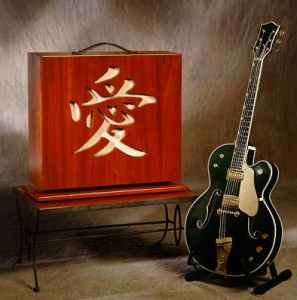
Now, don’t get your hopes up — we probably won’t create anything QUITE this awesome.
The limited edition Love amp fascinates me. Not its ornate furnishings, but the minimal controls: no tone stack, not even a volume control. It’s pretty much exactly what I was talking about when I expressed an interest in an amp with nothing but an on/off switch. That desire became even more focused last week when I reviewed a fabulous amp from a new Colorado Springs company called Toneville. (I’ll link to the Premier Guitar review when it goes live in a couple of weeks.) The Toneville Beale Street model I reviewed features a full compliment of blackface-style controls, but the tone controls are voiced so that the tone stack can largely be removed from the circuit, and there’s also a pot to remove the negative feedback loop for a more tactile/primitive response. As with some other ultra-high-end amps I’ve written about recently (like the Little Walter 50/22 covered here), the tone controls sound great wide-open, and it matters surprisingly little where you set the volume — you just drive it hard enough to warm things up, and then shape the tone from the guitar. With a nicely voiced and biased amp, you need far fewer controls than you might think. And the more crap you omit, more livelier the reponse and the more immediate the tone
The no-controls Mill Hill Love amp.
So why don’t we collectively create something in this vein? A simple but great-sounding tube amp with nothing but an on/off switch? I’ve never designed anything such thing and have little relevant expertise beyond the knowledge that, unlike 9v stompboxes, AC-powered amps can kill you. But I’ve built enough kit amps to know that a one-knob head can be easy, potentially inexpensive (though you could invest in ultra-premium tranformers, vintage tubes, NOS parts, and so on), and it should sound stunning. If we come up with a plan, we can source the parts, create step-by-step instructions, and probably get a vendor to put together a kit for us. (I’m thinking out loud here, so bear with me.)
I’m not firm on many details other than these:
head-only design (at least initially)
low-wattage for home/studio use — something you can crank without self-evicting
should sound big and bad-ass (not a cheap, practice-amp sensibility)
Any interest, folks? And more important, any ideas? And more important, any ideas? What would make this fun, useful, and bitchin’?
Do you ever get an idea that you just know is going to work out brilliantly? And then discover you were totally wrong?
That’s how it was when I finally reassembled my generic Mexican Strat with Duncan lipstick tube pickups. After I recorded a demoing of it here almost two years ago, the guitar lay in pieces alongside my workbench. I’d stare at decapitated body, feeling guilty and dreaming of all the fantastic mods I’d attempt when I finally got around to reanimating it. I had various ideas for the tone control: Maybe a two-band PTB control? Nope—totally underwhelming results. Perhaps a two-in-one TBX? Meh—even less interesting. I drew a blank, and the guitar wound up with a disappointingly normal tone circuit.
But I did discover some cool twists along the way. Details after the video:
My flatwound string addiction is only getting worse, but this is the first time I’ve combined flats and lipstick tubes. (Has anyone done that since the ’50s?) The results were fascinating. As happens when you put flats on an electric 12-string, you encounter a paradoxical increase in highs, despite the darker-toned bass strings. (Maybe it’s because the treble strings ring truer with less phase-canceling interference from roundwound bass strings.) As you can hear, this instrument doesn’t lack for zing.
The opposite, actually — treble notes explode from the instrument, often more than you’d like. I experimented with various action and pickup height adjustments, but no matter how I set things, it was difficult preventing certain notes from shrieking. The only solution was to play the damn guitar for a few hours and grow accustomed to the touch.
It’s almost always a bad idea to label something a manifesto. It’s pretentious, and it makes you sound like a crank, especially if you were born between 1890 and 1990. But it is dramatic. And would anyone pay attention if I gave this post a more accurate title, like “Please Participate in My Stompbox User Interface Focus Group?”
Anyway, I’ve been having this recurring workbench experience. (No, not the solder burns.) Every time I breadboard a stompbox project, I poke through the circuit, looking for places where I might add a switch or knob to unlock cool sounds. I usually find nice variations and build accordingly. But as soon as I plug in the pedal, I always seem to like one setting a lot more the others. Then I rebuild, hard-wiring the preferred value and ditching the switch or pot. Eventually almost everything I build winds up with only one or two knobs. (Unless I’m making it for personal use, in which case it often has no knobs.) It’s not a love of minimalism, and it’s certainly not an assumption that users are too stupid for anything more complex. It’s just that time and again, the simplest solutions sound best to me.
Meanwhile, I just had an interesting experience reviewing a (gulp) $5,000 amp for Premier Guitar, which crystallized some of my thoughts. The amp in question is a Little Walter 50/22 (which is actually two independent amps in a single housing), and I’ll link to the review when it goes live in a few days. But suffice it to say that Little Walter amps draw their inspiration from the earliest Fender tweeds, and have minimal controls to match: one volume knob and one tone knob. Furthermore, builder Phil Bradbury all but advises against using the tone control, pointing out that vintage-stye tube amp tone controls are strictly subtractive, and that you get maximum impact and richness with the tone circuit wide-open. And Bradbury is right. As on many great vintage amps, the Little Walter controls are practically superfluous. If you locate the right sweet spot, you can park the controls there and make any needed gain or tone adjustments the old-fashioned way: by playing them. Dig in harder for more distortion. Back of the volume to clean up. Use your angle of attack as a tone control. Like that.
But you don’t encounter many new-production amps that adhere to the philosophy. I get the sense that a lot of designers would like to create minimalist amps such as these, but they fear that the public wouldn’t get it. How could the one-knob amp possibly sound as good as the one with 11 knobs? But I suspect that the more experience you have with amps, the likelier you are to believe that simple sounds better. Now I want to build a great-sounding tube amp with only an on/off switch.
Three knobs?! What, do I look like Einstein to you?
I’m finding the same to be true with distortion/fuzz/overdrive stompboxes. For many players, the minimum complement of controls is gain, tone, and master volume. But almost every circuit I’ve explored sounds better without a tone control, and it’s hard to make a gain control sound great throughout its entire range. So more and more I find myself fine-tuning circuits to what I feel are the best gain and tone settings, hard-wiring them there, and then just slapping on a master volume for level-matching. (And if the pedal doesn’t add a great deal of volume, I often skip the master as well.) If you “tune” the distortion, you can control the gain perfectly well via your hands and guitar.
“But,” I hear the inquiring player ask, “don’t you need a tone control so you can use the same pedal with different guitars?” (Sadly, I sometimes believe I’m hearing the voices of inquiring players when I’ve neglected my meds.) Increasingly, I think not. In almost all cases, there’s a sweet spot where a circuit sounds good on everything from a bright Tele bridge pickup to a tubby neck humbucker. Those extremes don’t sound the same, of course. But if you’re playing distorted on a Tele, can’t we assume that you want a bright edge? (And vice-versa with the neck humbucker.) And if you do want to modify the tone, isn’t doing so with via fingers, amp, or mixing board a better solution than using a tone-sucking stompbox tone circuit?
Another example: I spent countless hours pursuing a stompbox vibrato circuit. (I mean true pitch-shift vibrato, not tremolo.) I’d obtained great tones, but I couldn’t get the effect to sound good at all rates and depths, because the perceived depth changes along with the rate. Finally, it occurred to me to go the one-knob route, using only a rate control, and letting that determine the depth. That may sound like a half-assed non-solution, but I’ll be danged if I didn’t suddenly have the most gratifying vibrato pedal I’ve ever played. Like the minimal controls on ’50s amps, the arrangement just worked.
Other factors influence my one-knob attitude: Since I’ve spent much of the last few years in the digital guitar realm, analog guitar has become a refuge from that sometimes math-based approach. When I switch on the analog rig, my goal isn’t maximum user options, but a primal experience. Also, there’s probably an element of advanced-player snob appeal. I don’t know much about cars, bicycles, motorcycles, or sporting goods, but there’s probably a parallel between minimalist musical tools that demand a fair amount of technical finesse, and vehicles and sports gear with stripped-down, featherweight, only-for-pros features. Not every bicycle needs a kick-stand, and not every fuzz pedal needs a gain control. (Or something like that.) Additionally, I hope to bring my pedal designs to market, and what a crowded market it is! Sure, it’s mainly crowded by clones, but many brilliant builders are creating complex mad scientist boxes. Maybe there’s a niche for one-knob mad-scientist boxes…
I’m not sure it’s kosher to conclude a manifesto with questionnaire. But I’m eager to hear your replies to these queries—or anything else you feel inspired to add. Thanks!
Do you tend to change tone settings on amps and pedals when you switch guitars?
How often do you fiddle with stompbox knobs mid-performance?
Do you use your guitars’ tone knobs much? If so, how and why?
Does anyone out there actually use their guitar volume knobs to veer from clean to dirty sounds? Or is just the wishful thinking of pompous guitar “journalists?”
Would you consider using a no-knob stompbox that pretty much requires you to use your guitar’s knobs?
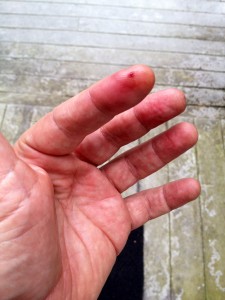
I was trying to decide which self-indulgent experiment fascinating project to demo this week when my hand slipped, driving a sharp soldering iron tip into the meat of my fretting-hand index finger. It didn’t hurt all that much—until I tried to play. Ye-OWCH! (No, of course I wasn’t using the tool properly! I was trying to pick loose a knot of wire with the iron’s tip rather than the recommended wire-picker-thingy.)
So no guitar recordings for me this week while my poor l’il finger recuperates. But I’ll try to compensate for this dog-ate-my-homework post by sharing three works in progress. If they turn out well (and they might!), audio and video will follow.
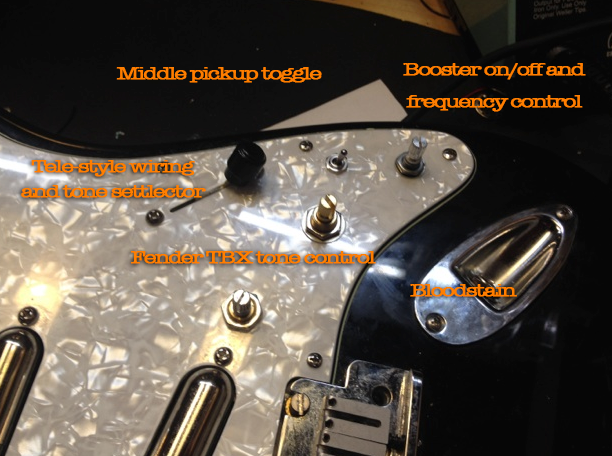
1. Lipstick Tubes Revisited. For more than a year, the generic Mexican Strat I fitted with lipstick tube pickups has lived, disassembled, in a filthy cardboard box next to my workbench, guilt-tripping me every time I fired up the soldering iron. There were a number of experiments I’d been meaning to perform on it, and in a spectacularly bad example of scientific methodology, I incorporated them all at once, making it pretty much impossible to discern what’s doing what. But I hear some things I like. Here’s what’s new (beside the blood spatters):
Not everything is working as desired yet — but there are some promising directions here, and it’s so nice to have a lipstick tube instrument again. :pacman:
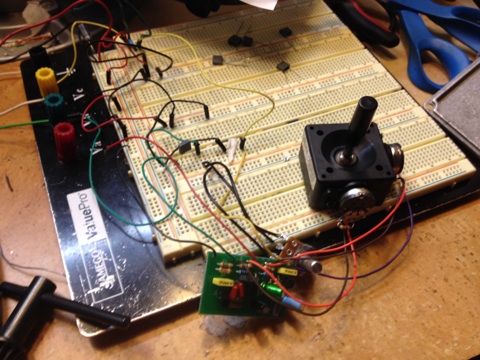
Joystick fuzz: like giving a loaded gun to a monkey.
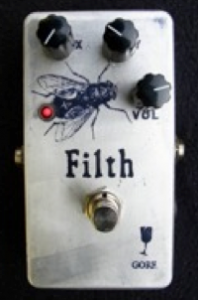
2. The Joy of Stick. Anyone tried a joystick effect, like Devi Ever’s Drone Fuck Drone? I bought a few joysticks from 4Site and have been having a blast. I thought they’d be difficult to wrangle, but it’s really just two pots, each with the standard three-lug connection, deployed in X/Y configuration. Two things to bear in mind, though: They’re generally available only with identical resistance values for each pot, and more important, you need two controls that have meaningful values throughout their ranges. Fortunately, I had just the circuit for it: my Filth Fuzz (which Fuzzbox Girl was kind enough to demo and review in 2011). I’d even labeled the controls X and Y! (I’m not selling these, but I do hope to bring it to market before long. Honest.)
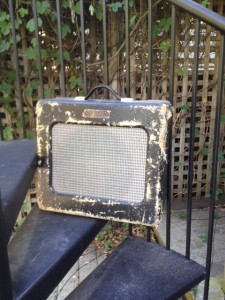
3. A Reanimated Amp. This one’s personal: I’m finally refurbishing the 1951 “TV front” Fender Deluxe amp that I received for as a bar mitzvah present in the ’70s. (I was mature enough not to express my disappointment over getting some crummy old tweed. But how I longed for that shiny post-CBS crap!) My mom procured it from the son of one of her fellow elementary school teachers, who worked at Fender in nearby Fullerton. (Sadly, I’ve forgotten his name.) I also got to pick from three early-’70s Fender guitars: a sunburst Strat, a paisley Tele, and a black Jazzmaster. I, of course, chose the Jazzmaster — at the exact moment when no one on earth gave a crap about that model. And naturally, I sold it just when new wave arrived and Jazzmasters became cool again. See? I established my pattern of buying and selling the wrong things at the wrong times while still in my teens!
I didn’t wreck the amp by myself — the process started with the black paint job it acquired long before I entered the picture. Over the years it received a preamp mod from Paul Rivera, and later got totally ruined by an overambitious repairman who added mods I never requested, and who probably stole most of the original electronic parts. But the cab, chassis, speaker, and output transformer are original, and there’s no reason why it shouldn’t sound bitchin’ after I restore it to its original 5A3 circuit. I’m getting expert help from Tube Depot’s Rob Hull, who helped me source parts and make a grommet board to house the components.
So my apologies for all talk, no audio. My boo-boo is healing, and I should be back able to, like, actually play some of this stuff soon!