Categories
DIY guitar

The Fender TBX:
A Cool 2-Band Tone Control

You can TELL it's Photoshopped! There's no TBX!
You can TELL it’s Photoshopped! There’s no TBX!

Thanks again to everyone who chimed in on the “What your favorite mod?” discussion. I got tons of great ideas from your comments.

Like this one, which I’ve been meaning to explore for ages: the Fender TBX tone control circuit, which appears in several Custom Shop instruments, notably the Clapton signature Strats. Like the G&L PTB circuit I’m so apeshit about, it’s a 2-band passive tone control — but one that sounds very different.

The PTB is a two-knob circuit that lets you siphon off highs, lows, or both. I’m agog at how well it works with humbuckers — you can get so many cool sounds by rolling off lows on the way to a fuzz, as heard here.

But TBX (it stand for “treble bass expander”) is a one-knob circuit, tbough that single knob rotates two stacked pots. The control has a center detente. Set here, it’s like a regular tone control, wide-open. Turn it counter-clockwise and highs vanish, per usual. (You could “tune” the roll-off frequency with various capacitors, though I went with the stock .022uF.) But when you rotate clockwise, the absence of lows makes glassy highs erupt.
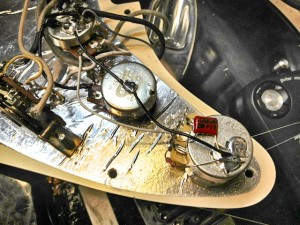
The dual pot cut highs or lows.

Technically, it’s not a boost, but it sure feels like one. Dirk Wacker, my now-colleague at Premier Guitar, dissects the circuit far more capably than I can here. (And he goes way beyond in this subsequent article on TBX mods. Man, I have some catching up to do!) He makes a good case for replacing the stock resistor with another value, but I went with the original 82K to establish a point of reference. I’ll try his mod when I restring, and I’ll update you here.)

BTW, you need the Fender TBX kit for this project — it uses highly customized pots to work its magic, and a standard stacked pot won’t do. But it’s cheap: You can find the TBX kit, with the pot, hardware, and passive components, online for about $15.

I put it into the mongrel strat I’ve been using as my digital synth/looping guitar. I’d been using a Stellartone Tone Styler, a cool Vari-Tone variant that switches between multiple capacitors. I dig it, but it’s the old model which clicks, rather than fades, from setting to setting, and it requires a powerful twist of the wrist to go from maximum to minumum, which I do every time I grab an EBow. Since I hadn’t gotten around to replacing it with the smooth-action version, I figured I’d try the TBX.

And I’m glad I did. It’s a super-easy install, at least to the extent that any job that requires removing both strings and pickguard can be easy.And here’s how it sounds:

I’m going to keep this one around for awhile. You’re hearing it through an analog rig, obviously, but I want to find out whether that extra shot of highs does anything meaningful when playing digitally. I’d also like to experiment with different cap and resistor values.

And now I can’t help wondering whether this would sound cool with humbuckers. Anyone have any experience with that?

Categories
DIY guitar

What’s Your Favorite Mod? (Here’s Mine.)

How am me make guitar thing better?

What’s your favorite guitar mod? The kind that changes how you play. One you’ve become so accustomed to that you wince when you pick up an axe that lacks it?

I’ll choose pickup wiring mods as a starting point: During the year that Seymour Duncan sponsored tonefiend.com, I devoted many posts to the under-appreciated wiring schemes I found in the company’s wiring diagram database. Some faves:

…and of course, the suicidal soldering mission known as the Pagey Project.

I’ve still got the “advanced” version of the Pagey wiring in my nothing-special beater Les Paul, and I like it so much, I want to fix up the guitar so it feels as nice as it sounds.

But of all the wiring experiments I tried, my absolute favorite is one that doesn’t appear in the Duncan archives: the so-called “PTB” tone control (for “passive treble and bass”). It’s a cliché to call a neglected idea “ahead of its time,” but in this case, it happens to be true. Being able to roll off lows as well as highs is unbelievably useful when sculpting sounds. It makes me want to run into the nearest Bain Capital Guitar Center, grab players by the collar, and shout, “You need to know about this!” (But I probably won’t, ’cause G.C. customers aren’t accustomed to receiving that sort of personal attention, and I wouldn’t want to freak them out.)

Allow me to repost last year’s video, demonstrating the circuit in action:

Over a year later, I remain totally addicted to this circuit, and I recommend it to anyone who doesn’t require a guitar with independent volume controls per pickup. (Everyone, basically.) It seems especially relevant for drop-tuned and 7-string metal players who realize you must sometimes cut a little bass to keep the lowest register tight and articulate. And the circuit is a godsend when used with bass-heavy fuzz pedals (such as vintage-style Fuzz Faces). In fact, I’ve even been building the circuit into the front end of certain loud fuzz pedals for use with guitars lacking this magnificent mod.

But I remembered something interesting this week when I opened up the Hamer 20th Anniversary guitar used in the video:

Categories
DIY Effects guitar

It’s Raining Germanium!

I just bought 500 germanium transistors. Yes, as a matter of fact, I am insane. Why do you ask?
I just bought 500 germanium transistors.
(Yes, as a matter of fact, I am insane. Why do you ask?)

UPDATE: My Dunlop Fuzz Face Mini review is live at Premier Guitar. Audio clips included!

How and when did it get so frickin’ easy to procure great-sounding germanium transistors?

I’ve been building stompboxes for four years or so. I used to consume article after article detailing the sheer horror of dealing with germanium. Sure, those old-school transistors sound great, I’d read, and they’re necessary for vintage distortion circuits. But they’re unstable. They’re expensive. They’re hard to find. You have to sort through dozens to find the few good ones. And once you do, you must spend countless hours matching and biasing them for optimal sound.

I believed everything I read — until I finally admitted to myself that I seldom encountered any of those problems.

(If you don’t know much about germanium transistors and why they’re cool, here’s my manifesto.)

I used to buy germanium transistors from Small Bear and other parts sites, and was always happy with the results, even though I had to pay eight or ten bucks per transistor. (Small Bear even does the matching for you, offering sets of transistors suitable for various vintage fuzz circuits.) However, it was a little tough finding NPN (negative-ground) germanium transistors. In fact, Small Bear once rejected my order of a dozen or so NPNs because they were so scarce. (To his credit, Small Bear’s Steve Daniels explained that he restricted sales so that everyone who wanted to build a couple of great DIY fuzzes would have the opportunity.)

The workaround is to build pesky positive-ground pedals, or jigger with the schematic in order to use PNP (positive-ground) transistors in negative-ground circuits. (This site’s Fiendmaster project is an example of the latter workaround.)

Then some odd things happened:

Categories
DIY Effects

Next Week on Fuzz Detective!

UPDATE: Based on cool info supplied by YOU, dear readers, I’m expanding the scope of this piece. I’m furiously wiring up clones of some very rare models, and I can promise many cool and interesting surprises. Thanks, guys! :beer:

Okay, now that we’ve all gotten that silly “reading” stuff out of our systems with Book Week, it’s time to get back to the real focus of this blog: nasty, filthy fuzz pedals.

Last time we were on the subject, we looked at the original version of Dallas-Arbiter Fuzz Face, and included Mitchell “super-freq” Hudson’s beautiful DIY instructions.

Those posts generated many interesting comments — plus some misinformation on my part. For example, I said that the original Fuzz Face circuit is a close cousin to the Tone Bender Mk I, which would mean, for example, that known Mk 1 user Mick Ronson was essentially using a Fuzz Face between his Les Paul and his Marshall. But subsequent listening and reading makes me believe I was wrong. So I figured it was time to play fuzz detective and sort the facts from the other stuff.

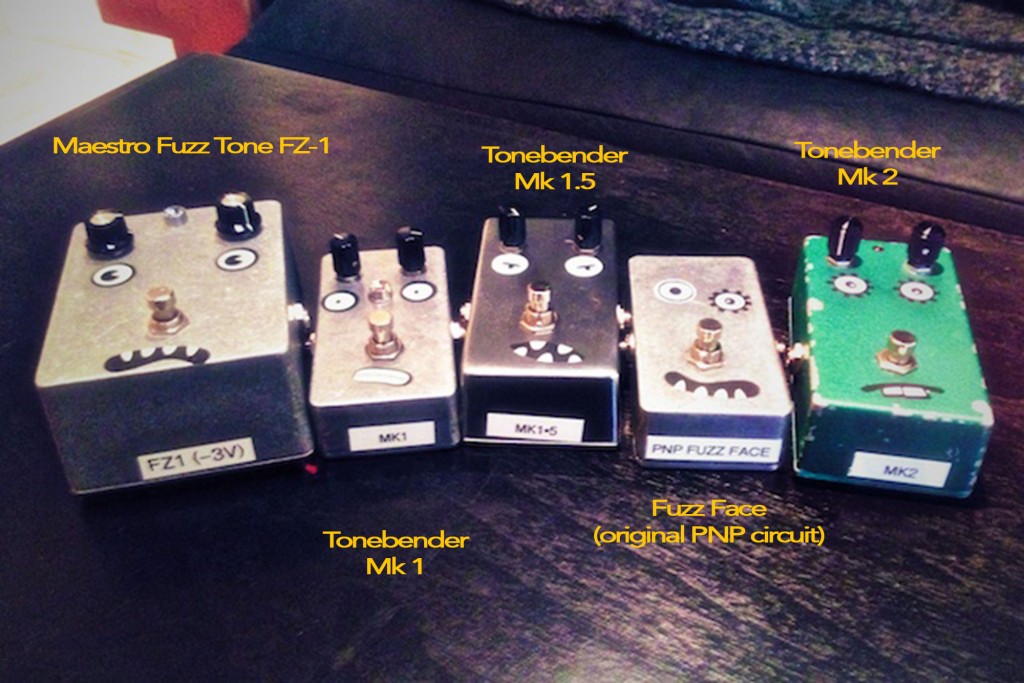
First, I made clones of all the early commercial fuzzes. I’ll be posting a compare-and-contrast video in the coming days. (The audio forensics will be quite incriminating.) Here’s the lineup:

The usual suspects. (Incriminating audio/video evidence to be posted soon!)

I’ve also re-read the experts, and man, even my most trusted sources contradict each other right and left, especially when it comes to those darn Tone Benders. While I have absolutely no inside dope on what actually transpired, I think David from D*A*M Stompboxes offers the most convincing Tone Bender chronology, which you can read here.

Anyway, here’s my best guess about how the early fuzz years unfolded:

Categories
DIY guitar Music

Tonefiend Book Week 2013: Epilogue

Monday: Theory and Technique
Tuesday: Gear
Wednesday: Repairs and DIY
Thursday: Biography
Friday: Fiction

Thanks to all my smart and cool readers who contributed to the first (maybe annual?) Tonefiend Book Week! I loved chatting about some old favorite books, and getting exposed to so many cool new ones.

An encyclopedia of rad.
An encyclopedia of rad mods.

I have just two quick additions: the first concerns an exciting new acquaintance, and the other a sad departure.

In comments to Tuesday’s post on DIY and repair books, reader smgear mentioned Nice Noise, a book on prepared guitar by Bart Hopkin and Yuri Landman. I immediately ordered a copy, and received it the other day. I’m blown away. It’s a small-format book, a mere 72 pages, but it is a veritable encyclopedia of alternate guitar treatments.

Hopkin (he edited the journal Experimental Musical Instruments and wrote the fabulous alternate instrument books Gravikords, Whirlies & Pyrophones and Orbitones, Spoon Harps & Bellowphones) and Landman (he builds mutant guitars for Sonic Youth, Liars, Melt Banana, and other artists) discuss pretty much every avant-garde guitar mod I’ve ever heard of, and many besides. It’s not just a catalog — it’s a detailed how-to, meant to be consumed alongside the pair’s online audio library of musical examples. I’m sure you’ll be reading about it more here, because I’m definitely going inflict some of these rad alterations on some unwitting guitars.

One of the finest rock-and-roll novels.
A great rock-and-roll novel.

An a sadder note, the death of Scotland’s Iain Banks this weekend reminded me of a book that should have been inclued in Friday’s installment on musical fiction. Both funny and moving, his 1987 novel, Espedair Street, is simply one of the finest rock-and-roll novels ever. Its protagonist is a fabulously successful rock star (think Floyd or Fleetwood Mac in their prime) who must process his own past while grappling with the prospect of suicide.

Readers in the UK, where Banks is hugely popular, may be surprised to learn he’s strictly a cult figure in the States. While Espedair Street is his only work to focus on the music world, he wrote many fine novels marked by wry humor and vast empathy. (The Crow Road and Whit are two other favorites of mine.) He also wrote scads of science fiction under the name Iain M. Banks. Banks, 57, had only recently learned he was dying of cancer. In April he composed a final communique to his readers, writing:

I’ve asked my partner Adele if she will do me the honour of becoming my widow (sorry – but we find ghoulish humour helps). By the time this goes out we’ll be married and on a short honeymoon. We intend to spend however much quality time I have left seeing friends and relations and visiting places that have meant a lot to us.

Categories
Acoustic Amps DIY Effects guitar

Tonefiend Book Week 2013
Wednesday: Repair and DIY

Monday: Theory and Technique
Tuesday: Gear
Wednesday: Repairs and DIY
Thursday: Biography
Friday: Fiction

Tonefiend Book Week is simple: I discuss a few titles I’ve found particularly enlightening, useful, or entertaining, and then you jump in and do the same. I’ve organized the days of this week by subject matter. Today’s topics are repair and DIY.

I'm indispensable.
I’m indispensable.

Sorry in advance if my faves in this category are a bit predictable!

For any repair topic, I turn to the redoubtable Dan Erlewine. Dan knows his stuff like no one else, plus he’s a terrific writer, with a rare talent for explanation and a charming sense of humor.

Dan has serviced the instruments of countless great players. (I’d insert a list, but it might wear out my comma key.) Better yet, he makes comprehensive notes and measurements. You learn much about, say, Albert King, just by studying Dan’s numbers.

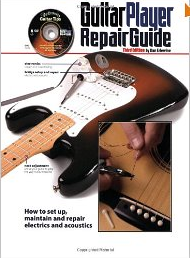
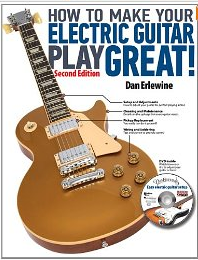
Now, I’m the furthest thing from a guitar tech. (Just ask San Francisco’s brilliant Gary Brawer, who regularly rescues my guitars from clumsy abuse and ill-considered DIY attempts.) But for players who simply need help with basic setup, maintenance, and modification tasks, Erlewine’s books — The Guitar Player Repair Guide and How to Make Your Electric Guitar Play Great — are godsends. Get ’em both. You won’t be sorry. (The digital versions live on my iPad for workbench reference.)

"Me too!"
I’m indispensable too!

I never had the pleasure of editing Dan’s columns when I worked at Guitar Player — Jas Obrecht jealously guarded that privilege. But the entire staff would laugh itself silly over Dan’s April Fools columns, like the one where he explained how to install a Floyd Rose tremolo on a pre-War Martin. (If I recall correctly, the process involved filling the body with cement.) Another year, he suggested using kitchen objects as lutherie tools. The photos included a kitchen table used as a clamp for a glue job on some über-valuable axe. (Touch of genius: The pic showed the poor guitar being crushed by a weighty trestle table, where Dan’s kids sat enjoying large bowls of breakfast cereal.) That one prompted a very famous guitar maker to write a shrill letter to the editor. (“It’s highly irresponsible for Mr. Erlewine to recommend using a heavy kitchen table as a clamp. Proper clamps don’t even cost that much!”) The luthier followed this with a frantic phone call, explaining that someone had alerted him to the joke, and begging us not to run the letter. We didn’t. (Dagnabbit!)

Categories
Acoustic Amps Bass Digital DIY Effects Gigs guitar Music Pickups Recording Technique

Tonefiend Book Week is Coming!

Tonefiend Book Week 2013

Next week at tonefiend we’ll be talking about our favorite guitar/music books. I’ll write about some of the titles I find especially useful, inspiring, or entertaining, and I hope you’ll chime in with some of your recommended reading.

Since there’s so much potential material here, I suggest we focus on a different book category each day. Here’s my proposed schedule:

Tonefiend Book Week is strictly an experiment, and a selfish one at that. If the past is any guide, the obsessive geeks experienced and sophisticated players who frequent this site will introduce us to lots of lively lutherie-linked literature. And I’ll do my best to keep up!

So scour your bookshelves, real and virtual. This shit is about to get real promises to be a most edifying conversation.

Categories
DIY Effects

DIY Club Help in the Forum

Despair en masse in the Forum!

Mitchell “Super-Freq” Hudson, creator of our DIY Fuzz Face project, made a smart suggestion: Dedicated Forum sections for each of the Tonefiend DIY Club projects.

You’ll find them here. Thanks, Mitchell! 🙂

Categories
DIY Effects guitar

The Fuzz of a Thousand Faces

Lon Chaney was reportedly an early user of the Fuzz Face.
Lon Chaney was an early Fuzz Face user.

It is a truth universally acknowledged that a guitarist in possession of a single Face Fuzz must be in want of cool Fuzz Face mods. (Sorry, Jane.)

Case in point: The comments section for the new Fuzz Face project.

We’re far from the first to cover this ground. In fact, I should have mentioned a couple of great articles on Fuzz Face mods. We’ve talked about the technique of using sockets in your build so you can audition multiple components. Years ago DIYer Gary Burchett took this notion to its logical conclusion with the Multi-Face, a Fuzz Face with most of the components socketed. It’s definitely worth trying this. Meanwhile, this Instructables project by randofo explains how to create a super-versatile Fuzz Face using switchable components.

Trust me — despite the simplicity of the circuit and the sheer number of adventurous souls who have deconstructed and reconstructed it, it’s hard not to play around with it and find something cool and new. That too is a truth universally acknowledged!

Categories
DIY Effects guitar

The “Super-Fiend” DIY Fuzz Face!

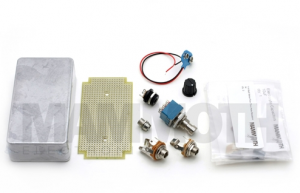
You can purchase a kit, or source your own parts.

UPDATE [06.16.2013]: Build instructions updated to v02.

The Fuzz Face has inspired countless spinoffs since Ivor Arbiter unveiled the device in 1966. Some introduced meaningful improvements. Many didn’t.

The goal of this project, created by my friend Mitchell “Super-Freq” Hudson, is to create a pedal very similar to the original. It’s a great way to explore one of the iconic sounds of ’60s rock (and lots of ’60s-influenced rock).

The instructions are available here. [19MB PDF.]

You can order a kit from Mammoth for $45. (Disclosure: Neither tonefiend nor super-freq has any financial stake in these kits. I simply asked the Mammoth guys to create one for your parts-sourcing convenience. All necessary parts are readily available from other vendors.)

But before you attempt the project, please be aware of some of its quirks. (And if you’re curious, you can read about how I customized the pedal I used in my video demo.)