Howdy from Frankfurt! I’m here for the week covering Musikmesse for Premier Guitar magazine. Messe is like NAMM, only somewhat larger and way louder. With beer and sausage. And probably lots of accordions, because you can’t have beer, sausage, or music trade shows without accordions.
You can check the many daily pics and notes posted at PG‘s Facebook page. We have a strict “new gear only” policy. No NAMM retreads — only items being introduced here in Frankfurt. Should be interesting!
:pacman: :pill: :beer: (pretend the pill is a sausage)
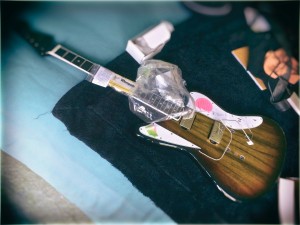
Oh, man — I’m flipping out over a new guitar I’ve assembled from Warmoth parts. It was an opportunity to try some new experiments — and amazingly, some of them may have worked!
I had several unrelated goals:
a better instrument to use with my digital rig, with the best possible MIDI tracking and digital modeling performance.
an excuse to acquire a guitar with P-90 pickups
a chance to try a new onboard booster scheme
Plus, I was suffering some Jazzmaster nostalgia. My first electric guitar was the used Jazzmaster I received for my 13th birthday. Naturally, I sold it at exactly the wrong time, and haven’t owned one since.
Fullerton vs. Kalamazoo. But as you can see, this apple has fallen far from the Fender tree. Beyond the bolt-on neck, 25 1/2″ scale, and JM shape, it’s really more Gibson-esque, with a relatively heavy korina body, mahogany neck, bound ebony fretboard, and Tune-o-matic-style bridge and tailpiece.
I wanted to see how a guitar that was bigger and heavier than the Fenders I’d been using in my digital setup would perform with MIDI triggering and amp modeling. This “Birdmaster” reminds me a lot of a Firebird, or even a Trini Lopez with its Firebird-style headstock. There’s just a lot of distance between the endpin and the tip of the headstock! Between the woody mass, authoritative-sounding Lindy Fralin P-92 pickups (which I’d previously reviewed in Premier Guitar), and my beloved overpriced flatwound strings, I wound up with an instrument whose exceptionally clear and stable pitch works better with digital tools than any guitar I’ve tried.
Intonation revelation. On a whim, I ordered the neck with a pre-installed Earvana nut. I’d always been a sceptic about “improved” intonation schemes, such as the Buzz Feiten system. Not because I didn’t think they’d work — more because I like the out-of-tuneness of guitars in general and rock guitars in particular. (And let’s face it — most of my best session work is howlingly out of tune.)
Okay, I was a dope.
I am over the moon about how sweetly this guitar plays in tune. It’s already an exceedingly resonant slice of tree, but I’d swear the minuscule intonation fixes just make it hum more. I’ve already taken in three more instruments to genius guitar tech Gary Brawer for Earvana retrofits.(The nuts go for about $40 each, compared to five bucks or so for a conventional nut.)
“Hi! We’re red pandas, and we inspired the guitar’s color scheme!”
Cult boost. I also tried a few new things with the electronics. There are single master volume and tone controls, with a Stellartone ToneStyler on the tone pot. I added my Cult circuit — a single-germanium-transistor boost descended from the Rangemaster, a trick I used in the Pagey Project Les Paul. A push/pull switch on the third knob activates it.
But here, the pot controls the level going into the boost, not out of it. Since it’s such an extraordinarily dynamic circuit (it cleans up almost completely when you back of the input), the knob works as an ultra-sensitive gain control. It’s easy to find spots where you can go from clean to dirty with just a little extra picking-hand pressure. (The booster, when engaged, is positioned before the volume and tone pots.) The same setup would probably work great with a built-in Fuzz Face.
I’m still fine-tuning things — I may want to add selectable booster input caps, for the option of a traditional Rangemaster-style treble boost. But overall, I’m thrilled to bits about how this guitar is turning out!
Anyone else have interesting experiences with Fender/Gibson hybrids? Care to share?
May I take this opportunity to pimp my new monthly recording column in Premier Guitar? The first installment covers basic electric guitar miking technique. It’s ground that’s been covered often enough before, though I hope the article’s many audio files (recorded via ReAmp, moving the mic between “takes”) shed some new light on the topic.
Meanwhile, I’m breathlessly stoked about my new “Partsmaster.” It’s a Korina “Split Jazzmaster” body from Warmoth with Fralin P-92s and some new tricks I’ve been wanting to try with wiring and onboard overdrive, plus several other ill-considered, stab-in-the-dark adventurous experiments. It’s like some wacky Firebird/Jazzmaster hybrid (“Birdmaster?”) I hope to post some video later this week, but right now, the guitar is awaiting the plek treatment at Gary Brawer’s shop. Gary is also prettying up some of my clever but sloppy wiring, and remedying the fact that, when I brought the beast in, the strings were about a half-inch from the fretboard.
I just received from Warmoth all the parts for my next DIY guitar. I loved testing eight sets of P-90 pickups for Premier Guitar, but I don’t own any P-90-eqipped guitars.I will soon, though!
This one will be a bit of a platypus — as opposed to, you know, all my other other platypi. (The actual plural of “platypus” is “platypuses,” but “platypi” is more fun to type.) It’s built from Warmoth’s “split Jazzmaster” template, with a korina body, bound neck, Tune-o-matic/stop-tailpiece bridge, and a pair of hum-cancelling Fralin P-92s. Yeah, it’s kind of a stab-in-the-dark experiment, and not a inexpensive one. But hope springs eternal. Prepare to be bored with details!
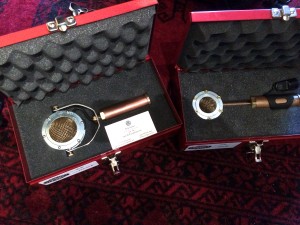
I’ve also just received an amazing-looking pair of condenser mics from Portland, Oregon’s Ear Trumpet Labs. ETL kingpin Philip Graham’s business card identifies him as “proprietor and bricoleur.” Bricolage, of course, is the ten-dollar word for “making stuff out of junk and other found objects.” Dig the steampunk vibe of that repurposed hardware! I haven’t even plugged these in yet (though the reviews I’ve read have been stellar). I just like staring at them! But I’m going to try them out at my monthly Strung Out! show tonight.
Ear Trumpet Labs’ Edwina and Edna models: a higher calling for found objects!
Which brings me another of this week’s highlights: I got to perform last night with my dear friends Teja Gerken and Adam Levy. Teja is an astonishing acoustic fingerstylist and a fine composer. His vocabulary has hints of Bensusan, Hedges, and classical, but he’s molded those influences into a thoroughly unique sound. And Adam, who I’ve known since my Guitar Player magazine days, is equally renowned for his jazz work and for accompanying such singer/songwriters as Norah Jones and Tracy Chapman. (I get to play some of Adam’s cool parts when I gig with Tracy.) These days Adam’s focusing on songwriting, and he his sings his “smart Americana” songs (my description, not Adam’s) in a sweet, soulful voice. Man, what a treat to hear both of them up close. And tonight, Adam, Shelley Doty, and I perform at my local dive, El Rio. Can life get any better?
Apparently so! Yesterday Premier Guitar posted John Bohlinger’s piece on the Pixies, which includes a pic of Charles “Frank Black/Black Francis” Thompson’s pedalboard, with my grubby, hand-built Duh fuzz pedal front and center. I’d originally made if for Joey Santiago, the other Pixies guitarist, but I guess Charles swiped it. Hey, I’d be honored if either guy spat on the thing! They’ve been heroes since I first heard the band in a small San Francisco club back in ’88. (Everyone went to hear the Sugarcubes, but left talking about that awesome opening act from Boston.)
Frank Black’s pedalboard: Lookit! I’m Pixies-approved!
It’s funny, because I really was thinking “Pixies” when I sound-designed the Duh. I was going for “bubblegum metal” — a thick, heavy sound, but not a macho one. The tone is too fizzy and funny for 100% sincere heavy rock, IMHO. It’s more of a “greasy kid stuff” distortion. (Note to readers under 45: That was once the tagline for a “dry look” mens hair product, referring to the outdated coiffures that would return with a vengeance when punk broke a few years later.) It’s a vaguely Muff-like sound, but with less compression, less scoop, and one big, stupid knob. I also like building that circuit into guitars. Like this one:
So it’s been a grand week, but a hectic one. Thanks for reading this far. Next week I promise a proper post, and not another collection of … odds & ends.
One of the coolest gizmos from last weeks NAMM show is already in my grubby little hands: It’s the Logidy EPSi, the first customizable convolution reverb pedal. I ordered it the instant I heard about it, and it arrived right before I left for Anaheim.
Convolution (or impulse response) reverbs can mimic acoustic spaces and outboard gear with astonishing accuracy. (If this concept is new to you, check out this article by me. Or better yet, this one written by someone who knows what he’s talking about.) Nutshell: You create impulse response (IR) files by playing and recording a test tone in rooms or through gear. Once you load the file into an IR reverb device or plug-in, it can make anything sound as if it was recorded with the same ambience.You can also generate eerie, otherworldly sounds by loading unusual audio files.
Many software and hardware amp and effect modellers use IRs to mimic gear. Software convolution reverb plug-ins such as Audio Ease’s Altiverb, Logic Pro’s Space Designer, and Waves IR1 include reverb libraries, and also let you load your own IRs. But as far as I know, EPSi us the first device that lets you load your IRs into a stompbox and access them without playing through a computer.
I’m psyched to add IR reverbs to my (mostly) analog pedalboard, and EPSi makes it relatively easy to load the IR libraries I’ve compiled. The files require special treatment: They must be 44.1kHz WAVs, and the names must be formatted quite specifically, as detailed in Logidy’s documentation. The interface is extremely minimal: just a bypass footswitch and a knob/button pair to navigate the simple menus.
This unique reverb stompbox sounds great and offers limitless opportunities for creative sound design. You can load your own impulses, or add ones from from some of the fine freeware libraries online. (Thanks for the link, Scott!) On the downside, it’s difficult to load or edit sounds on the fly, so while it might be fun to spelunk for new sounds in the studio with EPSi, don’t plan on modifying sounds onstage. (The ability to recall several saved presets would vastly improve EPSi as a gigging tool.)
I just drove back to San Francisco from Southern California, where I got to hang out with family and spend a long, full day at NAMM. And while even the longest and fullest of days isn’t enough to see half the stuff at the show, I’ve put together a little slideshow covering some highlights and lowlights.
Per usual, my focus is the obscure and the absurd. For details of the big releases from the major companies, check out the excellent coverage by my Premier Guitar colleagues. (I’m the designated PG reporter for Musikmesse in March, but at NAMM, I had the luxury of stumbling around in a daze, pausing to gape at whatever shiny object happened to enter my field of vision.)
Disclaimers apply:
While I receive no payment or perks in exchange for coverage, a number of folks whose products I mention are friends, clients, or both.
All opinions expressed are strictly my own — especially the obnoxious ones.
You can’t hear a frickin’ thing in the toxic noise zone that is NAMM, unless an exhibitor provides a soundproofed listening booth or a private suite. I have no idea how most of this stuff actually sounds, nor does anyone else reporting from the main show floot.
Finally, an apology: I couldn’t figure out how to embed links within my slideshow captions, so you’ll have to do some typing to learn more about these products. Sorry — but I did warn you that this was a half-assed NAMM report!
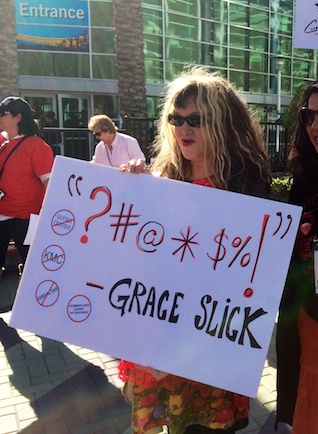
The very first thing I saw was a large group protesting against Bain Capital’s Guitar Center for allegedly ripping off a cajón pedal design by Michelle Mangione and Steve Soest. Demonstrators included my eternal punk goddess, Exene Cervenka of X (pictured). Details at guitarcentersucks.com.
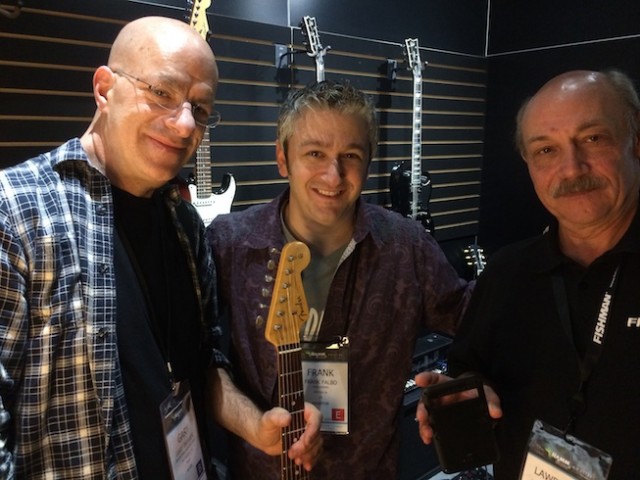
I finally got to hear Fishman’s Fluence — an electric guitar pickup that uses the radical technology of printing magnetic coils onto a circuit board rather than by winding wire. The pickup transmits a flat, full-frequency sound, which is subsequently shaped by an active EQ stage. The three initial releases feature two tones each, though theoretically, there is no limit to the number of pickup sounds you could generate via a single Fluence pickup. (The Strat held here by genius guitar tech Gary Brawer, for example, toggles between a vintage sound and a modern hot-coil tone.)
The results are very impressive. Changing modes really does sound more like a pickup swap than a mere EQ adjustment. Also pictured: Frank Falbo (center), who worked on the project, and Larry Fishman (left).
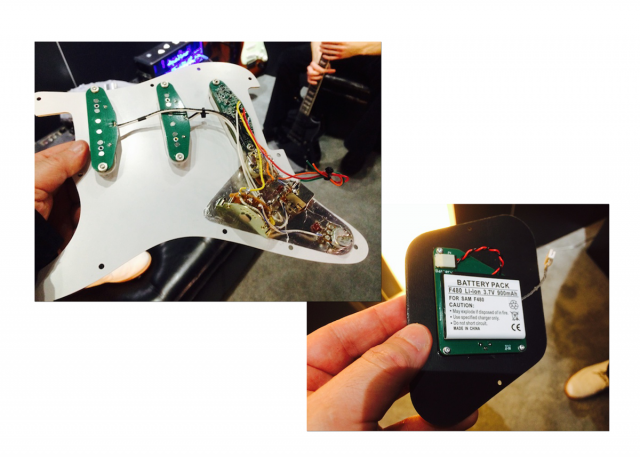
Rear view of the Fluence system and battery pack, which provides 100+ hours of playing time between USB charges. Fender/Marshall vet Ritchie Fliegler also worked on this product, and his son, Jack, provided a shredworthy demo of the high-gain humbucker version, which toggles between an active, EMG-like tone and a high-gain passive humbucker sound. The third model in the initial launch is a vintage humbucker setup offering a choice of PAF-style and hotter-than-vintage tones.
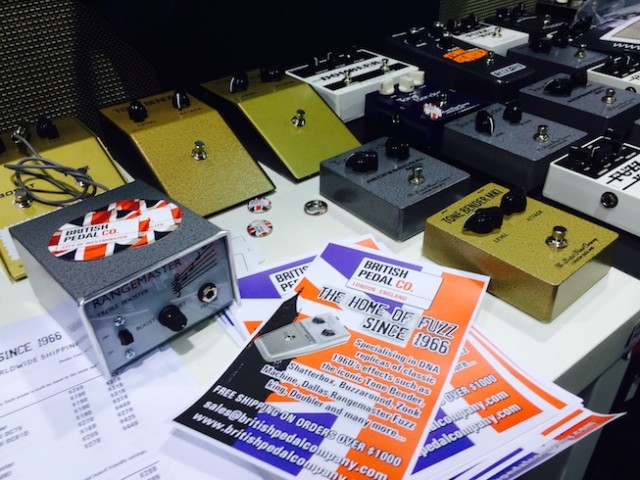
I didn’t get to hear them, but these fuzz pedals from the British Pedal Company certainly look authentic. The Rangemaster reissue even has a built-in output cable like the original.
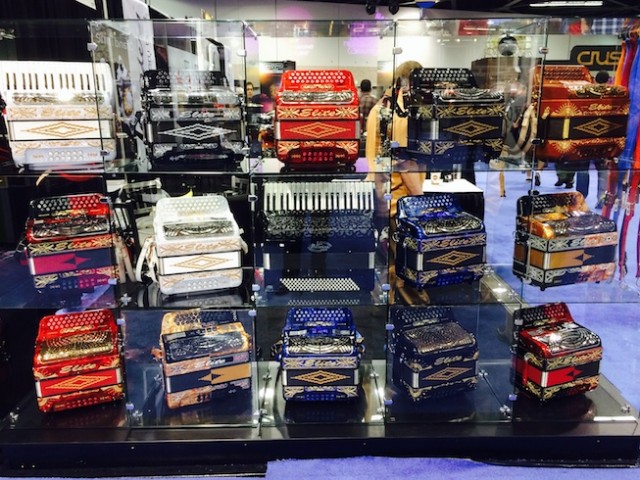
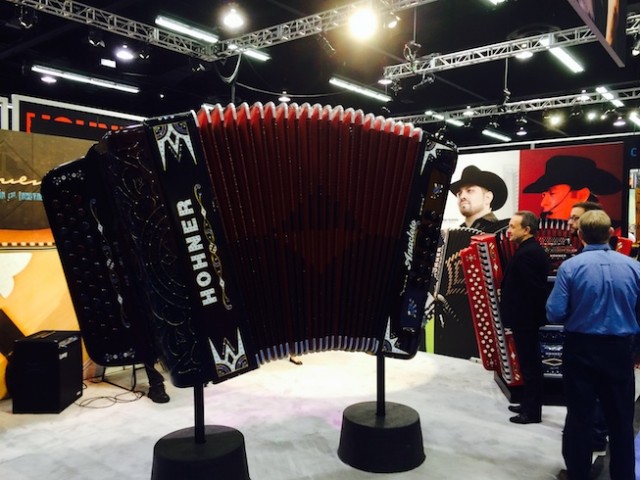
No NAMM report is complete without the obligatory accordion pic!
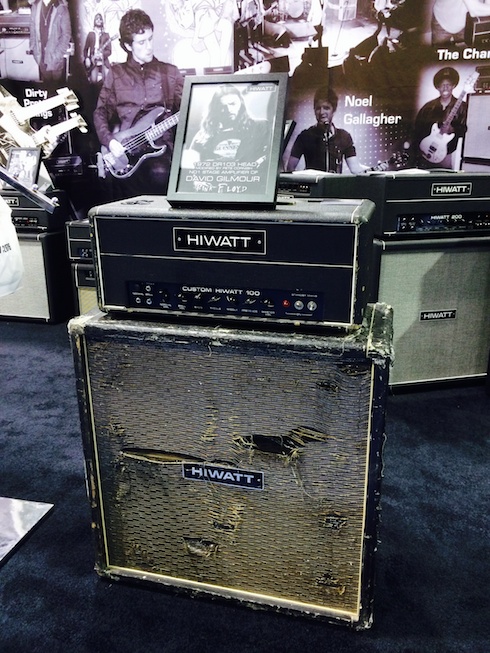
Hiwatt’s booth included this lovely relic: David Gilmour’s historic rig.
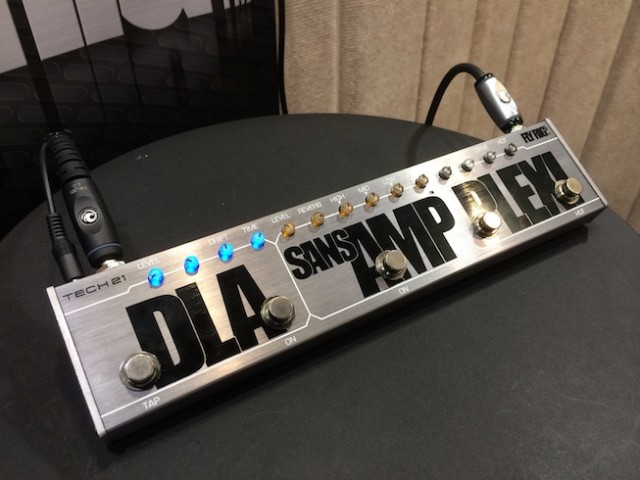
Small enough to fit into a guitar case, the tiny yet ergonomic Fly Rig by Tech 21 includes two stages of SansAmp gain, plus nice-sounding digital delay and reverb. I could totally envision using this not only on its own, but as a convenient and travel-friendly backup rig.
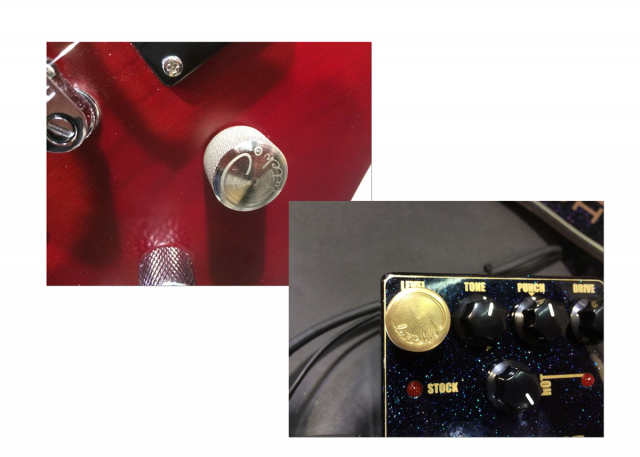
Tech 21’s Andrew Barta also showed me a prototype of the clever Clutch knob, an invention he didn’t create, but may develop and distribute. It’s a push/pull knob (not pot) that, when depressed, sticks in position while continuing to rotate in one direction. You might use it, for example, to dial back and forth between a wide-open guitar volume knob setting, and the exact spot you like for a rolled-back clean tone. I can think of many great stompbox applications as well. I want about 20 of these!
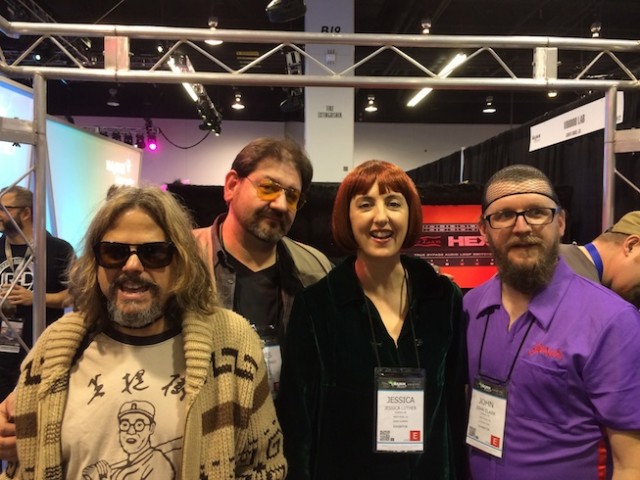
My pals from Voodoo Labs dressed as the cast of a certain film about bowling and ferrets. So much hipper than the usual black work shirt with embroidered company logo!
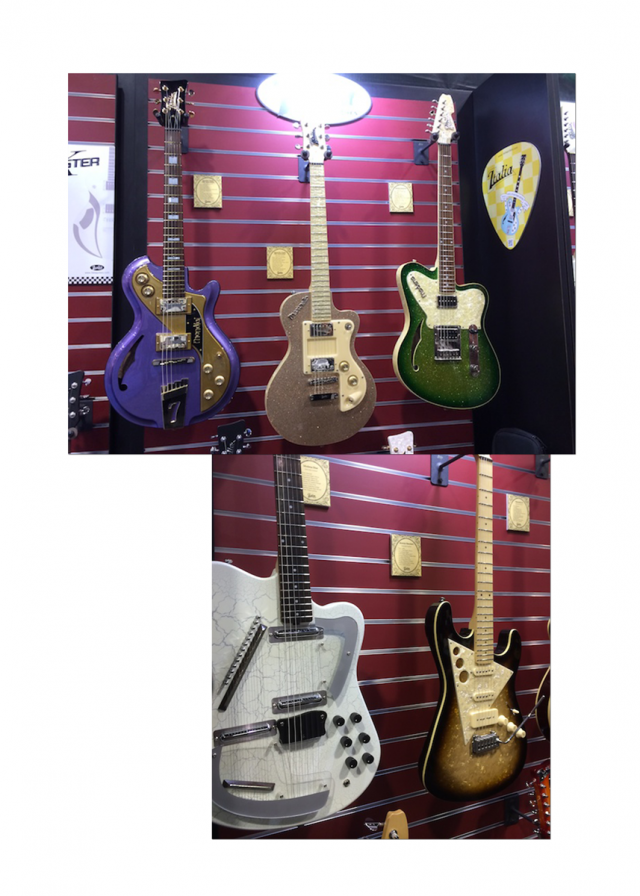
Cheap chic: The whimsical, retro-flavored designs from Trev Wilkinson’s budget-priced Italia line: Always a sickly-sweet treat! 🙂
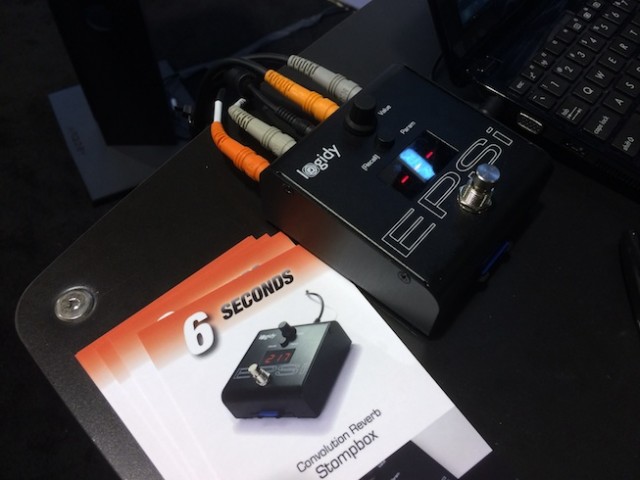
EPSi from Logidy is an impulse response reverb in pedal form. It reads IR files from an SD card, and yes, you can use your own. (If you don’t know about IR technology, search for “impulse response” on this site. It’s amazing and fascinating stuff.)
I’d ordered one of these the instant I heard about it, and received it just before departing for Anaheim. My initial reaction: wowie zowie. I’ll be writing more about this wily gizmo soon. (If you’re interested, get one now at $199. The price will probably go up soon.)
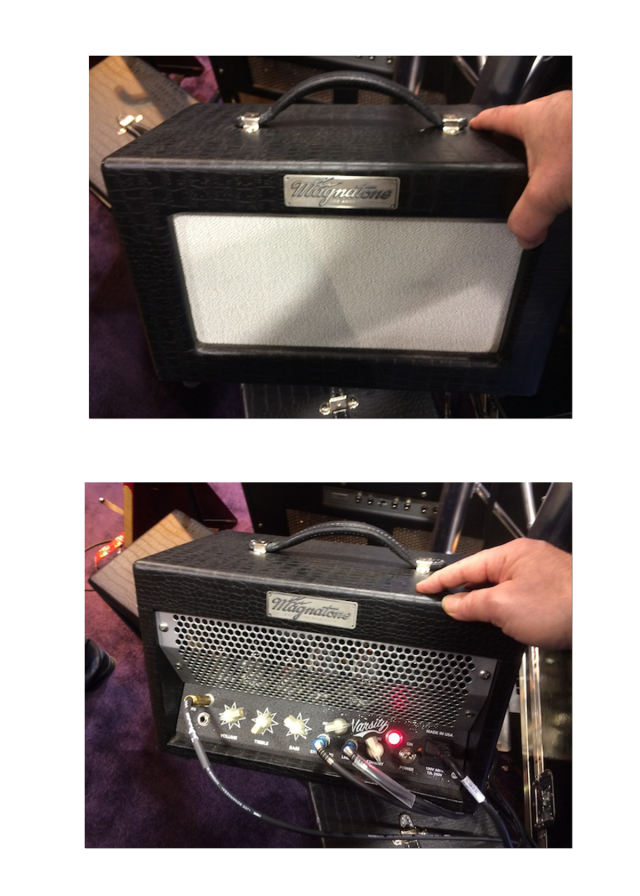
I recently reviewed Magnatone’s stunningly gorgeous (and, at $4,000, stunningly expensive) Super Fifty-Nine amp for Premier Guitar. Unlike its larger sibling, this compact 2 x 6V6 head offers true stereo vibrato, and will “only” set you back $1,700. To the extent I could hear it on the noisy show floor, it sounded gorgeous.
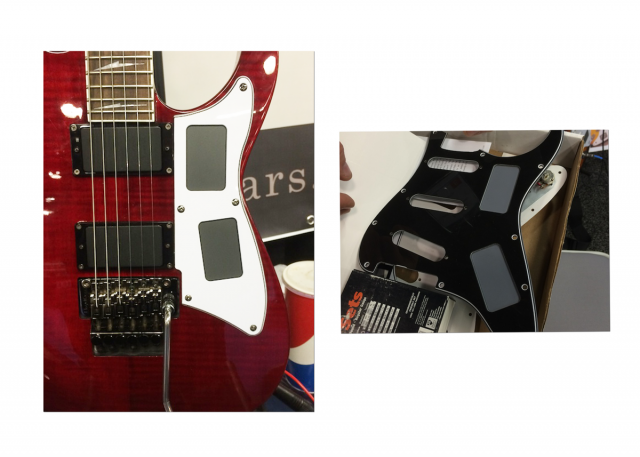
The prototype StrongArm Six-String Sustainer from Keith McMillen Industries looks promising. It allows you to blend sustained and normal tones and set the drive level via concentric pots. It definitely promises many exciting applications, but between the pots, saddles, and LED-enabled pickguard, it’s probably more suited to purpose-built guitars than DIY installation. Stay tuned.
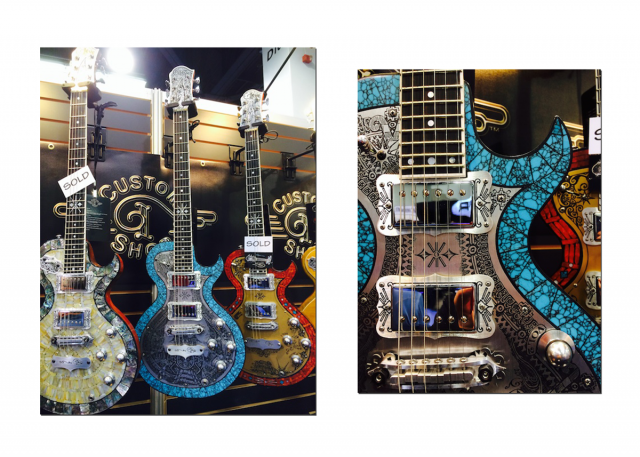
With their exquisite engraving and flamboyant surfaces, Teye guitars always attract a crowd. Most of them sell for north of $5K.
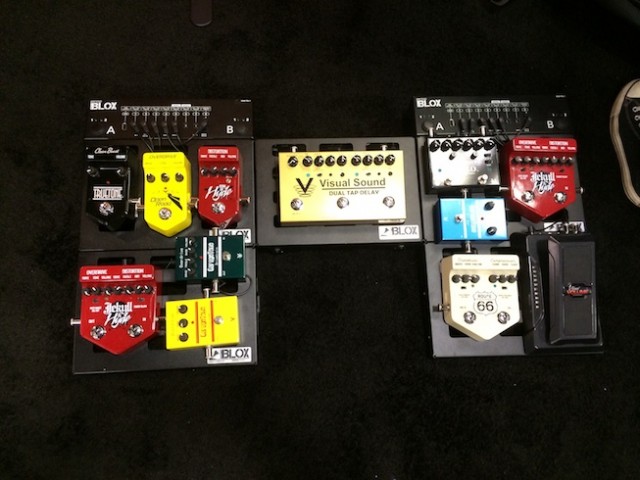
Stompblox specializes in modular pedalboards with snap-together sections. They also showed the Brick, an ambitious power supply/signal switcher.
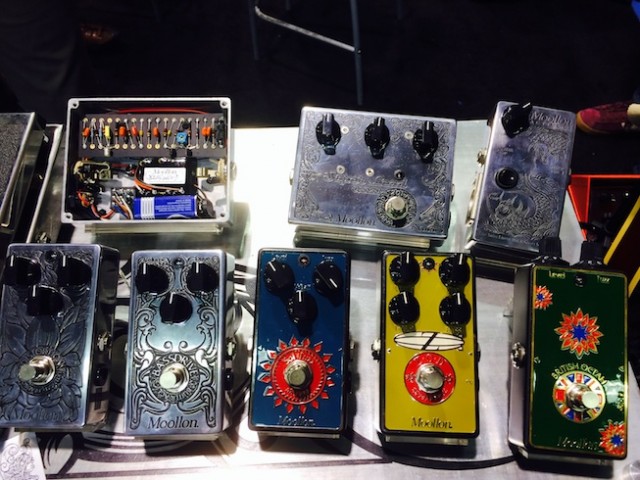
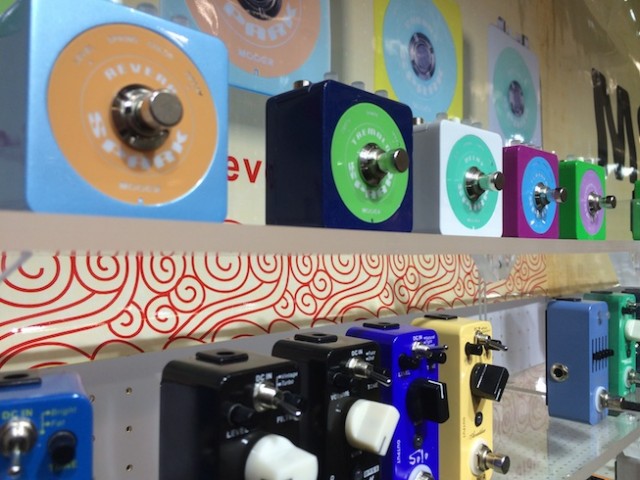
I haven’t had the opportunity to try Moolon pedals, but man, dig the beautiful engraving and eyelet-board construction!
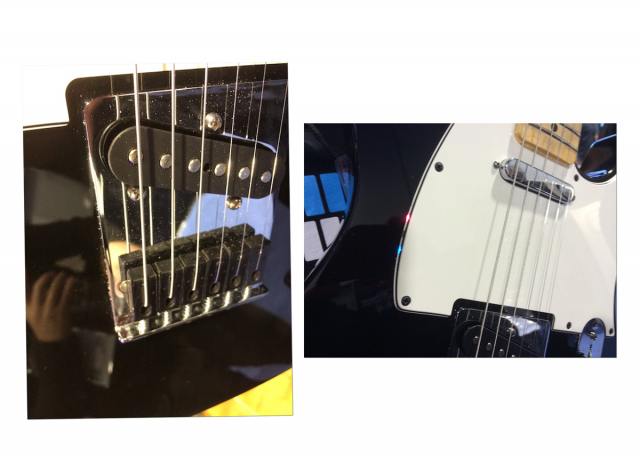
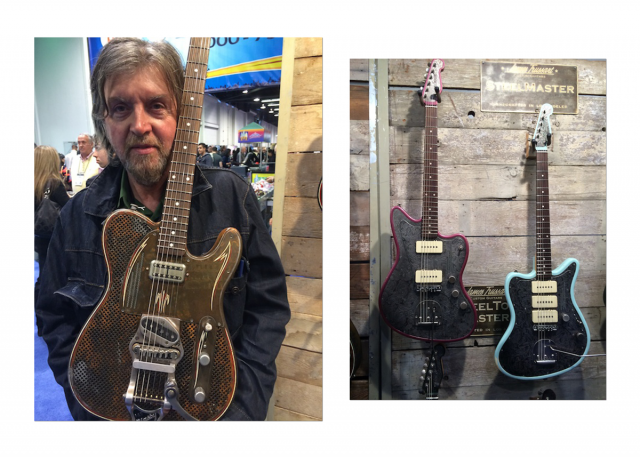
My brilliant friend James Trussart with one of his new pinstriped teles. Also new is his groovy “flipped” jazzmaster. As always, the Trussart booth was an island of design elegance in a sea of vulgarity.
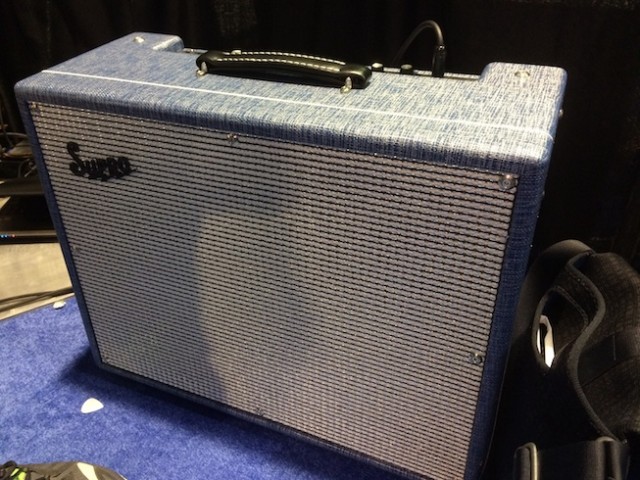
Famed Fender amp designer Bruce Zinky created the revitalized Supro amps, though the brand is now part of Pigtronix. This 6973-powered combo absolutely nails that “Immigrant Song”/”Communication Breakdown” tone.
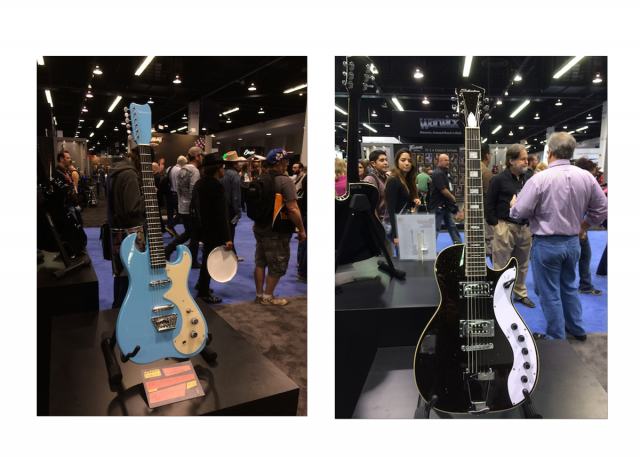
More Sears & Roebuck chic: The new Silvertone line offers replicas of various ’60s models. These use modern construction, which, for better or worse, probably means they’re more reliable but less freaky-cool than originals. I’m looking forward to checking these out.
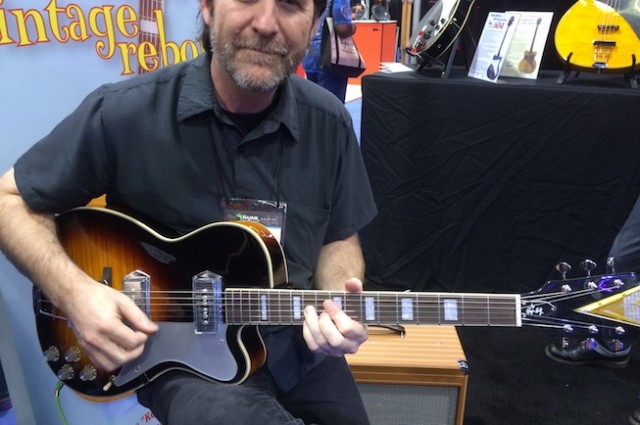
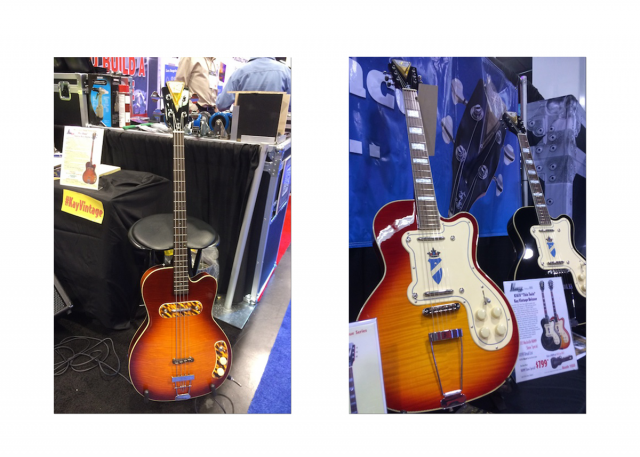
The retro resurrections continue! Tim Lerch playing one of the newly reissued Kay guitars. They’re budget-friendly reproductions of models from the historic Chicago brand.
More Kay coolness. I didn’t get a chance to hear or play these, but they’re so cool-looking, I almost don’t care how they sound. 😉
Now that is an artist endorsement photo: the inimitable Wanda Jackson for Daisy Rock guitars. (Plus I have that pink guitar fixation … )
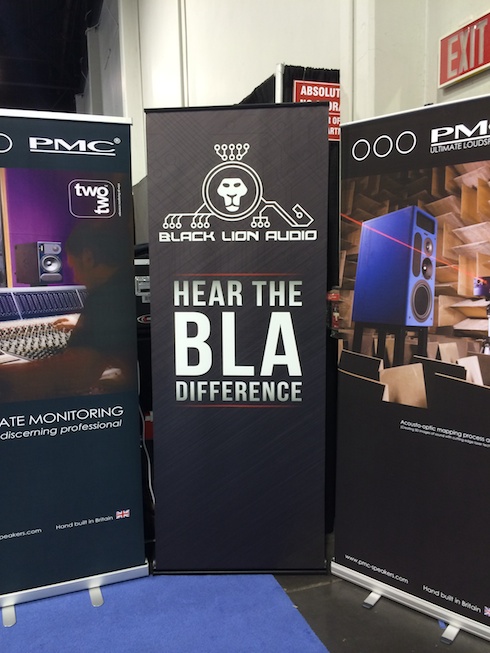
Marketing FAIL from Black Lion Audio.
Mooer specializes in micro-stompboxes, especially ones in small rectangular 1590A boxes. Now they’re doing a lot of effects in square 1590LB enclosures as well.
Hey, lookit! It’s the back of Stevie Wonder’s head!
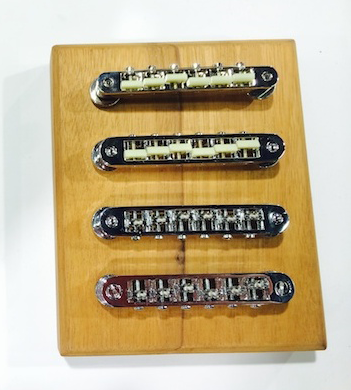
New replacement bridges from Tone Pros include a model with nylon saddles à la certain 1950s Gibsons, and a Bigsby-friendly roller bridge.
This control kit from Touchmark flips the touch-pad equation: They’re not for controlling external devices — there’s no MIDI output. They simply replace traditional tone and volume pots. With practice, a guitarist could manipulate the controls while playing. The system includes a pad-programming computer app.
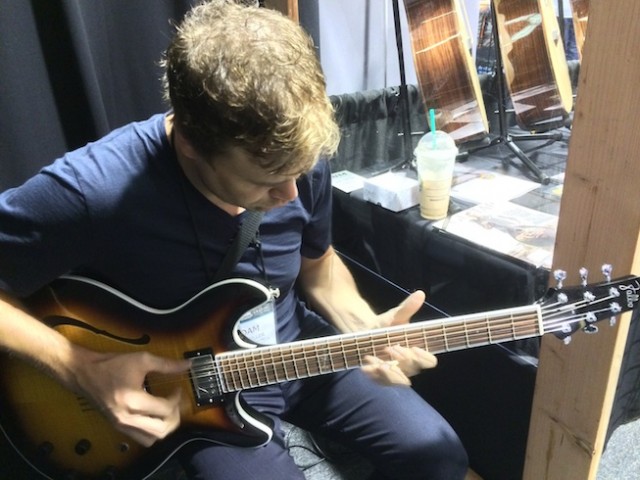
Aussie guitar monster Adam Miller tries out the first electric model from Falbo Guitars. (You saw luthier Frank Falbo way back in that Fishman Fluence pic.) Frank’s acoustic guitars are quite magnificent, and I’m looking forward to checking out this Fluence-equipped model someplace where I might actually hear it.
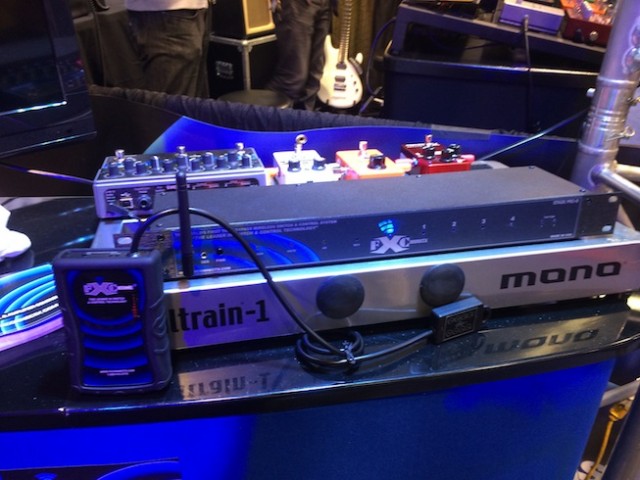
This wireless system from FXConnectx offers remote pedalboard control. Ambulatory rock stars can even position multiple units around the stage.
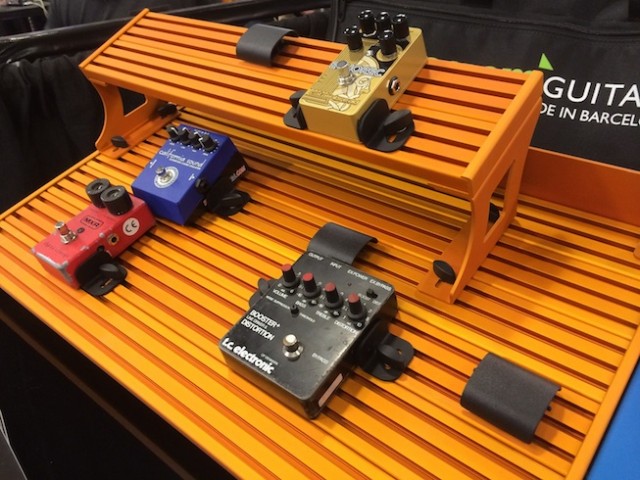
Ooh, pretty! This two-tiered Aclam pedalboard hails from Barcelona, ground zero for shapely and organic designs.
This is the best NAMM report ever, because it has two obligatory accordion pics. That’s one big-ass squeezebox!
Leaving the show, I chanced upon one last example of the taste and restraint for which NAMM is renowned.
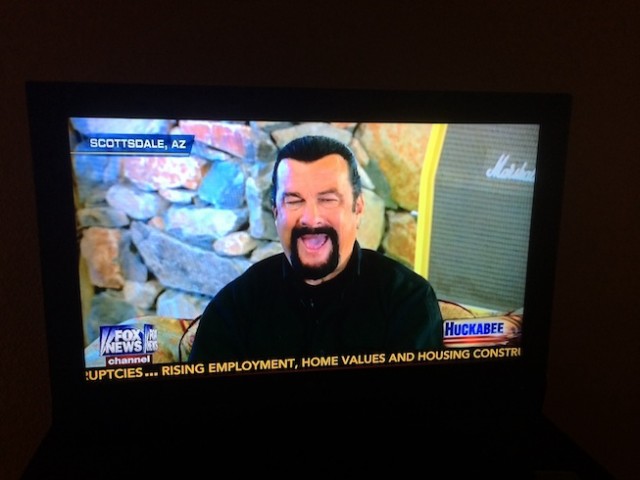
Back at the hotel I flicked through the channels, only to encounter Steven Segal telling Mike “Women Can’t Control Their Libidos” Huckabee about the awesomeness of his friend Vladimir “All Gays Are Child Molesters” Putin. Nice product placement!
After last week’s loudness experiments, and with the sonic carnage of NAMM just days away, I figured it was a good opportunity to dial down the decibels and share an interesting guitar/string combination I’ve been enjoying for a few months.
At $34 bucks a pop in the U.S., they’re blisteringly expensive, but they have a sound I’ve never encountered elsewhere. The result is the closest thing to a nylon-string sound I’ve heard from an ordinarily steel-stringed guitar.
I’ve had the same set on this guitar since May — they’re certainly long-lasting! Now I’m going to experiment with a few other options, but I wanted to document these before swapping them out.
Have a listen:
These strings fascinate me. They convert the guitar into what sounds like a hybrid nylon/steel-string instrument. They permit classical techniques such as rest-strokes, but when you bend them, they feel more like steel strings. The gauges are bizarre: .013 through .039. I’ve never played anything like them.
With these strings, my Martin is quieter than most classical guitars — more like the volume of Renaissance lute (an instrument I played a lot in my teens, though I haven’t owned one in many years). For me, this pairing has the same sort of sweet intimacy. This happens to be the one guitar I keep in my house — everything else is down in the studio. It’s quite literally a parlor instrument, and I’ve loved having a soft, quiet guitar to noodle on. It’s sometimes frustrating, though, how quickly these strings “overload” — the notes in the demo that snap and sizzle aren’t intentional — I’m just playing a little too hard.
I still consider this is a cool alternative classical sound, but after months of playing, I tend to think this combination would best suit a fingerstyle player who uses a lot of bending, smearing, and slapping. I bet Joseph Spence and Bert Jansch would have sounded great on these, as would Ry.
I may return to these extraordinary strings. Actually, in a perfect world, I’d have two lovely old Martins, one to strung conventionally, and the other strung with rope-cores. And since we’re talking “perfect world,” what the hell? Two pre-War Martins for everybody! No, make that three!
I just tried an interesting tone comparison, one I’ve never seen attempted. It concerns the search for loud amp sounds at low volumes.
Have any of you ever experimented with speaker attenuators — the passive load boxes that reside between your amp output and speaker input, which let you crank the amp while maintaining a low level from the speaker?
I’ve worked with one model before, a borrowed THD Hot Plate, and thought it performed well. I decided to purchase my own attenuator after several Premier Guitar reviews of large amps. As a small amp fan (not to mention an aging player with fragile ears), I wanted to minimize the aural assault of evaluating loud-ass amps.
But first, I wanted to determine whether it’s legit to evaluate amps at attenuated levels. Does attenuation inevitably alter the tone? And if so, can you compensate for via recording software?
Online opinions about attenuators range from “works like a charm!” to “totally killed my tone!” So I picked up a Swart Night Light and started recording and measuring. (I didn’t compare rival products. I just went with the Swart for its reasonable price, solid online reviews, and dual outputs for driving two cabs. I didn’t A/B it with a Hot Plate, though the results seem roughly similar.)
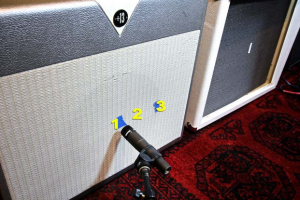
I direct-recorded a brief guitar phrase using my black Les Paul with Bigsby and PAFs, and then ran it through a ReAmp to my early ’60s Tremoverb, a 35-watt Fender with two 6L6 power tubes. I dimed the volume and left the EQ flat. Tt was insanely loud in my small studio. After recording that, I tracked the same clip again using the attenuator at each of its three settings. The lowest attenuation setting reduced the sound from insanely loud to very loud. Medium attenuation reduced to somewhat loud. Strong attenuation produced a sound quiet enough to speak over. I recorded the results through Royer R-121 ribbon mic. I added a touch of plate reverb, but no compression or EQ. (Though I did normalize the files so they played back at similar levels.) In other words, you hear the same clip four times through a head whose settings never vary.
So did the tone change? Have a listen:
Do you hear what I hear?
IMHO, none of the clips sound particularly great. (Most amps, including this one, don’t sound their best at 10.) But the unattenuated loud sound has some qualities the others examples lack. The attenuated clips have a little less low-mid impact, and the higher-register single notes that sound a bit thin and prickly even on the original sound even thinner and pricklier post-attenuation.
Why, since the amp settings don’t change, and the performance are identical? Mics can respond differently at different sound pressure levels, and the relatively restrained speaker movement alters the result as well. Conclusion: the timbres of the attenuated signals are fairly faithful to the original, but there are slight spectral differences and a bit less body/fatness, especially on single notes.
Then I introduced some additional wrinkles: (more…)
Aha! Now we know why no one has developed a cancer cure! It’s because young James Page took that skiffle thing a little too seriously.
Yep — it’s Jimmy Page at 13 in 1957. (He turned 70 this week.) Imagine how different the world would be had he followed his stated goal of becoming a cancer researcher. We’d probably have eliminated cancer 30 years ago, but our music would be a lot crappier.
As much as I love Pagey’s playing, I’ve long felt his greatest influence was as a producer. He defined what rock sounds like, largely via his unprecedented innovations in exploiting and manipulating reverberant spaces. Zep sounds like modern rock. Nothing before does.
Condescending BBC presenter: “What are you going to do when you leave school? Take up skiffle?”
Many years ago I was kicking that notion around with my friend Andrew Goodwin, the brilliant British media studies scholar. He expanded our ramblings into a journal paper, and gave me an entirely undeserved co-author credit. To this day, it’s my only academic publication. Andrew went on to create a Led Zeppelin course at the University of San Francisco. He was working on a Zep book when he died in a freak apartment fire a few month ago. I assume he was aware of this clip, though I’m not certain. He definitely would have loved it! I miss him.
What’s your favorite Pagey moment? I think mine is from one of those leaked studio outtakes, an excerpt from “Heartbreaker.” You hear the amp close-miked and claustrophobic-sounding. Then you hear it miked from a distance, spooky and reverberant. Then you hear both sounds together. Voilà — modern rock guitar.
My fave Pagey solo is — hehe — “Sympathy for the Devil.” Yeah — I still think he played that one.
Earlier this year I got to do a couple of shows with Marianne Faithfull, who prompted the song in the first place when she gave Mick a copy of Bulgalkov’s brilliant novel The Master and Margarita. We were talking about the song, so I figured it was my moment to finally solve the mystery.
“So who played the solo?” I asked.
She rolled her eyes and sighed. “I just knew you were going to ask me something idiotic like that.”
But not everyone is a resolution cynic. Check out the comments section below last year’s NYE post, and you’ll find a dozen entires from Josh Starmer, who pledged a year ago today to record an entire album, finishing one song per month.
Yup — he did it! You can read about his journey here.
Speaking of journeys: I emailed Josh to congratulate him, and he wrote back from frickin’ Cambodia on the day he was touring Angkor Wat.
Heck of a year, Josh!
I solicited words of wisdom. Josh’s reply:
For every one part challenging, it was 10 parts rewarding. Before I started, I’d never written a song before. I’d recorded little instrumental tunes, but nothing with words. I was pretty intimidated by lyrics early on, so I did what any awkward person would in such a circumstance, I sang about the weather. I then sent the song out to my closest friends and, over the months, their praise and complements kept me going, and their honest criticisms made me better. I’ll have an album out by mid-February.
Each month started out with one or two weeks of doubt and freak out. It didn’t matter how good an idea I had about what I wanted to record, it always seemed impossible. But, like everything, it was just a matter of starting, pressing record, and then putting the song together, piece by piece. The second two weeks of each month were always filled with immense pride as I watch the song materialize out of nothing. An idea in my head made real, and in many cases, better.
Along the way I developed a systematic method for singing in tune (which, sadly, is a different skill from playing any other instrument in tune), and I’m going to write about that as soon as I can. There’s a lot of bad advice out there on the internet, and I think what I came up with works really well.
Oh, and perhaps the most important thing – I can’t say enough about how cool it’s been to take an seemingly impossible task and just chip away at it each month in a disciplined way. I’ve found myself encouraging everyone I meet to do a similar thing – be it sewing a quilt, or writing short stories, etc…
How cool is that?
Anyone up for the “Starmer Challenge” in 2014? Or are you goals more modest? Or more grandiose? Please — confide your hopes and dreams for 2014 so that one year from today we can all join together to laugh at your failure toast your amazing accomplishments!
So what are my 2014 resolutions? Easy — same as 2013! :satansmoking:
Somewhere far, far away, all NYE resolutions come true.


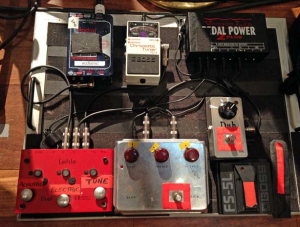

 I just drove back to San Francisco from Southern California, where I got to hang out with family and spend a long, full day at NAMM. And while even the longest and fullest of days isn’t enough to see half the stuff at the show, I’ve put together a little slideshow covering some highlights and lowlights.