Categories
Gigs guitar Music

The Jon Herington Interview

Soloist, Sideman & Steely Dan’s Guitarist of Choice

One unexpected pleasure of my recent Marianne Faithful mini-tour was getting to hear guitarist Jon Herington at the Kate Wolf Music Festival.

Jon Herington with his Gibson ES-336. [Photo: Tony Kukulich.]

Since 1999, Herington has been best known to audiences as Steely Dan’s touring and recording guitarist. He also performs with The Dukes of September Rhythm Review, an all-star band featuring Donald Fagen, Michael McDonald, and Boz Scaggs. And when he’s home in New York, he sings and plays with his trio, the Jon Herington Band, whose material blend bluesy raunch with sly, jazz-informed harmonies in a way that Steely Dan fans are likely to love. (Their latest release is Time on My Hands.) He’s also worked with many other jazz and pop luminaries (partial discography here).

Angel-voiced Madeleine Peyroux was onstage when out van pulled up at the festival. She was performing a set of intimate chamber jazz, complete with strings and a whisper-quiet rhythm section. We couldn’t see the band, but man, could we hear them! When the guitarist took flight with a ravishingly lyrical slide solo — in standard tuning, no less — my bandmate Rob Burger and I turned to each other. “Who is that?” I mouthed. More lovely guitar work wafted from the stage: a fluent bop solo. Sublimely understated rhythm guitar work straight out of a 1940s session. “Seriously,” I muttered. “Who is that?”

It was Jon, of course. As he left the stage, I plied him with as many questions as the quick set change permitted. How did he get those tones? How did he wring such a great slide sound from that Gibson ES-336 using conventional tuning and a standard setup? I was also curious about the demands of the Steely Dan gig, and not merely the challenge of performing a vast catalog of complex guitar parts for the notoriously demanding duo of Walter Becker and Donald Fagen. How, I wondered, would a player approach those oh-so-varied riffs and solos? How would a guitarist honor those beloved solos without making them sound canned?

I didn’t have time to ask half those questions. But Jon, a charming, articulate fellow, agreed to an email interrogation upon his return home, even though he’s busy with Steely Dan rehearsals in advance of the band’s summer tour.
Categories
Effects guitar

Fuzz Detective:
The Case of the 12 Germanium Fuzzes

As threatened, the Fuzz Detective video:

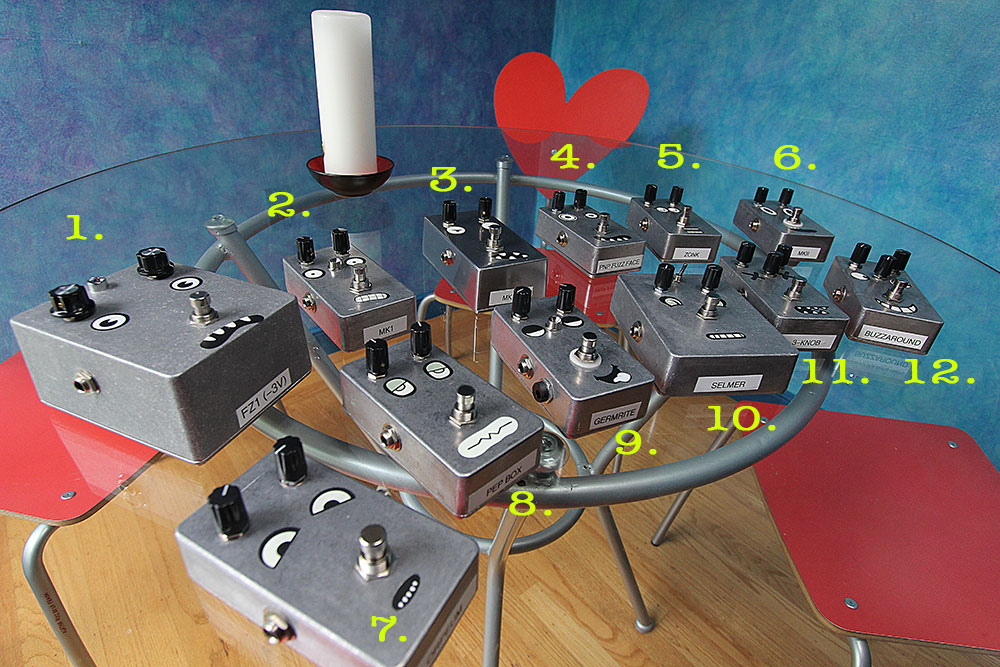
WHAT: Twelve germanium fuzz circuits compared and analyzed. These represent the sounds of almost every fuzz pedal introduced between 1962 and 1968.

WHY: A tool to help players identify the circuits most relevant to their musical needs. This isn’t about particular brands of pedals, but the circuits they employ. If you hear something you like, you can either do as I did and build a clone from the schematic, or buy one based on that particular design. (The relative merits of rival clones is another story.) Of course, if you’re rich and you desire an ancient pedal that probably doesn’t sound as good as a new clone, you can always purchase a vintage original. 😉

HOW: I tried to establish a “level playing field” by removing as many sonic variables as possible. I used the same signal chain, the same guitars, the same musical material, etc. (Tech details below.)

WHO:

  1. Maestro FZ-1 Fuzz Tone
  2. Sola Tone Bender Mk 1
  3. Hornby-Skewes Zonk Machine
  4. Sola Tone Bender “Mk 1.5” (similar to Vox Tone Benders)
  5. Dallas-Arbiter Fuzz Face
  6. WEM Pep Box Rush
  7. Sola Tone Bender Mk II (same as Marshall Supafuzz)
  8. Mosrite Fuzzrite (germanium version)
  9. Orpheum Fuzz (germanium version)
  10. Selmer Buzz Tone
  11. Sola Tone Bender Mk III (same as Park Fuzz Sound, Carlsbro Fuzz)
  12. Baldwin-Burns Buzzaround.

WHEN: Like, now, man!

Categories
Effects

Fuzz Detective: The Plot Thickens!

Man, I’m glad I announced my intentions about this project! Thanks to your links and suggestions, the “Fuzz Detective” project has grown vastly more ambitious. I need a few more days to make my test recordings are assemble the results, but I believe this will be the most complete and “scientific” audio comparison of 1960s fuzz circuits yet attempted. I’m posting this update to share my current plans — and solicit last-minute suggestions for improving them. —Joe

Wanker's Dozen: twelve Germanium fuzz pedals compete on a level playing field.
Wanker’s dozen: twelve germanium fuzz pedals will finally compete on a level playing field.

I’ve been a busy little solder monkey! Dig my new pedals:

1. Maestro Fuzz Tone FZ-1 clone
2. Sola Tone Bender “Mk I” clone
3. Sola Tone Bender “Mk 1.5” clone (near-twins: Vox Distortion Booster, Italian Vox Tone Benders)
4. Dallas-Arbiter Fuzz Face clone (very similar to Tone Bender Mk 1.5)
5. Hornby-Skewes Zonk Machine clone (near-twin: Tone Bender Mk 1)
6. Sola Tone Bender “Mk II” clone (near-twin: Marshall Supafuzz)
7. Orpheum Fuzz clone
8. WEM Pep Box Rush clone
9. Mosrite Fuzzrite clone (germanium version)
10. Selmer Buzz-Tone clone
11. Sola Tone Bender Mk III (“3-knob”) clone
12. Baldwin-Burns Buzzaround clone

About the Fuzz Detective project:

I’m attempting to create a comprehensive comparative sound library of germanium-transistor fuzz pedal circuits.

There’s no shortage of audio clips and demo videos featuring the great stompboxes of the ’60s and their modern clones. Yet it’s difficult to make qualitative comparisons between circuits because there are so many other variables at play. Who performed the examples? Using what gear? Were the examples recorded in a pro studio or on a mobile phone? Are the pedals ’60s originals or modern clones? What’s the condition of the transistors? And so on.

This isn’t about, say, deciding who makes the best Fuzz Face clone. The focus is the circuits themselves. The Fuzz Detective project aims to “level the playing field” by removing as many variables as possible.

Categories
DIY guitar Music

Tonefiend Book Week 2013: Epilogue

Monday: Theory and Technique
Tuesday: Gear
Wednesday: Repairs and DIY
Thursday: Biography
Friday: Fiction

Thanks to all my smart and cool readers who contributed to the first (maybe annual?) Tonefiend Book Week! I loved chatting about some old favorite books, and getting exposed to so many cool new ones.

An encyclopedia of rad.
An encyclopedia of rad mods.

I have just two quick additions: the first concerns an exciting new acquaintance, and the other a sad departure.

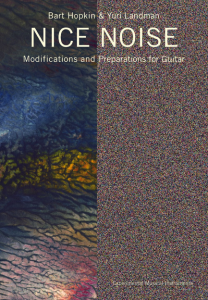
In comments to Tuesday’s post on DIY and repair books, reader smgear mentioned Nice Noise, a book on prepared guitar by Bart Hopkin and Yuri Landman. I immediately ordered a copy, and received it the other day. I’m blown away. It’s a small-format book, a mere 72 pages, but it is a veritable encyclopedia of alternate guitar treatments.

Hopkin (he edited the journal Experimental Musical Instruments and wrote the fabulous alternate instrument books Gravikords, Whirlies & Pyrophones and Orbitones, Spoon Harps & Bellowphones) and Landman (he builds mutant guitars for Sonic Youth, Liars, Melt Banana, and other artists) discuss pretty much every avant-garde guitar mod I’ve ever heard of, and many besides. It’s not just a catalog — it’s a detailed how-to, meant to be consumed alongside the pair’s online audio library of musical examples. I’m sure you’ll be reading about it more here, because I’m definitely going inflict some of these rad alterations on some unwitting guitars.

One of the finest rock-and-roll novels.
A great rock-and-roll novel.

An a sadder note, the death of Scotland’s Iain Banks this weekend reminded me of a book that should have been inclued in Friday’s installment on musical fiction. Both funny and moving, his 1987 novel, Espedair Street, is simply one of the finest rock-and-roll novels ever. Its protagonist is a fabulously successful rock star (think Floyd or Fleetwood Mac in their prime) who must process his own past while grappling with the prospect of suicide.

Readers in the UK, where Banks is hugely popular, may be surprised to learn he’s strictly a cult figure in the States. While Espedair Street is his only work to focus on the music world, he wrote many fine novels marked by wry humor and vast empathy. (The Crow Road and Whit are two other favorites of mine.) He also wrote scads of science fiction under the name Iain M. Banks. Banks, 57, had only recently learned he was dying of cancer. In April he composed a final communique to his readers, writing:

I’ve asked my partner Adele if she will do me the honour of becoming my widow (sorry – but we find ghoulish humour helps). By the time this goes out we’ll be married and on a short honeymoon. We intend to spend however much quality time I have left seeing friends and relations and visiting places that have meant a lot to us.

Categories
Amps Effects guitar Music

Tonefiend Book Week 2013
Tuesday: Guitar Gear

Monday: Theory and Technique
Tuesday: Gear
Wednesday: Repairs and DIY
Thursday: Biography
Friday: Fiction

This week we’re talking about our favorite guitar/music books. The plan is simple: I discuss a few titles I’ve found particularly enlightening, useful, or entertaining, and then you jump in and do the same. I’ve organized the days of this week by subject matter. Today’s topic is guitar gear.

Guitar gear books seem to fall into three categories:

  1. Pornographic. Lavish publications featuring beautiful photos of rare instruments, often focusing on a single manufacturer or collector.
  2. Encyclopedic. Thick reference books covering wide swaths of guitar history.
  3. Pragmatic. Books that explain the inner workings of guitar technology, with an emphasis on how to turn this info to your musical advantage.

Even if I weren’t a jaded former guitar mag editor, I doubt I’d have much interest in coffee-table guitar porn books (and the occasional guitar porn magazine). Or at least, no more interest than I’d have in photos of, say, beautiful watches, speedboats, or nutcrackers. I’m not a guitar collector.

Not on <i>my</i> coffee table, you don't!
Not on my coffee table, you don’t!

Hey — stop laughing! Yeah, I own more than 20 guitars. (The exact number depends on whether I count guitars I’ve loaned out indefinitely and ones I’ve borrowed indefinitely.) I appreciate my instruments greatly, and I am very aware of how fortunate I am to have access to so many musical tools. But in the end, they are just tools to me, with little significance beyond their musical applications.

I realize this is a pretty weird attitude for a guitar dude, and one reason why I was probably never a perfect fit as a guitar mag editor. (I must be missing some crucial male gene, because I’m equally blasé about cars and sports. With rare exceptions.)

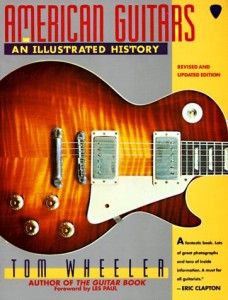
The classic reference book.

Reference books are a different story, especially the books of George Gruhn and Walter Carter, and those of Tom Wheeler. Sure, some of their weightier works have guitar porn aspects, but always paired with vast historical knowledge and the expertise of longtime industry insiders. Gruhn and Carter may know more about American guitars than anyone. But I always gravitate to Tom Wheeler’s books, and not just because he’s a longtime friend and mentor. Tom is a fine writer, an impeccable researcher (he’s been a journalism prof for the last 20 years), and he still conveys a teenager’s passion for the instrument. Tom is my hero.

(Bonus question: Has Wikipedia rendered the guitar reference book obsolete?)

But these days, the gear books that excite me most are the technically slanted, nuts-and-bolts titles. It’s one thing to ogle pretty instruments, and another to explain how they work, why they sound the way they do, and what that all means for the music we make today. And that’s why I love the books of Dave Hunter.

Categories
guitar Music Technique Uncategorized

Tonefiend Book Week 2013
Monday: Theory and Technique

Monday: Theory and Technique
Tuesday: Gear
Wednesday: Repairs and DIY
Thursday: Biography
Friday: Fiction

This week we’re talking about our favorite guitar/music books. The plan is simple: I discuss a few titles I’ve found particularly enlightening, useful, or entertaining, and then you jump in and do the same. I’ve organized the days of this week by subject matter. Today’s topics are theory and technique.

Tonefiend Book Week 2013 is an entirely selfish project. I expect to reap tons of great new info from you, smart readers. So don’t be shy about chiming in.

1. Ted Greene’s complete works

Yes, it's true — I studied guitar with Bigfoot!
This week on Finding Bigfoot, the BFRO team visits Encino, California.

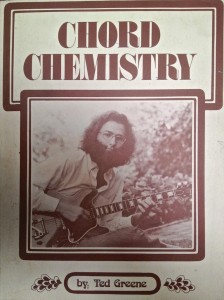
Ted Greene’s jazz guitar books have haunted me since the ’70s. Chord Chemistry, Modern Chord Progressions, and Jazz Guitar Single Note Soloing Vols 1 & 2 remain in print, and are available in both paper and digital editions.

Ted’s books helped me understand the fretboard, tackle jazz harmony, and perhaps most of all, grasp the concept of voice-leading — that is, the ability to perceive chords not as static blocks, but as volatile structures resulting from dynamic melodies. Ironically, even though Ted’s books are divided into chordal and single-note topics, they go a long way toward erasing such distinctions. Melody generates harmony, Ted teaches, and harmony generates melody.

Not that I’ve completely digested Ted’s books. Has anyone? These tomes are dauntingly dense and complex. I just cracked open Modern Chord Progressions at random, and this confronted me:

Categories
Acoustic guitar

Silk and Steel Strings Revisited

Silk and steel — bad-ass, or strictly for wusses?
Silk and steel — bad-ass, or strictly for wusses?.

It’s been a long, long time since I’ve tried silk and steel strings.

I’ve always thought of them as a transitional set for students migrating from nylon to steel strings. At least that’s how my mom used to explain them to me back when she was giving me my first lessons. Like many players, I viewed them more as a remedy for tender fingertips than a sound you’d actively seek out.

But over time, almost everything I thought I knew about strings turned out to be wrong. So I figured I’d give silk-and-steels a fresh listen.

This thread over at the Acoustic Guitar Forum seems like a fair summary of common attitudes about these strings. Opinions seems divided between players who simply find silk-and-steel strings too soft and quiet to be of much use, and those who enjoy them for fingerstyle playing, especially on small-bodied guitars.

I’ve been frustrated finding the right strings for the old Martin acoustic I picked up last year. I had a violent reaction against coated bronze strings, which I wrote about here. But I was kind of digging the way Martin Marquis 80/20s bronze strings sounded on the instrument, as heard in this video. Sometimes, though, the tone is just too harsh and clacky, so I wanted to try something lighter and softer.

I slapped down this quick duet performance of “Drewrie’s Accordes,” an anonymous lute duet found in The Jane Pickering Lute Book, a manuscript anthology of late 16th-century lute pieces. (This would have been played on gut strings in its day, and is usually performed on nylon-string classical guitar or lute today. My steel treble strings are definitely not historically correct, though some wire-stringed fretted instruments such as the cittern did exist in the Renaissance.)

Observations after the video.

Compared to all-metal strings, the silk-and-steels are definitely quieter, with less treble bite. I like their soft, malleable feel for intricate fingerstyle playing like this. They offer relatively smooth transitions between unwound and wound strings. They exhibit less clacky string and fingernail noise. Playing aggressively with a pick definitely “overloads” them, and would no doubt destroy the windings in short order. Even when playing exclusively fingerstyle, you get the sense that the bass strings aren’t long for this world. But I enjoy their sweet, quasi-classical tone, which to my ear does indeed split the difference between nylon and all-metal strings.

Still, I’m not sure I want to commit to having these on the guitar all the time. (I wish the guitar had a switch to toggle between a bronze and silk-and-steel sound!) Also, these are lighter than I usually play (the treble is .0115, and I pretty much never go below .012). But the relaxed tension does seem to suit this particular guitar.

How about you guys? Any experience with these soft-spoken strings? Do you think they sound cool, or are they merely a salve for sore fingers? And has anyone tried John Pearse silk-and-bronze strings? (That’s probably the next stop on this particular string quest.)

P.S.: This is also a pretty good example of how I apply lute techniques to steel-string playing, as I mentioned here. For most of the fast bits, I pick alternately using my right-hand thumb and index finger. A proper classical player would be more likely to alternate index- and middle-finger. Also, my right thumb sometimes drifts “behind” my right-hand fingers (that is, closer to the bridge). Classical players rarely position their picking thumbs closer to the bridge relative to the fingers. It’s not conscious on my part — it just what my hand does when I’m trying to brighten the bass notes and darken the trebles.

Categories
Music

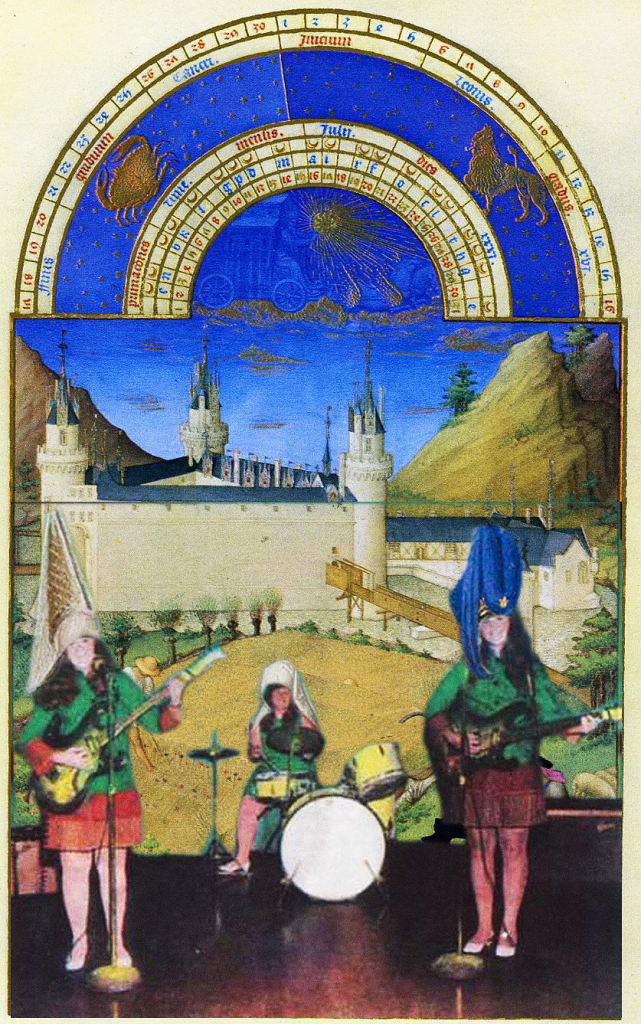
Were the Shaggs Medieval?

Were the Shaggs born in the wrong century?
Were the Shaggs born 600 years too late?

Here’s reader Freddie Lenzel, writing in response to my post on the bizarre late-medieval composition Fumee fume par fumee:

To me, it sort of sounds like The Shaggs from the Dark Ages. But seriously, it’s really interesting. Greetings from Spain, love your blog.

And I love your comment, Freddie! It really strikes a chord (pun intended), because the Shaggs have always sounded medieval to me. And I think I can explain why.

(But first: If you don’t know the Shaggs, stop reading this second and make your acquaintance with the group and their 1969 magnum opus, Philosophy of the World. Kurt Cobain cited it as one of the five-best albums of all time, and Frank Zappa insisted that the Shaggs were “better than the Beatles,” words that inspired this indie-trash tribute album. Meanwhile, NRBQ’s Terry Adams, who launched the Shaggs revival by getting Philosphy re-released in 1980, rightfully compared their homespun sound to Ornette Coleman’s free jazz.)

The Shaggs weren’t the only band to make an album before they knew how to play or write music, but they were one of the best. Many musicians, when first exposed to the Shaggs’ idiot-savant sound, compare it to what might result if you explained music to an alien species unfamiliar with the concept, and then sent them into the studio before letting them hear any actual music. Shaggs songs have no underlying chord structures, no consistent meter, no conventional phrasing, and little harmonization. It’s just odd, meandering “melodies” that stumble along until singer/guitarist Dot Wiggin happens to require a breath. Why, it’s practically…medieval!

Categories
DIY Effects guitar

The Fuzz of a Thousand Faces

Lon Chaney was reportedly an early user of the Fuzz Face.
Lon Chaney was an early Fuzz Face user.

It is a truth universally acknowledged that a guitarist in possession of a single Face Fuzz must be in want of cool Fuzz Face mods. (Sorry, Jane.)

Case in point: The comments section for the new Fuzz Face project.

We’re far from the first to cover this ground. In fact, I should have mentioned a couple of great articles on Fuzz Face mods. We’ve talked about the technique of using sockets in your build so you can audition multiple components. Years ago DIYer Gary Burchett took this notion to its logical conclusion with the Multi-Face, a Fuzz Face with most of the components socketed. It’s definitely worth trying this. Meanwhile, this Instructables project by randofo explains how to create a super-versatile Fuzz Face using switchable components.

Trust me — despite the simplicity of the circuit and the sheer number of adventurous souls who have deconstructed and reconstructed it, it’s hard not to play around with it and find something cool and new. That too is a truth universally acknowledged!

Categories
DIY Effects guitar

Fuzz Face:
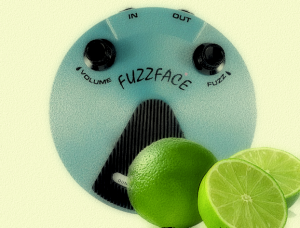
The Daiquiri of Distortion Pedals?

fuzzlimeMost sentient guitarists love Hendrix, but not everyone is equally fond of his signature distortion pedal.

So what’s your take on the Fuzz Face?

I used to hate them — but only because my sole exposure to them was via the crappy reissues of the ’70s, ’80s, and ’90s. They sounded so brittle and harsh! Not till this century did I encounter the pedal in its original incarnation.

What a difference!

Vintage-style Fuzz Faces produce tones that are warm, rich, and unbelievably dynamic. It was like the first time I tasted a vintage-style daiquiri. Like the Fuzz Face, the classic daiquiri is a delicate concoction made from a few simple yet complexly interactive ingredients — nothing like those nasty blended drinks that taste like Slurpees spiked with Everclear.

Here’s everything I love about vintage Fuzz Faces, compressed into 60 seconds:

My DIY version is based on inventor Ivor Arbiter’s original 1966 schematic. That’s also the basis for a new DIY project created by my stompbox-buildin’ pal Mitchell Hudson, who runs the cool DIY site Super-Freq. We’ll both be posting it on our sites in the next few days. You can source the parts on your own, or order a kit for less than $50 — not as cheap as some of our other DIY projects, thanks to its two relatively pricy germanium transistors.

Most lore about “mojo” stompbox parts is utter nonsense, but there is something harmonically unique about the germanium transistors used in ’60s fuzz pedals, including original Fuzz Faces. (See my “Germanium Mystique” post/rant for more info.) You don’t need germanium for a good fuzz sound — there are many great tones available via silicon transistors, integrated circuits, and digital modeling. But one problem with those god-awful Fuzz Face reissues was that they often simply substituted high-gain silicon transistors for germanium ones without modifying anything else in the circuit. The result was more gain, but at the cost of harsh, excessively bright tones and inferior dynamic response.

In the last decade or so, builders have wised up. Numerous manufacturers offer authentic ’60s-style replicas. Meanwhile, the DIY community has created countless variations, many of which use post-germanium parts to great effect. These days it’s pretty easy to find a Fuzz Face that doesn’t suck.

I’ve build many Fuzz Face variants, but until Mitchell created his Fuzz Face project, I’d never done a strict original, with positive-ground wiring, PNP transistors, and few latter-day “refinements.” (Don’t sweat it if those terms mean nothing to you — they’re all explained within the project.)

Anyway, that’s the circuit you hear in the video above. It’s not a fuzz for all seasons — it doesn’t have a ton of gain, and its loose, spongy distortion is unsuitable for metal and modern hard rock. But I love its warm, non-macho timbre and phenomenal dynamic response. It’s simple, classic, and delicious, much like this.