Categories
Gigs Music Pickups Recording

Guitar Mag Gossip: Personal and Practical

Screenshot 2015-11-02 12.42.23

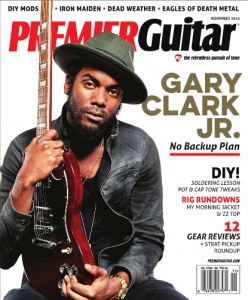
I’d like to call out several items of interest in the November issue or Premier Guitar. The first one is personal: As head honcho Shawn Hammond mentions in his monthly editor’s letter, I’m changing roles at the magazine. After two years as a part-time senior editor, I’m going part-part-time as a contributing editor.

It was a tough call for me — it was a fun gig working with awesome people on subjects I love. But I’ve felt an increasing need to dedicate more time to my own projects: playing, recording, writing, developing gear, and trying to make my tonefiend.com blog and YouTube channel seem a bit livelier than something you’d encounter at Urban Ghosts. (It’s one of my favorite websites, but not the attitude I’m aiming for here.)

If you’ve enjoyed the articles I’ve contributed to PG, well, first of all, thanks! And second, note that I’ll actually be contributing more columns and reviews than before. That may sound contrary to the laws of physics, but it’s possible because I will no longer be editing material by other writers. (I’d been processing an average of 35 stories per month in addition to my bylined pieces.) Picking up the slack will be new hire Ted Drozdowski, a fine writer and player, a lovely guy, and one of the music journalists I looked up to when I got into the guitar mag racket decades ago. (Ted was part of the now-legendary Musician magazine of the ’80s and ’90s.) Meanwhile, I’ll be contributing my Recording Guitarist column and at least three major gear reviews per issue.

Also in the issue are several tech-oriented pieces that I found particularly interesting. My old pal Frank Falbo — a leading pickup designer and master luthier — contributed a great piece on pot and capacitor substitutions. More than anything I’ve read, Frank’s article nails down exactly what changes to expect when swapping out part values, documented via audio files.

For me, the most fascinating part is how varying tone-pot values change your guitar’s tone, even when the tone knob is wide-open. Yeah, a lot of us would expect some change, because pots of varying resistances exert different loads on your pickups. But as far as I know, no one has ever nailed down the exact differences the way Frank has.
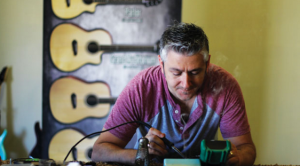
Others generalize. Frank Falbo nails it down.

Spoiler alert: The differences are massive — it’s a far bigger deal than I’d always assumed. Check out Frank’s first set of sound clips and prepare to be impressed.

It’s not a new idea that you can shift the overall tone of a guitar “bright-ward” or “dark-ward” by swapping pots, but Frank makes explicit how dramatic such changes can be, and what to expect from the likeliest substitutions.

I also learned much from two articles I wrote. The first is a shootout between five sets of ultra-vintage-style Strat replacement pickups, featuring models by Amalfitano, Fender, Klein, Manlius, and Mojotone. (Spoiler alert #2: They all sound pretty great, though the Kleins and Mojotones were my personal faves.)

I only realized after evaluating tones that the two sets I loved most don’t deploy a hotter pickup in the bridge position, while the other three do. (I don’t mean some blazing-hot bridge pickup, but one just a tasteful tad louder than the others, an approach many Strat players seem to love.) In the Klein and Mojotone sets, the middle pickup is loudest. Food for thought.

There are good reasons why few guitar mags run serious pickups reviews, and almost never compare models directly: It’s labor-intensive, and it’s damned hard to establish a level playing field. Here, I tried to remove as many variables as possible, installing all the pickups in the same test guitar, scrupulously measuring everything from pickup height to mic position, and laboring mightily to create identical demo performances for each set. My favorite part appears on the final page of the article, where you can directly compare each pickup from each manufacturer side-by-side.
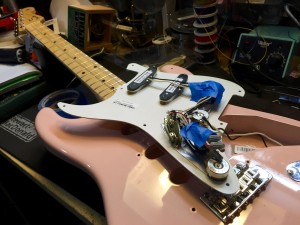
This poor pink Strat got one hell of a workout.

Finally, you might find interesting the audio clips in my latest Recording Guitarist column. It’s about is direct recording, a topic I’ve been covering since this blog began. I got cool sounds using a JHS Colour Box (a dumbed-down Neve channel in stompbox form) and especially with the Neve preamp simulations in the latest Universal Audio software. I’m hardly the first to point this out, but wow! Some recent plug-ins are so stupefyingly realistic that they can mimic analog gear pushed to extremes — a longstanding weak link in faux-analog plug-ins. I found it easy to create cool and compelling sounds without amps or amp simulators. Let me know what you think.

Okay, now I’m nodding off from jet lag. I just returned from a two-week trip to Italy, which generated some interesting musical thoughts and discoveries that I’ll share here soon. 🙂
Categories
Gigs

Solo Guitar Shows: L.A. Confidential & Furtive Frisco

LA_kitty

Psst…this week I embark on a grueling two-city solo guitar tour.

I’m playing my first ever L.A. solo show next Tuesday, the 12th, with one of my favorite players on the planet: the brilliant Mark Goldenberg. I’d previously know his pop work, but only became aware of his amazing solo playing last year when we both performed at one of Teja Gerken‘s guitar events. It was love at first note. We bonded on our affections for Ellington and ’60s L.A. pop, and the fact that we were both Ted Greene students. Plus, he’s just a cool guy.

The show’s at Genghis Cohen (740 N. Fairfax near Melrose). Danielle D’Andrea plays at 8:00 PM, Mark’s on at 9:30, and and I play a bit after 10:00. Maybe Mark and I will even work up a duet or two.

Admission is 10 bucks. The show is all-ages. If you’re in SoCal and free on the 12th, please join us!

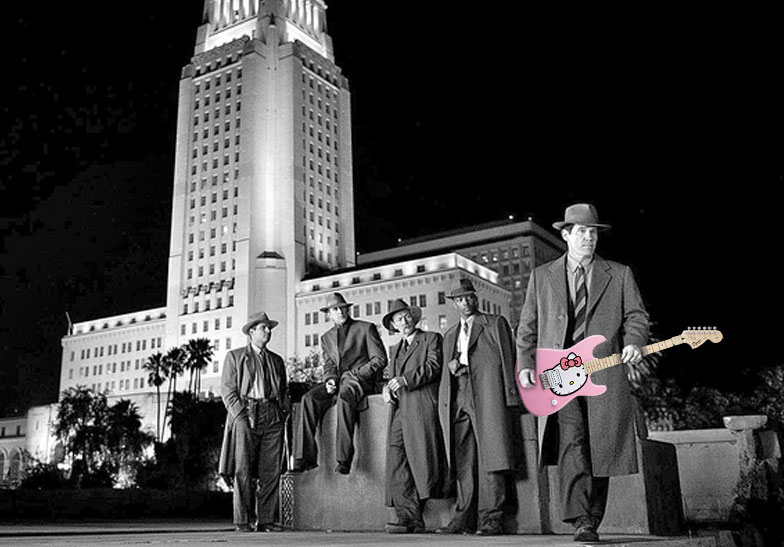
My pal Bill Selby drew this amazing illustration. I'm going to hell for defacing it in Photoshop.
My pal Bill Selby drew this amazing illustration. I’m going to hell for defacing it in Photoshop.

And then, on Thursday, the 14th, I play my monthly solo show at my beloved local dive, San Francisco’s El Rio. This one’s special too: My guest star is another astonishing player, Giacomo Fiore. Giacomo is rightly renowned as one of of our greatest avant-garde classical guitarists, specializing in difficult modern repertoire. But this time, Giacomo’s performing an all-electric set. I have no idea what to expect, though I’m certain it will be astonishing. (In addition to releasing some remarkable recordings, Giacomo lectures at several noted Northern California universities and conservatories, and he gets excellent marks on Rate My Professor. Just sayin’.)

This show is free, but over-21 only. I play at 7PM sharp, and Giacomo starts around 8.

Remember, you heard it here first — off the record, on the QT, and strictly hush-hush.*

* This quote, the post title, and the noir pics are inspired by James Ellroy’s L.A. Quartet, probably the greatest series of hardcore crime novels ever. (And Ellroy’s newly released prequel, Perfidia, is every bit is awesome.)

Categories
DIY Effects Gigs guitar Music Pickups

Odds & Ends & Pixies

jazzm (1)

Oh man — the gods have been generous this week.

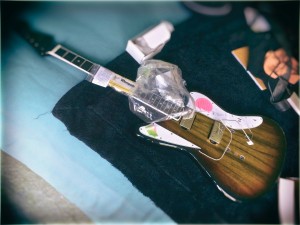
I just received from Warmoth all the parts for my next DIY guitar. I loved testing eight sets of P-90 pickups for Premier Guitar, but I don’t own any P-90-eqipped guitars.I will soon, though!

This one will be a bit of a platypus — as opposed to, you know, all my other other platypi. (The actual plural of “platypus” is “platypuses,” but “platypi” is more fun to type.) It’s built from Warmoth’s “split Jazzmaster” template, with a korina body, bound neck, Tune-o-matic/stop-tailpiece bridge, and a pair of hum-cancelling Fralin P-92s. Yeah, it’s kind of a stab-in-the-dark experiment, and not a inexpensive one. But hope springs eternal. Prepare to be bored with details!

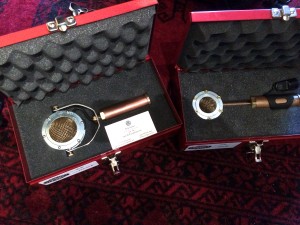
I’ve also just received an amazing-looking pair of condenser mics from Portland, Oregon’s Ear Trumpet Labs. ETL kingpin Philip Graham’s business card identifies him as “proprietor and bricoleur.” Bricolage, of course, is the ten-dollar word for “making stuff out of junk and other found objects.” Dig the steampunk vibe of that repurposed hardware! I haven’t even plugged these in yet (though the reviews I’ve read have been stellar). I just like staring at them! But I’m going to try them out at my monthly Strung Out! show tonight.

Ear Trumpet Labs' Edwina and Edna models: a higher calling for found objects!
Ear Trumpet Labs’ Edwina and Edna models: a higher calling for found objects!

Which brings me another of this week’s highlights: I got to perform last night with my dear friends Teja Gerken and Adam Levy. Teja is an astonishing acoustic fingerstylist and a fine composer. His vocabulary has hints of Bensusan, Hedges, and classical, but he’s molded those influences into a thoroughly unique sound. And Adam, who I’ve known since my Guitar Player magazine days, is equally renowned for his jazz work and for accompanying such singer/songwriters as Norah Jones and Tracy Chapman. (I get to play some of Adam’s cool parts when I gig with Tracy.) These days Adam’s focusing on songwriting, and he his sings his “smart Americana” songs (my description, not Adam’s) in a sweet, soulful voice. Man, what a treat to hear both of them up close. And tonight, Adam, Shelley Doty, and I perform at my local dive, El Rio. Can life get any better?

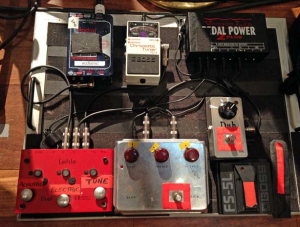
Apparently so! Yesterday Premier Guitar posted John Bohlinger’s piece on the Pixies, which includes a pic of Charles “Frank Black/Black Francis” Thompson’s pedalboard, with my grubby, hand-built Duh fuzz pedal front and center. I’d originally made if for Joey Santiago, the other Pixies guitarist, but I guess Charles swiped it. Hey, I’d be honored if either guy spat on the thing! They’ve been heroes since I first heard the band in a small San Francisco club back in ’88. (Everyone went to hear the Sugarcubes, but left talking about that awesome opening act from Boston.)

Lookit! I'm Pixies-approved!
Frank Black’s pedalboard: Lookit! I’m Pixies-approved!

It’s funny, because I really was thinking “Pixies” when I sound-designed the Duh. I was going for “bubblegum metal” — a thick, heavy sound, but not a macho one. The tone is too fizzy and funny for 100% sincere heavy rock, IMHO. It’s more of a “greasy kid stuff” distortion. (Note to readers under 45: That was once the tagline for a “dry look” mens hair product, referring to the outdated coiffures that would return with a vengeance when punk broke a few years later.) It’s a vaguely Muff-like sound, but with less compression, less scoop, and one big, stupid knob. I also like building that circuit into guitars. Like this one:

So it’s been a grand week, but a hectic one. Thanks for reading this far. Next week I promise a proper post, and not another collection of … odds & ends.

Categories
Gigs

I’m Performing Solo. Yikes.

joe_solo
Seriously, dude — where’s my band?

Anyone have much experience playing solo instrumental guitar gigs?

Even though I’ve been playing since the Pleistocene, I’ve only performed solo once since I was a teenaged classical guitarist. But I’ll be making the stumble leap this Wednesday, Sept. 11th, when I perform north of San Francisco at the Sleeping Lady Cafe in Fairfax. I’ll be a guest at Teja Gerken’s monthly fingerstyle guitar showcase, performing alternating tunes with Teja and Mark Goldenberg. (Gig details here.)

Both Teja and Mark are gifted players and composers — check out the evidence here and here. I believe they’ll be playing acoustically, while I’ll be dragging up my whole frickin’ looping/synth rig. Because what could provide better counterpoint to an evening of refined and intelligent fretwork than a goddamned electronic racket?

Oh — that one solo gig? It too was a multiplayer solo guitar night featuring some astonishing players: Will Bernard, Jim Campilongo, and Buckethead. Will, Jim, and Brian were as amazing as you’d expect. Meanwhile I put everyone to sleep by performing the entire Bach A Minor Lute Suite on steel-string acoustic. (I’m sure the audience was duly impressed by my formidable memorization skills as they nodded off.)

I’m not repeating that mistake! This time it’ll be fuzz and feedback, with a double side order of ring modulation!  :pity:

So got any survival tips for performing solo? Any good jokes for during the inevitable laptop crash and reboot?

If all else fails, I can borrow a trick that the late, lamented Danny Gatton once shared with me in an interview: A lifelong tinker, Gatton built a stompbox designed to blow the power in any club. If he didn’t like how the gig was going, he’d click it on, plunging the venue into darkness and calling it a night. (Or so he claimed.) Hmm — maybe that’ll be the next tonefiend DIY project….

Categories
Gigs guitar Music

The Jon Herington Interview

Soloist, Sideman & Steely Dan’s Guitarist of Choice

One unexpected pleasure of my recent Marianne Faithful mini-tour was getting to hear guitarist Jon Herington at the Kate Wolf Music Festival.

Jon Herington with his Gibson ES-336. [Photo: Tony Kukulich.]

Since 1999, Herington has been best known to audiences as Steely Dan’s touring and recording guitarist. He also performs with The Dukes of September Rhythm Review, an all-star band featuring Donald Fagen, Michael McDonald, and Boz Scaggs. And when he’s home in New York, he sings and plays with his trio, the Jon Herington Band, whose material blend bluesy raunch with sly, jazz-informed harmonies in a way that Steely Dan fans are likely to love. (Their latest release is Time on My Hands.) He’s also worked with many other jazz and pop luminaries (partial discography here).

Angel-voiced Madeleine Peyroux was onstage when out van pulled up at the festival. She was performing a set of intimate chamber jazz, complete with strings and a whisper-quiet rhythm section. We couldn’t see the band, but man, could we hear them! When the guitarist took flight with a ravishingly lyrical slide solo — in standard tuning, no less — my bandmate Rob Burger and I turned to each other. “Who is that?” I mouthed. More lovely guitar work wafted from the stage: a fluent bop solo. Sublimely understated rhythm guitar work straight out of a 1940s session. “Seriously,” I muttered. “Who is that?”

It was Jon, of course. As he left the stage, I plied him with as many questions as the quick set change permitted. How did he get those tones? How did he wring such a great slide sound from that Gibson ES-336 using conventional tuning and a standard setup? I was also curious about the demands of the Steely Dan gig, and not merely the challenge of performing a vast catalog of complex guitar parts for the notoriously demanding duo of Walter Becker and Donald Fagen. How, I wondered, would a player approach those oh-so-varied riffs and solos? How would a guitarist honor those beloved solos without making them sound canned?

I didn’t have time to ask half those questions. But Jon, a charming, articulate fellow, agreed to an email interrogation upon his return home, even though he’s busy with Steely Dan rehearsals in advance of the band’s summer tour.

Categories
Gigs guitar

Well, THAT Was Quite a Week!

8x Marianne

Wow, what a week!

On Thursday I met Marianne Faithfull for the first time at rehearsal, and then played two shows with her this weekend. It was intense. It was musically challenging. It was amazing.

Ten facts about Marianne Faithfull:

  • She’s written countless great songs, including the Stones’ “Sister Morphine.” Her songwriting collaborators have included Nick Cave, Polly Harvey, Jon Brion, Angelo Badalimenti, Beck, Roger Waters, Dave Stewart, Damon Albarn, Jarvis Cocker, and many others.
  • Many great songs were written about her: The Stones’ “Let’s Spend the Night Together” and “You Can’t Always Get What You Want.” The Beatles’ “And Your Bird Can Sing.” “Carrie Anne” by the Hollies.
  • Many great songs were written for her, including “As Tears Go By,” which she recorded before the Stones, and “Strange Weather” written for her by Tom Waits.
  • She portrayed God on the TV series Absolutely Fabulous.
  • She portrayed the devil in the stage production of Tom Waits’ The Black Rider.
  • She is hereditary Austrian nobility, the Baroness Sacher-Masoch. Her great uncle was Leopold Sacher-Masoch, author of the perv novel Venus in Furs and the man whose name inspired the word “masochism.”
  • In the early ’70s she was a junkie who lived homeless on the streets of London’s Soho district for two years.
  • She appears as one of the hangers-on in the seminal Bob Dylan documentary, D.A. Pennebaker’s Don’t Look Back.
  • She’s written two riveting memories: 1990’s Faithfull: A Biography (with David Dalton) and 2008’s Memories, Dreams, and Reflections.
  • She has collaborated with an astonishing list of great guitarists. Jimmy Page played on her earliest sessions. The week before last, she performed in Vienna, Paris and London with Bill Frisell, who’s worked with her for almost 30 years. Her other guitarists have included Keith and Ronnie from the Stones, Marc Ribot, Ry Cooder, Barry Reynolds, Chris Spedding, and Polly Harvey. So no pressure there.

Marianne  is one of my musical heroes — and would be even if she’d done nothing more than record 1979’s Broken English, for my money one of the bravest albums of all time. She is cool, gracious, witty, generous, and generally brilliant. What an experience!

Preparing for the shows presented a number of technical hurdles (beyond the usual difficulties of having to learn much music in little time). We performed as a trio, with just me and my old pal Robbie Burger on piano. I made a number of technical discoveries, both in terms of playing and gear. I’ll share some of them with you in upcoming posts. 🙂

I love my hometown.
I love my hometown.

All this unfolded against the delirious backdrop of San Francisco Pride Week, with the entire city exulting in the US Supreme Court ruling that nullified California’s homophobic Proposition 8. I strive to keep this blog apolitical, but I must speak out here, since the issue of marriage equality affects my family, friends, co-workers, bandmates, teachers, and mentors. My eyes teared up when I saw the pics of anti-Prop 8 plaintiffs Sandy Steir and Kris Perry getting hitched in the beautiful SF City Hall rotunda, where my wife and I exchanged vows 20 years ago.

Like I said: a hell of week. :beer:

Categories
Acoustic Amps Bass Digital DIY Effects Gigs guitar Music Pickups Recording Technique

Tonefiend Book Week is Coming!

Tonefiend Book Week 2013

Next week at tonefiend we’ll be talking about our favorite guitar/music books. I’ll write about some of the titles I find especially useful, inspiring, or entertaining, and I hope you’ll chime in with some of your recommended reading.

Since there’s so much potential material here, I suggest we focus on a different book category each day. Here’s my proposed schedule:

Tonefiend Book Week is strictly an experiment, and a selfish one at that. If the past is any guide, the obsessive geeks experienced and sophisticated players who frequent this site will introduce us to lots of lively lutherie-linked literature. And I’ll do my best to keep up!

So scour your bookshelves, real and virtual. This shit is about to get real promises to be a most edifying conversation.

Categories
Amps Digital Effects Gigs guitar Recording

The Future of Wishful Thinking

Coming soon to a star system near you!

Last week I dared all incautious chumps you to prognosticate about our guitaristic future. I knew the resulting comments thread would be fun, but I didn’t expect it to be that fun!

And also oddly uplifting. Future predictions just seem to skew in an optimistic direction, perhaps because you have to start by assuming that we have a future. So for every funny post suggesting that the most stupid and obnoxious aspects of today’s musical culture will get even more stupid and obnoxious, there’s a complementary positive perspective. In the future, these upbeat dreamers argue, we wil be better…stronger…faster. Of course we’ll have the technology! Better still, we’ll develop common sense.

Granted, some of the predictions are destined to be as disappointing as a 1948 issue of Popular Mechanics, with its broken promises of personal helicopters and monkey butlers domestic robots. But would it be preferable never to have dreamt of having you own jetpack? I think not!

Here’s a fine, optimistic example from Thecoslar, writing about “Lego” Pedals and Amps:

Standardized wiring “harnesses” and interchangeable components will allow companies to produce amp cabinets and pedal cases that consumers will purchase, in addition to compartmentalized circuits. The consumers will “design” their own pedals and amps by mixing and matching that various parts. Combine an optical compressor and a germanium boost. An octave up and a chorus. And that’s just pedals. Imagine what could be done by mixing and matching tone stacks, reverb and delay, or pre amp circuits in amps? Built in analog effects your amp, just by plugging in the components. Everyone and anyone will be able to piece together their own custom circuit, no solder, no muss, no fuss.

Yeah, that would be frickin’ awesome. Of course, we happen to live in a world with at least four common types of USB connectors, no standardized guitar wiring harnesses, and where millions of consumers sigh as they fork over yet more cash for the latest proprietary i-connector. But we can dream can’t we?

Hell yeah, we can! I hope you’re enjoying the conversation as much as I am.

(The fun’s not over, BTW — keep posting your predictions.)

Categories
Bass Effects Gigs guitar Recording

The Effect-Order Follies

This effect order ALWAYS works great!

Weird, isn’t it? You can explain the rules of thumb for ordering your guitar effects in about ten seconds, but you can still get stumped after years of experimentation.

You probably know the conventional effect-order advice, which goes something like this (in order of appearance):

  1. Distortion effects (fuzzes, distortion, overdrives)
  2. Modulation effects (phasers, flangers, vibratos, tremolos)
  3. Delay effects (digital or analog delays)
  4. Reverbs (analog or digital)

And that’s good advice, as far is it goes. But you don’t have to dig very deep before encountering alternatives, exceptions, and arrangements that make no sense whatsoever, but still sound great.

How, for example, do you deal with the following?

Categories
Acoustic Amps Bass Digital DIY Effects Gigs guitar Music Pickups Recording Technique

Who Dares Predict Our Fretboard Future?

“We are all interested in the future, for that is where you and I are going to spend the rest of our lives.” — Criswell, Plan 9 from Outer Space

UPDATE: Wow, I can’t believe all the cool stuff folks have been posting to comments. I find myself feeling quite inspired about the future of instrument — when I’m not laughing so hard I spit coffee all over my laptop. Thanks for all great ideas. Keep ’em coming! 🙂 :thumbup:

Prophecy is for suckers. Who’s stupid enough to go on record with bold prognostications about the future of music and music-making, given the near-certainty that the words will reappear someday to bite you on the ass?

Well, me. And, I hope, you.

So I invite my fellow foolhardy loudmouths to join me in sharing their half-assed guesses wise and well-informed predictions about our brave new fretboard future.

The author of the most compelling prediction wins one of my hand-built stompboxes. So does the author of the one that makes me laugh hardest.

Post your predictions to comments. I’ll go first. 🙂