I was polishing up my solo solo version of this lesser-known Mancini tune, and I was reminded once again of the late composer’s genius. Sure, we all know he was a great tunesmith and brilliant orchestrator. But the deeper you dig into his compositions, the more remarkable things you uncover.
Even though Mancini worked exclusively in pop idioms, I rank Hank as one of the 20th century’s greatest composers. Everything he composed seems to have some remarkable and unlikely compositional twist, even the best-known tunes we take for granted. Consider the slippery chromaticism and crunchy minor-3rd modulations of the Pink Panther theme. Or the familiar “Baby Elephant Walk” melody — if you take a step back, you realize how bizarre it is, rocketing up as an arpeggio before leaping down to a dissonant note. It’s also easy to forget how shocking the Peter Gunn theme was, with those violent dissonant accents, not to mention its unprecedented fusion of brainy Stan Kenton harmonies and greasy guitar rock. (Jobim is the only parallel I can draw in terms of writing wildly original chromatic themes that somehow become universally beloved pop melodies.)
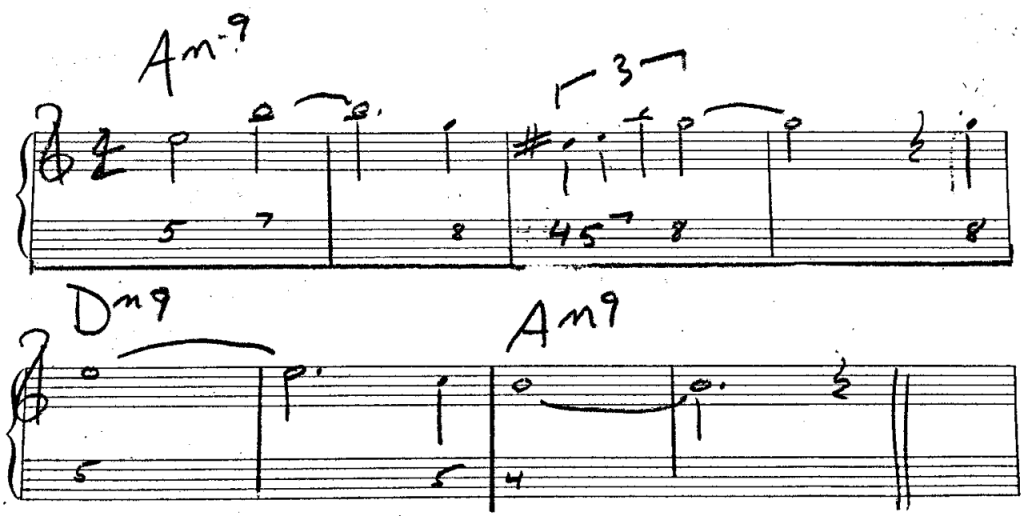
This song is Mancini’s take on the exotica style created by the likes of Martin Denny and Les Baxter. (Mancini was far too tasteful to include exotica’s signature big-call effects, but I lack such restraint.) But check out the cool melody and the way is straddles the underlying harmonies:
We’re in A minor, but no A notes appear in the main melody. Instead, the tune lingers on the 9th, emphasizing B over the Am7 chord and E over the Dm7. Eventually an A does appear — but not till the downbeat of the B second, by which point we’ve embarked on a long, twisted trail of chromatic modulation.
My Mancini obsession goes way back. In the ’90s, I was privileged to play in Oranj Symphonette, a jazz group lead by cellist Mat Brubeck (yeah, Dave’s son) that also included peerless keyboardist Robbie Burger, mad multi-instrumentalist Ralph Carney, and drum titan Scott Amendola (later replaced by the equally awesome Pat Campbell). Sadly, our two Rykodisc albums are out of print, but there’s buttloads of our stuff on YouTube.
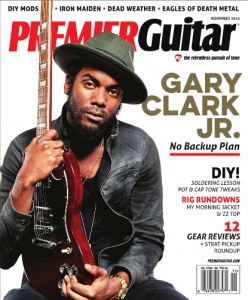
I’d like to call out several items of interest in the November issue or Premier Guitar. The first one is personal: As head honcho Shawn Hammond mentions in his monthly editor’s letter, I’m changing roles at the magazine. After two years as a part-time senior editor, I’m going part-part-time as a contributing editor.
It was a tough call for me — it was a fun gig working with awesome people on subjects I love. But I’ve felt an increasing need to dedicate more time to my own projects: playing, recording, writing, developing gear, and trying to make my tonefiend.com blog and YouTube channel seem a bit livelier than something you’d encounter at Urban Ghosts. (It’s one of my favorite websites, but not the attitude I’m aiming for here.)
If you’ve enjoyed the articles I’ve contributed to PG, well, first of all, thanks! And second, note that I’ll actually be contributing more columns and reviews than before. That may sound contrary to the laws of physics, but it’s possible because I will no longer be editing material by other writers. (I’d been processing an average of 35 stories per month in addition to my bylined pieces.) Picking up the slack will be new hire Ted Drozdowski, a fine writer and player, a lovely guy, and one of the music journalists I looked up to when I got into the guitar mag racket decades ago. (Ted was part of the now-legendary Musician magazine of the ’80s and ’90s.) Meanwhile, I’ll be contributing my Recording Guitarist column and at least three major gear reviews per issue.
Also in the issue are several tech-oriented pieces that I found particularly interesting. My old pal Frank Falbo — a leading pickup designer and master luthier — contributed a great piece on pot and capacitor substitutions. More than anything I’ve read, Frank’s article nails down exactly what changes to expect when swapping out part values, documented via audio files.
For me, the most fascinating part is how varying tone-pot values change your guitar’s tone, even when the tone knob is wide-open. Yeah, a lot of us would expect some change, because pots of varying resistances exert different loads on your pickups. But as far as I know, no one has ever nailed down the exact differences the way Frank has.
Others generalize. Frank Falbo nails it down.
Spoiler alert: The differences are massive — it’s a far bigger deal than I’d always assumed. Check out Frank’s first set of sound clips and prepare to be impressed.
It’s not a new idea that you can shift the overall tone of a guitar “bright-ward” or “dark-ward” by swapping pots, but Frank makes explicit how dramatic such changes can be, and what to expect from the likeliest substitutions.
I also learned much from two articles I wrote. The first is a shootout between five sets of ultra-vintage-style Strat replacement pickups, featuring models by Amalfitano, Fender, Klein, Manlius, and Mojotone. (Spoiler alert #2: They all sound pretty great, though the Kleins and Mojotones were my personal faves.)
I only realized after evaluating tones that the two sets I loved most don’t deploy a hotter pickup in the bridge position, while the other three do. (I don’t mean some blazing-hot bridge pickup, but one just a tasteful tad louder than the others, an approach many Strat players seem to love.) In the Klein and Mojotone sets, the middle pickup is loudest. Food for thought.
There are good reasons why few guitar mags run serious pickups reviews, and almost never compare models directly: It’s labor-intensive, and it’s damned hard to establish a level playing field. Here, I tried to remove as many variables as possible, installing all the pickups in the same test guitar, scrupulously measuring everything from pickup height to mic position, and laboring mightily to create identical demo performances for each set. My favorite part appears on the final page of the article, where you can directly compare each pickup from each manufacturer side-by-side.
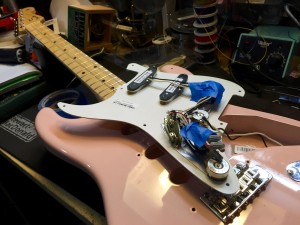
This poor pink Strat got one hell of a workout.
Finally, you might find interesting the audio clips in my latest Recording Guitarist column. It’s about is direct recording, a topic I’ve been covering since this blog began. I got cool sounds using a JHS Colour Box (a dumbed-down Neve channel in stompbox form) and especially with the Neve preamp simulations in the latest Universal Audio software. I’m hardly the first to point this out, but wow! Some recent plug-ins are so stupefyingly realistic that they can mimic analog gear pushed to extremes — a longstanding weak link in faux-analog plug-ins. I found it easy to create cool and compelling sounds without amps or amp simulators. Let me know what you think.
Okay, now I’m nodding off from jet lag. I just returned from a two-week trip to Italy, which generated some interesting musical thoughts and discoveries that I’ll share here soon. 🙂
Man, pontificating ain’t easy! KMI, who make the SoftStep controller I use almost every day, solicited a “Albums That Meant a Lot to You” list for their website, and I replied with “Ten Albums That Made My Head Explode,” which just went live on their site. And that made me want to hear your lists.
I don’t know why exercises like this can be so hard. First you can’t think of enough … and then too many … and then you worry you forgot an important one … and then you spend an hour reflecting on whether Joni Mitchell or Béla Bartók is more important … and then you read the whole thing through and realize how insufferably pretentious you sound. At some point, you just surrender and hit SEND. And that’s the moment you start second-guessing the whole thing.
For such a low-stakes effort, the pressure is high! And now I’m putting the pressure on you: I’d love to read your lists of mind-exploding music. Please post them to comments below, and add as much detail as you like. (And feel free to use the “runners up” dodge — I certainly did.)
I’m not sure if there’s much difference between “music that altered my mind” and “best music” lists. I guess it depends on how much importance you place on music that leaves brain specks all over your walls. For me, the brain-speck stuff usually is the best music.
I realized after the fact that only about half my picks have audible guitar parts. How about yours?
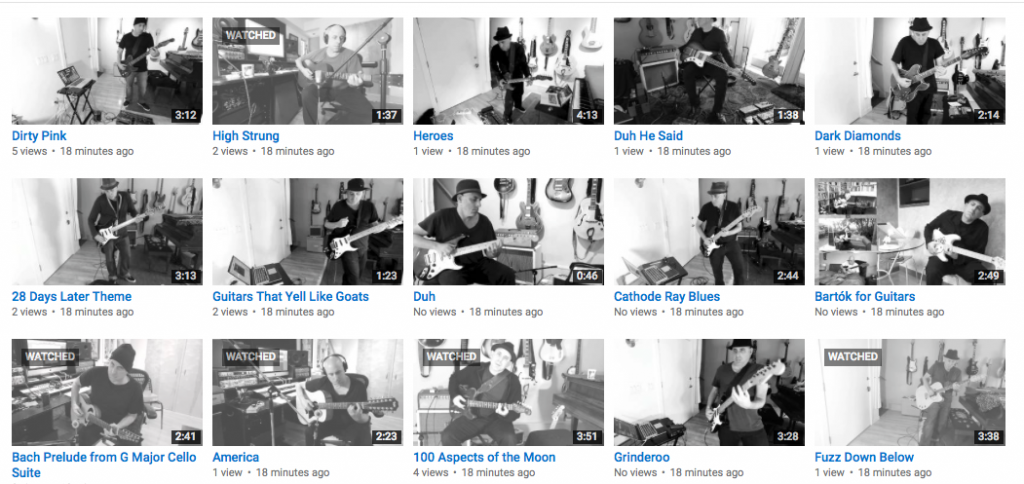
See, I recently finished the 100th video for my YouTube channel. Not quite ready to face the second hundred, I spent a few days reviewing all those clips. Some stuff I’m proud of. Some makes we wince. And I thought a few bits might stand on their own as music, so I plucked my 50 favorite exceprts and posted them as standalone performances, minus such distractions as tech mumbo-jumbo, incessant snark, and color. (But if you are curious about something you hear, note that each clip includes a link to the tech-slanted piece where it originated.)
(Fifty is a lot of videos. Just because I’m repeating myself doesn’t mean it wasn’t hard work!)
If you’re interested in all the above, you’re like me. (Sorry about that!) In that case, you can skip the playlists and just go in through the front door.
I’ve long been obsessed with Sam “The Man” Taylor’s epic sax solo on the Chords seminal 1954 rock ’n’ roll hit, “Sh-Boom.” But I never got around to learning, transcribing, and analyzing it till now. I heard it about 100 times while making and editing this video, and it still thrills me on every listen.
If you’re like me, you know it’s wise to study performances by non-guitarists, but seldom get around to doing it systematically. For once I followed through, and — at risk of sounding like a pedantic dork — I’ve analyzed what I heard and suggested ways to incorporate the concepts in styles far removed from the original doo-wop context.
You can download my transcription (in standard notation and guitar tab) here.
The final part of the video is a rant about how segregation shaped the course of early rock and roll, in which I piss all over the Crew Cuts’ tepid cover version of “Sh-Boom.” (Spoiler alert: It blows.) This was partially inspired by recent despicable comments from musical felon Pat Boone. I’ve linked to the following videos before, but I’m posting them again because the cost of quality music is eternal vigilance against sonic shit-shovelers.
Holy crap! It’s the coolest man in the universe! This foreshadows Hendrix, Prince, and the Beatles. Even lip-synched, it’s everything badass in one minute and 50 seconds. (And it speaks volumes about segregation in midcentury America.)
And then there’s this:
Unholy crap! It’s the least cool man in the universe. And this foreshadows nothing except the worst music of the last 60 years (though it too speaks volumes about race in 20th-century America).
Why beat this dead horse? Why pick on ol’ Pat 60 years after the fact? Maybe he regrets his musical misdeeds. Maybe he’s even developed a more nuanced view of race and racism.
Naw. When self-avowed white supremacist Dylann Roof murdered nine African-American churchgoers on June 17th, 2015, Boone leapt into action, penning an angry editorial that condemned … politicians who dared to refer to the atrocity as “racist.”
FUPB. There’s no statute of limitations on your crimes.
James Horner, one of the most successful film composers in Hollywood history, died yesterday after crashing his single-engine plane near Santa Barbara, California. He was 61.
It’s hard to pinpoint the highlight of Horner’s career — he scored such mega-hits as Titanic, A Beautiful Mind, Avatar, Braveheart, and many other films. But I can definitely point to a career lowlight: tutoring a struggling 16-year-old freshman music student in a musty, claustrophobic practice room at UCLA’s Schoenberg Hall in 1975.
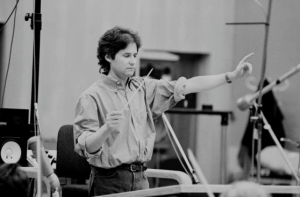
Seen here conducting his Braveheart score, Horner looks exactly as I remember him from 1975.
The tin-eared student was me — an incoming music major inadequately prepared for the rigors of college-level theory and musicianship. The TA leading my two-hours-per-day core class suggested I hire a private tutor to save me from sinking, and he recommended his fellow grad student, “Jamie” Horner. Borrowing a little extra cash from my folks, I paid Jamie some meager hourly fee ($10? $15, maybe?) to subject me to ear-training boot camp. It was basic music-major stuff: dictation (notating melodies and eventually counterpoint by ear alone), score-reading, sight-reading, sight-singing, and the like. (I needed the help! Then, as now, I was no “natural” musician. I labored mightily to acquire such skills.)
Jamie (as everyone called him then) was perfectly nice, but we weren’t pals or anything — he was just a busy and ambitious grad student earning a few quick, if measly, bucks via boilerplate tutoring of a slow student. He’s already embarked on his film scoring career, and his example was one of my earliest and most powerful eye-openers about the brutality of the biz.
Jamie was ridiculously gifted. He had laser-like focus on his goals. He was hereditary Hollywood royalty. (His dad was Harry Horner, an Austro-Hungarian émigré and famed production designer, and I think Jamie grew up with people like Otto Preminger as dinner guests.) And he was still ghost-writing scores for dog-shit films for next to nothing. For some, Jamie’s steep uphill path would have been an inspiration. But it scared me the hell away from his profession. (And today’s Hollywood scoring scene is vastly more brutal than it was back in the ’70s.)
I attended school during the last gasp of modernism. The focus was avant-garde 20th-century music, from Arnold Schoenberg to such then-leading lights as Luciano Berio, György Ligeti, and Witold Lutosławski. (You know — the ear-hurtin’ atonality that only perverts and music professors love.) Post-Romantic music was considered hopelessly tacky. No one studied Richard Strauss, especially his later, reactionary stuff! But I remember Jamie walking around with Strauss’s Alpine Symphony score under his arm. He was smarter than everyone else.
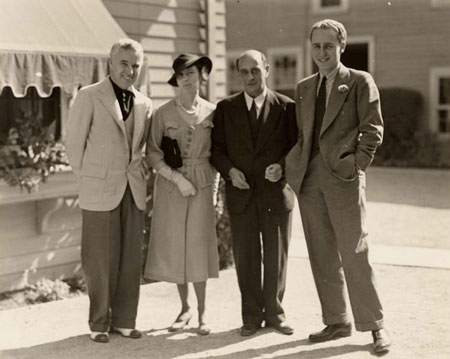
My favorite memory: A few years later in school, after I’d caught up and was doing okay, I had the unforgettable experience of taking a few semesters of David Raksin‘s film scoring class in the UCLA film department. Raksin was an amazing figure who worked with some of Hollywood’s greatest talents. (This photo sums up his significance. It’s Raksin on the right, posing with his teacher, frickin’ Arnold Schoenberg himself, Mrs. Schoenberg, and the man who gave David his first big break: Charlie Chaplin.)
Jamie dropped by Raksin’s class to meet David for a lunch date at the faculty restaurant. David kindly asked me along. (He’d taken a shine to me, not for any music skills, but because he liked what I’d written about scoring in my term papers.) So I got to tag along and listen to two geniuses talk shop. I just sat there trying not to say anything too stupid. I doubt I succeeded, but I’m grateful all these years later to have basked in their collective brilliance for a few minutes.
And I’m grateful to James Horner for helping me along. My heartfelt condolences to his family, friends, and colleagues.
For a while I’ve been playing this loop-based cover of Foster the People’s “Pumped-Up Kicks” at solo gigs and with my duo band, Mental 99. At risk of sounding like a pompous dick, I’ve annotated the performance, highlighting techniques I’ve found useful for making loop-based performances livelier and less predictable.
I’ve covered some of this ground before, particularly in this Premier Guitarlooping-technique article. But here I call out the techniques mid-performance, and I’ve included a few new ones. I hope you find some of them useful.
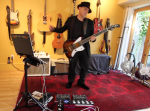
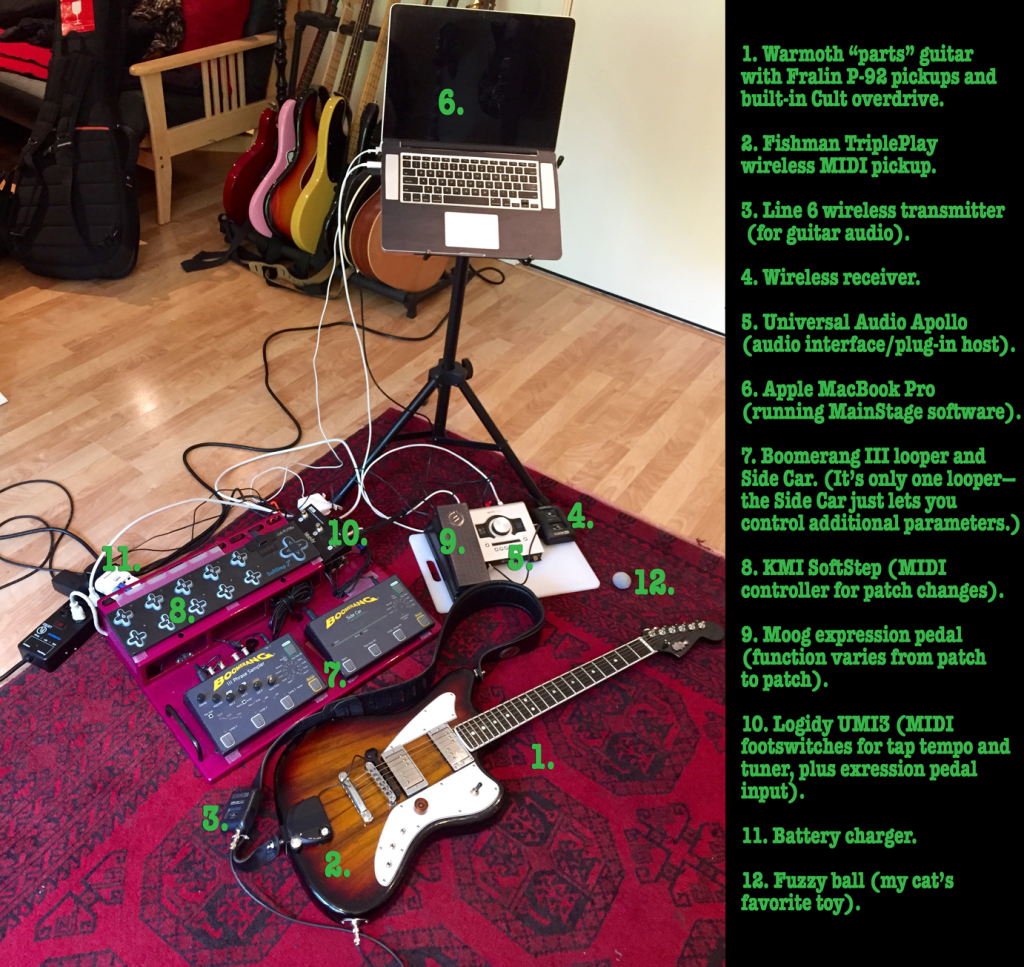
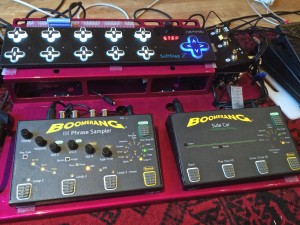
Likewise, I’ve already written about my live looping rig, but it’s changed a bit since then, and I’ve recently integrated a Universal Audio Apollo Twin interface (plus the stellar plug-ins it allows me to run). An updated overview:
The arrangement perform nicely, and I dig the individual components. But I dislike the system’s Rube Goldberg complexity—it’s a royal pain to set up and schlep. I’m always looking for ways to simply. (Other than, you know, just plugging the guitar into a frickin’ amp.) I’m open to suggestions for streamlining!
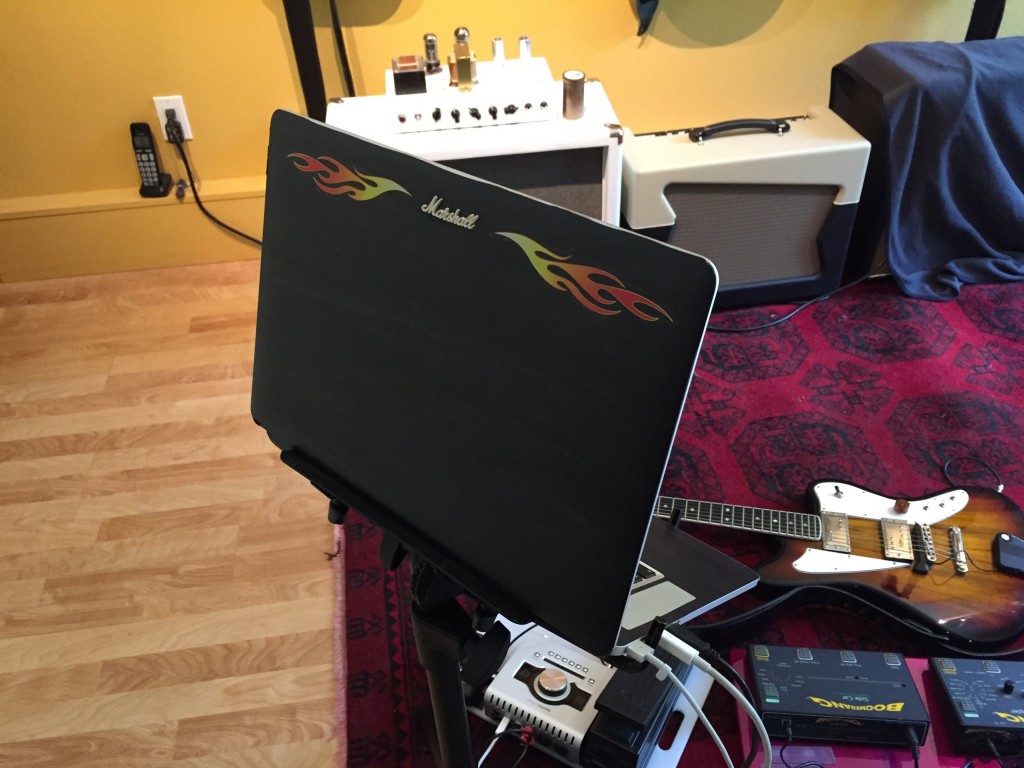
I love Apple products, but I hate having Macs onstage (mainly ’cause they’re so much better looking than me). Covering it in black wrap makes it less obtrusive. The Marshall logo is from one of those “toy” stacks (which, of course, can be far more than toys in the studio).
Premier Guitar just posted my latest recording column. It focuses on the “Multitrack Masters” recordings and other illicitly leaked audio files that deconstruct classic rock recordings into separate tracks with each instrument isolated.
This essential listening is thought-provoking for many reasons. The two that fascinate me most are a) what secrets these recordings reveal about the craft behind great rock records, and b) how they highlight some of the back-assward notions that underlie our laws governing copyright and intellectual property. I think it’s fascinating stuff, and I hope you agree!
Have you guys investigated any of this material? What are your observations?
I recently reviewed the gorgeous little Veillette Avante Gryphon for Premier Guitar and liked it so much that I bought one. This was my first opportunity to record it in my studio.
The Avante Gryphon is a relatively low-cost version of Woodstock luthier Joe Veillette’s Gryphon, an 18.5″-scale 12-string designed to be tuned a minor seventh (an octave minus two frets) above standard. But while 12-string guitars feature octave-tuned string pairs, here all six courses are unisons, as on a mandolin. In fact, the Avante Gryphon sounds a lot like a mandolin, but with a wider range and guitar-like tuning. And unlike the couple of janky plywood mandolins I own, it plays gloriously in tune. It’s made (very nicely!) by Korean CNC robots and sells for $1,400, as opposed to $4K+ for Veillette’s hand-built models.
For years I’ve been looking for the right upscale mandolin, but now I’m happy I found this instead. My original motivation was a high-tuned soprano instrument for multi-guitar arrangements, or for magic-fairy-dust studio overdubs. But the thing is so fun — and sounds so darn pretty — that I can’t stop playing it solo. This Bach prelude, for example:
I won’t recap my review here—check it out if you’re curious. Instead, let’s yak about Johann Sebastian!
This one’s a labor of love: Premier Guitar just published my live looping lesson. Included are most of the hard-won looping techniques I’ve acquired over the last few years. I crashed and burned 100 times onstage so you don’t have to! 😉
The percentage of my life spent looking at this exact view is too depressing to contemplate.
The 20 audio clips embedded in the article were trickier than usual to prepare. Ordinarily when I record music mag demos, it’s simply a matter of plugging in a guitar, amp, or pedal and noodling around while trying to make it sound good. But here I had to demonstrate techniques that unfold over time, which is harder than it sounds, at least for me. But I’m reasonably satisfied with how they turned out.
My emphasis throughout is going beyond looping cliches and defying listener expectations. That too is difficult — by definition, loops are predictable! But I’ve been racking my brain for years, trying to come up with ways to bust out of the usual patterns. Most of my ideas appear here. Hope you find them useful!