Categories
guitar

My Flatwound Addiction

flatwound
So smooth. So sexy.
So frickin’ expensive!

Hi. I’m Joe, and I’m a flatwound addict.

It took me a long time admit it. “What wrong with a little recrational flatwound use?” I used to ask. “I can quit anytime I want.”

Sure, I’d sometimes put flatwound strings on my Guild archtop. And sometimes on a bass. And yeah, I did that post about how flatwounds are the key to nailing that ’60s electric 12-string sound. And that other post on how flatwounds brought my reissue Fender Bass VI to life. And yeah, I may have happened to blurt out that I like using flatwounds on a MIDI guitar.

But I wouldn’t use them on, you know, one of my normal guitars.

But then I recorded that Bartók piece, using the above-mentioned Guid and Bass VI alongside two standard-tuned guitars with roundwounds. The piece has a lot of counterpoint — all these motifs bouncing between the instruments. And the more I listened, the more I realized that I liked the tone of the two flatwound guitars far more than that of the two roundwound guitars.

And then I bottomed out. I put flats on four more guitars. It wasn’t just musically risky — it was economically catastrophic! And that’s what brought me here tonight.

Funny thing about flatwounds: Everytime I pick up a guitar with flats, I react negatively to the dullness of the wound strings. Where’s the shimmer? Where’s the zing?

But the more I listen, the more I get sucked in. Parts layer over each other more readily. Chords speak more clearly. Fuzz and distortion yield sweeter overtones. It’s easier to get a consistent sound from melodies spanning wound and unwound strings. And the feel? Smooth, sleek and sensual.

Sigh. Maybe I’ll try and kick the habit again tomorrow.

Categories
guitar Music

Meet the REAL Spiders from Mars!
Bartók on Electric Guitar

Bartók: Smarter than math-rock — and way more violent.

My Bowie fandom is second to none. Yet I’ve always felt a vague sense of disappointment that the Spiders from Mars didn’t really sound much like spiders from Mars.

On the other hand, the fourth movement from Béla Bartók‘s Fourth String Quartet really does sound like Martian spiders — assuming the critters in question had been force-fed a diet of chord clusters, mathematics, Hungarian folk music, and some of the most astonishing counterpoint this side of J.S. Bach.

And dig it: This white-hot blast of dissonant modernism was composed in 1928!

And how does this string quartet music sound on guitars? Awesome, IMHO — largely because the movement is played entirely pizzicato (plucked, not bowed). Very few modifications were needed to adopt it for four electric guitars.

Categories
guitar Music

The Best Music Notation Software for Guitarists?

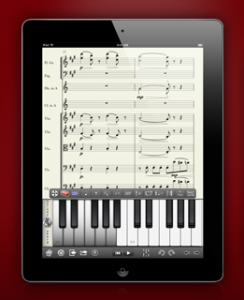
Since New Year resolutions expire at midnight, January 7th, I’m racing to realize my goal of finally becoming fluent with music notation software before the sands run out.

A new way to feign productivity in cafes!

I’d like to share some initial impressions about Notion. This isn’t a full-fledged product review — just a few thoughts about a half-dozen features I dig. (Most also apply to Notion’s sister app, Progression, which compiles all of Notion’s fretted-instrument tools, but omits the orchestral stuff. If you only plan to notate for guitar, the lower-priced Progression is probably all you need.)

1. Appropriate complexity. Two programs, Sibelius and Finale, dominate the music notation field. Both are powerful, deep programs. Most notation pros use them because they’re packed with features essential to “music engraving” (the archaic and pretentious term for the process of preparing music for publication).

Categories
guitar Music

my band (hearts) u

Season's Greeting from Mental 99

UPDATE: Here’s a direct link via SoundCloud. The file is downloadable for free. Sheesh — never occurred to me that folks might, like, actually download it and overwhelm my feeble little DropBox account!

While most people are baking cookies or lining up at the grocery store for 45 minutes to buy those frickin’ chives they forgot the other day, Dawn Richardson and I just put the finishing touches on Mental 99’s chaotic cover version of the Doors’ “Hello, I Love You.” (Mental 99 is our digital guitar/analog drums duo band.)

Have a free copy on us! Grab it here. (Download available.)

Why? Because we love you, man!

Seasons best from Mental 99!

(Nerd details: all guitar tracks played on my James Trussart Steelcaster though Apple’s MainStage software. Drums tracked at Fantasy Studio A, Berkeley, California, by Jason Carmer and Alberto Hernandez.)

Categories
DIY Effects guitar

New Frontiers in Fuzz:
The Devi Ever Interview

Some boutique stompbox builders pursue endless refinements of classic pedal designs, developing ever-more-suave iterations of the Tube Screamer and Ross Compressor.

And some just want to blow shit up.

Guess which category Portland, Oregon’s Devi Ever falls into? Hint: Her extensive line of guitar and bass pedals includes such anarchy boxes as the Little Shit, the Ruiner, the Heroin Lifestyle, and the Truly Beautiful Disaster.

Here’s what I’m talking about: Check out Devi’s video demo for her Shoe Gazer fuzz…

…or this one of Wilco’s mighty Nels Cline giving Devi’s Soda Meiser a workout:

Categories
Effects guitar

Museum of Lost Effects:
The Systech Harmonic Energizer

IMG_5847
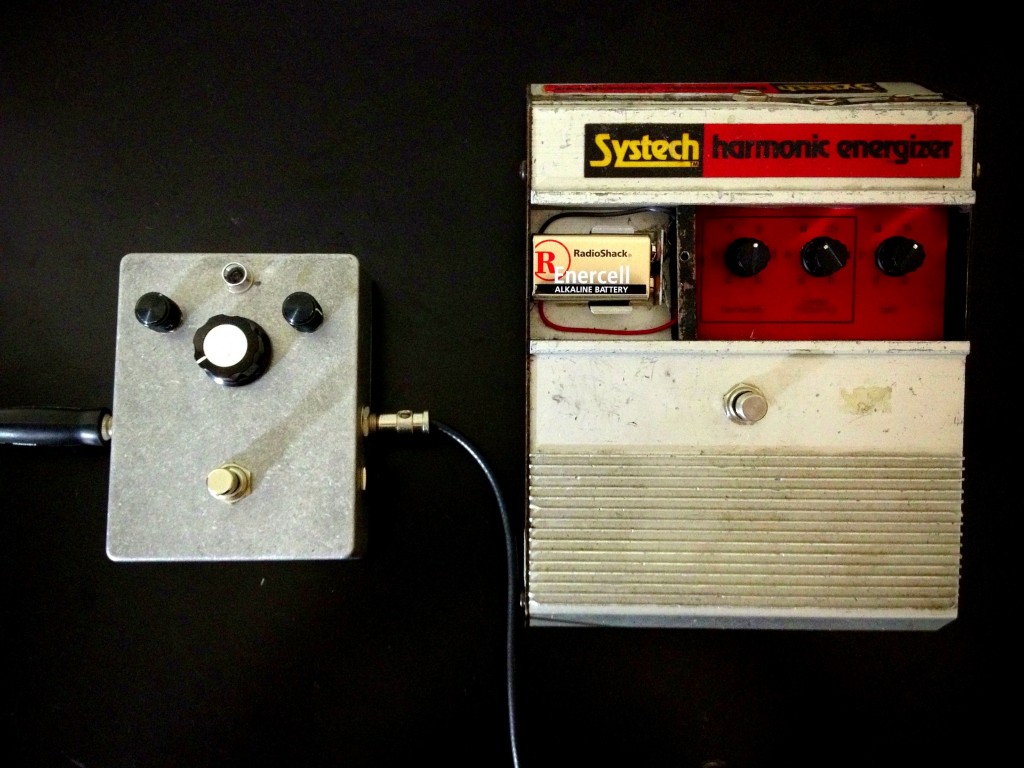
A homely clone cowers in the shadow of a ramshackle original.

Okay, here’s an old weirdo I’ve been meaning to write about for ages. The Systech Harmonic Energizer is an ultra-rare filter/distortion effect from the ’70s that takes the fuzz-wah formula in some interesting directions. Its signature is edgy, ultra-resonant filter sounds. You’re most likely to have heard it generating Frank Zappa’s nasal midrange squawk, but it does lots of other abrasive tricks too. I used this one on Tom Waits’s “All Stripped Down,” and on “Jets” by Action Plus.

The S.H.E. doesn’t do pretty. Most of its sounds are so strongly flavored, they’re hard to use as a primary tones. But it’s great for things like clanky percussive accents, or walloping low-frequency assaults.

But let’s talk later. First the video:

Categories
Acoustic Amps Bass Digital DIY Effects Gigs guitar Music Pickups Recording Technique

Who Dares Predict Our Fretboard Future?

“We are all interested in the future, for that is where you and I are going to spend the rest of our lives.” — Criswell, Plan 9 from Outer Space

UPDATE: Wow, I can’t believe all the cool stuff folks have been posting to comments. I find myself feeling quite inspired about the future of instrument — when I’m not laughing so hard I spit coffee all over my laptop. Thanks for all great ideas. Keep ’em coming! 🙂 :thumbup:

Prophecy is for suckers. Who’s stupid enough to go on record with bold prognostications about the future of music and music-making, given the near-certainty that the words will reappear someday to bite you on the ass?

Well, me. And, I hope, you.

So I invite my fellow foolhardy loudmouths to join me in sharing their half-assed guesses wise and well-informed predictions about our brave new fretboard future.

The author of the most compelling prediction wins one of my hand-built stompboxes. So does the author of the one that makes me laugh hardest.

Post your predictions to comments. I’ll go first. 🙂

Categories
Digital guitar

Analog Schmanalog

Ever notice how most analog vs. digital battles discussions boil down to two basic questions?

1. Can digital sound as good as analog?
2. What are the practical benefits of digital?

They’re good questions, but they tend to overshadow another important (and probably more interesting) topic: What are the musical benefits of digital?

Everyone loves great analog guitar sounds. But there’s lots of cool stuff that you can only do in digital. Here are a few of the ones I enjoy.

A partial list of the strictly digital sounds and techniques heard here:

• looping
• granular synthesis and delay
• pitch-shifted delays and reverbs
• impulse-response reverbs
• subharmonic sysnthesis
• Realtime MIDI control

You heard it here first!

Hey, I’m totally guilty of fostering simplistic analog vs. digital arguments. After all, I launched this blog over a year ago with an Amps vs. Models listening contest. (The prizes have long since been claimed, but you can still take the test.) But maybe we should spend a little less time arguing about how faithfully that amp model mimics the sound of an amp from 1965, and a little more time exploring the cool and meaningful musical applications of post-analog tone production?

Categories
Effects guitar

Psych-Out Special: The Kay Effector!

Lookit what Double D found….

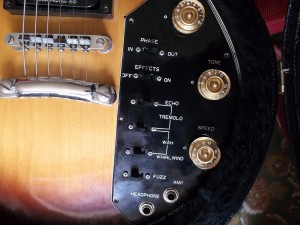
Oh man — did you guys see what local hero Double D posted over in the Forum under Onboard Effects: Foolish, or Merely Ill-Advised?

First, he got his hands on a Kay Effector — a psychotronic Korean axe with built-in effects. Then he got it working. Then he recorded a bitchin’ demo. It’s required reading/listening for deviant guitarists.

Read it here:

Part 1
Part 2

These posts, BTW, are just two among many cool articles at Double D’s blog (and I’m not just saying that because he wrote some nice things about me).

Thanks, man, for sharing this unspeakably cool guitar with us. 🙂

Categories
Effects guitar

Museum of Lost Effects: Klon Centaur

Overdrive from Heaven? Or hype from Hell?

Has any stompbox ever been as steeped in myth and legend as the Klon Centaur? Doubt it. Original Centaurs are extremely collectible, currently fetching around $1,500 on EBay. But for every player who drools over the prospect of obtaining this rare creature, there’s another who’s foaming at the mouth about idiots who’d pay four figures for a “glorified Tube Screamer.” When you Google “Klon Centaur,” one of the first items to appear is this memorable rant from the always entertaining Zachary of Zachary Guitars:

Here is a guitar pedal which has been around for about 10 years and stands for total Bull Shit in my opinion. The website, the presentation, the marketing, the hype, the price. Everything about it is why I hate the music business and the shockingly stupid guitar consumers. Its a mediocre and common pedal. Its your typical mild Tube Screamer- type of effect and sound. It really does not do much and is not very versatile. I found it stuffy and midrange sounding.In comparison to the great touch sensitivity, clarity, transparency and the wonderful independent Clean Boost section of the Zachary Pedal, well…there is absolutely no comparison.

Yow.

For a bit of perspective, how about we just listen to the thing? Here a little video demo, followed by a few observations.