For a while I’ve been playing this loop-based cover of Foster the People’s “Pumped-Up Kicks” at solo gigs and with my duo band, Mental 99. At risk of sounding like a pompous dick, I’ve annotated the performance, highlighting techniques I’ve found useful for making loop-based performances livelier and less predictable.
I’ve covered some of this ground before, particularly in this Premier Guitarlooping-technique article. But here I call out the techniques mid-performance, and I’ve included a few new ones. I hope you find some of them useful.
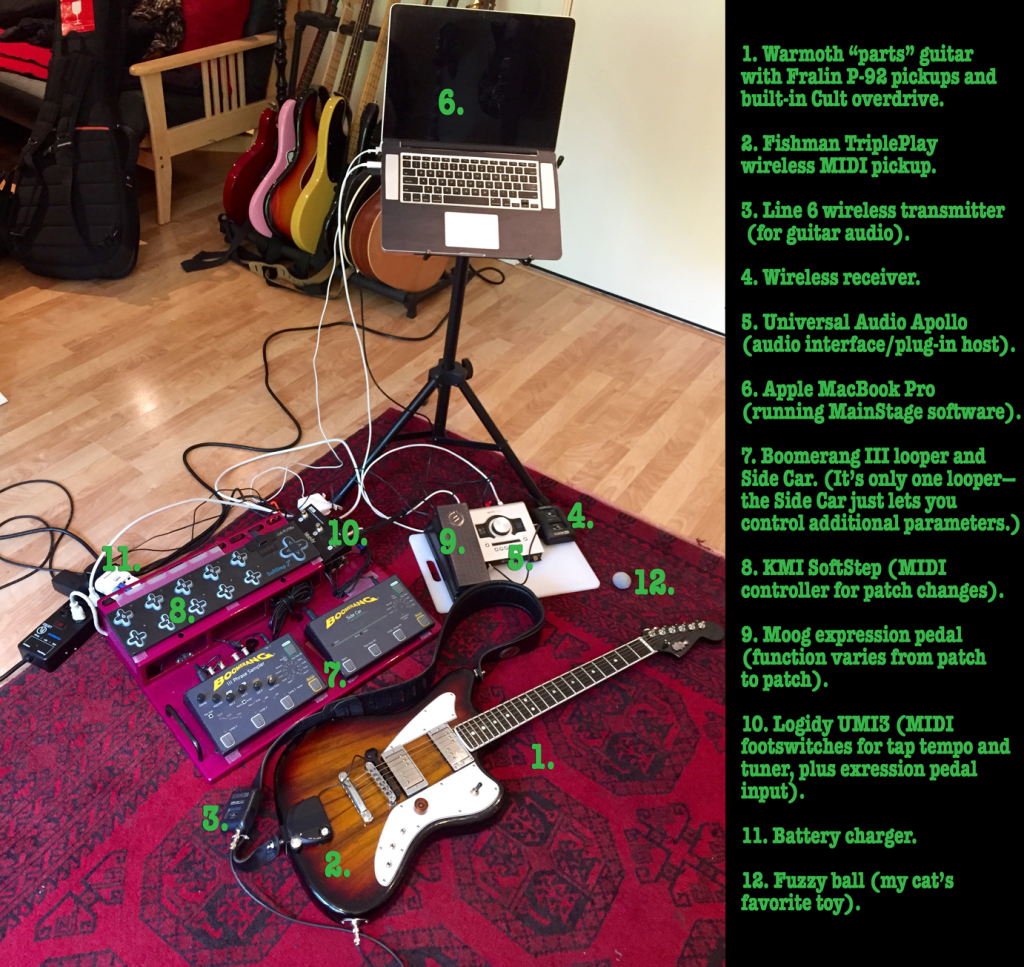
Likewise, I’ve already written about my live looping rig, but it’s changed a bit since then, and I’ve recently integrated a Universal Audio Apollo Twin interface (plus the stellar plug-ins it allows me to run). An updated overview:
The arrangement perform nicely, and I dig the individual components. But I dislike the system’s Rube Goldberg complexity—it’s a royal pain to set up and schlep. I’m always looking for ways to simply. (Other than, you know, just plugging the guitar into a frickin’ amp.) I’m open to suggestions for streamlining!
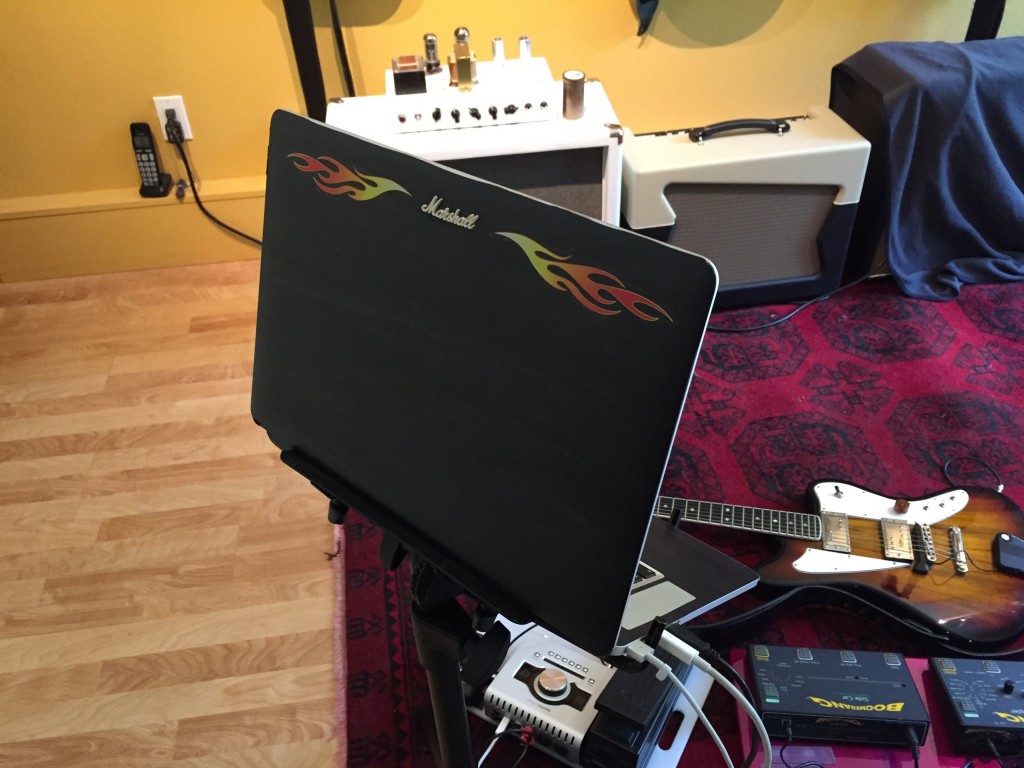
I love Apple products, but I hate having Macs onstage (mainly ’cause they’re so much better looking than me). Covering it in black wrap makes it less obtrusive. The Marshall logo is from one of those “toy” stacks (which, of course, can be far more than toys in the studio).
I just recorded a solo version of one of my fave film themes: Jerry Goldsmith’s main title to the 1967 spy spoof In Like Flint. I’ve adored the melody since childhood, and I blame it for instilling the love of chromaticism that made possible my extraordinarily uncommercial career.
I’d previously posted another version of this tune, performed upside-down on a friend’s lefty guitar. But that was all-analog — this time it’s digital. And I’ve used the video to highlight a favorite MIDI technique: doubling recognizable guitar sounds with non-guitar synths and samples.
I’ve been obsessed with this score since dinosaurs ruled the earth.
It’s funny — being able to trigger pretty much any sound from the guitar isn’t necessarily as liberating as you might think. Sure, when you first try it out, it’s thrilling to conjure an electric piano sound from the fretboard. But who wants to hear some schmo noodle aimlessly on electric piano when they could be noodling aimlessly on guitar?
For better or worse, I find myself using this technique repeatedly. When I double a part effectively, the result still seems like part of the guitar cosmos. It feels like expanding the palette, as opposed to vomiting on it. (Not that I’d be above vomiting on a palette if it helped create a cool painting.)
Did anyone else encounter this sort of childhood musical contamination? A melody, progression, or tone that infected you early on, and colored everything after? I’m not talking image, like falling in love with the Beatles on Ed Sullivan or Nickelback on the CBC because they were so frickin’ cool. I mean a primal sonic imprint. Anyone?
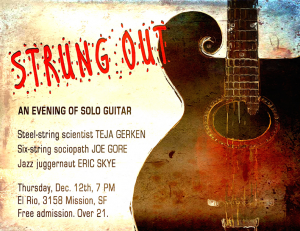
I’m thrilled to bits about a show I’m playing Thursday eve in San Francisco featuring two guitarists of impeccable skill and taste, plus me.
Teja Gerken and I are co-hosting a monthly solo guitar night at El Rio, my groovy neighborhood dive.Our guest is the amazing Eric Skye who, among other things, plays gorgeous solo guitar versions of classic Miles Davis tunes. If you happen to be in cold, cold San Francisco this week, stop by and say hi!
I’ve been doing the digital looping thing with Mental 99 for a few years now, and man, trying to work out solo arrangements with live-looped MIDI drums has been seriously humbling. You know all those jokes we love about how drummers speed up, slow down, drool, and generally disappoint? I can do all those things and everything else a drummer does, except occasionally play a competent groove. Some of the problems have to do with MIDI tracking in general, and some are simply general suckage. Man, it sure makes me appreciate my brilliant musical partner Dawn Richardson, who never speeds up and drools only rarely.
But those who can’t, teach. So I whipped up a little tutorial on playing drums with MIDI guitar. The first half covers the moves, and the second half features a live improv based on my fave afrobeat pattern. (Tony Allen is my rhythm god.) It also includes some of the hybird synth/guitar sounds I’ve been exploring, like double single-not lines an octave lower, mixing trashy guitar and trashy organ, and of course, space pigeons. (I stole the organ line from my pal Robin Balliger.)
In other news: I’ve been speaking to the ultra-knowledgable Rob Hull from Tube Depot about creating a minimalist DIY amp kit inspired by our conversations here. Lots more details to come. Tube Depot has a track record of making real nice amp kits, and Rob’s documentation/build instruction are the best in the biz. I reviewed their cool tweed Champ clone kit here.
If you like reading about internet memes that have just passed their sell-by date, tonefiend is the place to be!
Witness this brief video on triggering goat sound via guitar, created in a fit of desperation when a planned DIY post was delayed divine inspiration.
It’s based, of course, on the unbelievably popular video of unbelievably weird goats making unbelievably human-like sounds. It’s inspired countless spinoffs, including mine. I made these in my hotel room in Frankfurt during Musikmesse, feeling grateful the entire time that I live in an era when you can do crap like this in a German hotel room at midnight. Because trust me, there weren’t a lot of alternatives.
Tech details: homemade Strat, Fishman TriplePlay, Apple MainStage software hosting NI’s Kontakt sampler, goats.
Okay, I promise: tonefiend is not going to become an all-digital blog. I’ve got two new DIY analog pedal projects in the pipe, plus a piece on that delightfully retro technology, the book.
But while there’s more to life than MIDI, for the last few months my particular life has been all MIDI, all the time. I worked on the documentation for the Fishman TriplePlay MIDI guitar system, then demoed the product at MacWorld and Musikmesse. And now that the smoke has cleared and I’m off the Fishman clock, I’m still obsessed with the musical possibilities here. In fact, I’m just getting to the fun part: bending the technology to taste and making weird-ass music for weird-ass people compelling new sounds.
I’m posting two new pieces spun off from my Musikmesse demos. Technical and musical comments after the videos.
In my first TriplePlay demo, I used simple, recognizable acoustic instrument samples. For the second one, I focused on aggressive/distorted sounds. But now I’m getting into what really interests me: solo guitar arrangements featuring hybrid colors, deployed so that it’s often difficult to tell the guitar sounds from the synths and samples.
For the first Fishman TriplePlay demo I posted last month, I featured pretty, naturalistic acoustic sounds. This time around I went for something a little less polite.
I’ve been having a blast — albeit a humbling blast — trying to play real-time drum parts from the guitar. I still suck if it’s much more complicated than what I play here, but I can imagine learning to do it well. It’s also fun using the guitar to access the big keyboard sound libraries I’ve built over the years. Perhaps most exciting of all are the hybrid guitar/synth/sample sounds I’m starting to develop. (There aren’t any in this demo — the sounds are either samples or processed guitar, though I blur the lines with guitar-ish samples and guitars processed to sound like machinery. Next time, though, I’ll try to showcase some of those unholy hybrids.)
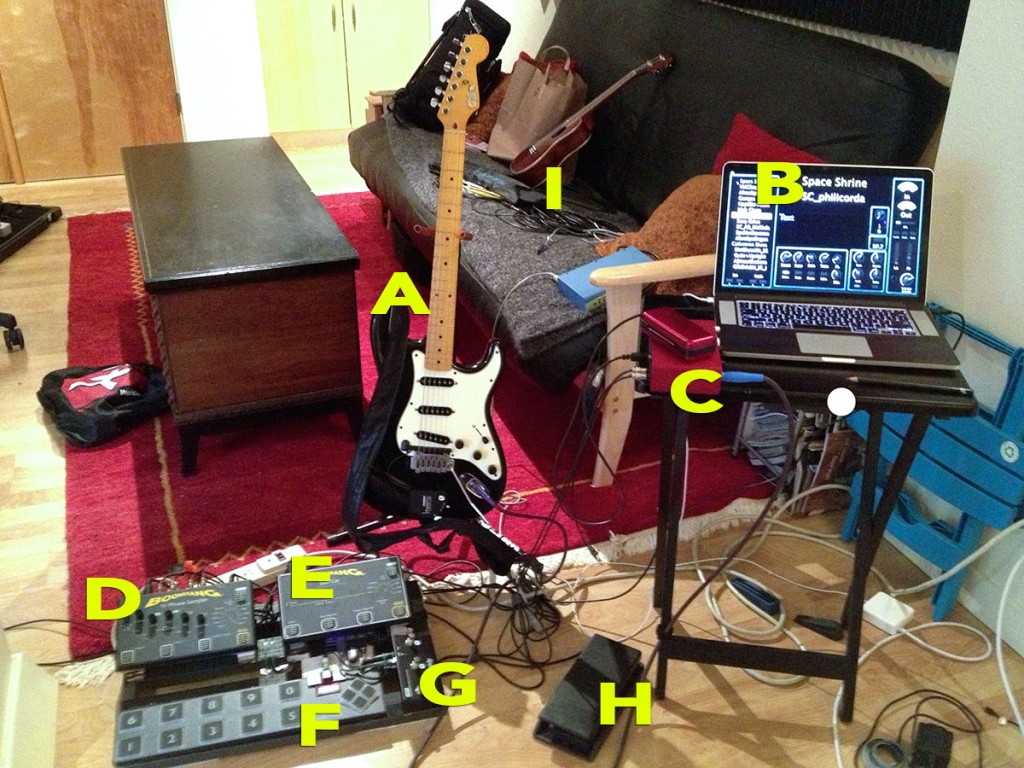
Here’s how the setup looks from my perspective. (I’m not trying to be secretive about what’s on the floor — it’s just hard to fit into the frame, even with a wide-angle lens.)
Joe’s looping/MIDI rig.
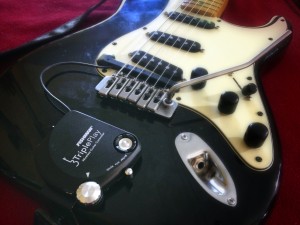
Homemade strat with Fishman controller/pickup. MIDI transmitted wirelessly.
MacBook Pro running Apple’s MainStage software. I use a ridiculous number of plug-ins and some ridiculously huge sample libraries. My main sampler is NI Kontakt.
Focusrite Scarlett interface. All the prosumer interfaces sound pretty decent to me these days, though I like the fact that this one isn’t made out of cheapo plastic.
Boomerang III looper. I love its ergonomics and smooth looping points. I screw up my loop points constantly, but I have fewer disasters with the Boomerang than with anything else I’ve tried.
Boomerang Sidecar. Basically just extra buttons for the Boomerang so you can access more features without reprogramming it or performing awkward foot moves.
Keith McMillen SoftStep MIDI controller. Powerful, rugged, feather-light, and not too expensive.
Logidy UMI3. A nice, rugged, and inexpensive USB MIDI controller — just to have a few extra switches.
Generic controller pedal. Its role varies from patch to patch. It might be a mod wheel, a pan pot, a fader, a filter cutoff control, etc.
Piles of crap. These magically materialize every time I start messing with this stuff.
Just to be clear — these sounds are from my collection, and are not included with TriplePlay. Also, I used TriplePlay in “simple mode” for this video — in other words, I’m not using the dedicated TriplePlay application, but simply using TriplePlay as a generic MIDI controller to trigger sounds loaded into MainStage.
BTW, I’m about to head out for Musik Messe in Frankfurt, Germany, where I’ll be demoing this contraption. Oddly, I’ve never been to this vast musical instruments show, which has been described as a much larger NAMM show with more sausage, beer, and accordions. I’ll be sure to tell you about any cool stuff I see!
DISCLOSURE: Fishman, Apple, and Keith McMillen are among my clients, but no one paid me to make or post this video.
For the last few months I’ve been working with Fishman on the documentation for TriplePlay, their long-awaited wireless MIDI guitar system, which will finally ship this quarter. I had a blast demoing TriplePlay at MacWorld a few weeks ago, and I’m looking forward to doing so again at Musikmesse in Frankfurt in April.
But at times, it’s been frustrating. I power up TriplePlay to study some feature, get all excited, and then have to turn it off and write about it instead of going off and playing it for six hours. This little demo was my first real chance to just fool around with the thing. Thoughts and details after the video.
This first installment of my 2013 NAMM report focuses on products for the digital guitarist. In the coming days I’ll be doing posts on analog amps, guitar, stompboxes, and accessories. (But maybe not as quickly as I’d like, because I’ve also got to cover MacWorld in San Francisco this weekend.) This is cross-posted from Create Digital Music, one of the few music sites I visit every frickin’ day.
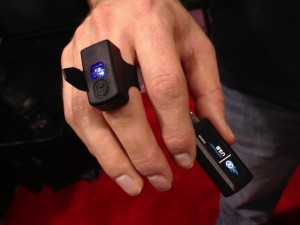
Source Audio’s Hot Hand USB wireless controller.
We guitarists tend to be a technologically conservative bunch, yet there was no shortage of forward-looking products at NAMM 2013.
Not that everyone was looking in the same direction. Guitar processors are getting smarter, but they’re doing so in different ways. Are we entering an era when every guitar, amp, and pedal in our effect chain will boast powerful processors and a dedicated editing environment? Or will we just simply centralize everything in some future i-device? (I suspect that latter, and tend to think that smart pedals and smart amps represent an evolutionary cul-de-sac. But that cul-de-sac might be a real nice place to hang out for a couple of years.)
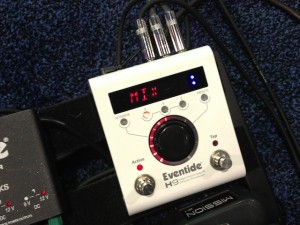
Eventide’s H9 can play all the sounds from the company’s software-intensive stompboxes, and you can edit and control them wirelessly.
One release I found particularly telling was Eventide’s H9, the latest addition to the company’s software-intensive stompbox line. The H9 has few new sounds, but can run all the DSP algorithms from Eventide’s other guitar stompboxes. The $499 box will ship late this quarter, preloaded with 9 of Eventide’s 43 current algorithms. Players hungry for more will be able to purchase them а la carte from an online store. (Eventide hasn’t yet finalized the add-on pricing.) The H9 also includes a handsome and full-featured iOS app for editing and managing patches via Bluetooth. There are no current plans to release an editor for OSX or Windows. (more…)